TEL:+86 132 6656 7067




PIN and APD are two widely used photodiode technologies in optical communication receivers. Both convert incoming optical power into an electrical signal, but they use different detection mechanisms. A PIN photodiode provides direct photodetection without internal avalanche multiplication, while an APD uses a high reverse-bias voltage to create internal multiplication and increase the electrical response generated from a received optical signal.
This difference affects receiver sensitivity, bias requirements, noise, electrical complexity, power consumption, dynamic range, cost and application range. PIN photodiodes are widely used where good sensitivity, high bandwidth and simpler operation are sufficient, while APDs are useful when additional receiver sensitivity is needed for more demanding optical links.
1. PIN vs APD at a Glance
| Feature | PIN Photodiode | APD Photodiode |
|---|---|---|
| Full Name | PIN Photodiode | Avalanche Photodiode |
| Detection Principle | Direct photodetection | Photodetection with internal avalanche multiplication |
| Internal Gain | No avalanche gain | Yes |
| Bias Voltage | Relatively low | Higher reverse-bias voltage |
| Receiver Sensitivity | Good | Typically better for demanding low-power signals |
| Noise | Generally lower and simpler to manage | Includes multiplication noise |
| Power / Bias Complexity | Lower | Higher |
| Cost | Generally lower | Generally higher |
| Typical Applications | Data center, access and general optical links | Longer-reach and sensitivity-demanding optical links |
2. What Is a PIN Photodiode?
A PIN photodiode is a semiconductor photodetector built around p-type, intrinsic and n-type semiconductor regions. When optical energy reaches the active area, photons generate electron-hole pairs, producing a photocurrent proportional to the received optical power.
A PIN photodiode does not provide avalanche multiplication. The generated photocurrent is therefore passed to the receiver electronics, typically a transimpedance amplifier, for amplification and signal processing.
Its relatively simple structure makes PIN technology attractive for a wide range of optical communication receivers.
3. What Is an APD?
APD stands for Avalanche Photodiode. Like a PIN photodiode, an APD converts incoming photons into an electrical signal, but it also uses avalanche multiplication inside the semiconductor.
The photodiode is operated at a relatively high reverse-bias voltage. Photo-generated carriers gain enough energy to trigger additional carrier generation through impact ionization, producing internal electrical gain.
This multiplication increases the electrical signal generated from a given amount of received optical power.
4. The Core Difference: Internal Optical Detection Gain
The most important distinction can be summarized as:
PIN = Photodetection without internal avalanche multiplication
APD = Photodetection with internal avalanche multiplication
Because the APD produces internal gain before the signal reaches the following receiver electronics, it can detect weaker optical signals more effectively under suitable operating conditions.
However, avalanche multiplication also introduces additional design requirements and noise, so greater internal gain does not automatically mean better performance in every receiver.
5. Receiver Sensitivity
Receiver sensitivity describes the minimum optical power required for the receiver to achieve a specified bit-error or performance target.
APDs can provide improved sensitivity compared with PIN detectors because the internal multiplication increases the electrical signal produced by weak received light.
This can be valuable for long optical links where the received power is reduced by fiber attenuation and other optical losses. The actual sensitivity difference depends on wavelength, data rate, detector design, receiver electronics and operating conditions.
6. Avalanche Gain and Bias Voltage
APD operation depends on avalanche multiplication, which requires a substantially higher reverse-bias voltage than a conventional PIN photodiode.
The avalanche gain is controlled through the applied bias and semiconductor structure. As the bias changes, multiplication changes as well.
This creates additional requirements for the receiver design, including a suitable bias circuit, voltage control and protection against operating conditions outside the recommended range.
7. Noise Characteristics
PIN photodiodes generally have a simpler noise profile because they do not introduce avalanche multiplication.
APDs generate multiplication gain, but the avalanche process is statistical and introduces multiplication noise. Increasing avalanche gain therefore does not provide unlimited improvement in receiver performance.
The receiver designer must balance detector gain, shot noise, thermal noise, multiplication noise and the characteristics of the following amplifier.
8. Bandwidth and High-Speed Operation
Both PIN and APD technologies can support high-speed optical communication, but the achievable bandwidth depends on the detector structure, capacitance, carrier transit time, packaging and receiver electronics.
PIN photodiodes can provide excellent high-speed performance with relatively straightforward biasing. APD designs must additionally manage the trade-off between avalanche gain, bandwidth, noise and operating voltage.
For high-speed modules, the photodiode cannot be considered separately from the TIA and the complete receiver chain.
9. Dynamic Range and Optical Input Power
Receiver design must handle both weak and relatively strong optical signals. A detector with high gain can improve weak-signal detection, but excessive received optical power can push the receiver toward overload.
PIN receivers can offer a relatively straightforward relationship between received optical power and photocurrent. APD receivers require additional attention to avalanche gain and bias conditions, making receiver operating range an important system consideration.
10. Temperature Dependence
APD avalanche characteristics can be more sensitive to temperature than a conventional PIN photodiode. Changes in temperature can alter the avalanche multiplication behavior and therefore affect receiver performance.
Depending on the APD technology, bias control or temperature compensation may be used to keep the detector operating within the intended range.
PIN photodiodes generally have simpler bias and temperature-management requirements.
11. Power and Circuit Complexity
PIN-based receivers usually require a simpler bias arrangement because the detector operates at a lower reverse-bias condition.
APD receivers require higher-voltage bias circuitry and tighter control of detector operating conditions. This can increase circuit complexity and may contribute to higher overall receiver power consumption.
The actual power difference depends on the detector, TIA, bias circuit and complete transceiver architecture.
12. Cost and Manufacturing
PIN photodiodes are generally less expensive and easier to integrate into high-volume optical modules because of their simpler operating requirements.
APDs can cost more because the detector itself and its supporting bias and control circuits are more demanding. Additional testing and operating-point control can also contribute to the overall receiver cost.
For this reason, APD technology is normally applied where its additional sensitivity provides a meaningful system benefit.
13. Typical Applications
| Application | PIN Photodiode | APD |
|---|---|---|
| Short-Reach Data Center Links | Widely suitable | Usually unnecessary unless specifically required |
| Access Networks | Commonly used | Used in selected higher-sensitivity designs |
| Longer-Reach Optical Links | Suitable when link budget allows | Useful when additional receiver sensitivity is needed |
| PON Receivers | Widely used in many applications | Used in selected optical receiver designs |
| Telecom / Transport | Used in appropriate receiver architectures | Used where sensitivity and link budget justify the complexity |
14. PIN vs APD in ROSA
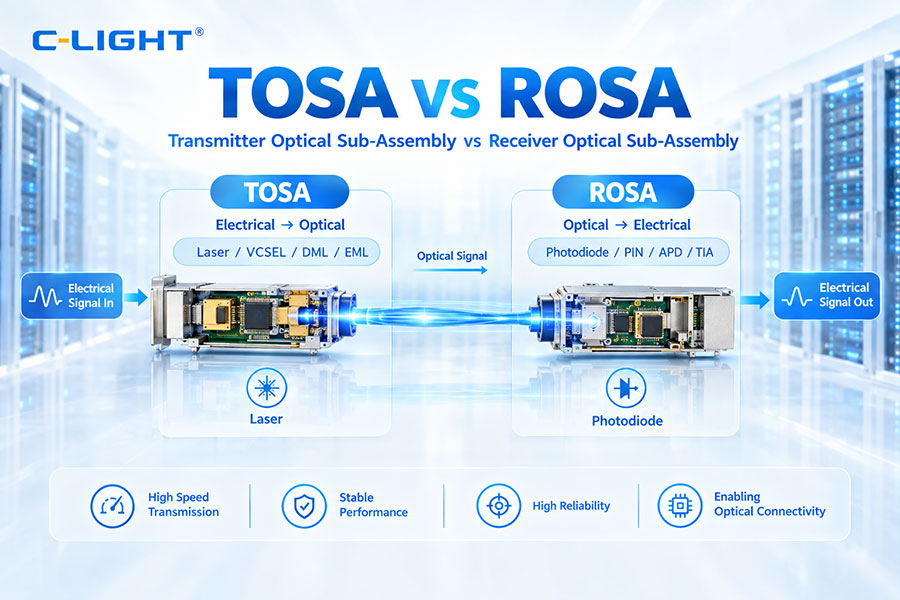
Both PIN and APD photodiodes can be integrated into a ROSA, or Receiver Optical Sub-Assembly.
In a PIN-based ROSA, the detector converts the received optical signal to an electrical current that is then amplified by the receiver electronics.
In an APD-based ROSA, the photodiode provides internal avalanche multiplication before the electrical signal reaches the subsequent amplification stage. This can improve weak-signal detection but requires the associated high-voltage bias and control circuitry.
15. PIN vs APD in PON and Access Networks
Access networks often need to balance receiver sensitivity, cost, power and deployment scale.
PIN photodiodes are widely used where the available optical budget is sufficient and a simple receiver architecture is desirable. APDs can be selected for links that require additional sensitivity or greater optical reach within the specified system design.
The appropriate detector depends on the PON standard, split ratio, optical budget, wavelength and ONU or ONT receiver architecture.
16. Does APD Always Provide a Longer Reach?
No. APD can improve receiver sensitivity, but optical reach is determined by the complete link budget.
A simplified relationship is:
Maximum Allowable Loss = Transmitter Output Power − Receiver Sensitivity
Improving receiver sensitivity can increase the available link budget, but actual reach also depends on fiber attenuation, connector losses, splice losses, optical components, dispersion, wavelength and transmitter performance.
Therefore, replacing a PIN detector with an APD does not automatically double or otherwise guarantee a particular increase in transmission distance.
17. How to Choose Between PIN and APD
| Requirement | Key Consideration |
|---|---|
| Simple receiver architecture | PIN provides straightforward photodetection |
| Cost-sensitive deployment | PIN is generally more economical |
| Lower bias complexity | PIN requires a simpler operating voltage |
| Very weak received optical signal | Evaluate APD for additional internal gain |
| Longer optical link | Compare complete link budgets rather than detector type alone |
| High-speed receiver | Evaluate detector bandwidth, TIA and complete receiver architecture |
| Wide temperature range | Consider APD bias and temperature characteristics |
18. PIN vs APD: Summary
PIN and APD photodiodes both perform optical-to-electrical conversion, but they take different approaches to signal detection. PIN relies on direct photodetection without internal avalanche gain, while APD introduces internal multiplication through a high reverse-bias avalanche process.
The APD architecture can provide higher receiver sensitivity for weak optical signals, making it useful in demanding long-reach and optical-budget-limited applications. The trade-offs include higher bias voltage, multiplication noise, temperature sensitivity, circuit complexity and cost.
PIN technology remains highly useful for optical modules where the available link budget is sufficient and a simpler, efficient receiver is desired. APD becomes more attractive when additional receiver sensitivity can improve the overall optical link performance.
 >
>

 >
>
 >
>
 >
>
 >
>
 >
>
 >
>
 >
>