TEL:+86 132 6656 7067




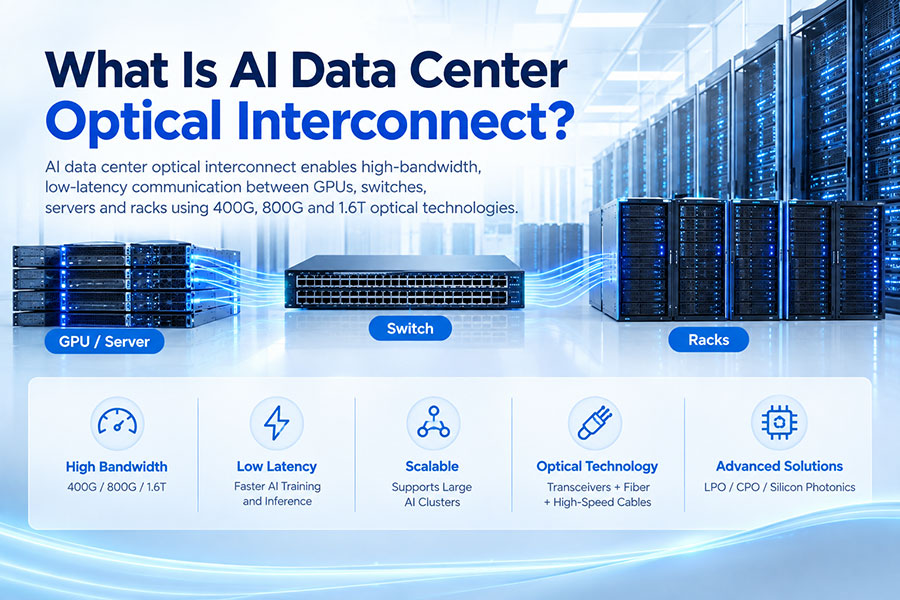
Optical interconnect for GPU clusters provides high-bandwidth, low-latency connectivity between GPUs, servers, network switches, and accelerator fabrics. As AI workloads scale, 400G, 800G, 1.6T, optical transceivers, AOC, DAC, AEC, InfiniBand, Ethernet, and optical switching technologies are becoming increasingly important for scalable GPU networking.
1. What Is Optical Interconnect for GPU Clusters?
Optical interconnect for GPU clusters refers to the use of optical communication technologies to connect GPUs, servers, switches, storage systems, and other accelerator infrastructure across an AI computing environment.
The primary objective is to move large amounts of data between computing nodes while maintaining high bandwidth, low latency, reliable transmission, and manageable power consumption.
2. Why GPU Clusters Need High-Speed Interconnects
Modern AI workloads distribute computation across many GPUs. Training and inference jobs require continuous communication between processors to exchange model parameters, gradients, activations, datasets, and other intermediate information.
As the number of GPUs increases, the network can become a limiting factor if its bandwidth and latency do not scale with the compute system.
3. GPU Compute and Network Communication
A GPU cluster is not only a collection of compute devices. It is a tightly connected system in which the performance of the interconnect directly affects how efficiently distributed workloads can use available GPU resources.
Fast optical links help reduce communication bottlenecks between GPUs and network switches, especially when large amounts of data must be transferred simultaneously.
4. Optical Interconnect vs Electrical Interconnect
| Feature | Optical Interconnect | Electrical Interconnect |
|---|---|---|
| Transmission medium | Optical fiber | Copper or PCB traces |
| Reach | Short to long, depending on technology | Usually shorter |
| Bandwidth scaling | Highly scalable | More constrained by channel loss |
| EMI sensitivity | Very low | Higher |
| Longer high-speed links | Well suited | More challenging |
5. Optical Interconnect in AI Data Centers
AI data centers can contain large GPU clusters connected through high-speed switching fabrics. Optical links are commonly used when the required distance, bandwidth, or electrical channel loss exceeds the practical range of copper interconnects.
6. GPU-to-GPU Interconnect
Direct GPU-to-GPU communication may use specialized high-speed electrical or optical technologies depending on the system architecture. Inside tightly integrated GPU servers, electrical links can provide very short connections.
When the physical topology extends beyond the server or requires switch-based networking, optical interconnect becomes increasingly important.
7. GPU-to-Switch Optical Interconnect
GPU-to-switch is one of the key optical connection points in distributed AI infrastructure. A GPU server can connect to a high-speed Ethernet or InfiniBand switch using optical transceivers, AOC, or other high-speed interconnect solutions.
8. Server-to-Switch Optical Interconnect
Optical interconnect can also connect AI servers to leaf, spine, or accelerator-oriented switches. The appropriate interface depends on the server NIC, switch port, transmission distance, and required bandwidth.
9. Switch-to-Switch Optical Interconnect
Large GPU clusters depend on multiple layers of switching. Optical links between switches allow high-capacity traffic to move across the network fabric and support scaling beyond individual racks.
10. Why Optical Fiber Is Important for GPU Clusters
Optical fiber provides low-loss transmission compared with high-speed copper over longer distances and is not affected by electromagnetic interference in the same way as electrical cabling.
These characteristics make fiber attractive for high-density AI environments where hundreds or thousands of high-speed connections may operate simultaneously.
11. 400G Optical Interconnect for GPU Clusters
400G remains an important connectivity speed for AI infrastructure. A common 400G architecture uses eight 50G-class PAM4 electrical lanes, although implementations vary by platform.
400G optical modules can support GPU-to-switch, server-to-switch, and switch-to-switch connectivity across short and moderate distances.
12. 800G Optical Interconnect for GPU Clusters
800G is increasingly important as GPU clusters scale. A common architecture uses eight 100G-class PAM4 lanes to provide 800Gbps aggregate bandwidth.
800G connectivity can increase bandwidth per switch port and reduce the number of ports required for a given aggregate traffic level.
13. 1.6T Optical Interconnect for GPU Clusters
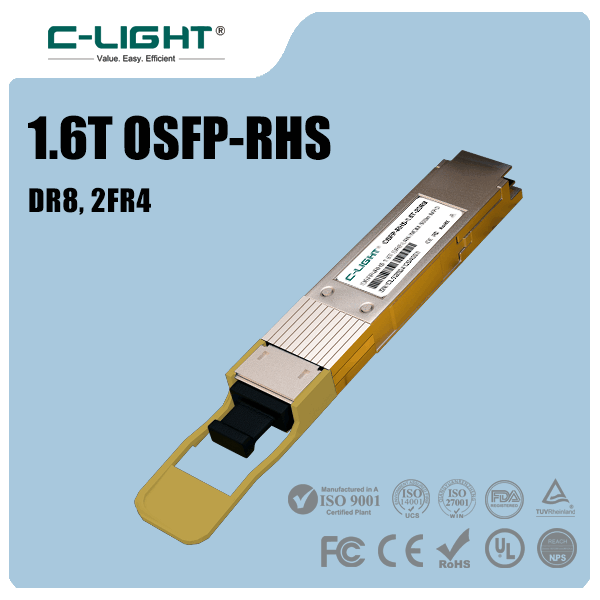
1.6T represents the next major bandwidth step for AI networking. A common architecture uses eight 200G-class electrical lanes, although specific implementations can differ.
The increase to 1.6T places greater demands on DSPs, optical engines, electrical channels, thermal design, and packaging.
14. PAM4 in GPU Cluster Optics
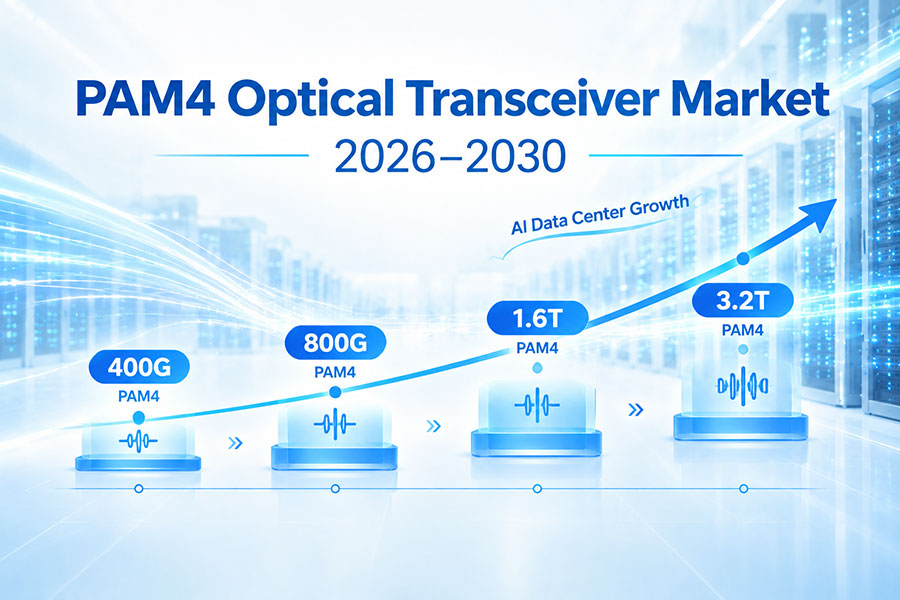
PAM4 is widely used in high-speed optical interconnect because it carries two bits per symbol across four signal levels. This allows higher data rates without proportionally doubling the symbol rate.
The trade-off is a smaller signal eye and greater sensitivity to noise, distortion, crosstalk, and signal-integrity limitations.
15. Optical DSP in GPU Cluster Interconnect
Optical DSPs process high-speed electrical and optical signals to improve transmission performance. Depending on the architecture, DSP functions can include equalization, clock recovery, lane management, FEC-related processing, and other signal-conditioning operations.
As GPU networks move from 400G to 800G and 1.6T, DSP efficiency becomes increasingly important because power consumption directly affects data center energy use.
16. Optical Transceivers for GPU Clusters
Optical transceivers convert electrical signals into optical signals for transmission over fiber and recover optical signals at the receiving side.
Common form factors for modern high-speed networking include QSFP-DD, QSFP112, and OSFP, depending on the bandwidth and platform generation.
17. QSFP-DD Optical Interconnect
QSFP-DD provides a compact high-density architecture for high-speed optical networking. It is widely associated with 400G-class systems and can also support different breakout and higher-speed implementations depending on the platform.
18. QSFP112 Optical Interconnect
QSFP112 is designed around a newer high-speed electrical architecture and is relevant to high-performance 400G and next-generation data center systems.
19. OSFP Optical Interconnect
OSFP provides a larger mechanical envelope than QSFP-family modules and offers additional thermal design options. This makes it particularly relevant to high-power 800G and future 1.6T optical systems.
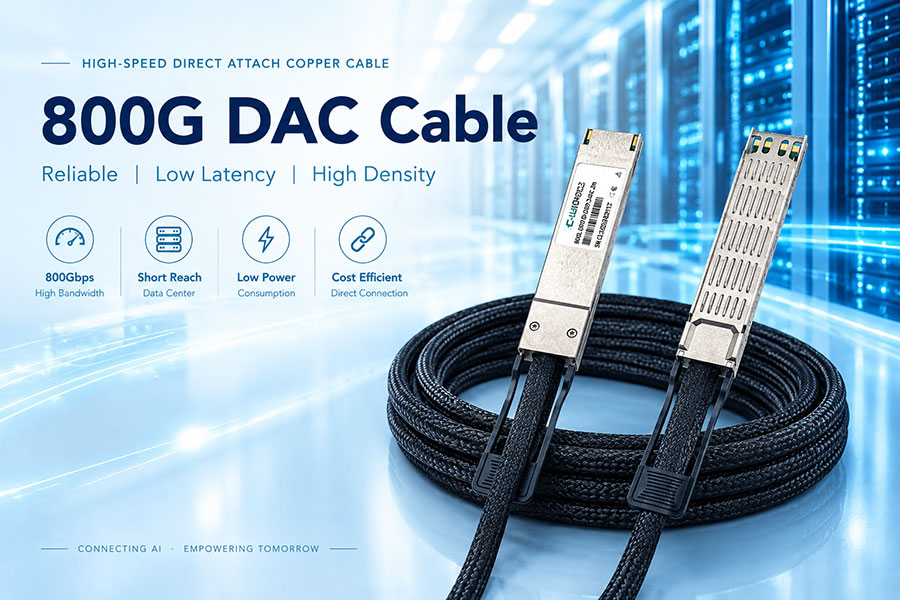
20. DAC for GPU Clusters
Direct Attach Copper is useful when GPUs, servers, NICs, and switches are located within a very short physical distance.
400G DAC is typically used for short intra-rack connections, while 800G DAC can provide similar functionality at higher bandwidth where supported by the host platforms.
21. AOC for GPU Clusters
Active Optical Cable combines optical fiber with integrated transceiver electronics in a single cable assembly. AOC is useful when the required distance exceeds the practical range of passive copper interconnects.
It is particularly attractive for short rack-to-rack and longer intra-data-center links.
22. AEC for GPU Clusters
Active Electrical Cable uses active electronics to condition high-speed electrical signals and extend copper connectivity beyond the typical range of passive DAC.
AEC can provide an intermediate solution between passive copper and optical links for selected AI cluster topologies.
23. DAC vs AEC vs AOC
| Solution | Medium | Typical Role |
|---|---|---|
| DAC | Passive copper | Very short intra-rack links |
| AEC | Active copper | Extended electrical links |
| AOC | Optical fiber | Longer short-reach links |
| Optical transceiver | Optical fiber | Flexible data center and longer links |
24. InfiniBand Optical Interconnect
InfiniBand is widely used in high-performance AI and HPC environments where low latency and high throughput are critical. Optical transceivers and active cables allow InfiniBand networks to scale beyond the shortest electrical connections.
25. Ethernet Optical Interconnect for GPU Clusters
Ethernet-based AI networks are also increasing demand for high-speed optical connectivity. 400G and 800G Ethernet links can connect GPU servers, NICs, leaf switches, spine switches, and other network components.
26. InfiniBand vs Ethernet for Optical GPU Networking
Both InfiniBand and Ethernet can use optical transceivers and active optical cables. The choice depends on the network architecture, switching platform, software stack, congestion management, application requirements, and interoperability strategy.
27. Optical Interconnect Distance
The required distance is one of the first factors when selecting an AI optical interconnect. Short intra-rack links can use DAC, while longer links may require AOC or optical transceivers.
| Distance | Typical Solution |
|---|---|
| Sub-meter to a few meters | DAC |
| Several meters | AEC or AOC |
| Tens of meters | AOC or short-reach optical transceiver |
| Hundreds of meters | Multimode or single-mode optical transceiver |
| Kilometers | Single-mode optical transceiver |
28. Multimode Fiber for GPU Clusters
Multimode fiber can be used for short-reach optical interconnects inside data centers. VCSEL-based solutions such as SR optics are commonly associated with multimode fiber applications.
29. Single-Mode Fiber for GPU Clusters
Single-mode fiber provides longer transmission capability and is commonly used for 400G DR, FR, and other longer-reach optical solutions.
Single-mode fiber becomes increasingly important when the network extends between racks, buildings, campuses, or data centers.
30. 400G SR8 for AI Clusters
400G SR8 uses multiple optical lanes for short-reach multimode transmission. It is suitable for high-density data center connections where the optical path remains within the supported multimode reach.
31. 400G DR4 for AI Clusters
400G DR4 uses four optical lanes on single-mode fiber and is designed for longer reach than short-reach multimode solutions. It is useful for high-capacity connections across larger sections of a data center.
32. 800G SR8 for AI Clusters
800G SR8 provides 800Gbps short-reach optical connectivity using multiple multimode lanes. It is well suited to high-density AI and HPC environments where the optical distance remains relatively short.
33. 800G DR8 for AI Clusters
800G DR8 is designed for longer single-mode fiber connections than SR8. It can support high-capacity switch-to-switch and other data center links that exceed short multimode transmission distances.
34. 800G FR4 for AI Clusters
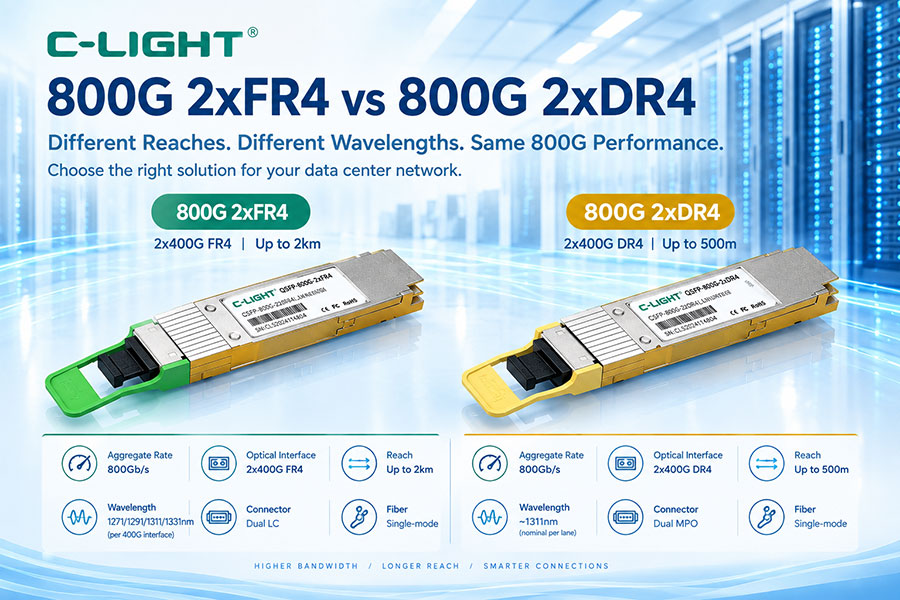
800G FR4 uses multiple LAN-WDM wavelengths and single-mode fiber to provide longer reach than many short-reach multimode solutions.
FR4 can be attractive for data center links where higher reach is required without moving to a more complex coherent architecture.
35. 1.6T Optical Architectures
1.6T optical connectivity is likely to use multiple 200G-class electrical lanes and increasingly advanced optical engines. Depending on the implementation, architectures may include parallel optics, wavelength multiplexing, or other approaches.
36. Parallel Optics vs WDM
Parallel optics use multiple optical lanes or fibers, while wavelength-division multiplexed solutions send multiple wavelengths through the same fiber pair.
The selection affects fiber count, connector density, optical component complexity, reach, and cost.
37. WDM for GPU Cluster Scaling
Wavelength Division Multiplexing can increase aggregate capacity while reducing the number of physical fiber pairs required. This becomes increasingly valuable as GPU clusters grow and optical port density increases.
38. Optical Interconnect and Network Topology
The topology of the GPU cluster determines where optical interconnect is deployed. Common architectures include leaf-spine, fat-tree, folded-Clos, and accelerator-oriented network designs.
39. Leaf-Spine GPU Networking
In a leaf-spine network, GPU servers typically connect to leaf switches, while leaf switches connect to spine switches through high-speed links.
Optical interconnect is frequently used for the higher-distance connections between switching layers.
40. Clos Networks for AI Clusters
Clos architectures scale networking capacity by distributing traffic across multiple switching stages. As the number of stages and links increases, optical connectivity becomes increasingly important for maintaining practical reach and cable density.
41. Optical Interconnect Density
AI clusters can require extremely high port counts. High-density optical modules help reduce the amount of front-panel space required for a given aggregate bandwidth.
Higher bandwidth per port also reduces the number of physical interfaces needed for some network designs.
42. Cable Management in GPU Clusters
Cable management becomes challenging as thousands of high-speed links are installed. Optical cables can reduce some of the weight and size associated with large copper bundles, while DAC remains useful for very short paths.
43. Thermal Challenges
High-speed optical modules consume power and generate heat. At 800G and 1.6T, thermal design becomes increasingly important because a switch may contain dozens of high-speed optical ports operating simultaneously.
44. Power Efficiency
Power efficiency can be evaluated as watts per port or, more usefully, watts per transmitted bit. Reducing power per bit is particularly important in large AI clusters because the number of optical links can scale rapidly with GPU count.
45. Optical Interconnect and LPO
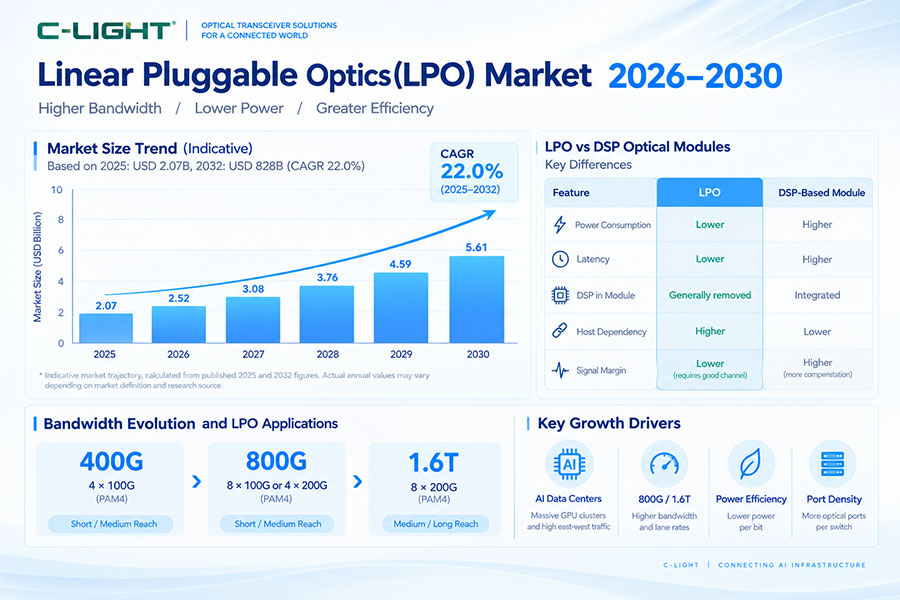
Linear-drive pluggable optical technologies aim to reduce or eliminate some of the power and processing associated with traditional retimed optical DSP architectures.
LPO can lower power consumption in suitable short-reach applications, but it may introduce tighter requirements for host electrical signal quality, optical link design, interoperability, and reach.
46. Optical Interconnect and CPO
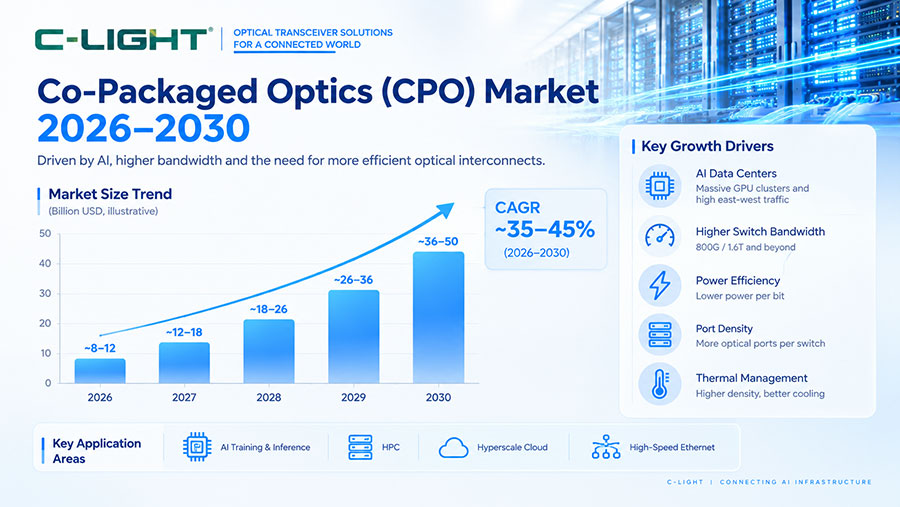
Co-Packaged Optics moves optical engines closer to the switching ASIC, reducing the electrical distance between the switch silicon and optical interface.
CPO is being investigated for future very-high-bandwidth systems where traditional pluggable electrical channels become increasingly difficult to manage.
47. Pluggable Optics vs CPO for GPU Networks
| Feature | Pluggable Optics | CPO |
|---|---|---|
| Deployment | Replaceable modules | Integrated with switch package |
| Serviceability | High | More complex |
| Electrical path | Longer host-to-module path | Very short |
| Upgrade flexibility | High | Lower |
| Future high-speed role | Strong | Potentially important at extreme bandwidth |
48. Reliability of Optical GPU Interconnect
AI clusters are highly dependent on network availability. A single optical link problem can affect multiple computing nodes if the network topology has insufficient redundancy.
49. Optical Link Monitoring
Modern optical modules can provide diagnostic information such as temperature, voltage, transmit power, receive power, and alarms. Monitoring these parameters can help identify degrading links before they cause major service disruption.
50. BER in GPU Optical Networks
Bit Error Rate is a key performance metric for high-speed optical links. AI networks require stable low-error transmission because retransmissions and packet loss can reduce effective cluster performance.
51. FEC in High-Speed GPU Networking
Forward Error Correction adds redundancy that allows a receiver to correct certain transmission errors. FEC is increasingly important as signaling rates rise and optical and electrical margins become more difficult to maintain.
52. Latency in Optical GPU Interconnect
Optical transmission does not remove the physical propagation delay of the fiber, but optical links can provide very high bandwidth with low additional processing in appropriately designed systems.
Latency is especially important for AI workloads that require frequent synchronization between distributed GPUs.
53. Bandwidth and GPU Utilization
Insufficient network bandwidth can prevent GPUs from receiving or sending data quickly enough, leaving compute resources waiting on communication.
High-speed optical interconnect helps increase the probability that the available GPU compute capacity can be effectively utilized.
54. Network Oversubscription
AI cluster design must consider the ratio between server-facing bandwidth and upstream network capacity. Excessive oversubscription can create congestion even when individual optical links operate at full speed.
55. Optical Interconnect and Scale-Out AI
Scale-out architectures distribute workloads across many compute nodes. Optical connectivity supports the high-capacity links required between those nodes and the switching fabric.
56. Optical Interconnect and Scale-Up AI
Scale-up architectures focus on tightly integrating multiple accelerators into a larger compute system. Electrical and specialized accelerator interconnects are often important at this level, while optical links become increasingly relevant as the architecture extends beyond the immediate compute enclosure.
57. Scale-Up vs Scale-Out Networking
| Architecture | Primary Connectivity | Optical Role |
|---|---|---|
| Scale-up | Very short accelerator connections | More limited or emerging |
| Scale-out | Server and switch fabric | Major role |
| Scale-across | Data center to data center | Coherent optical networking |
58. Optical Interconnect for Multi-Rack GPU Clusters
As GPU deployments expand beyond a single rack, cable distance and density increase. Optical connectivity becomes increasingly useful for connecting racks and switching tiers without creating excessively large copper bundles.
59. Optical Interconnect for Multi-Data-Center AI
When AI computing is distributed across geographically separated facilities, conventional data center optics may no longer provide sufficient reach.
Coherent 400ZR, 400ZR+, 800ZR, and future higher-capacity coherent technologies can provide the optical foundation for long-distance AI DCI.
60. Coherent Optical Interconnect for GPU Clusters
Coherent optics become useful when the optical path extends into metro, regional, or longer-distance DCI. They use advanced DSP and coherent detection to overcome impairments that limit conventional direct-detection data center optics.
61. Choosing Optical Interconnect by Distance
| Application | Typical Solution |
|---|---|
| GPU-to-switch within rack | DAC or short-reach optical |
| Rack-to-rack | AOC or optical transceiver |
| Data center optical fabric | 400G/800G optical transceivers |
| Metro AI DCI | Coherent pluggables |
| Regional AI DCI | High-performance coherent optics |
62. Key Optical Parameters for GPU Interconnect
Important parameters include transmit optical power, receiver sensitivity, wavelength, insertion loss, optical return loss, BER, extinction ratio, TDECQ where applicable, power consumption, operating temperature, and supported transmission distance.
63. Compatibility in GPU Optical Networks
Interoperability must be checked between the optical module, GPU server NIC, switch, cable, firmware, and host platform. A module with the correct connector and nominal bandwidth is not necessarily compatible with every system.
64. Vendor Coding and GPU Networking
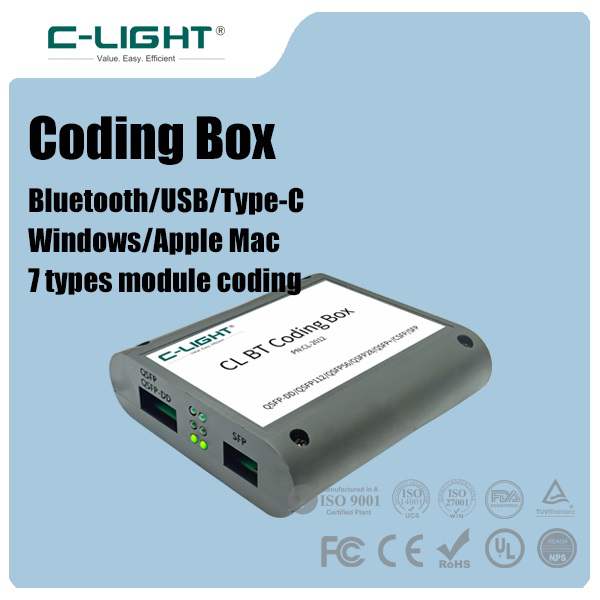
Some switches and network adapters use module identification or vendor coding mechanisms. Correct coding and tested interoperability can therefore be important in large multi-vendor GPU environments.
65. Thermal Density in AI Optical Networks
AI switches and GPU servers can operate at high power levels. The optical interconnect must therefore be considered together with airflow, heat dissipation, connector density, and cable routing.
66. Future Optical Interconnect for GPU Clusters
The industry is moving toward higher bandwidth per optical port, lower power per bit, denser optical packaging, improved DSP efficiency, and greater integration between switching silicon and optical engines.
400G and 800G remain important deployment technologies, while 1.6T and advanced optical architectures are positioned for the next stage of AI cluster scaling.
67. 400G, 800G and 1.6T Evolution
The progression from 400G to 800G and 1.6T reflects the increasing communication requirements of large GPU clusters. Each generation must improve not only bandwidth but also signal integrity, thermal efficiency, reliability, and cost per bit.
68. LPO, CPO and the Next Generation
LPO and CPO are being developed as alternatives or complements to conventional retimed pluggable optics. LPO can reduce DSP-related power in suitable links, while CPO reduces the electrical distance between the switch ASIC and optical engine.
The most suitable architecture will depend on reach, power, interoperability, serviceability, and the physical design of the GPU network.
69. How to Select Optical Interconnect for a GPU Cluster
Start with the required bandwidth and physical distance. Then select the appropriate transmission medium, form factor, optical architecture, and cable type.
Next, verify host compatibility, power consumption, thermal limits, breakout requirements, fiber type, diagnostics, and interoperability.
70. Optical Interconnect Selection Checklist
| Item | Consideration |
|---|---|
| Bandwidth | 400G, 800G, 1.6T or required port speed |
| Distance | Actual fiber or cable route |
| Medium | Copper, multimode fiber, or single-mode fiber |
| Form factor | QSFP-DD, QSFP112, OSFP, or other supported interface |
| Power | Module and system power budget |
| Thermals | Airflow and rack density |
| Compatibility | NIC, switch, firmware, coding, and interoperability |
| Reliability | Diagnostics, redundancy, and link monitoring |
71. Conclusion
Optical interconnect is a fundamental part of scalable GPU cluster networking. As AI systems expand from individual servers to large multi-rack and multi-data-center architectures, the network must scale in bandwidth, reach, density, power efficiency, and reliability.
400G, 800G, and 1.6T optical technologies provide the bandwidth evolution, while DAC, AEC, AOC, optical transceivers, coherent pluggables, LPO, and CPO address different connectivity requirements.
The best solution is determined by the complete network architecture. Distance, bandwidth, fiber type, host interfaces, power, thermal conditions, latency, interoperability, and future upgrade requirements should all be evaluated before selecting an optical interconnect for a GPU cluster.
 >
>

 >
>
 >
>
 >
>
 >
>
 >
>
 >
>
 >
>