TEL:+86 132 6656 7067




Optical engine and optical transceiver are closely related terms in modern optical communication, but they do not describe the same type of product. An optical engine is typically a core optoelectronic assembly designed to provide optical transmit and receive functions, while an optical transceiver is a complete pluggable or integrated module designed to connect directly to a host system.
As network speeds move from 400G to 800G and 1.6T, optical engines are becoming increasingly important in high-density switch, AI data center and co-packaged or near-packaged optical architectures. Optical transceivers, meanwhile, continue to provide modular and serviceable optical connectivity at the front panel.
Understanding the difference between an optical engine and an optical transceiver is important when designing data center networks, switch platforms, optical modules and next-generation AI interconnect systems.
1. What Is an Optical Engine?
An optical engine is an optoelectronic assembly that integrates the main optical transmit and receive components required for an optical link.
Depending on the architecture, an optical engine may include laser devices, photodetectors, drivers, TIAs, optical coupling components and other related components.
The optical engine is generally intended to serve as part of a larger system rather than acting as a complete externally pluggable network module.
2. What Is an Optical Transceiver?
An optical transceiver is a complete communication module that converts electrical signals to optical signals on transmission and optical signals back to electrical signals on reception.
A typical pluggable optical transceiver may include an optical engine or TOSA/ROSA-related assemblies together with DSP or CDR functions, management electronics, control circuitry, a host electrical interface, optical connector and mechanical enclosure.
The module is designed to interface directly with a compatible switch, router, server, NIC or other host device.
3. Basic Difference Between Optical Engine and Optical Transceiver
| Feature | Optical Engine | Optical Transceiver |
|---|---|---|
| Role | Core optoelectronic assembly | Complete optical communication module |
| System Position | Inside a larger system | Typically interfaces directly with host equipment |
| Mechanical Form | Varies by system architecture | Often standardized pluggable form factor |
| Optical Components | Integrated | Integrated |
| Host Interface | Depends on system design | Designed for a defined electrical host interface |
| Management | May rely on system-level control | Typically includes module management and monitoring |
| Serviceability | Usually system-level | Pluggable modules can be replaced independently |
| Typical Applications | CPO, NPO, optical engines, switch platforms | Ethernet, InfiniBand, DCI, telecom and data centers |
4. Optical Engine vs Optical Transceiver: Architecture
The most important distinction is architectural.
An optical engine is normally one building block within a larger optical system. A transceiver is a more complete product that includes the interfaces and control functions needed to operate as a standalone module.
In simple terms, an optical engine can be considered the optoelectronic core, while the optical transceiver is the complete module surrounding that core.
5. Main Components of an Optical Engine
An optical engine may contain several major components:
Laser or laser array, optical modulator, photodetector, laser driver, TIA, optical coupling components and optical interfaces.
The exact component set depends on whether the engine uses direct modulation, external modulation, silicon photonics, parallel optics, WDM or another architecture.
6. Main Components of an Optical Transceiver
A complete optical transceiver can include a larger set of components:
Optical engine or TOSA/ROSA, DSP or CDR, laser driver, TIA, microcontroller, EEPROM or management memory, power management, thermal control, host electrical connector, optical connector and mechanical housing.
Not every transceiver contains every component, especially in low-power linear architectures such as LPO.
7. Is an Optical Engine the Same as TOSA and ROSA?
No. TOSA and ROSA are specific optoelectronic subassemblies.
TOSA primarily performs electrical-to-optical conversion on the transmit side, while ROSA performs optical-to-electrical conversion on the receive side.
An optical engine can integrate both transmit and receive functions and may therefore contain or replace separate TOSA and ROSA structures depending on the architecture.
8. Optical Engine vs Optical Transceiver and TOSA/ROSA
| Component | Main Function | Typical Position |
|---|---|---|
| TOSA | Electrical-to-optical conversion | Inside transceiver |
| ROSA | Optical-to-electrical conversion | Inside transceiver |
| Optical Engine | Integrated transmit and receive optoelectronics | Inside or near the host system |
| Optical Transceiver | Complete network interface module | Host equipment |
9. Optical Engine vs Optical Transceiver Packaging
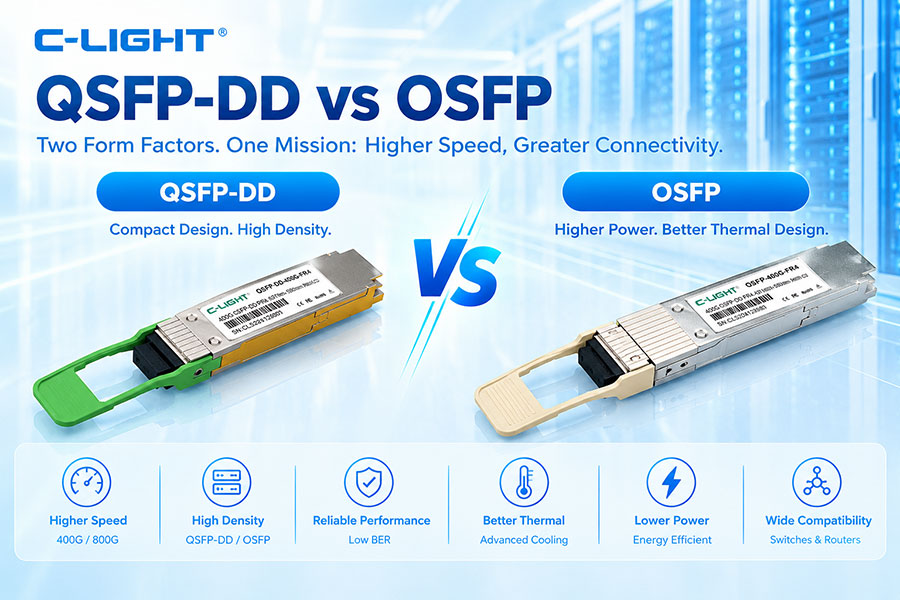
Optical transceivers are usually packaged according to defined mechanical form factors such as QSFP-DD or OSFP.
Optical engines have more flexibility because they can be packaged specifically for a switch, optical I/O system, CPO platform or other host architecture.
This flexibility is particularly important for system designs that place optics closer to the switching ASIC.
10. Optical Engine vs Pluggable Optical Transceiver
A pluggable transceiver is designed to be installed and removed from a host connector or cage.
An optical engine usually does not function as a standard front-panel pluggable module. Instead, it is integrated into the host architecture or attached to another optical subsystem.
This difference has a direct impact on serviceability, mechanical design and system integration.
11. Optical Engine vs Optical Transceiver Interface
A transceiver normally has a defined host electrical interface and an optical connector interface.
For example, a high-speed Ethernet transceiver can receive electrical lanes from a switch ASIC and convert them into multiple optical channels.
An optical engine may instead connect directly to the host optical or electrical architecture through a system-specific interface.
12. Electrical Interface of an Optical Transceiver
Modern optical transceivers use high-speed electrical interfaces between the host ASIC and the module.
Depending on the generation, these interfaces can use different lane rates and signaling architectures.
The module may contain a DSP, retimer or linear electrical path depending on the transceiver architecture.
13. Electrical Interface of an Optical Engine
An optical engine can be designed much closer to the system ASIC, reducing the electrical distance between the serializer/deserializer and optical conversion point.
This is one of the key reasons optical engines are important in near-package and co-packaged optical architectures.
14. Why Move the Optical Engine Closer to the ASIC?
As electrical signaling rates increase, PCB traces and package-level electrical connections become more challenging.
Placing the optical conversion point closer to the switching ASIC can reduce high-speed electrical channel length and associated signal integrity challenges.
This can support higher bandwidth density and potentially improve system-level energy efficiency.
15. Optical Engine in NPO Architecture
In Near-Packaged Optics, the optical engine is positioned close to the switch ASIC but remains physically separate from the ASIC package.
This arrangement shortens the electrical path while retaining more modularity than a fully co-packaged design.
The optical engine therefore plays a central role in the NPO architecture.
16. Optical Engine in CPO Architecture
In Co-Packaged Optics, optical engines are integrated much more closely with the switching ASIC package.
The objective is to minimize the high-speed electrical connection between the ASIC and optical components.
This architecture is being explored for high-bandwidth switching systems where conventional front-panel pluggable optics face increasing electrical and thermal challenges.
17. Optical Engine vs CPO Optical Engine
Not every optical engine is necessarily a CPO optical engine.
Optical engine is a component or subsystem concept, while CPO describes a system-level packaging architecture.
An optical engine can be used in pluggable-adjacent, NPO, CPO and other optical architectures depending on its design.
18. Optical Engine vs NPO Optical Engine
An NPO optical engine is specifically positioned near the ASIC to reduce electrical channel length.
The term optical engine itself does not define the physical location.
This distinction is important because the same basic optoelectronic engine concept can appear in different system architectures.
19. Optical Engine vs Optical Transceiver and DSP
Many conventional optical transceivers include a DSP that performs equalization, signal recovery and other processing functions.
An optical engine may contain the optical conversion components but may not contain the same level of signal processing.
Depending on the architecture, signal processing can remain in the host ASIC, external retimer, driver or another system component.
20. Optical Engine in LPO Systems
Linear Pluggable Optics removes much of the conventional digital signal processing from the optical module.
An LPO system can therefore be viewed as a combination of a linear optical transceiver architecture and highly integrated optical components.
The optical engine concept becomes useful because the host system can perform more of the signal conditioning while the optical portion focuses on the optical conversion path.
21. Optical Engine vs LPO Optical Transceiver
An LPO optical transceiver is still a complete pluggable transceiver, even though its internal architecture is simplified.
An optical engine is the optoelectronic core rather than necessarily the complete pluggable product.
Therefore, LPO and optical engine describe different aspects of the system and can be used together.
22. Optical Engine vs Traditional Transceiver DSP
Traditional DSP-based transceivers place significant signal processing inside the module.
This can provide electrical signal conditioning and compensate for channel impairments, but it also adds power consumption, latency, thermal load and component complexity.
Optical engines used in newer architectures may shift more of the processing responsibility toward the host ASIC or system.
23. Optical Engine vs Optical Transceiver Power Consumption
Comparing power consumption requires care because an optical engine and a complete transceiver do not include the same functions.
A transceiver may include DSP, management circuitry and power conversion that are not part of the optical engine itself.
Therefore, an optical engine can have a lower component-level power figure without implying that the entire system consumes less power in every architecture.
24. Optical Engine vs Optical Transceiver Thermal Design
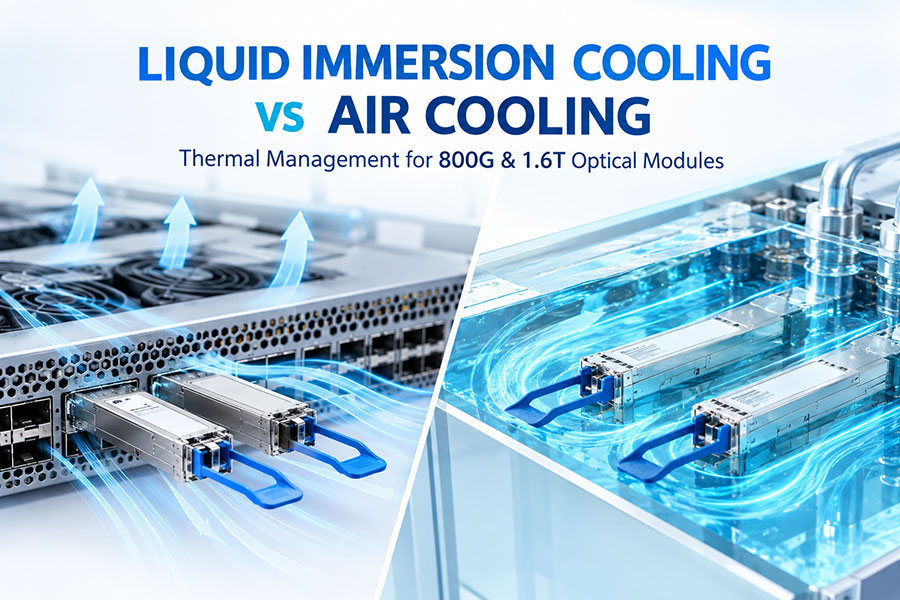
Thermal design becomes increasingly important at 800G and 1.6T.
A pluggable transceiver has a constrained thermal environment inside a front-panel cage.
An optical engine positioned near the ASIC can use a different thermal path, potentially allowing the system designer to manage heat more directly.
However, CPO and NPO architectures also introduce new thermal integration challenges.
25. Optical Engine vs Optical Transceiver Serviceability
Pluggable transceivers have a major serviceability advantage because failed modules can generally be removed and replaced without replacing the entire switch platform.
An integrated optical engine may require service procedures at the system or board level.
This difference is one of the main architectural trade-offs between highly integrated optics and traditional pluggable modules.
26. Optical Engine vs Optical Transceiver Flexibility
Pluggable transceivers provide significant flexibility because different optical modules can be selected according to reach, fiber type, wavelength and network topology.
An integrated optical engine can provide tighter system integration but generally gives the system designer less modularity after deployment.
27. Optical Engine vs Optical Transceiver Interoperability
Optical transceivers are designed around standardized host and optical interfaces, management requirements and mechanical form factors.
Optical engines are often more system-specific and may depend on the host platform design.
As a result, optical engine interoperability can require closer coordination between the ASIC, optical subsystem, package and system manufacturer.
28. Optical Engine vs Optical Transceiver Cost
The cost comparison is not simply a component price comparison.
An optical engine may cost less than a complete transceiver because it does not necessarily include the enclosure, host connector, management electronics and other module-level components.
However, an integrated optical engine may increase system development and packaging costs.
29. Optical Engine vs Optical Transceiver Manufacturing
Optical transceiver manufacturing typically includes optical assembly, electrical assembly, firmware or management configuration, module testing and final mechanical integration.
Optical engine manufacturing focuses more heavily on precise optoelectronic integration and may require advanced packaging and optical alignment processes.
The manufacturing workflow therefore depends strongly on the intended architecture.
30. Optical Engine vs Optical Transceiver Size
An optical engine can be significantly smaller than a complete pluggable transceiver because it does not need to conform to the same mechanical housing requirements.
This smaller form factor can support dense optical integration around a switch ASIC.
A transceiver, by contrast, must accommodate optical, electrical and thermal components within a standardized mechanical envelope.
31. Optical Engine vs Optical Transceiver Density
Optical engines can potentially increase optical I/O density by moving optical conversion closer to the ASIC.
This can be particularly valuable in large switching systems and AI clusters where the number of optical lanes is very high.
Pluggable transceivers remain highly modular but are constrained by front-panel space and the electrical connection between the ASIC and the front-panel cages.
32. Optical Engine vs Optical Transceiver for 400G
Both architectures can support 400G connectivity.
Traditional 400G pluggable modules are widely used in data centers and high-speed Ethernet networks.
Optical engines can also be used in integrated optical systems where tighter ASIC-to-optics integration is required.
33. Optical Engine vs Optical Transceiver for 800G
At 800G, the difference between the two architectures becomes more significant because electrical channel loss and signal integrity become increasingly challenging.
800G pluggable transceivers continue to provide flexible deployment and replacement.
Optical engines can reduce electrical distance when they are placed closer to the switching ASIC, making them attractive for advanced switch and AI infrastructure designs.
34. Optical Engine vs Optical Transceiver for 1.6T
At 1.6T, system-level electrical and thermal limitations become even more important.
Optical engines can help shorten the electrical path and provide higher optical I/O density.
However, 1.6T pluggable transceivers remain important because they preserve modularity and simplify field replacement.
The choice depends on the system architecture rather than data rate alone.
35. Optical Engine and Parallel Optics
An optical engine can contain multiple transmit and receive optical channels arranged as a parallel optical architecture.
This is useful for high-bandwidth short-reach systems where multiple optical lanes are transmitted independently.
VCSEL arrays, photodetector arrays and multi-fiber optical interfaces can be used depending on the application.
36. Optical Engine and WDM
Optical engines can also support wavelength-division multiplexing.
Multiple optical transmitters can operate at different wavelengths, with optical multiplexing combining the channels onto a common fiber path.
This is useful when high aggregate bandwidth must be transmitted over a limited number of fibers.
37. Optical Engine vs Optical Transceiver and Fiber Type
Both optical engines and transceivers can be designed for multimode or single-mode fiber.
The optical technology depends on the application rather than the word "engine" or "transceiver" itself.
| Architecture | Possible Fiber | Typical Use |
|---|---|---|
| VCSEL Optical Engine | Multimode Fiber | Short-reach parallel optics |
| Single-Mode Optical Engine | Single-Mode Fiber | High-speed single-mode systems |
| WDM Optical Engine | Single-Mode Fiber | High-density wavelength multiplexing |
| Pluggable Transceiver | MMF or SMF | Modular network connectivity |
38. Optical Engine and Silicon Photonics
Silicon photonics is an important platform for building highly integrated optical engines.
A silicon photonics optical engine can combine waveguides, modulators, couplers, multiplexers and other photonic functions on a photonic integrated circuit.
A separate laser source may be coupled to the silicon photonics device, depending on the architecture.
39. Optical Engine and EML
EML technology can also be used within optical engine designs.
An EML-based engine can provide high-speed optical transmit functions for applications requiring controlled chirp and single-mode transmission.
Therefore, optical engine is not a specific laser technology. The engine can use different optical transmitter technologies depending on system requirements.
40. Optical Engine and VCSEL
VCSEL arrays are another important optical engine technology, particularly for short-reach parallel optical systems.
The compact array structure of VCSELs is well suited to high-density multi-channel optical engines.
This makes VCSEL-based engines useful in selected data center and AI interconnect applications.
41. Optical Engine and Co-Packaged Optics
CPO places optical engines close to the switching ASIC inside a highly integrated package or package-level system.
This reduces the electrical path between the ASIC and optical conversion point.
The approach can improve bandwidth density, but it also introduces challenges related to thermal management, package design, manufacturing, testing and serviceability.
42. Optical Engine and Near-Packaged Optics
NPO uses a less tightly integrated arrangement than CPO.
The optical engine remains physically separate from the ASIC package while being positioned nearby.
This approach seeks to balance the electrical benefits of close optical integration with greater manufacturing and maintenance flexibility.
43. Optical Engine vs Front-Panel Pluggable Optics
| Characteristic | Optical Engine | Front-Panel Pluggable Transceiver |
|---|---|---|
| Integration | High | Modular |
| ASIC Distance | Can be very short | Usually longer electrical path |
| Replacement | System-dependent | Simple module replacement |
| Thermal Architecture | System-specific | Constrained by cage and host design |
| Interoperability | More system dependent | Generally broader standardization |
| Optical Density | Potentially very high | Limited by front-panel space |
44. Optical Engine vs Optical Transceiver Management
A pluggable optical transceiver usually includes management functions that allow the host system to monitor module status, temperature, voltage, optical power and other operating parameters.
An optical engine may rely more heavily on the host system for monitoring and control.
The actual implementation depends on the architecture and management interface.
45. Optical Engine vs Optical Transceiver Testing
Transceiver testing typically covers both optical and electrical performance at the finished-module level.
Optical engine testing can focus on the performance of the optoelectronic assembly before it is integrated into the complete system.
System-level validation is still required because engine performance can change after integration with the ASIC, package, PCB and thermal system.
46. Optical Engine vs Optical Transceiver Reliability
Pluggable transceivers benefit from modular replacement, which can simplify maintenance when a module fails.
Integrated optical engines may have fewer removable interfaces but can make service more complex because the optical subsystem is closely tied to the host architecture.
Reliability therefore includes both component reliability and system maintenance strategy.
47. Optical Engine vs Optical Transceiver Application Areas
| Application | Optical Engine | Optical Transceiver |
|---|---|---|
| Ethernet Data Centers | Yes | Yes |
| AI Clusters | Yes | Yes |
| CPO | Yes | Not necessarily |
| NPO | Yes | Possible depending on architecture |
| Front-Panel Networking | Usually as an internal component | Yes |
| DCI | Possible | Yes |
| Telecom | Possible | Yes |
48. Why Optical Engines Are Important for AI Data Centers
AI clusters require extremely high communication bandwidth between accelerators and network switches.
As electrical data rates increase, moving optical conversion closer to the switching ASIC can reduce the length of high-speed electrical connections.
This is one reason optical engines are receiving increasing attention in AI networking and high-density switch architectures.
49. Why Pluggable Optical Transceivers Remain Important
Pluggable transceivers provide modularity, interoperability and field serviceability.
Network operators can select different modules according to reach, wavelength, fiber type and network topology without redesigning the entire switch.
These advantages remain important in many data center and telecom environments.
50. Can an Optical Engine Replace an Optical Transceiver?
An optical engine does not directly replace a complete optical transceiver in every application.
A transceiver provides the mechanical, electrical, optical and management interfaces required by the host platform, while an optical engine generally provides a subset of those functions as a core optoelectronic assembly.
Replacing a transceiver architecture with an optical engine usually requires a corresponding change to the host system design.
51. Can an Optical Engine Be Used Inside a Transceiver?
Yes. An optical engine can serve as the optoelectronic core of a transceiver or optical module.
In such a design, the completed transceiver adds the necessary host interface, management functions, mechanical enclosure, power system and other components around the optical engine.
52. Optical Engine vs Optical Transceiver: Key Selection Factors
| Selection Factor | Optical Engine | Optical Transceiver |
|---|---|---|
| System Integration | High | Moderate to low |
| Modularity | Lower | Higher |
| Serviceability | System dependent | High |
| ASIC-to-Optics Distance | Can be minimized | Usually longer |
| Optical Density | High potential | High but front-panel constrained |
| System Customization | High | Lower |
| Standardization | More architecture dependent | Higher |
| Typical Role | Core optical subsystem | Complete optical interface |
53. Optical Engine vs Optical Transceiver: Future Development
Future high-speed network architectures are likely to use a combination of optical engines and pluggable optical transceivers rather than a single universal approach.
Optical engines are well suited to highly integrated switch and AI networking platforms, while pluggable transceivers remain valuable where modularity, field replacement and broad deployment flexibility are priorities.
Architectures such as CPO, NPO and advanced linear optics can further expand the role of optical engines.
54. Optical Engine vs Optical Transceiver: Final Comparison
| Category | Optical Engine | Optical Transceiver |
|---|---|---|
| Definition | Core optoelectronic assembly | Complete optical communication module |
| Main Function | Optical transmit and receive conversion | Complete electrical-optical network interface |
| Packaging | System-specific | Often standardized |
| ASIC Integration | Can be located close to ASIC | Usually connected through front-panel electrical channels |
| Modularity | Lower | Higher |
| Serviceability | More system dependent | High |
| Typical Use | NPO, CPO, integrated optical systems | Ethernet, DCI, telecom and data center networks |
Optical engine and optical transceiver are complementary concepts rather than directly competing products. The optical engine focuses on integrated optoelectronic conversion, while the optical transceiver adds the electrical, mechanical, optical and management interfaces required for deployment as a complete module.
For 400G, 800G and 1.6T systems, the choice between highly integrated optical engines and pluggable transceivers depends on electrical channel length, power, thermal design, optical density, serviceability, interoperability and overall system architecture.
 >
>

 >
>
 >
>
 >
>
 >
>
 >
>
 >
>
 >
>