TEL:+86 132 6656 7067




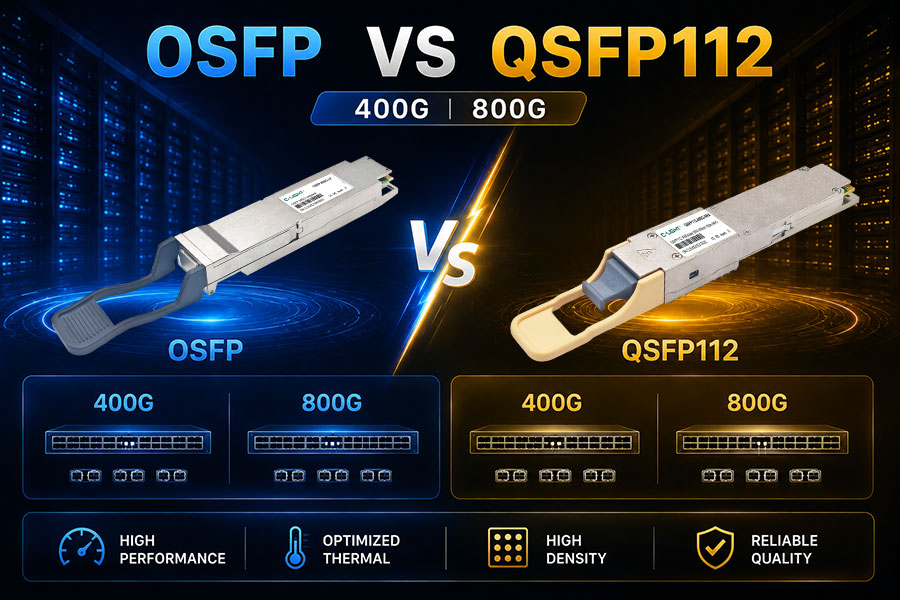
As data center networks move from 400G to 800G and toward 1.6T, optical module form factors are becoming increasingly important. Among the high-speed interfaces used in next-generation data centers, OSFP and QSFP112 are two important solutions for 800G optical connectivity.
Although both technologies are designed to support high-speed networking, OSFP and QSFP112 differ in mechanical dimensions, thermal characteristics, electrical architecture, port density, and application priorities. Understanding these differences is important when selecting optical modules for AI data centers, high-performance computing, and hyperscale networking.
1. What Is OSFP?
OSFP stands for Octal Small Form-factor Pluggable. It was developed as a high-speed pluggable form factor to support increasing network bandwidth and power requirements.
The OSFP form factor is larger than QSFP-based modules, giving it more physical space for high-speed electrical components, optical engines, and thermal structures.
OSFP is widely associated with high-speed applications such as:
400G optical modules
800G optical modules
1.6T optical modules
AI data center networking
High-performance computing
The larger physical size can provide additional thermal design flexibility, which becomes increasingly important as optical module power increases.
2. What Is QSFP112?
QSFP112 is a high-speed QSFP form factor designed around 112Gbps-class electrical lanes. It extends the widely deployed QSFP architecture into higher-speed networking generations.
A major feature of QSFP112 is its compatibility with the compact QSFP form factor while supporting higher electrical signaling rates.
Typical applications include:
400G optical connectivity
800G optical connectivity
High-speed Ethernet
AI and HPC networks
High-density data center switches
3. OSFP vs QSFP112: Basic Comparison
| Feature | OSFP | QSFP112 |
|---|---|---|
| Form Factor | Larger | More compact |
| Electrical Lane | Commonly associated with 112G-class and higher-speed architectures | 112Gbps-class electrical lanes |
| Thermal Capacity | Higher physical space for thermal solutions | More compact thermal design |
| Port Density | Lower than QSFP-based solutions | Higher |
| Typical Use | High-power 800G and future high-speed networks | High-density 400G and 800G networking |
| Upgrade Direction | Strong path toward 1.6T and beyond | Strong focus on compact high-density networking |
| Thermal Flexibility | Strong | More constrained by compact size |
4. OSFP vs QSFP112 Form Factor
One of the most obvious differences between OSFP and QSFP112 is physical size.
OSFP is larger than QSFP112. This additional physical volume can provide more room for optical engines, electrical components, heat spreaders, and thermal management structures.
QSFP112 maintains the more compact QSFP-style form factor, which can be attractive for systems where switch front-panel density is a major design objective.
This creates a basic engineering trade-off:
OSFP → More physical space and thermal flexibility
QSFP112 → More compact packaging and higher port density
5. OSFP and QSFP112 Electrical Architecture
Both OSFP and QSFP112 support high-speed electrical signaling, but the implementation depends on the specific optical module and host system.
At 800G, optical modules commonly use multiple high-speed electrical lanes. PAM4 signaling is widely used to increase the amount of data transmitted per lane.
Higher electrical lane rates create increasing requirements for:
Signal integrity
Insertion loss control
Return loss
Crosstalk management
Jitter control
Equalization
As network speeds increase, the quality of the host electrical channel becomes increasingly important regardless of whether the system uses OSFP or QSFP112.
6. Thermal Management: One of the Biggest Differences
Thermal management is becoming one of the most important considerations for high-speed optical modules.
800G and future 1.6T optical modules may include high-speed DSPs, laser arrays, drivers, TIAs, and other components that generate significant heat.
6.1 OSFP Thermal Advantages
The larger OSFP housing provides more physical space for heatsinks and other thermal structures.
This can be particularly useful for:
High-power 800G modules
1.6T optical modules
Advanced thermal management
Liquid-cooling-compatible designs
6.2 QSFP112 Thermal Considerations
QSFP112 provides a more compact package, which can increase port density but leaves less physical space for thermal structures.
This means that module efficiency, heatsink optimization, airflow, and system thermal design become especially important.
7. OSFP vs QSFP112 for 800G
Both OSFP and QSFP112 can be used for 800G-class optical connectivity, but they target somewhat different system priorities.
OSFP is particularly attractive when the system prioritizes thermal capability, high power handling, and a path toward future higher-speed modules.
QSFP112 is attractive when compact packaging and switch port density are important.
For AI data centers, the final choice should be based on the complete system design rather than optical speed alone.
8. OSFP vs QSFP112 for 1.6T
The transition to 1.6T places much greater demands on thermal management, electrical signaling, optical engines, and package integration.
The additional physical space of OSFP can be beneficial for high-power 1.6T implementations, particularly when advanced heatsinks or other thermal structures are required.
QSFP-based architectures remain attractive where compact density is a priority, but the thermal design becomes increasingly challenging as module power rises.
This is one reason OSFP is frequently considered for future ultra-high-speed AI networking applications.
9. Port Density Comparison
Port density is one of the major strengths of QSFP112.
Because QSFP112 maintains a relatively compact form factor, more ports can potentially be placed on the front panel of a switch within the same physical width.
This can be important for:
High-density Ethernet switches
AI fabric networks
Hyperscale data centers
Rack-scale infrastructure
OSFP gives up some port density in exchange for additional physical space and thermal design flexibility.
10. OSFP vs QSFP112 in AI Data Centers
AI data centers require a balance between bandwidth density, power efficiency, thermal performance, and network scalability.
OSFP can be advantageous in high-power AI switching systems because the form factor provides additional space for thermal management.
QSFP112 can be advantageous where front-panel density and compact switch design are the highest priorities.
This creates two different optimization paths:
OSFP: Optimize for power, thermal performance, and future bandwidth scaling.
QSFP112: Optimize for compact size, density, and established QSFP-based infrastructure.
11. Compatibility and Network Migration
Compatibility is another important factor when choosing between OSFP and QSFP112.
The optical module must be compatible with the switch port, electrical interface, firmware, management system, and optical specifications of the network equipment.
A module should therefore not be selected based only on its nominal data rate.
Engineers should also verify:
Host interface compatibility
Electrical lane configuration
Optical interface
Transmission distance
Power budget
Thermal requirements
Management and monitoring support
12. Optical Applications of OSFP and QSFP112
12.1 800G OSFP
800G OSFP modules are suitable for high-performance AI networks, data center switch interconnects, and applications where thermal capability is important.
12.2 800G QSFP112
800G QSFP112 solutions can provide high-bandwidth optical connectivity while maintaining the compact QSFP footprint.
12.3 400G QSFP112
400G QSFP112 modules provide a practical high-speed solution for data centers that require high bandwidth and compact port density.
13. OSFP, QSFP112 and the Future of 1.6T Networking
The development of 1.6T optical connectivity is pushing both module architectures toward higher integration and more advanced thermal management.
Important technologies include:
200G-per-lane electrical signaling
PAM4 modulation
Advanced DSP
Silicon photonics
Improved laser technology
Advanced thermal solutions
Liquid cooling
The higher the module power and lane speed, the more important system-level thermal and signal-integrity design becomes.
14. OSFP and QSFP112 in the Transition to CPO
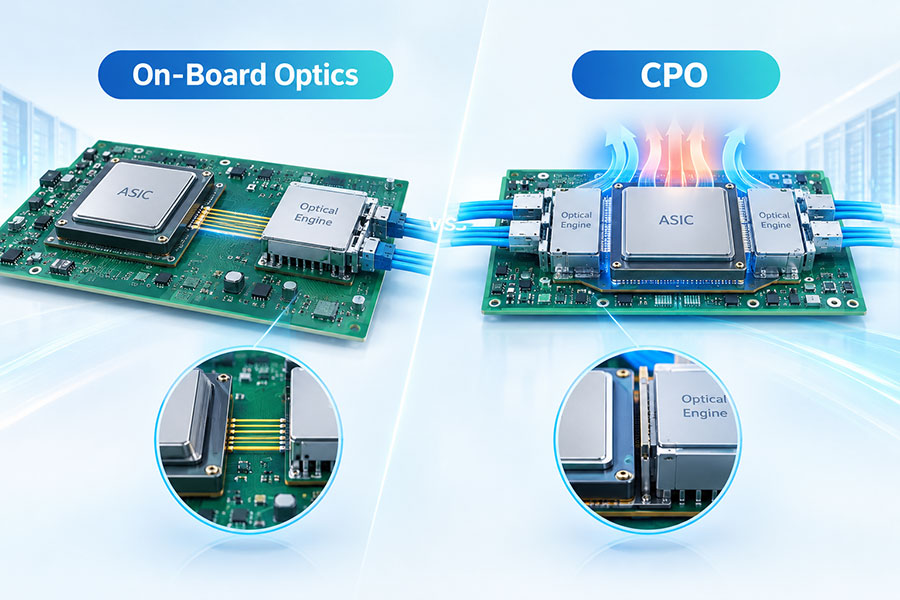
OSFP and QSFP112 are both examples of pluggable optical architectures. Meanwhile, the industry is also exploring more integrated approaches such as Linear Pluggable Optics (LPO), silicon photonics, optical engines, and Co-Packaged Optics (CPO).
CPO moves optical engines closer to the switching ASIC, reducing electrical transmission distance and potentially improving system efficiency.
Pluggable optics, however, remain important because they provide:
Field replacement
Flexible upgrades
Modular deployment
Easier maintenance
OSFP and QSFP112 are therefore likely to remain important during the transition toward more integrated optical architectures.
15. C-LIGHT OSFP and QSFP112 Optical Solutions
C-LIGHT provides high-speed optical connectivity solutions covering different data center networking requirements.
Relevant product families include:
800G OSFP optical modules
400G QSFP-DD optical modules
400G QSFP112 optical modules
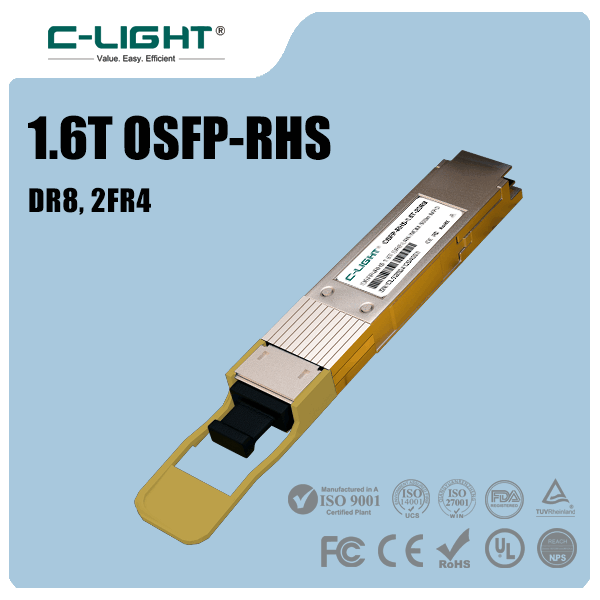
1.6T OSFP optical solutions
High-speed DAC, AOC, and AEC solutions
These products can support different AI data center architectures depending on transmission distance, bandwidth requirements, thermal conditions, and system design.
16. How to Choose Between OSFP and QSFP112
The decision should be based on the requirements of the complete network system.
Choose OSFP when: Higher thermal flexibility, higher module power handling, and future scalability are major priorities.
Choose QSFP112 when: Compact size and higher port density are more important.
For AI networking: Evaluate power, cooling, bandwidth, latency, and switch architecture together.
For 1.6T: Pay particular attention to electrical lane speed, thermal design, and host compatibility.
17. OSFP vs QSFP112: Key Takeaway
OSFP and QSFP112 are both important high-speed optical module form factors, but they solve different system-level problems.
OSFP emphasizes thermal flexibility and high-power scalability, making it well suited to demanding 800G and future 1.6T AI networking environments.
QSFP112 emphasizes compact packaging and high port density, making it attractive for data center systems where space efficiency is critical.
There is no universally better form factor. The appropriate choice depends on switch architecture, power budget, cooling strategy, port density, transmission distance, and future upgrade requirements.
18. Conclusion
The evolution of AI data centers is accelerating the adoption of high-speed optical connectivity. As networks move from 400G to 800G and toward 1.6T, the choice between OSFP and QSFP112 becomes increasingly important.
OSFP provides additional physical space for thermal management and high-power optical designs, while QSFP112 maintains a compact form factor that supports high port density.
For next-generation AI data centers, both architectures will continue to play important roles. The optimal solution will depend on the balance between bandwidth, thermal performance, density, compatibility, power consumption, and long-term scalability.
19.OSFP vs QSFP112 Q&A
Q1: What is the main difference between OSFP and QSFP112?
Answer: OSFP is physically larger and provides greater thermal design space, while QSFP112 uses a more compact form factor that can provide higher port density.
Q2: Is OSFP better than QSFP112 for 800G?
Answer: Neither is universally better. OSFP can be advantageous for higher-power and thermally demanding applications, while QSFP112 can be attractive when compact size and port density are priorities.
Q3: Can QSFP112 support 800G?
Answer: Yes. QSFP112 can be used for 800G-class optical connectivity depending on the module architecture and host platform.
Q4: Why is OSFP popular in AI data centers?
Answer: The larger OSFP form factor provides additional space for thermal management and high-power optical components, which is useful in demanding AI networking environments.
Q5: Why choose QSFP112?
Answer: QSFP112 provides a compact high-speed architecture that can help maximize switch port density and support space-constrained data center systems.
Q6: Which is better for 1.6T, OSFP or QSFP112?
Answer: OSFP is often attractive for high-power 1.6T applications because its larger form factor provides more thermal design flexibility. However, the final choice depends on the specific switch architecture and module implementation.
Q7: What factors should be considered when selecting OSFP or QSFP112?
Answer: Important factors include bandwidth, electrical lane configuration, power consumption, thermal management, port density, transmission distance, optical technology, host compatibility, and future upgrade requirements.
Q8: Are OSFP and QSFP112 both suitable for AI data centers?
Answer: Yes. Both can support high-speed AI networking. OSFP is particularly attractive for thermally demanding systems, while QSFP112 is useful for compact, high-density deployments.
Q9: Will OSFP and QSFP112 coexist in future data centers?
Answer: Yes. Different network architectures have different requirements, so multiple optical form factors are expected to coexist across AI, cloud, enterprise, and high-performance computing environments.
Q10: What OSFP and QSFP112 products does C-LIGHT provide?
Answer: C-LIGHT provides high-speed optical solutions including 800G OSFP modules, 400G QSFP112 modules, 400G QSFP-DD modules, and next-generation 1.6T OSFP solutions for data center and AI networking applications.
 >
>

 >
>
 >
>
 >
>
 >
>
 >
>
 >
>
 >
>