TEL:+86 132 6656 7067





The rapid growth of AI clusters, high-performance computing, and distributed data center architectures is driving the need for higher-bandwidth optical connectivity. As 800G deployments continue to expand, 1.6T optical modules are emerging as an important next step for next-generation data center networks.
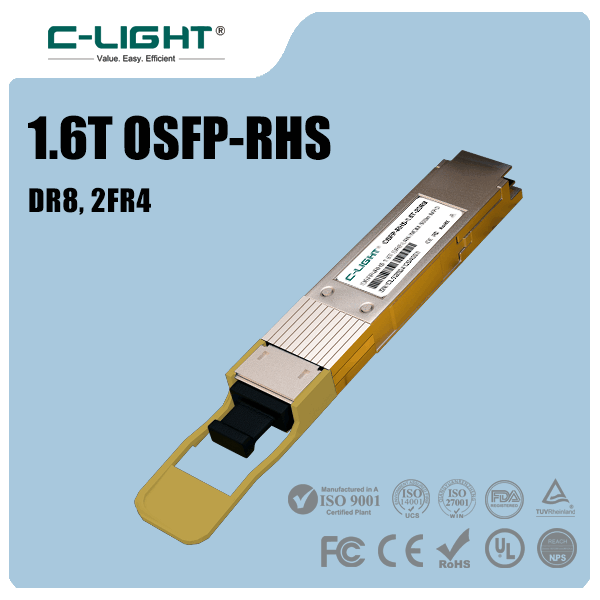
The 1.6T OSFP Optical Module provides an aggregate data rate of 1.6Tb/s and is designed around the OSFP1600 form factor. C-LIGHT's CL1.6TOSFP2DR4-RHS is a 1.6T OSFP-RHS transceiver designed for high-density Ethernet connectivity, supporting 8 × 200G Ethernet and an optical interface compliant with the 1.6TBASE-DR8 specification.
1. What Is a 1.6T OSFP Optical Module?
A 1.6T OSFP optical module is a high-speed pluggable transceiver designed to provide an aggregate bandwidth of up to 1.6Tb/s. Compared with previous generations such as 400G and 800G, 1.6T increases the bandwidth available from a single optical module, helping network operators scale AI and high-performance computing infrastructure without increasing the number of physical ports at the same rate.
The OSFP form factor provides additional physical space for high-speed electrical and optical components, thermal management, and high-density connectivity. These characteristics make OSFP an important form factor for high-bandwidth optical networking.
2. C-LIGHT 1.6T OSFP-RHS Transceiver
C-LIGHT's CL1.6TOSFP2DR4-RHS is a 1.6T OSFP-RHS transceiver designed for Ethernet applications. According to the product specification, the module supports an aggregate bit rate of 1.6Tb/s and 8 × 200G Ethernet.
Form Factor: OSFP1600
Aggregate Data Rate: 1.6Tb/s
Electrical Interface: 1.6TAUI-8 C2M
Optical Interface: 1.6TBASE-DR8
Ethernet Configuration: 8 × 200G
Transmitter: Higher-bandwidth EML
Receiver: PIN photodiode
Fiber Interface: Dual MPO-12/APC receptacle
Management: CMIS 5.2 with digital diagnostic monitoring
Operating Temperature: 0°C to 70°C
3. 1.6T Bandwidth Architecture
One of the most important characteristics of a 1.6T optical module is its lane architecture. The C-LIGHT CL1.6TOSFP2DR4-RHS supports 8 × 200G Ethernet, providing an aggregate bandwidth of 1.6Tb/s.
This architecture represents the continued evolution of high-speed Ethernet connectivity:
400G: Established high-speed connectivity for modern data centers.
800G: Increasingly important for AI clusters and high-performance network fabrics.
1.6T: Extends bandwidth per optical port to support larger-scale AI and data center networks.
The move toward 1.6T is not simply a matter of increasing the nominal data rate. It also requires advances in electrical interfaces, optical engines, signal integrity, thermal management, and module management.
4. 1.6T OSFP and PAM4 Technology
High-speed Ethernet modules operating at 200G per lane require advanced modulation and signal processing technologies. The 1.6T optical module specified by C-LIGHT uses PAM4-related optical performance parameters, including TDECQ and TECQ.
PAM4 enables two bits to be represented by each symbol, increasing the amount of data transmitted per symbol compared with conventional NRZ signaling. This makes PAM4 an important technology for scaling individual electrical and optical lanes to 200G and beyond.
However, higher signaling rates also introduce greater requirements for transmitter quality, receiver sensitivity, signal integrity, dispersion performance, and system-level link design.
5. 1.6TBASE-DR8 Optical Interface
The CL1.6TOSFP2DR4-RHS is specified with a 1.6TBASE-DR8 optical interface. The module uses eight high-speed optical lanes, corresponding to the 8 × 200G architecture.
The specified lane wavelength range is 1304.5–1317.5 nm. The transmitter uses EML technology, while the receiver uses PIN photodiodes.
The module also specifies a maximum TDECQ of 3.4 dB per lane under the defined test conditions, providing an important optical performance parameter for evaluating PAM4 transmission quality.
6. Dual MPO-12/APC Connectivity
The 1.6T OSFP-RHS module uses a dual MPO-12/APC receptacle. This high-density interface is designed to accommodate the multiple optical lanes required by the 1.6T architecture.
Compared with conventional duplex LC interfaces used in lower-speed optical modules, multi-fiber MPO connectivity provides a practical way to manage a large number of optical channels within a compact module and cabling architecture.
For 1.6T deployments, connector selection becomes particularly important because optical density, insertion loss, return loss, fiber management, and cabling structure all influence the overall link design.
7. Why OSFP Is Important for 1.6T Networking
The physical design of a high-speed optical module becomes increasingly important as bandwidth increases. Higher-speed modules generally require greater attention to power consumption, heat dissipation, electrical signal integrity, and mechanical design.
The OSFP1600 form factor provides a larger module footprint than smaller form factors, offering additional design space for high-speed optical and electrical components as well as thermal management.
This makes OSFP a strong candidate for high-bandwidth applications where performance and thermal requirements are more demanding.
8. 1.6T OSFP for AI Data Centers
AI workloads are changing the requirements of data center networks. Large GPU clusters generate substantial east-west traffic, requiring high-bandwidth connections between compute nodes, switches, and other networking elements.
As AI clusters scale, increasing bandwidth per optical port can help network designers build higher-capacity fabrics while maintaining manageable port counts and cabling architectures.
1.6T optical modules are therefore positioned as an important connectivity technology for next-generation AI infrastructure, particularly in environments where 800G bandwidth is becoming insufficient for future network scaling.
9. 1.6T OSFP vs. 800G Optical Modules
| Feature | 800G Optical Module | 1.6T OSFP Optical Module |
|---|---|---|
| Aggregate Data Rate | 800Gb/s | 1.6Tb/s |
| Typical High-Speed Architecture | Multiple high-speed lanes | 8 × 200G |
| Application | AI Data Centers, Ethernet Fabrics | Next-Generation AI and High-Performance Networks |
| Bandwidth per Port | 800G | 1.6T |
| Thermal Requirements | High | More demanding |
| Network Direction | Current high-speed deployment | Next-generation bandwidth scaling |
The transition from 800G to 1.6T does not mean that 800G modules will immediately disappear. Instead, 1.6T is expected to complement 800G as AI clusters and high-performance network architectures continue to scale.
10. Thermal Management for 1.6T Optical Modules
Thermal management becomes increasingly important as optical module bandwidth increases. Higher-speed electrical and optical components can increase module power consumption and thermal density, making heat dissipation a critical consideration for system designers.
The OSFP form factor provides additional physical space that can support thermal design strategies for high-speed modules. At the system level, switch airflow, heat sinks, module placement, cage design, and rack-level cooling all influence optical module operating conditions.
The C-LIGHT CL1.6TOSFP2DR4-RHS specifies a case operating temperature of 0°C to 70°C.
11. Digital Monitoring and Management
High-speed optical networks require accurate monitoring of module operating conditions and optical performance. The C-LIGHT 1.6T OSFP-RHS transceiver supports a two-wire serial interface with digital diagnostic monitoring.
The module is also compliant with CMIS Rev. 5.2, providing a standardized management framework for monitoring and controlling the optical module within compatible network equipment.
Digital monitoring can help network operators obtain information about module operating conditions and support maintenance and troubleshooting in high-density data center environments.
12. Key Applications
The 1.6T OSFP optical module is primarily intended for high-bandwidth networking environments where conventional 400G and 800G connectivity may not provide sufficient capacity for future expansion.
AI Data Center Networks
GPU Cluster Interconnects
High-Performance Computing
High-Speed Ethernet Networks
Data Center Spine and Leaf Networks
Next-Generation Network Fabrics
13. C-LIGHT 1.6T OSFP Optical Module
C-LIGHT's CL1.6TOSFP2DR4-RHS combines a 1.6Tb/s aggregate data rate, OSFP1600 form factor, 8 × 200G Ethernet architecture, EML transmitter, PIN receiver, and dual MPO-12/APC optical connectivity.
The module is designed around the emerging requirements of next-generation Ethernet and AI data center networks, providing a high-density optical connectivity solution for applications moving beyond 800G.
Its support for IEEE 802.3dj D1p2 1.6TBASE-DR8 and 1.6TAUI-8 C2M interfaces also aligns the product with the evolution of 1.6T Ethernet technology.
14. Frequently Asked Questions
Q1:What is a 1.6T OSFP optical module?
Answer: A 1.6T OSFP optical module is a high-speed pluggable transceiver capable of providing an aggregate data rate of 1.6Tb/s. It is designed for next-generation Ethernet, AI data center, and high-performance networking applications.
Q2:What is the data rate of the C-LIGHT 1.6T OSFP module?
Answer: The C-LIGHT CL1.6TOSFP2DR4-RHS supports an aggregate bit rate of 1.6Tb/s and an 8 × 200G Ethernet architecture.
Q3:What optical interface does the 1.6T OSFP module use?
Answer: The module supports a 1.6TBASE-DR8 optical interface and uses a dual MPO-12/APC receptacle.
Q4:Does the 1.6T OSFP module use PAM4?
Answer: Yes. The optical performance specifications include PAM4-related parameters such as TDECQ and TECQ, which are important for evaluating high-speed PAM4 transmission performance.
Q5:What is the wavelength range of the module?
Answer: The specified lane wavelength range is 1304.5–1317.5 nm.
Q6:What type of laser does the C-LIGHT 1.6T OSFP module use?
Answer: The module uses a higher-bandwidth EML transmitter and a PIN photodiode receiver.
Q7:What is the operating temperature of the 1.6T OSFP module?
Answer: The specified case operating temperature range is 0°C to 70°C.
Q8:Why is OSFP suitable for 1.6T optical connectivity?
Answer: The OSFP1600 form factor provides physical space for high-speed electrical and optical components and supports the thermal and mechanical requirements associated with higher-bandwidth optical modules.
Q9:What are the main applications of 1.6T OSFP optical modules?
Answer: Typical applications include AI data centers, GPU cluster interconnects, high-performance computing, high-speed Ethernet networks, and next-generation data center fabrics.
15. Conclusion
The move toward 1.6T optical connectivity reflects the rapidly increasing bandwidth requirements of AI clusters and next-generation data center networks. By increasing the bandwidth available from a single optical port, 1.6T modules provide a path for network operators to scale capacity while managing port density and cabling complexity.
The C-LIGHT CL1.6TOSFP2DR4-RHS combines a 1.6Tb/s aggregate data rate, 8 × 200G Ethernet, OSFP1600 form factor, 1.6TBASE-DR8 optical interface, EML/PIN optical technology, dual MPO-12/APC connectivity, and CMIS 5.2 management.
As AI data center architectures continue to evolve from 400G and 800G toward 1.6T and higher bandwidth, high-density OSFP optical modules will play an increasingly important role in next-generation optical interconnect solutions.
 >
>

 >
>
 >
>
 >
>
 >
>
 >
>
 >
>
 >
>