TEL:+86 132 6656 7067




OS2 and OM3 are two widely used optical fiber types for data communication and structured cabling, but they are designed for very different transmission environments. OS2 is a single-mode fiber category, while OM3 is a laser-optimized multimode fiber category.
The main differences between OS2 and OM3 include core size, propagation mode, wavelength, modal bandwidth, attenuation, transmission distance, optical source, and typical applications. OS2 is commonly associated with 1310 nm and 1550 nm single-mode transmission, while OM3 is commonly used around 850 nm with VCSEL-based multimode optics.
For modern 100G, 400G, and 800G networks, the correct choice depends not only on the fiber itself but also on the optical transceiver, transmission distance, lane architecture, connector, optical budget, and future network requirements.
1. What Is OS2 Fiber?
OS2 is a single-mode optical fiber category commonly used for telecommunications, data centers, enterprise backbones, and other longer-reach optical links.
OS2 fiber has a small core and supports essentially single-mode propagation at its intended operating wavelengths. This greatly reduces modal dispersion and allows high-performance transmission over significantly longer distances than typical multimode systems.
2. What Is OM3 Fiber?
OM3 is a 50/125 µm laser-optimized multimode fiber designed primarily for high-speed short-reach communication.
OM3 is commonly used with 850 nm VCSEL-based optical transceivers and is widely deployed in data centers, enterprise networks, and high-density short-distance optical links.
3. OS2 vs OM3 at a Glance
| Feature | OS2 | OM3 |
|---|---|---|
| Fiber type | Single-mode | Multimode |
| Typical structure | Approximately 9/125 µm class | 50/125 µm |
| Propagation | Essentially one mode | Multiple modes |
| Common wavelength | 1310 nm / 1550 nm | 850 nm |
| Typical optical source | Laser-based | VCSEL-based |
| Modal dispersion | Very low | Important factor |
| Typical reach | From hundreds of meters to many kilometers depending on optics | Short reach |
| Typical applications | Longer-reach data center, telecom and backbone links | Short-reach data center and enterprise links |
4. The Fundamental Difference
The fundamental difference is that OS2 is single-mode fiber while OM3 is multimode fiber.
OS2 uses a small core to strongly restrict the number of propagation modes. OM3 has a larger core that supports many optical modes, allowing relatively easy coupling with short-wavelength VCSEL transmitters.
5. OS2 Core Size
OS2 is typically based on a single-mode fiber structure with a core around 8 to 10 µm and a 125 µm cladding diameter.
The small core requires precise optical alignment but provides controlled propagation characteristics suitable for long-distance transmission.
6. OM3 Core Size
OM3 uses a 50 µm core with a 125 µm cladding diameter.
The larger core makes optical coupling easier and supports multiple propagation modes, which is one reason OM3 is commonly paired with VCSEL-based short-reach transceivers.
7. Why Core Size Matters
Core size affects both optical coupling and propagation behavior.
A small single-mode core limits the propagation modes and greatly reduces modal dispersion. A larger multimode core supports multiple paths for the optical signal, increasing modal dispersion but simplifying coupling and supporting efficient short-reach optical sources.
8. Propagation Modes in OS2
OS2 is designed for essentially single-mode operation at its intended wavelengths.
This reduces the difference in propagation time between different modes and provides strong bandwidth performance over long distances.
9. Propagation Modes in OM3
OM3 supports multiple propagation modes.
Different modes can travel through different effective paths inside the fiber. As the distance or data rate increases, the resulting modal dispersion can reduce the available signal margin.
10. Modal Dispersion
Modal dispersion is one of the major technical differences between OS2 and OM3.
Because OS2 is essentially single-mode, modal dispersion is greatly reduced. In OM3, modal dispersion is an important factor that influences the relationship between data rate, wavelength, and transmission distance.
11. OM3 Effective Modal Bandwidth
OM3 is specified with an effective modal bandwidth of at least 2000 MHz·km at the relevant 850 nm operating condition.
This characteristic allows OM3 to support high-speed short-reach communication while controlling the effects of modal dispersion.
12. OS2 Bandwidth Characteristics
OS2 is not normally described using multimode effective modal bandwidth because it operates primarily in a single mode.
Its transmission capability is instead influenced by parameters such as attenuation, chromatic dispersion, polarization mode dispersion, optical power budget, transmitter characteristics, and receiver performance.
13. OS2 Wavelengths
OS2 is commonly used at wavelengths around 1310 nm and 1550 nm.
These wavelength regions are widely used for single-mode communication because they provide suitable attenuation and dispersion characteristics for a broad range of optical applications.
14. OM3 Wavelength
OM3 is strongly associated with the 850 nm wavelength region in data center communication.
This is closely related to the widespread use of VCSEL transmitters in multimode optical systems.
15. Why 850 nm Is Common for OM3
850 nm VCSEL technology provides compact, efficient optical transmitters that can be produced in arrays for parallel optical communication.
The combination of VCSELs and OM3 provides a practical solution for short-reach high-speed data center links.
16. Why 1310 nm Is Common for OS2
Single-mode optical systems commonly use the 1310 nm region because it provides low fiber attenuation and favorable dispersion characteristics.
This makes OS2 suitable for many data center, enterprise, metro, and longer-distance optical architectures.
17. 1550 nm and OS2
OS2 can also be used around 1550 nm.
The 1550 nm region can provide very low fiber attenuation and is widely used in longer-distance optical communication systems. Exact reach depends on the transceiver and link architecture rather than the fiber category alone.
18. OS2 Attenuation
OS2 generally provides substantially lower attenuation than typical multimode fiber at its commonly used telecom wavelengths.
Representative OS2 specifications can be around 0.4 dB/km at 1310 nm and around 0.3 dB/km at 1550 nm, although exact values depend on the specific fiber product and applicable specification.
19. OM3 Attenuation
OM3 has higher attenuation than OS2 in commonly used data center wavelength conditions.
Representative OM3 specifications can be around 2.8 dB/km at 850 nm. This is acceptable for short-reach links but becomes more significant as distance increases.
20. OS2 vs OM3 Distance
OS2 supports significantly longer transmission distances than OM3 in typical network applications.
However, it is not correct to assign one universal maximum distance to either fiber. Actual reach depends on transceiver class, wavelength, data rate, connector loss, splice loss, optical power budget, and the applicable Ethernet or Fibre Channel standard.
21. OM3 Reach Depends on the Optical Standard
OM3 can support different distances at different data rates.
For example, modern standards may specify one reach for 10GBASE-SR and a shorter reach for higher-speed parallel-optical systems. The transceiver specification must therefore be checked together with the fiber category.
22. OS2 Reach Depends on the Optical Standard
OS2 can support short-reach, medium-reach, and long-reach applications depending on the optical transceiver.
A 400G DR4 module, a 400G FR4 module, and a long-reach optical module can all use single-mode fiber while supporting very different distances.
23. Optical Sources for OS2
OS2 systems commonly use semiconductor laser technologies such as DFB lasers, EMLs, or other laser architectures.
The specific source depends on the wavelength, data rate, reach, modulation, and optical architecture.
24. Optical Sources for OM3
OM3 is commonly paired with VCSEL transmitters operating around 850 nm.
VCSEL arrays are particularly suitable for parallel multimode architectures in high-density data center applications.
25. OS2 and Laser Coupling
The small OS2 core requires precise alignment between the laser source and the fiber.
This makes transceiver optical coupling, connector alignment, and manufacturing tolerances important factors in single-mode systems.
26. OM3 and VCSEL Coupling
The larger OM3 core provides more tolerance for optical coupling.
This characteristic works well with VCSEL transmitters and contributes to the practicality of short-reach multimode transceivers.
27. OS2 in Data Centers
OS2 is widely used in data centers for longer interconnects and high-speed single-mode optical architectures.
It is especially useful for spine-leaf connections, inter-rack links, data center interconnects, and WDM-based transceivers.
28. OM3 in Data Centers
OM3 is widely used in short-reach data center connections.
It can provide efficient connectivity between servers, switches, storage systems, and other equipment where the required distance remains within the supported multimode range.
29. OS2 for 100G
100G single-mode transceivers commonly use OS2 or compatible single-mode infrastructure.
Applications can include parallel single-mode architectures and WDM-based designs depending on the optical standard.
30. OM3 for 100G
OM3 can support short-reach 100G optical systems, particularly parallel multimode architectures based on 850 nm VCSEL transmission.
The exact reach depends on the transceiver and the fiber's modal bandwidth characteristics.
31. OS2 for 400G
OS2 is widely used with high-speed 400G single-mode optical architectures.
Examples include 400G DR4, FR4, LR4, and other implementations in which single-mode fiber is required by the optical design.
32. OM3 for 400G
OM3 can support selected 400G short-reach multimode architectures.
400G SR8 is a representative example of a parallel multimode architecture using multiple optical channels over multimode fiber.
33. OS2 for 800G
OS2 is commonly used in 800G single-mode optical systems.
Parallel architectures such as DR8 and wavelength-multiplexed architectures can use single-mode fiber depending on the specific optical design.
34. OM3 for 800G
OM3 can be used for selected short-reach 800G architectures, particularly where multiple VCSEL-based channels are deployed over multimode fiber.
At higher data rates, however, the supported distance must be checked carefully because modal bandwidth becomes increasingly important.
35. Connector Types
OS2 and OM3 can both use common fiber connector types such as LC, SC, and MPO-family connectors.
The connector itself does not determine the fiber category.
36. LC Does Not Mean OS2
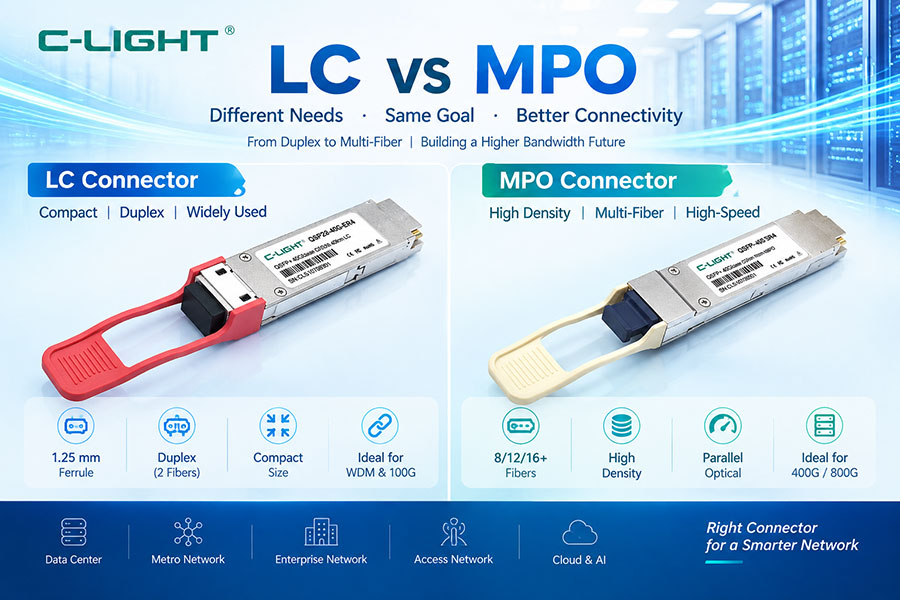
LC is a connector interface rather than a fiber type.
An LC connector can terminate both single-mode and multimode fiber. Therefore, an LC patch cable should always be identified by its fiber type and optical specifications in addition to its connector.
37. MPO Does Not Mean OM3
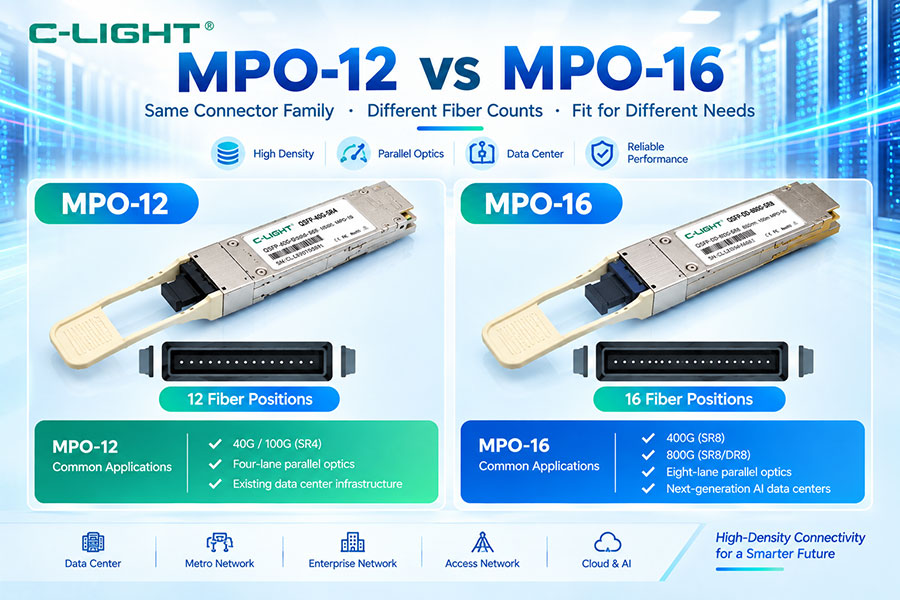
MPO is a multi-fiber connector family and can also be used with both single-mode and multimode fiber.
For example, MPO can be deployed with single-mode parallel optics as well as OM3 multimode parallel optics.
38. OS2 and Duplex LC
Duplex LC is common in single-mode WDM optical modules because multiple wavelengths can travel over a two-fiber transmit and receive pair.
This can reduce the number of physical fibers required compared with parallel single-mode architectures.
39. OM3 and MPO
MPO is common in high-density OM3 parallel optical systems.
Multiple multimode fibers can carry separate optical lanes through one connector, making MPO useful for high-density short-reach applications.
40. OS2 vs OM3 Cable Density
Fiber density is influenced by the optical architecture rather than fiber category alone.
An OS2 system using duplex WDM can use relatively few fibers, while an OM3 parallel optical system may require more fibers for the same aggregate data rate.
41. Parallel Optics
Both OS2 and OM3 can support parallel optical architectures.
OM3 parallel optics are commonly associated with VCSEL-based short-reach transmission, while OS2 parallel optics are commonly used for higher-reach single-mode architectures.
42. WDM and OS2
OS2 is particularly well suited to wavelength-division multiplexing.
Multiple wavelengths can be combined into the same fiber pair, allowing high aggregate bandwidth without requiring one physical fiber for every optical lane.
43. WDM and OM3
OM3 can also participate in wavelength-multiplexed multimode architectures, but conventional OM3 deployment is strongly associated with 850 nm parallel transmission.
OM5 is more specifically optimized for wideband multimode wavelength applications.
44. OS2 vs OM3 Optical Budget
Optical budget is important for both fiber types.
The total link loss includes fiber attenuation, connector loss, splice loss, passive component loss, and engineering margin. The transceiver must provide sufficient optical power and receiver sensitivity for the complete link.
45. OS2 vs OM3 Cost
Fiber cable cost is only one part of the total network cost.
MMF systems can be economical for short links because VCSEL-based transceivers and multimode components are well established. OS2 can provide greater reach and architectural flexibility, particularly when single-mode WDM or longer-distance transmission is required.
46. Transceiver Cost
The optical transceiver can have a greater influence on total cost than the bare fiber itself.
OM3 systems can use relatively compact VCSEL-based modules, while OS2 systems may use more sophisticated single-mode laser and WDM architectures depending on the target reach.
47. Future Network Upgrades
Future upgrade plans should be considered before selecting the fiber infrastructure.
OS2 offers a broad platform for high-speed single-mode and WDM applications. OM3 is highly effective for short-reach networks but has more limited scalability as distance and data rate increase.
48. Existing OM3 Infrastructure
If a data center already has extensive OM3 cabling, it can remain useful for compatible short-reach optical modules.
Replacing the fiber is not automatically necessary when moving to a higher network speed. The exact transceiver standard should first be checked to determine whether the existing OM3 infrastructure meets the required reach.
49. Migrating from OM3 to OS2
A migration from OM3 to OS2 may be considered when the required reach, network architecture, or future bandwidth exceeds the practical capabilities of the existing multimode system.
This can provide a longer-term single-mode infrastructure for high-speed WDM and longer-distance optical connections.
50. OS2 vs OM3 Selection Guide
| Requirement | OS2 | OM3 |
|---|---|---|
| Short data center link | Suitable | Highly suitable |
| Longer reach | Highly suitable | Limited |
| 850 nm VCSEL | Less typical | Highly suitable |
| 1310 nm optical systems | Highly suitable | Not typical |
| WDM | Highly suitable | Possible in selected architectures |
| 400G DR4 | Common | Not typical |
| 400G SR8 | Not typical | Common |
| 800G single-mode architectures | Common | Not typical |
| Future long-reach expansion | Strong | Limited |
51. OS2 vs OM3 Performance Comparison
| Parameter | OS2 | OM3 |
|---|---|---|
| Fiber type | Single-mode | Multimode |
| Core | Approximately 8–10 µm class | 50 µm |
| Propagation modes | Essentially one | Multiple |
| Common wavelength | 1310 / 1550 nm | 850 nm |
| Typical source | Laser | VCSEL |
| Attenuation | Lower | Higher |
| Modal bandwidth | Not the primary specification | 2000 MHz·km minimum effective modal bandwidth |
| Modal dispersion | Very low | Important factor |
| Reach | Broad | Short |
52. OS2 vs OM3 and Optical Module Selection
Fiber should always be selected together with the optical transceiver.
Before deployment, verify the transceiver wavelength, fiber type, supported distance, optical power budget, connector, lane architecture, and applicable Ethernet or optical standard.
53. Common Selection Mistakes
A common mistake is assuming that all LC cables can be used with any optical transceiver. Another is selecting OM3 or OS2 only according to the network's headline data rate.
Other problems can occur when the fiber type is correct but the wavelength, connector, polarity, optical budget, or supported reach does not match the optical module.
54. OS2 or OM3 for a New Data Center?
The answer depends on the planned network architecture.
For infrastructure expected to support a broad range of high-speed single-mode and longer-reach applications, OS2 provides a flexible platform. For short-reach connections with an established 850 nm multimode optical architecture, OM3 can remain practical.
55. OS2 vs OM3 for AI Networks
AI and high-performance computing networks can use both fiber types.
OM3 can support short-reach parallel optical connections, while OS2 is better suited to single-mode parallel and WDM architectures where longer reach, higher optical bandwidth density, or broader connectivity options are required.
56. Final Comparison
| Category | OS2 | OM3 |
|---|---|---|
| Fiber family | Single-mode | Multimode |
| Core diameter | Approximately 8–10 µm | 50 µm |
| Typical wavelength | 1310 / 1550 nm | 850 nm |
| Typical source | Laser | VCSEL |
| Typical application | Longer-reach and WDM optical links | Short-reach parallel optical links |
| Data center use | Spine-leaf, inter-rack, DCI and high-speed single-mode links | Short-reach switch/server and parallel links |
| Modal dispersion | Very low | Higher |
| Future reach flexibility | High | More limited |
57. Conclusion
OS2 and OM3 are designed for different optical transmission environments. OS2 is a single-mode fiber category with a small core and very low modal dispersion, making it suitable for longer-reach, high-speed, single-mode, and WDM optical systems. OM3 is a 50/125 µm multimode fiber optimized for short-reach communication, particularly with 850 nm VCSEL-based transceivers.
The choice between OS2 and OM3 should not be based only on fiber cost or Ethernet speed. The optical transceiver, wavelength, reach, lane architecture, connector, optical budget, and future upgrade requirements must all be considered together.
For modern 400G and 800G networks, OS2 is commonly used for single-mode parallel and WDM architectures, while OM3 remains relevant for compatible short-reach multimode applications. The best fiber infrastructure is therefore the one that matches the actual optical architecture and expected network evolution.
 >
>

 >
>
 >
>
 >
>
 >
>
 >
>
 >
>
 >
>