TEL:+86 132 6656 7067




OM4 and OM5 are both 50/125 µm laser-optimized multimode fibers designed for high-speed optical communication. They share the same basic core and cladding dimensions and both support 850 nm transmission, but OM5 adds specified wideband performance for multiple wavelengths beyond the traditional 850 nm operating point.
The most important difference is therefore not core size. OM4 is optimized around conventional high-speed 850 nm multimode transmission, while OM5 is designed as a wideband multimode fiber for wavelength-division multiplexing across a short-wavelength range.
This distinction is important when selecting fiber for 40G, 100G and other multimode optical systems. OM5 can provide additional value for multi-wavelength architectures such as SWDM, but it does not automatically provide higher performance than OM4 for every 850 nm application.
1. What Is OM4 Fiber?
OM4 is a 50/125 µm laser-optimized multimode fiber designed for high-speed data communication, particularly around 850 nm.
It provides higher effective modal bandwidth than OM3 and is widely used in data centers and enterprise networks for short-reach optical transmission.
2. What Is OM5 Fiber?
OM5 is a 50/125 µm wideband multimode fiber designed to support both conventional 850 nm transmission and multi-wavelength short-wave optical systems.
Its main additional characteristic is specified bandwidth performance at wavelengths extending from the traditional 850 nm region toward approximately 953 nm.
3. OM4 vs OM5 at a Glance
| Feature | OM4 | OM5 |
|---|---|---|
| Fiber type | Multimode | Wideband multimode |
| Core / cladding | 50/125 µm | 50/125 µm |
| 850 nm EMB | ≥4700 MHz·km | ≥4700 MHz·km |
| 953 nm EMB | Not specified | ≥2470 MHz·km |
| Typical wavelength | 850 nm | 850–953 nm wideband applications |
| Typical source | VCSEL | VCSEL |
| Common architecture | Parallel multimode transmission | Parallel and multi-wavelength multimode transmission |
| Typical application | High-speed short-reach data center links | Wideband multimode and SWDM applications |
4. The Fundamental Difference
At 850 nm, OM4 and OM5 have the same minimum effective modal bandwidth requirement of 4700 MHz·km.
The major difference is that OM5 also specifies effective modal bandwidth at 953 nm. This additional wavelength characterization supports multi-wavelength multimode architectures.
5. Same Core Size
Both OM4 and OM5 use a nominal 50 µm multimode core with a 125 µm cladding diameter.
This means the basic physical fiber dimensions are very similar even though their specified optical bandwidth characteristics are different.
6. Why OM5 Is Called Wideband Multimode Fiber
Traditional multimode fiber specifications are strongly associated with 850 nm transmission.
OM5 extends the specified performance toward additional short wavelengths so that one fiber can be used more effectively with multi-wavelength short-wave optical systems.
7. Effective Modal Bandwidth
Effective Modal Bandwidth, or EMB, is a key parameter for laser-based multimode transmission.
It describes the fiber's ability to support high-speed optical signals while accounting for modal effects that can limit system bandwidth and reach.
8. OM4 Effective Modal Bandwidth
OM4 specifies an effective modal bandwidth of at least 4700 MHz·km at 850 nm.
This makes OM4 suitable for a wide range of high-speed short-reach multimode applications.
9. OM5 Effective Modal Bandwidth
OM5 also specifies at least 4700 MHz·km at 850 nm.
In addition, OM5 specifies effective modal bandwidth at 953 nm, with a minimum value of 2470 MHz·km.
10. OM4 vs OM5 at 850 nm
This is one of the most important points when comparing the two fibers.
At 850 nm, OM5 does not have a higher minimum EMB requirement than OM4. Both are specified at 4700 MHz·km minimum.
Therefore, an 850 nm optical system does not automatically gain a bandwidth advantage simply by changing from OM4 to OM5.
11. OM4 vs OM5 Beyond 850 nm
The difference becomes more meaningful when multiple wavelengths are used beyond the traditional 850 nm operating point.
OM5 provides specified bandwidth performance at 953 nm, allowing it to support wideband multimode transmission architectures designed around multiple short wavelengths.
12. What Is SWDM?
SWDM stands for Short Wavelength Division Multiplexing.
It uses multiple wavelengths in the short-wavelength multimode region and combines them over multimode fiber. A typical SWDM architecture can use wavelengths distributed across approximately 850 to 940 nm.
13. OM4 and SWDM
OM4 can be used with some SWDM optical systems when the particular transceiver and distance requirements are supported.
However, conventional OM4 is not characterized for the full wideband wavelength range in the same way as OM5.
14. OM5 and SWDM
OM5 was specifically developed to support wideband multimode architectures such as SWDM.
Its additional bandwidth specification at 953 nm provides a fiber-level performance definition for wavelengths beyond the traditional 850 nm point.
15. Why Multiple Wavelengths Matter
Parallel multimode transmission normally uses separate fibers for different optical lanes.
Wavelength multiplexing can instead place multiple optical channels onto the same fiber, reducing the number of fibers required for a given aggregate data rate.
16. Fiber Count Reduction with WDM
One of the potential advantages of short-wavelength WDM is reduced fiber count.
For example, a multi-wavelength transceiver can carry several optical channels over a duplex fiber connection rather than requiring one fiber for every parallel optical lane.
17. OM4 and Parallel Optics
OM4 is widely used in parallel multimode optical systems.
High-speed transceivers can use multiple 850 nm VCSEL lanes, with each optical lane carried over a separate multimode fiber.
18. OM5 and Parallel Optics
OM5 can also be used for conventional parallel multimode transmission.
Because its 850 nm EMB requirement matches OM4, OM5 does not automatically provide greater 850 nm parallel-optics performance, but it offers additional wideband capability for multi-wavelength systems.
19. OM4 vs OM5 Transmission Distance
There is no single universal transmission distance for OM4 or OM5.
The actual reach depends on the transceiver, wavelength, modulation, data rate, optical power, receiver sensitivity, modal bandwidth, connector loss, and the specific optical standard.
20. 10G Applications
10GBASE-SR is a classic 850 nm multimode application.
Under the commonly referenced standard reach values, 10GBASE-SR can reach approximately 400 meters over OM4. OM5 can also support this type of 850 nm transmission because it meets the OM4-class bandwidth requirement at 850 nm.
21. 40G Applications
40G multimode transmission can use either parallel optics or multi-wavelength architectures.
For conventional 850 nm parallel systems, OM4 provides the required modal bandwidth. For multi-wavelength SWDM systems, OM5 can provide additional fiber-level bandwidth characterization across the wider short-wavelength range.
22. 100G Applications
100G multimode systems can also use different optical architectures.
Traditional parallel 100G optics operate around 850 nm, while SWDM-type architectures use multiple wavelengths. OM4 remains suitable for conventional 850 nm transmission, while OM5 is particularly relevant to wideband multimode implementations.
23. 400G Applications
400G multimode architectures can use multiple parallel optical channels and high-density fiber connections.
Whether OM4 or OM5 is required depends on the exact optical implementation. Fiber selection should always follow the transceiver specification rather than the 400G data rate alone.
24. 800G Applications
Selected 800G short-reach multimode architectures can also use OM4-class or wideband multimode infrastructure depending on the optical technology.
At very high speeds, the exact transceiver, wavelength, lane architecture, and supported reach become more important than the fiber category name alone.
25. OM4 and VCSEL
OM4 is commonly paired with 850 nm VCSEL-based optical transceivers.
VCSELs provide compact semiconductor laser sources that are well suited to high-density multimode parallel optical systems.
26. OM5 and VCSEL
OM5 is also designed for VCSEL-based transmission.
In addition to conventional 850 nm VCSEL operation, OM5 can support multi-wavelength VCSEL architectures that operate across a broader short-wavelength range.
27. OM4 vs OM5 and Optical Sources
The fiber category does not determine the entire optical source architecture.
Both OM4 and OM5 can be paired with VCSEL-based transceivers, but the transceiver design determines whether the system uses one wavelength, multiple wavelengths, or another optical architecture.
28. Attenuation
Fiber attenuation is another important specification, but it should not be confused with modal bandwidth.
OM4 and OM5 can have similar performance at 850 nm while OM5 additionally provides specified wideband characteristics at longer short wavelengths.
29. Chromatic Dispersion
Chromatic dispersion can become relevant when a multimode system operates across a wider wavelength range.
OM5 is designed with wideband operation in mind, and its specifications include performance characterization toward 953 nm, which is relevant to short-wavelength WDM systems.
30. OM4 vs OM5 and Cable Construction
OM4 and OM5 have the same basic fiber size, but individual cable products can have different constructions, bend performance, jackets, and installation characteristics.
The fiber category should therefore be considered separately from the cable design.
31. Connector Compatibility
OM4 and OM5 can use the same common multimode connector families.
Examples include LC, SC, and MPO-family connectors. Connector type does not identify whether the fiber is OM4 or OM5.
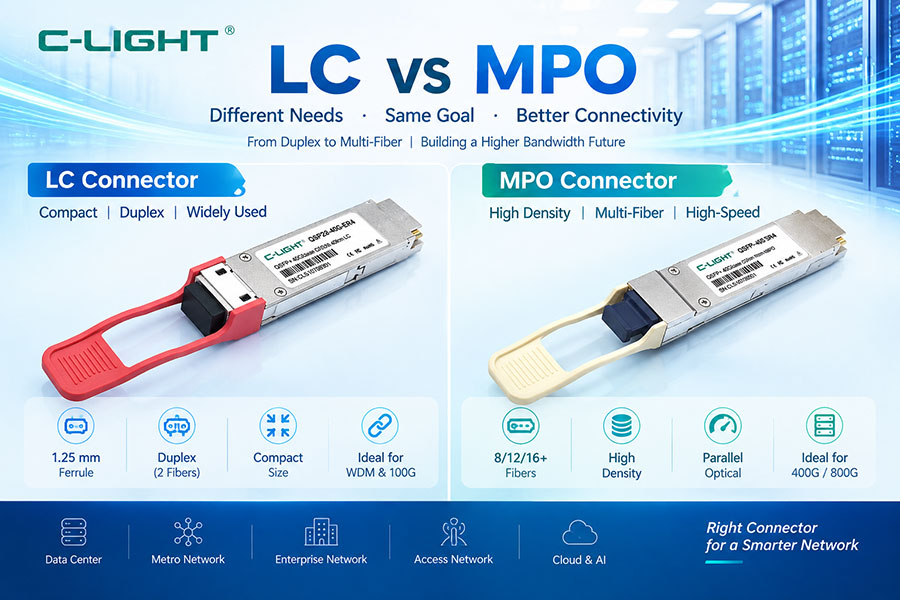
32. LC with OM4 and OM5
LC duplex connectors can be used with both OM4 and OM5 fiber.
They are common in duplex multimode systems and multi-wavelength optical architectures that use two-fiber connectivity.
33. MPO with OM4 and OM5
MPO-family connectors can also be used with both OM4 and OM5.
They are particularly useful for parallel optical systems where multiple fibers are required to carry separate optical lanes.
34. OM4 and OM5 Interchangeability
OM5 is physically compatible with OM4 infrastructure in many applications because both use a 50/125 µm multimode structure.
However, system compatibility depends on the optical transceiver and wavelength architecture. Simply replacing an OM4 cable with OM5 does not change the operating characteristics of a transceiver that uses only 850 nm transmission.
35. Can OM5 Replace OM4?
OM5 can generally support applications that use OM4-class 850 nm performance.
However, the higher purchase cost of OM5 may not provide a practical benefit when the network only uses conventional single-wavelength 850 nm transmission.
36. Can OM4 Replace OM5?
OM4 may work in some short-wavelength multi-wavelength systems, but OM5 provides additional specified performance at 953 nm and is specifically designed for wideband multimode applications.
Therefore, OM4 should not automatically be substituted for OM5 when the transceiver requires the additional wideband fiber characteristics.
37. OM4 vs OM5 Cost
OM5 is generally positioned as a premium multimode fiber compared with OM4.
The additional cost is primarily associated with its wideband characteristics and manufacturing requirements. The economic benefit depends on whether the network actually uses multi-wavelength transmission.
38. When OM5 Provides More Value
OM5 can provide more value when a network uses or is specifically designed for short-wavelength WDM and the additional wavelength coverage can reduce fiber count or simplify the optical architecture.
In a conventional 850 nm-only system, the difference between OM4 and OM5 is much smaller from a bandwidth perspective.
39. When OM4 Is Sufficient
OM4 can be sufficient for many conventional 850 nm multimode applications.
It provides 4700 MHz·km minimum EMB at 850 nm and supports a wide range of high-speed data center optical systems when the required link distance is within the supported range.
40. OM4 vs OM5 for Data Centers
| Application | OM4 | OM5 |
|---|---|---|
| 850 nm parallel optics | Highly suitable | Suitable |
| 10GBASE-SR | Suitable | Suitable |
| 40G/100G conventional SR | Suitable | Suitable |
| SWDM | Possible depending on system | Strong fit |
| Multi-wavelength MMF | Limited compared with OM5 | Designed for this use |
| 850 nm EMB | ≥4700 MHz·km | ≥4700 MHz·km |
| 953 nm EMB | Not specified | ≥2470 MHz·km |
41. OM4 vs OM5 for AI Data Centers
AI data centers increasingly use high-density optical interconnects where fiber count, port density, power, and cabling complexity matter.
OM4 remains suitable for many short-reach 850 nm parallel optical systems. OM5 can provide additional options where wideband multimode WDM is part of the architecture.
42. Fiber Count and Network Architecture
The choice between OM4 and OM5 can influence fiber count when the optical system uses wavelength multiplexing.
A parallel architecture may require several fibers for separate lanes, while a multi-wavelength architecture can place multiple channels on fewer fibers.
43. OM4 vs OM5 and Future Upgrades
Future upgrades should be considered when selecting new multimode infrastructure.
OM4 offers strong support for conventional 850 nm high-speed optics. OM5 adds flexibility for multi-wavelength short-wave architectures, but this flexibility is useful only when supported by the optical transceiver roadmap.
44. Common OM4 and OM5 Selection Mistakes
One common mistake is assuming that OM5 is simply a faster version of OM4.
Another is assuming that OM5 automatically increases reach for every 850 nm transceiver. Since OM4 and OM5 have the same minimum EMB at 850 nm, the difference can be minimal for conventional single-wavelength 850 nm systems.
A third mistake is selecting fiber without checking the optical wavelength plan and transceiver architecture.
45. How to Choose OM4 or OM5
Choose OM4 when the network primarily uses conventional 850 nm multimode optics and the supported reach meets the application requirements.
Consider OM5 when the network is designed for multi-wavelength short-wave transmission, such as SWDM, and the additional wideband characteristics provide a practical system benefit.
46. OM4 vs OM5 Performance Comparison
| Parameter | OM4 | OM5 |
|---|---|---|
| Fiber type | Laser-optimized multimode | Wideband laser-optimized multimode |
| Core diameter | 50 µm | 50 µm |
| Cladding diameter | 125 µm | 125 µm |
| 850 nm EMB | ≥4700 MHz·km | ≥4700 MHz·km |
| 953 nm EMB | Not specified | ≥2470 MHz·km |
| Typical wavelength | 850 nm | 850–953 nm |
| Typical source | VCSEL | VCSEL |
| Conventional 850 nm optics | Excellent fit | Excellent fit |
| Short-wavelength WDM | Possible | Strong fit |
| Typical infrastructure cost | Lower | Higher |
47. OM4 vs OM5: What Really Changes?
OM5 does not fundamentally change the 50 µm multimode fiber structure. Its main difference is the additional wideband optical specification.
In practical terms, OM4 is optimized for conventional high-speed multimode transmission, while OM5 adds a defined operating window for multiple short wavelengths.
48. OM4 vs OM5 and Optical Transceivers
The optical transceiver should always be checked before choosing the fiber.
Important parameters include wavelength, number of optical channels, modulation, maximum supported distance, connector, optical power budget, and whether the transceiver uses conventional parallel transmission or wavelength multiplexing.
49. OM4 vs OM5 Selection Guide
| Requirement | OM4 | OM5 |
|---|---|---|
| Standard 850 nm MMF | Highly suitable | Suitable |
| High-speed short-reach data center | Highly suitable | Highly suitable |
| Parallel VCSEL optics | Highly suitable | Suitable |
| SWDM | Possible | Designed for wideband use |
| Multiple short wavelengths | Less specialized | Strong fit |
| Cost-sensitive deployment | Generally favorable | Higher cost |
| Existing OM4 infrastructure | Native | Generally compatible in many applications |
50. Conclusion
OM4 and OM5 are both 50/125 µm multimode fibers, but their main difference is the scope of their optical bandwidth specifications. OM4 provides at least 4700 MHz·km effective modal bandwidth at 850 nm, while OM5 provides the same minimum EMB at 850 nm and additionally specifies at least 2470 MHz·km at 953 nm.
This means OM5 is not simply a higher-speed version of OM4. Its primary advantage is support for wideband multimode transmission and short-wavelength WDM architectures such as SWDM. For conventional 850 nm parallel optics, OM4 and OM5 have the same minimum EMB requirement.
OM4 remains a practical choice for many established 850 nm data center networks. OM5 becomes more relevant when multi-wavelength multimode transmission is part of the network architecture and the additional wavelength coverage provides a real deployment benefit.
Before selecting either fiber, verify the optical transceiver, wavelength plan, data rate, transmission distance, connector, fiber count, optical budget, and future upgrade requirements. The fiber category should always be matched to the actual optical system rather than selected based on the OM number alone.
 >
>

 >
>
 >
>
 >
>
 >
>
 >
>
 >
>
 >
>