TEL:+86 132 6656 7067





Active Optical Cables (AOCs) are widely used in data centers, high-performance computing environments, and AI infrastructure to provide high-speed connections between switches, servers, storage systems, and GPU clusters. By using optical fiber instead of copper conductors, AOCs support longer transmission distances while maintaining high bandwidth and low electromagnetic interference.
But how far can an AOC cable actually reach? The answer depends on its data rate, optical technology, fiber type, and product design. Many data center AOCs support distances up to 100 meters, while some specialized products offer longer reaches of several hundred meters.
Unlike DAC cables, whose reach is primarily limited by electrical signal loss, AOC reach is determined by the optical link budget, fiber characteristics, transmitter and receiver performance, and the specifications of the complete cable assembly.
1. What Is the Maximum Reach of an AOC Cable?
There is no universal maximum reach for all AOC cables. Different generations and data rates have different optical requirements, and manufacturers may offer multiple reach options for the same interface.
For mainstream data center applications, 100 meters is a common reach specification for multimode-fiber AOCs. However, selected lower-speed products and specialized optical cable designs can support 300 meters, 400 meters, or even longer distances.
The following table provides representative product-level reach examples. These figures are not universal limits or guaranteed distances for every AOC.
| Data Rate | Common AOC Reach Examples | Typical Application |
|---|---|---|
| 10G | 100m–400m, depending on product | Server and switch connections |
| 25G | Up to 100m in selected products | Server access and data center networking |
| 40G | Up to 150m in selected products | Switch-to-switch connections |
| 100G | 100m is common; some products support 300m | Data center and HPC networks |
| 200G | Up to 100m in selected products | High-speed data center interconnects |
| 400G | Up to 100m in selected products | AI clusters and high-performance networks |
| 800G | 50m–100m in selected products | AI and next-generation data centers |
| 1.6T | Product-specific; specialized designs may offer longer reach | Next-generation AI and HPC infrastructure |
For example, manufacturers list 400G AOC products supporting up to 100 meters over OM4 or OM5 multimode fiber. Some 800G products support up to 100 meters, while other 800G designs specify shorter distances depending on the fiber and optical implementation.
Some manufacturers also advertise specialized 800G and 1.6T AOC or hybrid AOC products with reaches of up to 500 meters. These are specific product implementations and should not be interpreted as the standard reach of every 800G or 1.6T AOC.
2. What Determines the Maximum Reach of an AOC Cable?
The maximum transmission distance of an AOC depends on several optical and electrical characteristics. Although the cable uses fiber for signal transmission, its integrated optical engines and electrical interfaces also affect overall performance.
2.1 Fiber Type
Multimode fiber (MMF) is widely used in short-reach AOC applications. OM3, OM4, and OM5 are common multimode fiber categories, each with different bandwidth and transmission characteristics.
In general, OM4 and OM5 provide higher modal bandwidth than OM3 at 850nm, making them suitable for many high-speed short-reach optical connections.
However, using a higher-grade fiber does not automatically increase the reach of every AOC. The transmitter, receiver, optical modulation, and complete link specification must also support the target distance.
2.2 Optical Transmitter and Receiver
AOC cables integrate optical transmitters and receivers into their connector housings. The transmitter converts electrical signals into optical signals, while the receiver converts incoming optical signals back into electrical signals.
Important parameters include transmitter output power, receiver sensitivity, extinction ratio, and optical penalties. These parameters determine whether the optical signal maintains sufficient margin after traveling through the fiber.
2.3 Data Rate and Modulation Format
Higher data rates generally require more demanding optical performance. As lane speeds increase, the transmitter and receiver must maintain signal integrity at higher signaling rates.
Modern high-speed AOCs commonly use PAM4 modulation, which transmits two bits per symbol using four optical signal levels. PAM4 supports higher data rates but has smaller signal-level separation than NRZ, making optical performance and signal margins especially important.
For this reason, an 800G AOC does not necessarily support the same distance as a 400G AOC, even when both use multimode fiber.
2.4 Optical Link Budget
The optical link budget describes the available margin between the transmitter's optical output and the receiver's minimum required input power.
Fiber attenuation, connector losses, splices, bending, and other optical penalties reduce the available margin. If the received optical power falls below the receiver's required level, reliable communication cannot be maintained.
In an integrated AOC assembly, the manufacturer validates the optical components and fiber together. Therefore, the specified cable reach should be treated as a complete product rating rather than calculated from fiber attenuation alone.
3. How Does Fiber Type Affect AOC Reach?
Fiber type is an important factor when selecting an AOC cable. Multimode fiber is commonly used for data center AOCs because it supports short-reach, high-bandwidth optical transmission with compact VCSEL-based optical engines.
| Fiber Type | Typical Characteristics | AOC Considerations |
|---|---|---|
| OM3 | 50/125 μm multimode fiber | Supports many short-reach optical applications |
| OM4 | 50/125 μm multimode fiber with higher modal bandwidth than OM3 | Common choice for higher-speed data center links |
| OM5 | Wideband multimode fiber | Supports wideband applications; compatibility depends on the optical interface |
| Single-mode fiber | Small core and single-mode transmission | Used in specific optical cable architectures and longer-reach applications |
Many conventional AOCs use 850nm VCSEL transmitters and multimode fiber. However, not every AOC uses the same wavelength or fiber architecture. The optical interface must be checked before connecting an AOC to other optical equipment.
4. Can an AOC Cable Reach 300 Meters or 500 Meters?
Yes, some AOC products support distances beyond 100 meters, but the supported reach depends on the data rate and optical design.
4.1 AOC Cables Supporting 300 Meters
Selected 10G and 100G AOC products are available with reach specifications of up to 300 meters. These products are designed around optical components and fiber configurations that support the specified distance.
However, a 300-meter rating for a particular 100G AOC should not be assumed to apply to every 100G product. Different optical interfaces can have different transmission limits.
4.2 AOC Cables Supporting 500 Meters
Some specialized 800G and 1.6T AOC or hybrid AOC products are advertised with reaches of up to 500 meters. Such products may use optical architectures different from conventional short-reach multimode AOCs.
Before specifying a 500-meter AOC, verify the exact fiber type, optical interface, connector configuration, supported data rate, and equipment compatibility. The advertised reach must apply to the complete cable assembly, not simply to the fiber category.
5. AOC vs DAC vs AEC: Which Supports Longer Distances?
AOC, DAC, and AEC are all used for high-speed device interconnection, but they use different transmission media and signal-processing architectures.
| Cable Type | Transmission Medium | Signal Architecture | Typical Reach Characteristics |
|---|---|---|---|
| Passive DAC | Copper | Direct electrical transmission | Usually a few meters or less for high-speed links |
| Active DAC / ACC | Copper | Redriver or linear signal conditioning | Longer than comparable passive DAC designs |
| AEC | Copper | Retimer-based signal recovery and regeneration | Extended copper reach within product-specific limits |
| AOC | Optical fiber | Electrical-to-optical and optical-to-electrical conversion | Typically tens to hundreds of meters, depending on the product |
For short connections within a rack, passive DAC is often the most economical choice. Active copper technologies can extend copper reach when additional signal conditioning is required.
AOC is generally more suitable when the connection distance exceeds practical copper limits or when lower cable weight and electromagnetic isolation are important.
For more information, see the related C-LIGHT articles:
6. Why Are AOC Cables Used in 400G and 800G Data Centers?
As data center networks evolve toward 400G and 800G connectivity, the need for high-bandwidth connections between switches, servers, and AI computing systems continues to increase.
AOCs provide several advantages for these environments:
High bandwidth: AOCs support high-speed optical connections for modern Ethernet and InfiniBand networks.
Longer reach than copper: Optical transmission supports connections beyond the practical reach of many high-speed DAC configurations.
Low electromagnetic interference: Fiber transmission is not affected by electromagnetic interference in the same way as electrical copper links.
Lower cable weight: Fiber-based assemblies can simplify cable routing in dense racks.
Integrated optical interfaces: The optical engines are factory-integrated into the cable ends, eliminating the need to select and install separate optical transceivers and patch cables.
For AI and high-performance computing clusters, AOCs can connect network switches, GPU servers, and other high-bandwidth devices where the required distance and system architecture are compatible with the selected cable.
7. AOC vs Optical Transceiver and Fiber Patch Cable
An AOC and a conventional optical transceiver connection both use optical fiber, but their deployment methods are different.
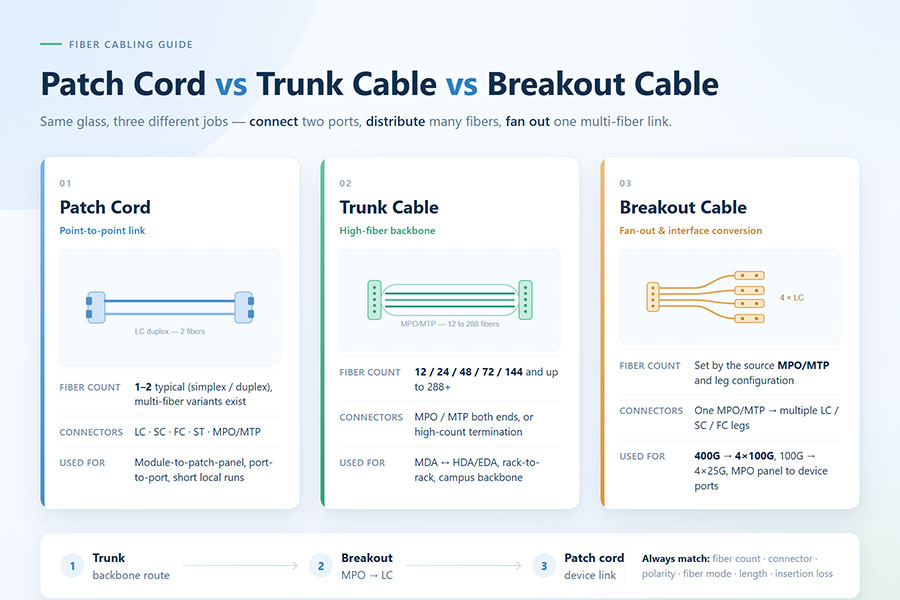
An AOC integrates optical transceivers and fiber into one cable assembly. It has fixed optical interfaces at both ends and is generally supplied in a predefined length.
A conventional optical connection uses separate optical transceivers installed in network devices and a fiber patch cable between them. This approach offers more flexibility in choosing fiber type, cable length, and optical reach.
| Feature | AOC | Optical Transceiver + Fiber |
|---|---|---|
| Construction | Integrated optical engines and fiber | Separate transceivers and fiber cable |
| Installation | Plug-and-play cable assembly | Requires compatible transceivers and fiber connections |
| Length flexibility | Available in predefined or customized lengths | More flexible through separate fiber cabling |
| Maintenance | Entire assembly may need replacement if one end fails | Transceivers and fiber cables can be replaced independently |
| Typical use | Direct device-to-device connections | Flexible network cabling and structured fiber infrastructure |
AOC is convenient for direct connections where the required cable length is known. Separate optical transceivers and fiber patch cables are often preferable when network layouts require different fiber routes, longer distances, or independent component replacement.
8. How to Choose the Right AOC Cable Length
Selecting an AOC requires more than matching the data rate and connector. The complete optical and electrical interface must be compatible with both connected devices.
8.1 Confirm the Data Rate and Form Factor
Identify the required data rate and connector type, such as SFP28, QSFP28, QSFP56, QSFP-DD, or OSFP. Also verify whether the cable supports the required Ethernet or InfiniBand application.
8.2 Select the Required Reach
Measure the actual cable route between devices, including rack routing and cable-management requirements. Choose a cable length that provides sufficient installation flexibility without unnecessary excess cable.
8.3 Check Fiber and Optical Specifications
Verify the fiber type, wavelength, optical interface, and specified maximum reach. Do not assume that two AOCs with the same data rate and connector have identical optical characteristics.
8.4 Verify Host Compatibility
Check the switch or server manufacturer's compatibility requirements. Confirm that the device supports the cable's power consumption, management interface, coding, and operating parameters.
8.5 Consider Future Network Expansion
For large data center deployments, consider the expected network layout and future bandwidth requirements. If connections may need to extend beyond the reach of an AOC, a separate optical transceiver and fiber infrastructure may provide greater flexibility.
9. Conclusion
The maximum reach of an AOC cable depends on its data rate, fiber type, optical components, and complete link design. Many mainstream data center AOCs support up to 100 meters, while selected 10G and 100G products can reach 300 meters or more. Specialized high-speed AOC and hybrid AOC designs may offer even longer distances, but these are product-specific capabilities.
For 400G, 800G, and 1.6T networks, the exact optical architecture and manufacturer specifications are especially important. A higher data rate does not automatically mean a longer or shorter reach; the complete optical design determines the supported distance.
When choosing an AOC, verify the data rate, fiber type, reach, connector, and host compatibility. For applications requiring greater flexibility or distances beyond the AOC specification, separate optical transceivers and fiber patch cables may be a better solution.
Frequently Asked Questions
Q1: What is the maximum reach of an AOC cable?
There is no universal maximum. Many data center AOCs support up to 100 meters, while selected products support 300 meters, 400 meters, or longer distances.
Q2: Can an AOC cable reach 100 meters?
Yes. A 100-meter reach is common for many 100G, 200G, 400G, and selected 800G AOC products, depending on their optical specifications.
Q3: Can an AOC cable reach 300 meters?
Yes. Some 10G and 100G AOC products support up to 300 meters. The supported distance depends on the optical architecture and product specification.
Q4: Can an 800G AOC reach 100 meters?
Some 800G AOC products support up to 100 meters, while others specify shorter reaches. Check the exact product data sheet and fiber requirements.
Q5: Can a 1.6T AOC reach 500 meters?
Some specialized 1.6T AOC or hybrid AOC products are advertised with reaches up to 500 meters. This is not a universal 1.6T AOC specification.
Q6: Does OM4 fiber support longer AOC distances than OM3?
OM4 provides higher modal bandwidth than OM3 at 850nm and can support longer reach in compatible optical applications. Actual AOC reach still depends on the complete optical design.
Q7: Is AOC better than DAC for long-distance connections?
AOC is generally more suitable when the required distance exceeds practical high-speed copper limits. DAC remains attractive for short connections because of its low cost and simple architecture.
Q8: Does AOC require separate optical transceivers?
No. AOC integrates optical transmitters and receivers into both cable ends, so separate optical transceivers are not required.
Q9: Can an AOC connect devices from different manufacturers?
It can, provided both devices support the AOC's form factor, electrical interface, data rate, management requirements, and compatibility profile.
Q10: When should I use optical transceivers instead of AOC?
Separate optical transceivers and fiber patch cables are useful when the network requires flexible fiber routing, different optical reaches, or independent replacement of transceivers and cables.
 >

 >
 >
 >
 >
 >
 >
 >