TEL:+86 132 6656 7067




Long-distance AI data center interconnect connects geographically separated GPU clusters, data centers, and computing facilities using high-capacity optical networking. As AI workloads scale across sites, 400G, 800G, 1.6T, coherent optics, DWDM, and advanced optical transport technologies are becoming increasingly important for high-bandwidth, low-latency, and reliable inter-site connectivity.
1. What Is Long-Distance AI Data Center Interconnect?
Long-distance AI data center interconnect, or AI DCI, refers to the optical and networking infrastructure used to connect AI computing resources across separate data centers or geographically distributed sites.
Unlike conventional intra-data-center connections, long-distance DCI must operate across much longer fiber paths and deal with greater attenuation, dispersion, optical noise, and network complexity.
2. Why AI Data Centers Need Long-Distance Interconnects
AI infrastructure increasingly requires enormous compute capacity. A single facility may not always provide sufficient power, cooling, land, or network capacity, which can lead operators to distribute AI workloads across multiple sites.
These distributed architectures require high-capacity connections between facilities so that computing, storage, model serving, and other resources can operate as part of a coordinated infrastructure.
3. AI Scale-Across Data Centers
Traditional AI networking focuses primarily on communication inside one data center. Scale-across architectures extend this model between physically separated facilities.
Long-distance optical interconnect becomes the key transport layer when GPUs, storage systems, and network fabrics are distributed across multiple locations.
4. Long-Distance DCI vs Intra-Data-Center Connectivity
| Feature | Intra-Data-Center | Long-Distance DCI |
|---|---|---|
| Typical environment | Rack, row, or building | Multiple facilities |
| Transmission medium | DAC, AOC, multimode or single-mode fiber | Primarily single-mode optical fiber |
| Typical technology | 400G/800G PAM4 | 400ZR, 400ZR+, 800ZR, 800ZR+, coherent optics |
| Main challenge | Density and thermal performance | Reach, loss, OSNR, dispersion, and reliability |
5. Main Technologies for Long-Distance AI DCI
Long-distance AI interconnect can use several optical technologies depending on reach and network architecture. Key technologies include coherent pluggable optics, DWDM, ROADM, optical amplification, 400ZR, 400ZR+, 800ZR, and emerging 1.6T coherent solutions.
6. Why Coherent Optics Matter for Long-Distance AI DCI
Coherent optical technology is designed for long-distance transmission and provides sophisticated digital signal processing to compensate for channel impairments.
Compared with conventional direct-detection data center optics, coherent systems can provide substantially greater tolerance to dispersion, optical loss, polarization effects, and optical noise.
7. 400ZR for AI Data Center Interconnect
400ZR is a major coherent technology for high-capacity DCI. It was designed around 400Gbps-class transmission in a compact pluggable architecture and is particularly suitable for data center interconnection.
400ZR allows optical transport capabilities to be integrated directly into compatible routers and switches instead of requiring a separate dedicated transponder for every connection.
8. 400ZR+ for Longer DCI
400ZR+ extends the concept toward more demanding optical links. Depending on implementation, it can provide additional reach or operating flexibility compared with standard 400ZR.
Actual performance depends on modulation, baud rate, transmit power, DSP, FEC, fiber loss, amplification, and the optical line system.
9. 800ZR for AI DCI
As AI traffic increases, 400G wavelengths can become insufficient for some large-scale DCI applications. 800ZR increases per-wavelength capacity and can reduce the number of optical channels required to transport the same aggregate bandwidth.
This is especially relevant when multiple AI facilities need to exchange large volumes of distributed computing traffic.
10. 800ZR+ for Extended Reach
800ZR+ provides another step toward longer and more demanding DCI links. Its usefulness becomes greater when the fiber path includes more loss, optical amplification, ROADMs, or other transport elements.
The exact reach is not universal and should be engineered based on the complete optical path.
11. 1.6T Coherent DCI
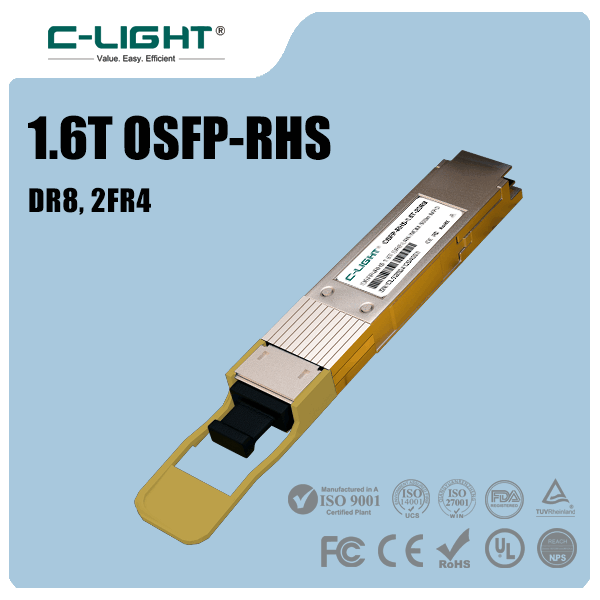
1.6T coherent optics are emerging as a higher-capacity solution for future DCI networks. Higher per-channel capacity can increase fiber utilization and reduce the number of optical interfaces needed for very large AI networks.
At the same time, 1.6T introduces more demanding requirements for baud rate, coherent DSP, optical engines, thermal design, and host electrical interfaces.
12. PAM4 vs Coherent Transmission
| Technology | Typical Application | Reach |
|---|---|---|
| PAM4 direct detection | Intra-data-center and short-reach links | Short to moderate |
| 400ZR | Metro and DCI | Longer DCI reach |
| 400ZR+ | Extended DCI | Beyond standard ZR use cases |
| 800ZR/800ZR+ | High-capacity AI DCI | Metro and regional applications |
13. DWDM for Long-Distance AI DCI
Dense Wavelength Division Multiplexing allows multiple optical channels to share the same fiber pair. Instead of using one fiber pair for each connection, multiple wavelengths can be multiplexed onto the same infrastructure.
DWDM is therefore fundamental to high-capacity DCI when the amount of traffic exceeds what a single optical wavelength can provide.
14. Why DWDM Increases DCI Capacity
Suppose a fiber system carries multiple 400G coherent channels. The aggregate capacity can reach several terabits per second without requiring a separate fiber pair for every wavelength.
This makes DWDM particularly valuable for large AI facilities where traffic between sites can grow rapidly.
15. ROADM in AI DCI Networks
Reconfigurable Optical Add-Drop Multiplexers, or ROADMs, allow wavelengths to be added, dropped, or routed through an optical network without manually rebuilding the fiber path.
ROADM technology becomes increasingly useful when AI DCI networks contain multiple facilities and diverse optical routes rather than simple point-to-point links.
16. Optical Amplification
Long fiber spans introduce optical loss that eventually becomes too large for direct transmission. Optical amplifiers such as EDFA-based systems can restore optical signal power without converting the signal to the electrical domain.
Amplification allows multiple fiber spans to be connected into longer optical paths, although amplifier noise and power limits must also be considered.
17. Fiber Loss in Long-Distance DCI
Fiber attenuation is one of the most fundamental limitations in long-distance optical networking. Every kilometer consumes part of the available optical power budget.
Connector loss, splice loss, patch panels, ROADM insertion loss, and other passive components add additional loss to the link.
18. Optical Link Budget
A DCI link budget compares the optical power available from the transmitter with the minimum power required by the receiver after accounting for all losses and penalties.
A robust design should also include engineering margin so that the link remains reliable when fiber conditions, temperature, connectors, or equipment characteristics change over time.
19. OSNR in Long-Distance AI DCI
Optical Signal-to-Noise Ratio, or OSNR, becomes increasingly important as optical signals pass through amplifiers and other transmission elements.
Amplifiers increase signal power but also introduce noise. As the number of optical spans increases, the available OSNR margin can become a key limitation for high-capacity coherent transmission.
20. Chromatic Dispersion
Chromatic dispersion causes different optical frequency components to propagate at different velocities through the fiber.
Over long distances, this can significantly distort high-speed signals. Coherent DSP can digitally compensate for dispersion, which is one reason coherent technology is well suited to long-distance DCI.
21. Polarization Effects
Long fiber paths can cause polarization rotation and polarization-mode dispersion. Coherent receivers can track polarization changes and use digital processing to recover the transmitted data.
22. Nonlinear Optical Effects
At high optical powers and over long distances, nonlinear effects can become important. These effects can interact with DWDM channels and reduce overall transmission performance.
Long-distance DCI must therefore balance launch power against OSNR, nonlinear penalties, amplifier configuration, and channel count.
23. Coherent DSP in AI DCI
The coherent DSP is responsible for much of the digital processing required to recover a long-distance optical signal. Depending on the architecture, it can perform equalization, carrier recovery, polarization processing, FEC, and other signal-processing functions.
Higher-capacity coherent generations require more advanced DSP architectures while also placing increasing pressure on power consumption.
24. FEC in Long-Distance AI DCI
Forward Error Correction adds controlled redundancy that allows the receiver to correct transmission errors. FEC can improve the effective operating margin of a coherent link and is an important part of modern high-capacity optical transmission.
FEC should be evaluated together with modulation format, baud rate, optical power, OSNR, and target distance.
25. Power Consumption Challenge
Power efficiency becomes increasingly important as AI data centers deploy large numbers of high-capacity optical ports. Long-distance coherent modules can consume significantly more power than short-reach direct-detection modules because of their advanced DSP and optical processing.
Reducing power per transmitted bit is therefore one of the main objectives of next-generation coherent technology.
26. Thermal Management
High-power optical modules generate heat inside routers, switches, and optical platforms. In dense AI systems, thermal limits can restrict the number of coherent ports that can operate simultaneously.
Form factor, optical engine architecture, DSP process technology, heat sinks, airflow, and host chassis design all influence thermal performance.
27. Coherent Pluggables for DCI
Coherent pluggables combine the functions of a coherent optical system into a replaceable module. This architecture allows high-capacity optical interfaces to be installed directly into compatible routers, switches, and optical platforms.
It is one of the main reasons coherent technology has become increasingly attractive for modern DCI.
28. IP-over-DWDM for AI DCI
IP-over-DWDM integrates optical transport more directly into the IP networking layer. A router can use a coherent pluggable to create a DWDM optical channel without requiring a separate transponder at every endpoint.
This can simplify the network architecture and reduce equipment footprint in suitable deployments.
29. Router-to-Router AI DCI
A typical DCI architecture can connect routers at two geographically separated sites using coherent pluggables and a DWDM optical line system.
The router handles packet forwarding while the coherent module provides the high-capacity optical interface.
30. Switch-to-Switch AI DCI
High-capacity Ethernet switches are increasingly becoming important parts of AI infrastructure. Where the switch supports coherent pluggables, long-distance optical connectivity can be integrated directly into the switching layer.
31. AI Training Across Multiple Data Centers
Distributed AI training can require high-speed communication between compute resources at different locations. The practical feasibility of such architectures depends not only on bandwidth but also on latency, synchronization requirements, network reliability, and application architecture.
32. Latency in Long-Distance AI DCI
Propagation delay increases with physical distance. Optical technology cannot eliminate the fundamental delay introduced by the fiber path.
As a result, long-distance AI architectures should carefully separate traffic that requires extremely low latency from workloads that can tolerate additional geographic distance.
33. Why Distance Matters for Distributed AI
Some AI workloads require frequent synchronization between computing nodes. Increasing the physical distance between these nodes increases round-trip latency and may reduce application efficiency.
For this reason, scale-across AI architectures generally require careful workload placement and network optimization.
34. Fiber Route Diversity
AI data centers depend on network availability for critical workloads. Long-distance DCI should therefore consider route diversity and protection instead of relying on a single physical fiber path.
Diverse optical routes can reduce the impact of fiber cuts, construction damage, equipment failures, and other physical network disruptions.
35. Network Protection
Protection architectures can use redundant optical paths, diverse fiber routes, backup wavelengths, or higher-layer networking mechanisms.
The correct approach depends on whether the DCI is designed for active-active operation, standby protection, or application-level resilience.
36. Long-Distance DCI and Reliability
Reliability must be evaluated across the complete optical system. A high-performance module cannot compensate for a poorly engineered fiber route, unstable amplifier chain, excessive connector loss, or insufficient system margin.
37. Monitoring Long-Distance AI DCI
Operational monitoring can include optical power, OSNR-related metrics, module temperature, optical alarms, FEC statistics, link errors, and traffic behavior.
Continuous monitoring allows operators to identify gradual optical degradation before it becomes a complete service outage.
38. Coherent Pluggable Diagnostics
Modern coherent modules can provide management information through the host interface. Diagnostic data can help operators monitor module temperature, optical parameters, power consumption, alarms, and operating status.
39. 400G vs 800G Long-Distance DCI
| Feature | 400G Coherent | 800G Coherent |
|---|---|---|
| Capacity per channel | 400G class | 800G class |
| Maturity | Established DCI technology | Next-generation DCI |
| Port density | High | Higher capacity per port |
| Power challenge | Significant | More demanding |
| AI DCI role | Current high-capacity DCI | Higher-bandwidth AI DCI |
40. Why 800G Matters for AI DCI
AI traffic growth can increase the amount of bandwidth required between facilities much faster than conventional enterprise traffic. Moving from 400G to 800G can increase the capacity carried by each optical channel and help scale inter-site links more efficiently.
41. 1.6T and Future AI DCI Capacity
1.6T optical technologies are being developed to continue increasing the bandwidth carried by a single optical interface. The main engineering challenge is achieving this higher capacity while keeping power consumption, optical performance, and host compatibility within practical limits.
42. Coherent Pluggables vs Dedicated Transport Equipment
Dedicated transport equipment can provide extensive optical network functionality, while coherent pluggables integrate much of the optical transmission capability directly into the host device.
Pluggables can provide a simpler and more modular architecture for DCI when the router or switch and optical line system support the required operating model.
43. AI DCI and Optical Line Systems
A coherent module should not be evaluated independently from the optical line system. WDM filters, ROADMs, amplifiers, connectors, fiber spans, and other components contribute to the total channel impairment.
Successful DCI engineering therefore requires system-level validation.
44. Open and Interoperable DCI
Interoperability is particularly important when routers, coherent modules, and optical line systems come from different vendors.
Standardized interfaces such as 400ZR help create more interoperable optical ecosystems, while extended coherent implementations may require more detailed validation.
45. Multi-Vendor AI DCI
A large AI deployment may use switches from one vendor, coherent modules from another, and DWDM equipment from a third. Compatibility must be evaluated at the electrical, optical, management, and network levels.
46. What Determines Long-Distance AI DCI Reach?
Reach depends on a combination of:
Fiber loss: Total attenuation of the optical path.
OSNR: Available optical signal quality after transmission and amplification.
Dispersion: Chromatic and polarization-related impairments.
FEC: Error-correction capability.
Modulation: Coherent modulation format and baud rate.
Optical power: Launch power and receiver capability.
Line system: ROADM, amplifier, and WDM characteristics.
Engineering margin: Additional allowance for real-world variation.
47. How to Design a Long-Distance AI DCI Link
Start with the required traffic capacity and target distance. Then determine the optical technology, number of wavelengths, fiber route, optical line system, amplification requirements, and acceptable latency.
Finally, validate the link budget, OSNR, interoperability, power consumption, thermal conditions, and redundancy strategy.
48. Example Long-Distance AI DCI Architecture
A representative architecture can be structured as:
AI Data Center A → Router/Switch → Coherent Pluggable → DWDM MUX → Optical Amplifier/ROADM → Fiber Route → ROADM/Amplifier → DWDM DEMUX → Coherent Pluggable → Router/Switch → AI Data Center B
The exact number of amplifiers, ROADMs, and intermediate spans depends on the geographic route and optical engineering requirements.
49. Short DCI vs Long DCI Technology Selection
| Link Type | Preferred Technology |
|---|---|
| Within rack | DAC |
| Within data center | AOC or PAM4 optical transceivers |
| Short DCI | 400G/800G optical or coherent solutions depending reach |
| Metro DCI | 400ZR/ZR+ and 800ZR/ZR+ |
| Regional DCI | Higher-performance coherent transport |
50. Power Efficiency vs Reach
There is usually a trade-off between reach, optical performance, and power consumption. More sophisticated coherent processing can extend transmission capability but requires additional electronic and optical resources.
AI DCI operators therefore need to select the lowest-complexity solution that can reliably meet the required reach and capacity.
51. Cost Efficiency of Long-Distance AI DCI
DCI economics should be evaluated at the system level. The total cost can include coherent modules, routers, switches, DWDM equipment, amplifiers, ROADMs, fiber leasing, power consumption, and maintenance.
Higher-capacity wavelengths can reduce the number of channels needed for a given traffic volume and may improve the cost per transmitted bit.
52. Fiber Utilization
When AI traffic grows rapidly, existing fiber routes can become a valuable infrastructure asset. Higher-capacity coherent channels and DWDM allow more traffic to be transported over existing fiber pairs.
53. Long-Distance AI DCI and Network Scaling
Scaling from one DCI connection to dozens or hundreds changes the engineering problem significantly. Operators must consider wavelength planning, optical spectrum, route diversity, port density, power consumption, monitoring, and operational automation.
54. Automation and DCI Operations
Large optical networks benefit from automated provisioning and monitoring. Automated systems can track module state, optical parameters, alarms, traffic load, and available optical capacity.
This becomes increasingly valuable as AI DCI networks grow from a small number of links to large multi-site optical fabrics.
55. Reliability During Capacity Upgrades
Capacity upgrades should not compromise existing services. Operators may deploy additional wavelengths, upgrade 400G interfaces to 800G, or migrate to higher-capacity coherent modules while maintaining existing optical routes.
Careful interoperability and optical margin testing are necessary during each upgrade stage.
56. Future Long-Distance AI DCI
The future of AI DCI is likely to combine higher-capacity coherent optics, improved DSPs, more efficient optical engines, DWDM, advanced line systems, and intelligent network management.
As AI clusters become more geographically distributed, optical networking will play an increasingly important role in connecting computing resources across facilities.
57. 400G, 800G and 1.6T DCI Evolution
The evolution can be broadly viewed as a move from 400G-class coherent DCI toward 800G and eventually 1.6T-class optical interfaces. Each generation seeks to transport more data per wavelength or interface while reducing the power and cost per bit.
58. Key Challenges for Long-Distance AI DCI
The main challenges include optical loss, OSNR degradation, nonlinear effects, higher DSP power, thermal density, fiber availability, route diversity, interoperability, and the latency introduced by geographic distance.
59. Long-Distance AI DCI Selection Checklist
| Item | What to Check |
|---|---|
| Capacity | 400G, 800G, 1.6T or required aggregate bandwidth |
| Distance | Actual fiber route length |
| Fiber | Fiber type and total attenuation |
| Line system | DWDM, ROADM, amplifiers, filters |
| Optical margin | Power, OSNR, dispersion, and engineering margin |
| Latency | Application tolerance for geographic delay |
| Reliability | Route diversity and protection |
| Compatibility | Host, module, line-system, and management interoperability |
60. Conclusion
Long-distance AI data center interconnect is becoming an important part of distributed AI infrastructure. As GPU capacity expands across multiple facilities, conventional short-reach data center optics are not sufficient for every connection.
Coherent pluggable optics, 400ZR, 400ZR+, 800ZR, 800ZR+, 1.6T coherent technologies, DWDM, ROADMs, and optical amplification provide the foundation for high-capacity inter-site connectivity.
The most effective DCI architecture is determined by the complete combination of bandwidth, fiber distance, optical loss, OSNR, latency, power, thermal constraints, interoperability, and network resilience.
 >
>

 >
>
 >
>
 >
>
 >
>
 >
>
 >
>
 >
>