TEL:+86 132 6656 7067




Linear Pluggable Optics (LPO) and DSP-based optical transceivers are two different approaches to high-speed optical connectivity. Both can be used in pluggable form factors such as OSFP and QSFP-family modules, but the signal-processing architecture inside the module is fundamentally different.
A conventional retimed optical transceiver uses a Digital Signal Processor (DSP) or retimer to process and restore the electrical signal inside the module. LPO removes the DSP or retimer from the module's signal path and relies more heavily on the host ASIC or NIC SerDes to compensate for channel impairments.
This architectural difference can reduce module power, latency, and cost in suitable systems, but it also places greater requirements on the host electrical channel, module linearity, signal integrity, and end-to-end interoperability.
1. What Is LPO?
LPO stands for Linear Pluggable Optics. It is an optical module architecture in which the high-speed signal passes through the module without conventional DSP-based retiming or regeneration.
The LPO module typically uses a linear electrical interface, a laser driver on the transmit side, and a TIA on the receive side. The host ASIC or NIC is responsible for a larger portion of the signal conditioning and equalization normally associated with a retimed module.
2. What Is a DSP-Based Optical Transceiver?
A DSP-based optical transceiver contains a digital signal processor in the module's high-speed signal path.
The DSP can perform functions such as equalization, clock recovery, signal conditioning, and other digital processing required to compensate for electrical and optical impairments.
This architecture separates some of the signal-processing burden from the host ASIC and places it inside the optical module.
3. LPO vs DSP-Based Transceiver at a Glance
| Feature | LPO | DSP-Based Transceiver |
|---|---|---|
| Module DSP | Removed from the main signal path | Present |
| Signal path | Primarily linear | Retimed and digitally processed |
| Host SerDes responsibility | Higher | Lower relative to LPO |
| Module power | Lower | Higher |
| Module latency | Lower | Higher |
| Module complexity | Lower | Higher |
| Electrical channel requirements | More demanding | More relaxed in many system architectures |
| Interoperability requirements | Strong end-to-end dependency | More processing isolation inside the module |
| Typical target | High-density AI and data center links | Broad high-speed optical networking |
4. The Fundamental Architectural Difference
The most important difference is where signal processing takes place.
In a DSP-based module, the host electrical signal is processed inside the module before the optical signal is transmitted. On the receive side, the optical signal is converted back to electrical form and processed again before being delivered to the host.
In an LPO architecture, the module does not perform the same digital retiming function. The host ASIC and its SerDes perform more of the required electrical compensation across the complete channel.
5. Conventional DSP-Based Signal Path
A simplified retimed link can be represented as:
Host ASIC → Electrical Channel → Module DSP → Optical Engine → Fiber → Optical Engine → Module DSP → Electrical Channel → Host ASIC
The DSP acts as a signal-processing boundary between the host electrical channel and the optical engine.
6. LPO Signal Path
A simplified LPO link can be represented as:
Host ASIC → Electrical Channel → Linear Optical Module → Fiber → Linear Optical Module → Electrical Channel → Host ASIC
The signal remains substantially linear through the module, allowing the host SerDes to handle more of the overall channel equalization.
7. Why Remove the DSP?
High-speed optical modules can consume a significant amount of power in their digital signal-processing circuitry.
Removing the module DSP reduces the number of active processing functions inside the module. This can reduce module power and latency and can also simplify the module design.
The trade-off is that the host system must provide sufficiently capable SerDes and a well-controlled electrical channel.
8. LPO Does Not Mean No DSP in the System
A common misunderstanding is that LPO eliminates DSP technology from the entire network.
LPO specifically removes the conventional DSP or retimer function from the pluggable optical module's signal path. The switch ASIC or NIC can still contain sophisticated SerDes equalization and signal-processing capabilities.
9. Host ASIC Becomes More Important
In an LPO architecture, the host ASIC plays a more important role in maintaining end-to-end signal integrity.
The transmitter and receiver SerDes must compensate for the electrical channel between the ASIC and optical module as well as the optical link characteristics defined by the LPO architecture.
10. Electrical Channel Loss
At 100G-per-lane and higher signaling rates, the electrical channel between the ASIC and optical module can introduce substantial insertion loss, reflections, crosstalk, and other impairments.
LPO requires the host SerDes and electrical channel to be designed together so that the resulting end-to-end link remains within the required performance range.
11. DSP-Based Modules and Electrical Channels
A DSP-based optical module places a signal-processing boundary between the host electrical channel and the optical engine.
This can reduce the direct burden placed on the host-to-module electrical interface because the module DSP receives the host signal and generates a processed signal for the optical engine.
12. LPO and Equalization
LPO depends strongly on the equalization capabilities of the host transmitter and receiver.
Modern switch ASICs and NICs can provide sophisticated equalization functions such as FFE and DFE. LPO takes advantage of these capabilities rather than repeating similar processing inside the optical module.
13. DSP-Based Equalization
A DSP-based module can perform additional equalization and signal processing inside the module.
This provides greater control over the signal presented to the optical engine and can help compensate for impairments across a wider range of host and optical conditions.
14. Power Consumption
Power is one of the primary reasons LPO has attracted interest in high-density networking.
By removing the module DSP or retimer, an LPO module can significantly reduce its electrical processing power compared with a conventional retimed implementation.
The actual system-level power advantage depends on the host architecture and should be measured across the complete link rather than from module specifications alone.
15. DSP-Based Module Power
A DSP consumes electrical power for high-speed signal processing. As lane rates and the number of lanes increase, the power requirements of the processing circuitry become increasingly important.
This can become a significant consideration in large switches where hundreds of high-speed optical modules may operate simultaneously.
16. LPO Module Power
LPO modules typically contain fewer high-power digital processing components.
The resulting module can use power primarily for the laser driver, optical transmitter, receiver, TIA, monitoring, control, and related electronics rather than a full retiming DSP.
17. Latency
Because LPO removes the conventional module DSP processing path, it can reduce module-added latency.
DSP-based transceivers introduce processing delay associated with the digital signal path. The exact latency depends on the DSP architecture and operating mode.
18. Why Latency Matters for AI Networks
AI and high-performance computing systems can contain very large numbers of interconnected devices.
When traffic crosses multiple optical links and switches, small per-link processing differences can contribute to overall communication behavior. Lower module latency can therefore be valuable in applications with demanding network performance requirements.
19. Reliability of LPO
LPO's simpler module signal path does not automatically mean that it is less reliable.
The LPO MSA defines electrical and optical requirements intended to achieve robust interoperability and link performance. However, the reliability of an LPO deployment depends on the complete host-module-fiber system and the quality of its implementation.
20. Reliability of DSP-Based Transceivers
DSP-based modules have the advantage of established signal-processing architectures and can accommodate a broad range of electrical and optical impairments.
The DSP can provide signal restoration and compensation functions that help separate the host electrical interface from the optical channel.
21. LPO Link Budget
LPO link design involves both electrical and optical budgets.
The optical budget still includes transmitter power, receiver sensitivity, fiber attenuation, connector loss, and other optical parameters. In addition, the electrical host-to-module channel must remain within its specified loss and signal-integrity range.
22. DSP-Based Link Budget
DSP-based modules also require both electrical and optical link budgets, but the internal DSP can provide additional signal conditioning.
This can make the system less sensitive to some electrical channel impairments compared with a fully linear module approach, although the exact margin depends on the implementation.
23. LPO and Host SerDes Capability
Host SerDes capability is one of the most important factors when deploying LPO.
The host ASIC or NIC must support the appropriate linear electrical interface, equalization, jitter tolerance, and channel characteristics required by the LPO implementation.
24. DSP-Based Transceiver Host Requirements
DSP-based modules also require a compatible host interface, but more of the signal conditioning is handled inside the module.
This can provide additional separation between the host electrical channel and the optical transmission requirements.
25. 100G-Per-Lane LPO
The LPO MSA's first published specification defines 100 Gb/s-per-lane PAM4 operation and includes 100G-DR1-LPO, 200G-DR2-LPO, 400G-DR4-LPO, and 800G-DR8-LPO configurations.
The specification defines operating ranges up to 500 meters for the specified single-mode DR architectures.
26. 800G LPO
800G is currently one of the most important application areas for LPO.
An 800G LPO architecture can use eight 100G-class optical lanes, while the host electrical interface uses eight 100G-class PAM4 lanes. The optical design may use parallel single-mode fiber or other architectures depending on the specific implementation.
27. 800G DSP-Based Optical Transceiver
800G DSP-based transceivers can use architectures such as DR8, FR4, SR8, LR8, and other optical configurations.
The DSP provides signal conditioning between the host electrical interface and the optical engine, allowing the module to support complex optical transmission architectures.
28. LPO and FR4
LPO is not limited to parallel-fiber architectures.
The LPO MSA also published a 400G-FR4-LPO specification based on four 100G-per-lane WDM channels over single-mode fiber. This demonstrates that linear module architectures can also be applied to wavelength-multiplexed optical links.
29. LPO and 1.6T
Higher-rate LPO is a major area of development as electrical interfaces move toward 200G-per-lane operation.
However, a 1.6T LPO implementation should not be treated as simply an 800G LPO operating at twice the speed. The electrical channel, SerDes capability, optical engine, module thermal performance, and interoperability requirements all become substantially more demanding.
30. Why 224G-Class LPO Is Challenging
At approximately 224G-class electrical signaling, PCB loss, package parasitics, connector performance, crosstalk, jitter, and equalization become extremely demanding.
For this reason, the transition toward 200G-per-lane linear optics requires coordinated development of host ASICs, electrical interfaces, optical engines, modules, and system-level specifications.
31. LPO Cost
Removing the DSP can reduce the component count and processing complexity of the optical module.
This creates the potential for a lower module cost, although actual pricing depends on optical engines, lasers, drivers, packaging, manufacturing scale, testing, and the specific product architecture.
32. DSP-Based Module Cost
A DSP-based module generally has more complex electronics and higher component requirements.
The added cost can provide greater signal-processing capability and broader compatibility with challenging host electrical channels.
33. Module Size and Thermal Design
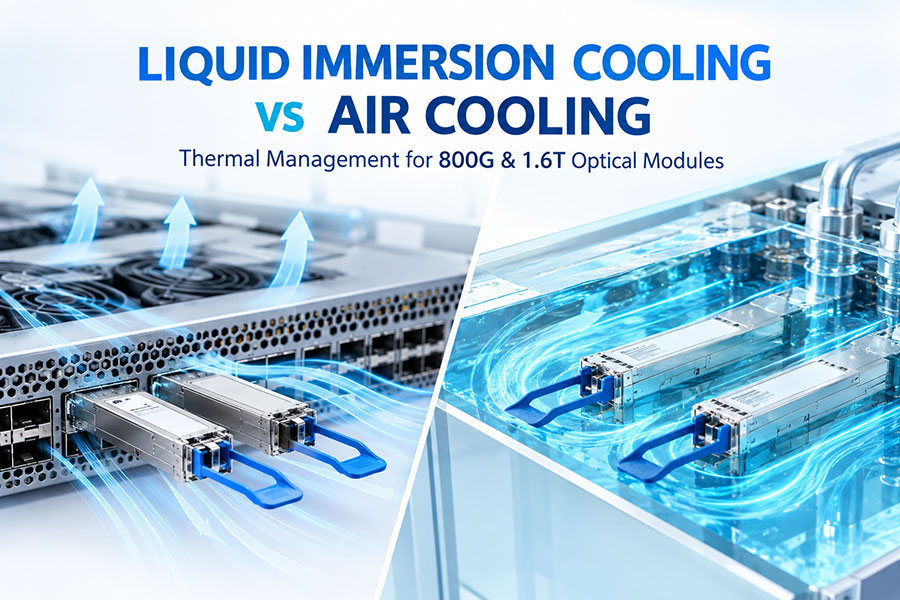
Removing a high-power DSP can simplify thermal management within the pluggable module.
This can be particularly valuable in high-density OSFP environments where switch front-panel airflow and module temperature are major design constraints.
34. LPO and Thermal Management
LPO can reduce module heat generation, but the overall system still requires effective thermal management.
Laser drivers, optical engines, TIAs, host ASICs, cages, heatsinks, and surrounding modules all contribute to the thermal environment.
35. DSP-Based Thermal Management
The DSP is one of the major active components inside a conventional high-speed optical module.
As module data rates increase, controlling DSP power and temperature becomes increasingly important. This can affect heatsink design, airflow requirements, module spacing, and system-level cooling.
36. Interoperability
LPO requires careful end-to-end interoperability because the host electrical channel and module operate together as a more continuous linear link.
The LPO MSA has therefore defined system-level electrical and optical interoperability requirements rather than treating the module as an isolated component.
37. DSP-Based Interoperability
DSP-based modules also require interoperability testing, but the internal DSP provides a degree of signal-processing isolation between the host interface and optical engine.
This architecture can make it easier to accommodate differences in electrical channel characteristics within the supported operating range.
38. LPO Diagnostics
Removing the DSP does not mean that optical diagnostics disappear.
LPO systems can use monitoring and measurement capabilities distributed across the host ASIC, optical module, and link to analyze signal quality, optical power, and other performance parameters.
39. DSP-Based Diagnostics
DSP-based transceivers can provide extensive digital monitoring because the DSP already has access to internal signal-processing information.
This can make certain diagnostic and performance-monitoring functions easier to implement inside the module.
40. LPO vs DSP for Data Center Networks
| Application Requirement | LPO | DSP-Based Transceiver |
|---|---|---|
| Very low module power | Strong fit | Less optimized |
| Low module latency | Strong fit | Higher processing contribution |
| Simple optical module architecture | Yes | More complex |
| Highly capable host SerDes | Important | Still important but less central |
| Long or difficult electrical channel | More challenging | More tolerant in many designs |
| High-density AI network | Strong target application | Widely established |
| Broad optical architecture support | Growing | Broad |
41. When LPO Is a Practical Choice
LPO can be practical when the host ASIC or NIC has strong SerDes capabilities, the electrical channel is well controlled, module power is a major concern, and the network uses supported LPO architectures.
This makes LPO particularly relevant to high-density AI and data center links where many optical modules operate simultaneously.
42. When DSP-Based Optics Are a Practical Choice
DSP-based optical transceivers remain useful when the link requires substantial signal conditioning, when the host electrical channel is more challenging, or when a mature retimed optical architecture is preferred.
They are also widely applicable across different reach classes and optical technologies.
43. LPO vs DSP-Based Transceiver: Core Comparison
| Parameter | LPO | DSP-Based Optical Transceiver |
|---|---|---|
| DSP inside module | No conventional DSP/retimer in signal path | Yes |
| Signal processing | More concentrated in host SerDes | Shared with module DSP |
| Module power | Lower | Higher |
| Module latency | Lower | Higher |
| Module complexity | Lower | Higher |
| Host electrical requirements | Higher | Lower relative to LPO |
| Optical module flexibility | Dependent on host and LPO architecture | Broad |
| AI/data center suitability | Strong for supported short-reach links | Strong and broadly deployed |
| Interoperability approach | End-to-end linear link optimization | Module-level signal processing boundary |
44. Conclusion
LPO and DSP-based optical transceivers represent two different approaches to solving the signal-integrity challenges of high-speed optical networking. LPO removes the conventional module DSP or retimer and allows the host ASIC or NIC SerDes to handle more of the complete electrical and optical link. This can reduce module power, latency, and complexity.
DSP-based optical transceivers place substantial signal-processing capability inside the module. This increases module power and processing complexity but can provide greater signal conditioning and more tolerance for challenging electrical interfaces.
For 400G and 800G AI and data center networks, LPO is particularly attractive where the host SerDes and electrical channel are optimized for linear operation. DSP-based optics remain important where broader signal-conditioning capability and established retimed architectures are required. The correct architecture depends on the host platform, electrical channel, optical reach, module power target, thermal design, interoperability requirements, and overall network architecture.
 >
>

 >
>
 >
>
 >
>
 >
>
 >
>
 >
>
 >
>