TEL:+86 132 6656 7067




InfiniBand and Ethernet are two major networking technologies used to connect servers, accelerators, storage systems and other devices. Both can provide high-bandwidth communication, but they were developed around different networking architectures and operational models.
InfiniBand is purpose-built as a high-performance fabric with features such as RDMA, credit-based link-level flow control, subnet management, virtual lanes and hardware-assisted traffic management. Ethernet is a broad networking technology used across enterprise, cloud, storage and data center environments. For AI and HPC workloads, Ethernet can be combined with RDMA over Converged Ethernet, or RoCE, to provide low-overhead data movement while retaining Ethernet and IP-based networking capabilities.
1. InfiniBand vs Ethernet at a Glance
| Feature | InfiniBand | Ethernet |
|---|---|---|
| Primary Design | High-performance switched fabric | General-purpose network technology |
| RDMA | Native | Available through technologies such as RoCE |
| Flow Control | Credit-based link-level flow control | Depends on implementation; RoCE deployments commonly use congestion management and may use PFC |
| Routing Management | Subnet Manager | Distributed networking protocols and network management systems |
| Congestion Management | Fabric-aware hardware and management mechanisms | ECN, congestion control and vendor or standards-based enhancements |
| QoS | Service Levels and Virtual Lanes | QoS classes, VLAN/priority mechanisms and IP-based traffic controls |
| Network Ecosystem | Specialized high-performance fabric ecosystem | Broad multi-vendor networking ecosystem |
| Typical Use | AI, HPC and tightly coupled compute fabrics | Enterprise, cloud, data center, storage and AI networks |
| Current High-End AI Platforms | InfiniBand platforms up to 800Gb/s per port are available | AI Ethernet platforms up to 800Gb/s per port are available |
2. What Is InfiniBand?
InfiniBand is a switched-fabric interconnect architecture designed for high-performance communication between compute and storage devices.
It provides native RDMA capabilities, hardware-based flow control, Quality of Service mechanisms and fabric management through the InfiniBand Subnet Manager.
Modern InfiniBand platforms are widely used in high-performance computing and AI clusters where communication efficiency and tightly controlled fabric behavior are important.
3. What Is Ethernet?
Ethernet is a broad family of networking technologies used from enterprise access networks to large cloud data centers and high-speed AI fabrics.
Unlike InfiniBand, Ethernet is not a single specialized AI or HPC fabric architecture. It provides the underlying link and network technologies on which many different protocols and higher-level applications operate.
For high-performance computing, Ethernet can be combined with RDMA through RoCE, particularly RoCEv2, which carries RDMA transport over UDP/IP.
4. Native RDMA vs RDMA over Ethernet
RDMA is one of the most important points of comparison.
InfiniBand includes RDMA as a native part of its architecture. Ethernet itself does not inherently mean RDMA, but RoCE allows applications to use RDMA semantics over an Ethernet network.
RoCEv2 operates at Layer 3 and uses UDP/IP, allowing RDMA traffic to traverse routed Ethernet networks. NVIDIA documentation describes RoCE as a way to use RDMA for direct server-to-server data movement while using Ethernet infrastructure.
5. Flow Control: Credit-Based vs Ethernet Congestion Management
InfiniBand uses credit-based flow control at the link level. A receiving device advertises available buffer credits, and the sender transmits according to the credits available.
This mechanism is designed to prevent a sender from transmitting more data than the receiving side can accommodate on the link. NVIDIA's InfiniBand technical documentation describes credit-based flow control and its operation on a per-virtual-lane basis.
Ethernet uses a different collection of mechanisms. Depending on the implementation, Ethernet networks can use queue management, ECN, priority flow control and other congestion-control techniques. RoCEv2 deployments commonly use ECN, while PFC can be used to provide more granular pause behavior where required.
6. Routing and Fabric Management
InfiniBand uses a Subnet Manager to discover fabric devices, configure paths, apply routing policies and manage functions such as QoS and partitioning.
The Subnet Manager is therefore a central part of InfiniBand fabric initialization and routing management. NVIDIA documentation describes the InfiniBand Subnet Manager as the entity responsible for discovering and configuring fabric devices and applying routing and QoS-related settings.
Ethernet networks normally rely on distributed routing and switching protocols, controller-based management or a combination of both. The exact model depends on whether the network is enterprise, cloud, data center or AI-oriented.
7. QoS and Virtual Lanes
InfiniBand provides QoS through Service Levels and Virtual Lanes. Multiple logical traffic classes can share the same physical link while receiving different scheduling and priority treatment.
NVIDIA's current NCCL documentation describes how InfiniBand Service Levels are mapped to Virtual Lanes and how this mechanism can be used to assign different traffic classes.
Ethernet provides QoS through mechanisms such as traffic classes, priority markings, queue scheduling and other network policies. RoCE traffic can use IP-level traffic classification and ECN-based congestion handling.
8. Congestion Management
Congestion handling is particularly important in AI and HPC networks because many endpoints can transmit simultaneously and collective communication can create synchronized traffic patterns.
InfiniBand provides fabric-level mechanisms including adaptive routing and hardware-oriented congestion-management functions. NVIDIA documents adaptive routing as a way to move traffic onto less congested paths when traffic patterns change.
Ethernet-based AI networks can use ECN, congestion-control algorithms, adaptive routing and NIC-assisted mechanisms. Modern AI Ethernet platforms increasingly combine these functions rather than relying only on traditional Ethernet forwarding behavior.
9. Latency and Communication Behavior
Both InfiniBand and Ethernet can provide low-latency communication, but the actual latency depends on switch architecture, NIC or SuperNIC design, serialization delay, topology, congestion and software stack.
InfiniBand was designed from the beginning for high-performance communication, while modern AI-oriented Ethernet platforms add hardware acceleration and congestion-management functions to achieve predictable performance for distributed workloads.
For a specific deployment, measured application-to-application latency is more meaningful than comparing the network technologies from their names alone.
10. Ethernet and RoCEv2
RoCEv2 is important because it changes the usual comparison between Ethernet and InfiniBand. A modern Ethernet AI fabric does not necessarily mean conventional best-effort Ethernet without RDMA.
RoCEv2 combines RDMA transport with UDP/IP networking. This allows the network to retain Ethernet switching and Layer 3 routing capabilities while supporting direct memory-to-memory data movement.
However, high-performance RoCE deployments require careful congestion-control and traffic-management design. ECN is commonly used, and PFC may be used depending on the network architecture. :contentReference[oaicite:6]{index=6}
11. InfiniBand and Ethernet for AI Networking
AI clusters place unusual demands on networking because GPU or accelerator workloads frequently exchange large volumes of data through collective communication operations.
InfiniBand is designed specifically for high-performance fabrics and includes features such as native RDMA, adaptive routing and in-network computing. NVIDIA's current Quantum-X800 platform provides 800Gb/s InfiniBand connectivity per port and includes SHARP v4, adaptive routing and telemetry-based congestion control.
Ethernet has also evolved rapidly for AI workloads. NVIDIA's Spectrum-X platform uses standards-based Ethernet together with SuperNICs, adaptive routing and congestion-control mechanisms, while the Ethernet Alliance's 2026 roadmap includes 100G–800G Ethernet and emerging 1.6Tb/s interfaces for AI and other applications.
12. In-Network Computing
InfiniBand platforms can include in-network computing functions that move selected collective operations into the switch fabric.
NVIDIA SHARP is an example of this approach. It can offload certain collective operations from compute nodes to the network switches, reducing the amount of data that needs to traverse the full fabric.
Ethernet AI platforms are also adding more switch and NIC-based acceleration. The specific capabilities depend on the vendor, switch ASIC, NIC or SuperNIC and software stack.
13. Scalability and Network Topology
Both technologies can support large data center fabrics, but their scaling models are different.
InfiniBand fabrics are commonly designed around structured topologies and centrally managed fabric routing. Ethernet networks can use leaf-spine, Clos, multi-plane and other topologies with distributed routing and standard Ethernet/IP mechanisms.
Modern Ethernet AI platforms are also incorporating adaptive routing and multi-plane designs. NVIDIA's Spectrum-X documentation describes two-tier multi-plane architectures that can scale to very large AI endpoint counts.
14. Cabling and Optical Connectivity
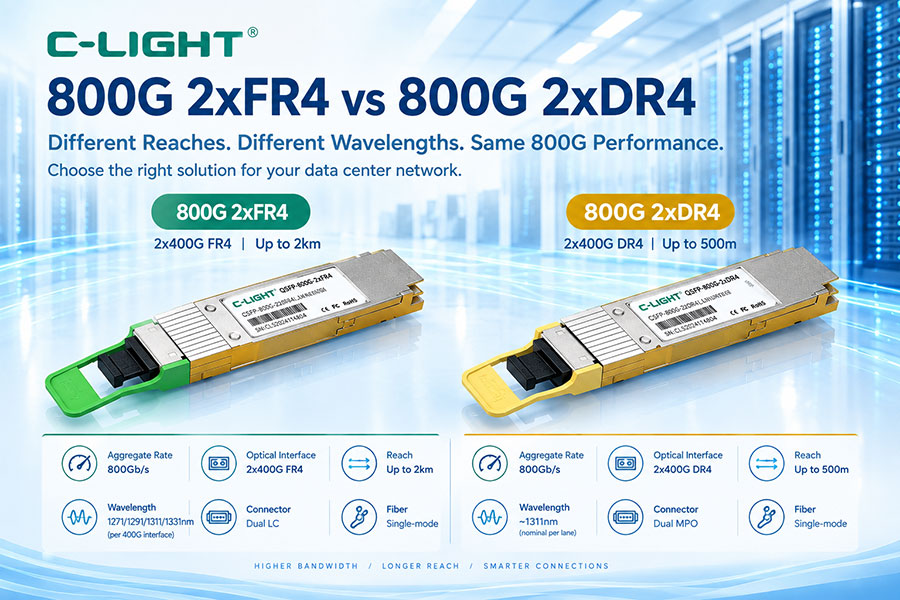
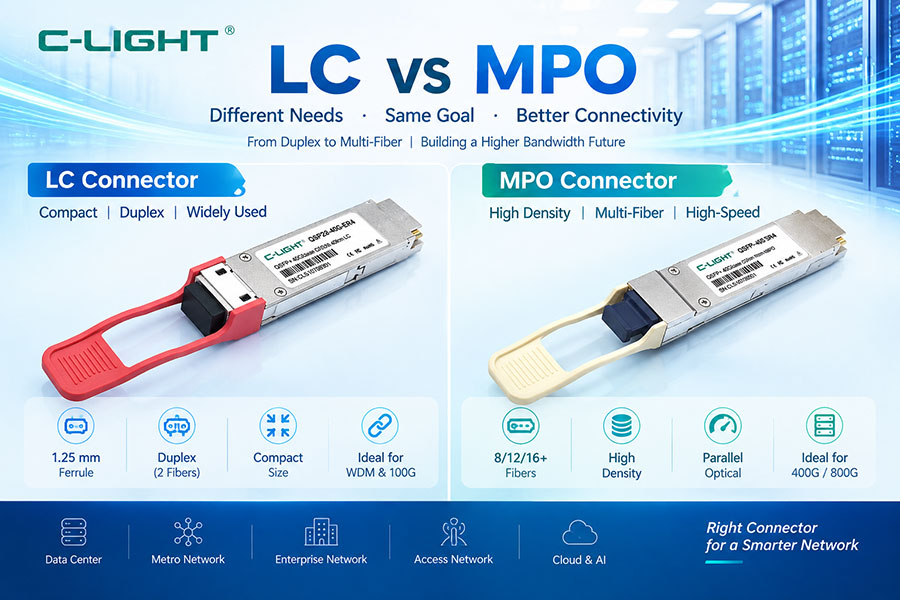
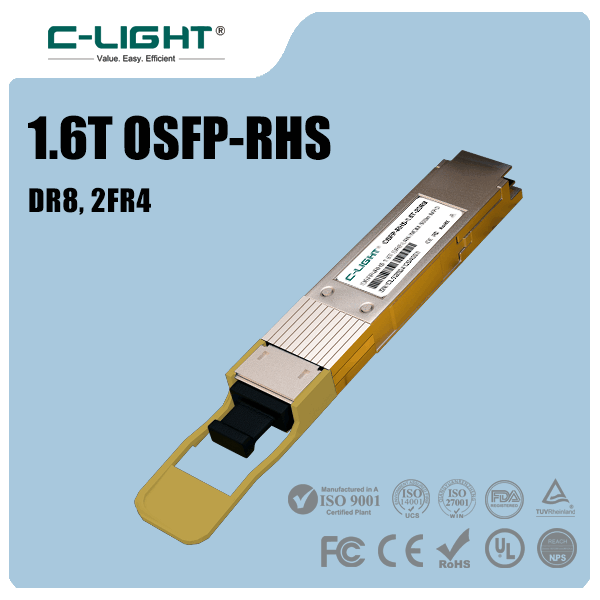
At high data rates, both InfiniBand and Ethernet rely heavily on modern optical transceivers, DACs, AOCs, AECs and other high-speed interconnect technologies.
The physical optical module is not inherently “InfiniBand” or “Ethernet” simply because it uses a particular form factor. Compatibility depends on the electrical interface, signaling rate, coding or modulation, lane architecture and host platform.
For example, 800G-class optical transceivers can be used within different high-performance networking ecosystems when their electrical and protocol requirements are compatible.
15. Management and Operational Model
| Management Area | InfiniBand | Ethernet |
|---|---|---|
| Fabric Initialization | Subnet Manager | Switch and routing protocols / controllers |
| Routing | Fabric-managed routing | Distributed or controller-assisted routing |
| QoS | Service Levels and Virtual Lanes | Traffic classes, QoS policies and queue mechanisms |
| Congestion | Fabric-aware mechanisms and adaptive routing | ECN, congestion control, adaptive routing and other mechanisms |
| RDMA | Native | Typically through RoCE |
| IP Networking | Can be supported, but not the core fabric model | Core networking function |
| Operational Ecosystem | Specialized fabric management | Extensive enterprise and cloud networking ecosystem |
16. Cost, Ecosystem and Interoperability
Ethernet benefits from a very broad ecosystem spanning switches, routers, NICs, optical modules, operating systems and network-management tools. Its use across enterprise and cloud infrastructure can make integration with existing networks more straightforward.
InfiniBand has a more specialized ecosystem focused on HPC and high-performance computing fabrics. The specialized architecture can reduce the amount of adaptation needed inside a dedicated compute fabric, while it also means that the networking environment is more distinct from conventional enterprise Ethernet infrastructure.
Actual total cost depends on switches, adapters, optics, cables, management software, support requirements and the network topology.
17. InfiniBand vs Ethernet: Where Each Fits
| Use Case | InfiniBand | Ethernet |
|---|---|---|
| HPC Cluster | Native high-performance fabric | Can be used with high-performance Ethernet and RDMA technologies |
| AI Training Cluster | Native RDMA and fabric-management architecture | Can use RoCE-based AI Ethernet fabrics |
| Enterprise Data Center | Usually a specialized deployment | Broadly used |
| Cloud Infrastructure | Used in selected high-performance environments | Core infrastructure technology |
| Storage Networking | Can support high-performance storage communication | Broad ecosystem including Ethernet-based storage protocols |
| General IP Networking | Not its primary role | Core use case |
18. How to Evaluate InfiniBand vs Ethernet
| Evaluation Factor | Questions to Check |
|---|---|
| Application | Is the network for AI training, HPC, enterprise, cloud or mixed workloads? |
| Communication Pattern | How much collective, east-west and accelerator-to-accelerator traffic is expected? |
| RDMA | Is native InfiniBand RDMA or Ethernet RoCE required? |
| Congestion | Which congestion-control and routing mechanisms are available? |
| Operations | Does the team prefer a specialized fabric-management model or an Ethernet/IP operational model? |
| Optics | Which transceivers, DACs, AOCs and electrical lane configurations are supported? |
| Scale | How many accelerators, hosts and switches must the fabric support? |
| Software | Are drivers, libraries and communication frameworks validated for the chosen fabric? |
19. InfiniBand vs Ethernet: Summary
InfiniBand and Ethernet can both serve high-performance data center networks, but they approach the problem from different foundations. InfiniBand is a purpose-built switched fabric with native RDMA, credit-based flow control, Subnet Manager-based fabric management, Virtual Lanes and specialized high-performance features.
Ethernet is a much broader networking technology. For AI and HPC workloads, Ethernet can be extended with RoCEv2, ECN, PFC, adaptive routing and hardware-accelerated congestion management to support high-performance RDMA networking.
The comparison therefore should not be reduced to a simple bandwidth or latency number. The relevant factors include fabric architecture, RDMA model, congestion behavior, routing, QoS, management, optical connectivity, software support, network scale and the operational environment.
Both ecosystems are continuing to evolve toward higher bandwidth and AI-oriented networking. NVIDIA currently offers 800Gb/s-class InfiniBand and Ethernet AI platforms, while the Ethernet Alliance's 2026 roadmap extends the Ethernet roadmap toward 1.6Tb/s interfaces and additional AI-focused technologies.
 >
>

 >
>
 >
>
 >
>
 >
>
 >
>
 >
>
 >
>