TEL:+86 132 6656 7067





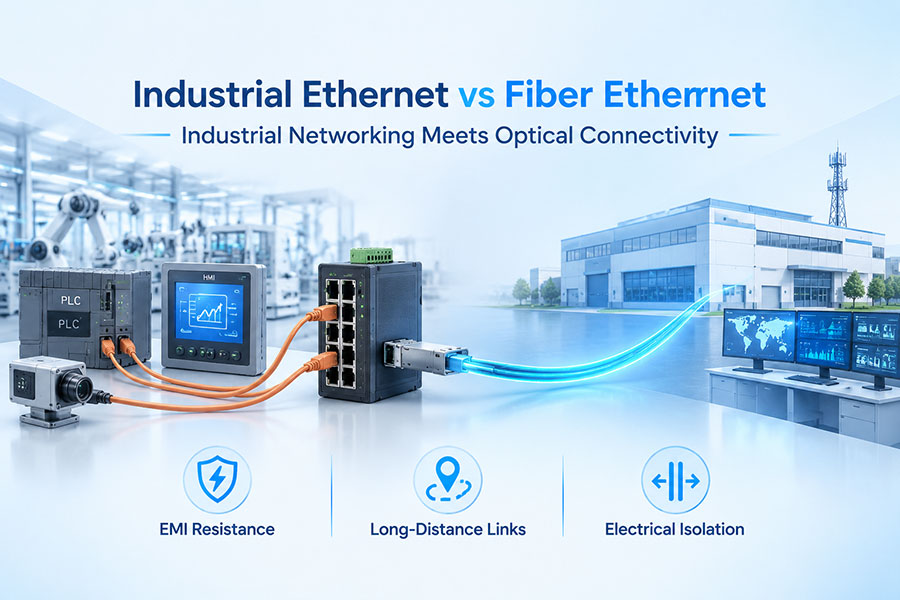
Industrial networks rely on both copper and optical fiber to connect controllers, sensors, drives, industrial computers, and supervisory systems. Copper Ethernet remains practical for short equipment connections and applications requiring Power over Ethernet (PoE). Fiber Ethernet provides longer transmission distances, electromagnetic interference immunity along the fiber, and electrical isolation between network endpoints.
The choice between an industrial fiber network and an industrial copper network depends on cable distance, electrical conditions, device interfaces, power delivery, bandwidth requirements, installation costs, and maintenance considerations. In large manufacturing facilities, a hybrid architecture often provides the most effective balance.
1. Industrial Fiber Network vs Industrial Copper Network
An industrial copper network transmits Ethernet data through electrical signals carried by metallic conductors, typically using shielded or unshielded twisted-pair cables. RJ45 interfaces are widely used to connect PLCs, HMIs, industrial PCs, switches, cameras, and other field equipment.
An industrial fiber network transmits data as optical signals through glass or plastic optical fiber, depending on the application. Optical transceivers or media converters translate electrical Ethernet signals into light at the transmitting end and convert the received optical signals back into electrical data.
Neither medium is universally superior. Copper provides convenient electrical connectivity and can carry power, while fiber provides transmission characteristics that are valuable for distributed and electrically challenging industrial installations.
2. Technical Comparison of Industrial Fiber and Copper Networks
| Technical Factor | Industrial Fiber Network | Industrial Copper Network |
|---|---|---|
| Transmission method | Optical signals transmitted through fiber | Electrical signals transmitted through metallic conductors |
| Common interface | SC, LC, SFP, SFP+ and other optical interfaces | RJ45 and other copper Ethernet interfaces |
| Typical Ethernet channel distance | Ranges from hundreds of meters to tens of kilometers or more, depending on the optical standard and fiber type | Typically up to 100 m for standard balanced twisted-pair Ethernet channels |
| Electromagnetic interference | Fiber cable is immune to electromagnetic interference | May require shielding, grounding, and careful cable routing |
| Electrical isolation | Provides galvanic isolation between optical endpoints | Electrical connection remains between copper interfaces |
| Power delivery | Fiber itself does not carry PoE power | Supports PoE when compatible equipment and cabling are used |
| Bandwidth potential | Supports high-capacity links and different optical Ethernet generations | Supports high data rates over shorter distances, depending on cable category and Ethernet standard |
| Cable size and weight | Often lighter and smaller for comparable high-capacity backbone routes | Depends on conductor size, shielding, jacket, and cable category |
| Installation skills | Requires fiber termination, connector inspection, cleaning, and optical testing | Uses familiar copper termination and cable testing procedures |
| Common deployment | Plant backbones, inter-building connections, remote equipment, and high-EMI areas | Machine connections, local control cabinets, cameras, and powered field devices |
Distance figures depend on the Ethernet physical-layer standard, cable category, fiber grade, transceiver specification, and installation conditions. The 100 m copper figure is a common structured-cabling reference for balanced twisted-pair Ethernet, not a universal limit for every industrial Ethernet technology. Single-pair Ethernet standards can support different link distances.
3. Transmission Distance and Network Coverage
Distance is one of the main factors influencing the choice of industrial transmission medium. Copper Ethernet is convenient for connecting nearby devices, but standard twisted-pair Ethernet channels generally have a 100 m planning limit. Longer copper routes may require additional network equipment or a different physical-layer technology.
Fiber Ethernet can extend communication across production buildings, warehouses, substations, remote monitoring locations, and geographically distributed industrial facilities. Depending on the optical standard and transceiver, fiber links can cover hundreds of meters, several kilometers, or substantially longer distances.
| Fiber or Copper Technology | Typical Application | Distance Consideration |
|---|---|---|
| 1000BASE-T Copper | Local industrial device connections | Typically up to 100 m per standard channel |
| 100BASE-FX | Fast Ethernet fiber links | Depends on multimode or single-mode implementation |
| 1000BASE-SX | Short-range Gigabit multimode fiber | Commonly used for facility links over hundreds of meters |
| 1000BASE-LX | Gigabit single-mode or supported multimode fiber | Commonly supports kilometer-class links on single-mode fiber |
| 10GBASE-SR | Short-range 10G multimode fiber | Reach depends on OM fiber grade |
| 10GBASE-LR | 10G single-mode fiber backbone | Typically up to 10 km under the applicable standard |
For fiber deployments, the optical link budget must account for transmitter output power, receiver sensitivity, fiber attenuation, connector loss, splice loss, and engineering margin. Selecting a transceiver based only on its advertised reach is insufficient if the installed fiber route or passive components introduce excessive loss.
4. Electromagnetic Interference and Electrical Isolation
Industrial facilities contain motors, variable-frequency drives, welding equipment, high-current power distribution, switching devices, and other potential sources of electromagnetic interference (EMI). These conditions can affect copper communication links if cable selection, shielding, bonding, grounding, and routing are not properly designed.
Shielded twisted-pair cable and suitable industrial connectors can improve copper link robustness. However, shielding and grounding must follow the equipment manufacturer's recommendations and the facility's electrical design.
Optical fiber carries light rather than electrical current. The fiber cable itself does not pick up electromagnetic interference in the same way as metallic conductors. It also provides electrical isolation between the two optical endpoints, which is useful when connecting equipment across different electrical zones or buildings.
No electrical signal coupling through the fiber cable.
Galvanic isolation between connected optical interfaces.
Suitable for routes near high-power electrical equipment.
Useful for inter-building and remote-site connections.
Select appropriate industrial cable categories.
Apply correct shielding and grounding practices.
Separate data cables from power cables where required.
Check connector, cable-jacket, and installation ratings.
Optical fiber does not make every component in a fiber link immune to electrical interference. Switches, media converters, power supplies, and optical transceivers still contain electronic circuits and must be selected for the operating environment.
5. PoE, Power Delivery and Field Device Connectivity
Power delivery is a major practical difference between copper and fiber. Power over Ethernet allows compatible devices to receive electrical power and data through a single copper Ethernet connection. This reduces the need for a separate power cable at certain endpoints.
PoE is particularly useful for industrial IP cameras, wireless access points, access-control devices, and remote monitoring equipment. Fiber can extend the data connection over a longer distance, but it cannot directly supply PoE power through the optical strand.
A common architecture places an industrial fiber media converter or PoE-capable converter near the remote device. The fiber carries network traffic to the location, while the local converter supplies Ethernet data and PoE power over a short copper connection.
C-LIGHT's Industrial PoE Media Converter combines fiber-to-copper Ethernet conversion with PoE power delivery. It is designed for remote industrial devices that require both optical network connectivity and local power through an RJ45 connection.
RJ45 Ethernet and optical fiber interfaces, depending on model.
100Base-X SC and 1000Base-X SC configurations.
SFP and selected SFP+ optical interface options.
PoE power configurations from 30W to higher-power models, depending on the selected product.
12–48 VDC or other model-specific power input arrangements.
Aluminum enclosure and industrial temperature operation.
Operating temperature of -40°C to 75°C for listed models.
Typical applications include industrial cameras, transportation monitoring, remote access points, and distributed PoE equipment. The PoE standard, available power budget, input voltage, and optical interface must be checked against the exact model.
6. Industrial Fiber Media Converters and SFP Transceivers
Many industrial devices provide copper Ethernet ports but do not have native optical interfaces. A fiber media converter allows these devices to communicate over an optical network without replacing the original equipment.
Industrial switches with SFP slots provide another approach. A compatible SFP transceiver converts the switch's electrical interface into an optical signal. The selected module determines important link characteristics, including wavelength, fiber type, transmission distance, and optical power requirements.
Industrial Fiber Media Converter
C-LIGHT's Industrial Fiber Media Converter series provides bidirectional conversion between copper Ethernet and optical fiber. It is suitable for extending industrial Ethernet connections between local equipment and remote fiber network segments.
RJ45 copper interfaces combined with SC, SFP, or SFP+ optical interfaces, depending on model.
100Base-X, 1000Base-X, 100Base-FX, and selected 10G optical configurations.
10/100/1000 Mbps auto-negotiation on applicable models.
12–48 VDC power input on listed models.
Redundant power input on selected configurations.
Compact aluminum enclosure and fanless design.
Operating temperature of -40°C to 75°C for listed models.
The series supports different copper-port and optical-port combinations, allowing network designers to match the converter to the installed Ethernet equipment and fiber infrastructure.
For networks that already use SFP-equipped industrial switches, a separate media converter may not be necessary. The appropriate optical transceiver can be installed directly into a compatible switch port.
C-LIGHT's Optical Transceiver Portfolio includes 100M, 1.25G, 2.5G, 10G, 25G, and higher-speed categories. The 100M SGMII SFP product category includes multimode and single-mode options with different transmission distances, making it relevant to selected legacy and low-speed industrial Ethernet applications.
Module selection should account for switch compatibility, supported data rate, optical wavelength, connector type, fiber specification, temperature rating, and link budget. A standard commercial transceiver should not automatically be treated as suitable for an industrial temperature environment.
7. Installation Cost, Maintenance and Lifecycle Considerations
Copper networks often have a lower initial deployment cost for short connections because RJ45 interfaces are widely available and cable termination is familiar to most installation teams. Copper can also deliver power to compatible endpoint devices through PoE.
Fiber networks require optical transceivers or media converters at the endpoints, fiber termination, connector inspection, and optical testing. These requirements can increase initial installation complexity, particularly where the facility has limited fiber infrastructure or maintenance experience.
However, the total cost of ownership should include more than the cable and connector price. Long copper routes may require additional switches or repeaters, while fiber may reduce the number of intermediate network devices needed for distance extension. Fiber can also simplify electrical isolation between remote areas.
| Cost or Maintenance Factor | Industrial Fiber | Industrial Copper |
|---|---|---|
| Initial cable cost | Depends on fiber grade, jacket, protection, and installation route | Often economical for short device connections |
| Active equipment | Requires compatible optical ports, transceivers, or media converters | Can connect directly to native RJ45 ports |
| Termination | Requires optical connectorization, cleaning, and testing | Requires copper termination and cable certification |
| Fault diagnosis | May require optical power meters, inspection tools, or OTDR testing | Can use copper cable testers and link diagnostics |
| Power delivery | Separate power source or local PoE converter required | PoE can combine data and power on one cable |
| Long-distance expansion | Can reduce the need for intermediate regeneration equipment | May require additional network equipment beyond supported channel distance |
| Physical protection | Requires suitable bend-radius, pulling-tension, and crush protection | Requires suitable jacket, shielding, abrasion, and mechanical protection |
Both media require suitable industrial cable construction. Fiber cables may need armored or reinforced jackets in areas exposed to mechanical damage, while copper cables may need oil-resistant, flexible, shielded, or continuous-flex designs for moving machinery.
8. Typical Industrial Network Architectures
Large industrial facilities rarely use fiber or copper exclusively. A hybrid network assigns each medium to the connection type where it provides the greatest practical value.
Machine-Level Copper Connections
Within a production cell, copper Ethernet connects PLCs, HMIs, drives, sensors, and other nearby devices. Short cable runs and native RJ45 ports simplify equipment integration and maintenance.
Fiber Backbone Between Production Areas
Industrial switches in different production areas connect through single-mode or multimode fiber according to the required distance and data rate. Fiber uplinks provide electrical isolation and avoid signal interference along the optical cable route.
Remote PoE Device Connections
A fiber backbone can reach a remote monitoring point, where a PoE media converter supplies data and power to an IP camera or wireless access point through a short copper cable.
Inter-Building Connectivity
Single-mode fiber is commonly suitable for connections between separate buildings. Its nonconductive transmission path avoids a direct metallic communication connection between the buildings, while the optical interfaces provide the required Ethernet link.
PLC / HMI / Sensors → Copper Ethernet → Industrial Access Switch → SFP Optical Uplink → Fiber Backbone → Remote Industrial Switch → Local Copper Devices
For remote PoE equipment, the optical link can terminate at an industrial PoE media converter before the final copper connection to the powered device.
9. How to Choose Between Industrial Fiber and Copper
Network design should begin with the connected devices and operating environment. The physical medium should then be selected according to distance, electrical conditions, power requirements, data rate, and maintenance capabilities.
Device connections are short and within the supported channel distance.
Equipment provides native RJ45 Ethernet ports.
PoE power delivery is required.
Installation and maintenance simplicity are priorities.
Electrical conditions allow reliable copper cabling.
Network segments extend beyond conventional copper distances.
Communication paths pass through high-EMI environments.
Electrical isolation between locations is required.
Separate buildings or remote facilities need connectivity.
High-capacity optical backbone links are required.
For most large industrial facilities, a hybrid design is often the most practical option. Copper handles local equipment connections and power delivery, while fiber connects industrial switches, remote network segments, and central control facilities.
10. Industrial Fiber Connectivity Solutions from C-LIGHT
Reliable industrial communication depends on selecting the correct cable medium, optical interface, active equipment, and network architecture. C-LIGHT provides industrial fiber media converters, PoE media converters, and optical transceivers for industrial and Ethernet connectivity applications.
The Industrial Fiber Media Converter supports copper-to-fiber Ethernet conversion for extending network connections between industrial devices and optical backbones.
The Industrial PoE Media Converter combines optical network extension with PoE power delivery for remote cameras and other compatible field devices.
For industrial switches equipped with optical ports, the C-LIGHT Optical Transceiver Portfolio provides multiple data rates and optical interface options. The selected transceiver should match the switch specification, fiber type, wavelength, transmission distance, and operating-temperature requirements.
Industrial Fiber and Copper Network Connectivity
From industrial fiber media converters and PoE connectivity to optical transceivers, C-LIGHT supports network extension and fiber integration across industrial Ethernet applications.
For product specifications, interface compatibility, and customized connectivity requirements, Contact C-LIGHT.
 >

 >
 >
 >
 >
 >
 >
 >