TEL:+86 132 6656 7067




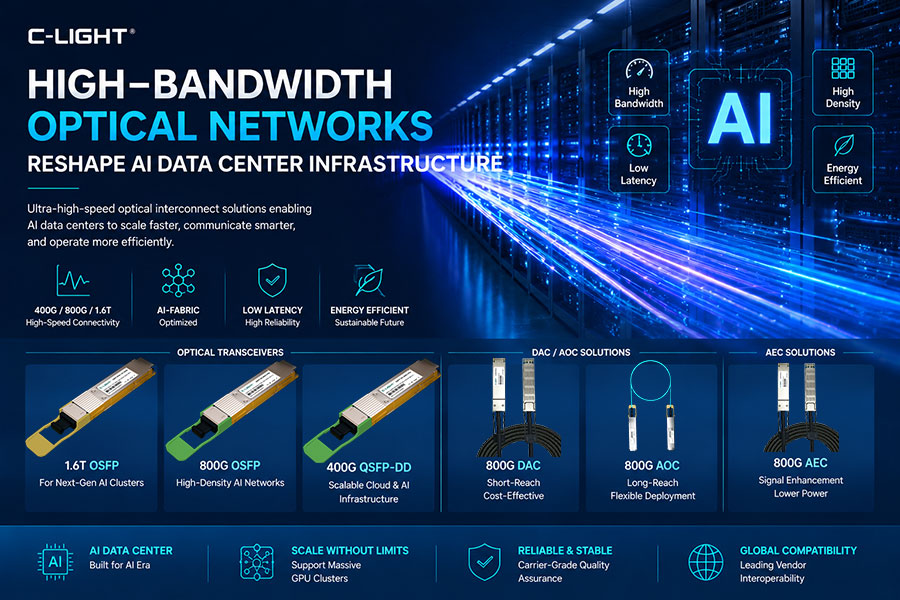
The rapid growth of artificial intelligence (AI), large language models (LLMs), and high-performance computing (HPC) is transforming modern data center architectures. Traditional network infrastructure is facing increasing challenges as AI workloads require higher bandwidth, lower latency, and more efficient data transmission capabilities.
High-bandwidth optical networks are becoming the foundation of next-generation AI data centers. With the rapid deployment of 400G, 800G, and 1.6T optical modules, optical interconnect technologies are enabling faster communication between GPUs, switches, and computing nodes while supporting the continuous expansion of AI clusters.
1. Why AI Data Centers Require High-Bandwidth Optical Networks
AI workloads generate massive east-west traffic inside data centers. Unlike traditional cloud applications, AI training and inference require continuous communication between thousands of GPUs, creating extremely high requirements for network bandwidth and latency.
Large-scale GPU cluster communication
High-speed data synchronization between computing nodes
Low-latency AI fabric networking
Higher efficiency for next-generation computing infrastructure
Copper-based interconnect solutions face limitations in transmission distance, signal integrity, and power efficiency. As a result, optical connectivity has become a key technology for scaling AI data center networks.
2. Optical Network Evolution from 400G to 1.6T
The continuous growth of AI computing power is accelerating optical network upgrades. Data centers are moving from traditional 100G and 200G connections toward 400G, 800G, and future 1.6T optical solutions.
| Generation | Optical Speed | Main Applications |
|---|---|---|
| 100G | 100Gbps | Traditional data center networks |
| 200G | 200Gbps | High-performance networking |
| 400G | 400Gbps | Current AI clusters and cloud infrastructure |
| 800G | 800Gbps | Large-scale AI training networks |
| 1.6T | 1.6Tbps | Future AI superclusters |
3. Optical Interconnect Architecture for AI Data Centers
3.1 Compute Layer
The compute layer includes GPUs, AI accelerators, and high-performance servers. The increasing scale of AI clusters requires extremely fast communication between computing nodes.
Advanced GPU architectures and AI acceleration platforms depend on high-speed interconnect solutions to maintain computing efficiency.
3.2 AI Fabric Network
The AI fabric connects thousands of GPUs through high-speed Ethernet or InfiniBand networks. Optical transceivers provide the essential connectivity between switches and servers.
Ultra-high bandwidth transmission
Low latency communication
High-density network deployment
Reliable operation for AI workloads
3.3 Data Center Backbone
Large AI clusters require backbone networks capable of supporting long-distance and high-capacity transmission. Advanced optical solutions such as 400G, 800G, and 1.6T modules provide scalable connectivity for future AI infrastructure.
4. Key Technologies Driving AI Optical Networking
4.1 800G Optical Modules
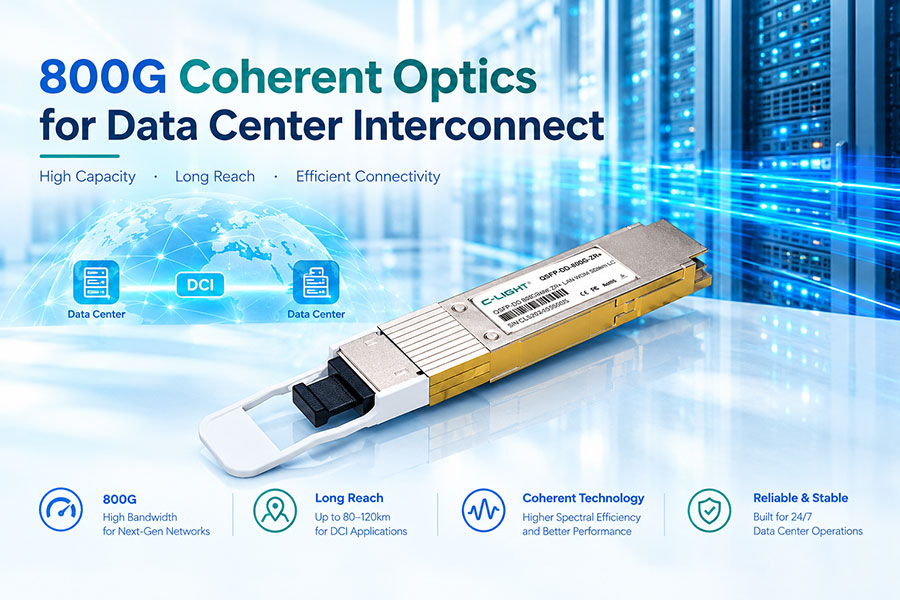
800G optical modules are becoming a mainstream solution for AI data center networks. Compared with 400G solutions, 800G provides higher bandwidth density and improves network scalability.
Typical applications include:
AI switch-to-switch connections
GPU cluster networking
High-density data center fabrics
4.2 1.6T Optical Modules
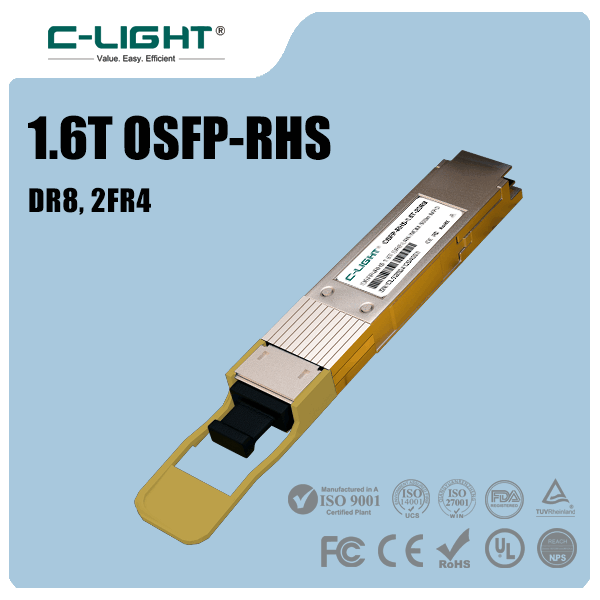
As AI models continue to grow in complexity, future data centers will require even higher-speed optical connectivity. 1.6T optical modules based on advanced PAM4 technology are designed for next-generation AI networks.
8×200G PAM4 architecture
Higher bandwidth capacity
Support for future AI clusters
5. Liquid Cooling for High-Power Optical Modules
Liquid Immersion Transceiver for AI Data Centers | 400G/800G/1.6T Optical Solutions丨C-LIGHT
Higher-speed optical modules introduce increased power consumption and thermal challenges. Advanced cooling technologies are becoming essential for maintaining reliability in AI data centers.
Liquid cooling solutions can improve thermal management through:
Better heat dissipation performance
Stable operation for high-power optical modules
Support for dense AI infrastructure deployment
Liquid-cooled optical modules are expected to play an important role in future 800G and 1.6T AI networking environments.
6. DAC, AOC, and AEC Solutions for AI Networks
Direct Attach Cable (DAC)
DAC solutions provide low-cost and low-latency connectivity for short-distance connections inside AI racks.
Active Optical Cable (AOC)
AOC solutions extend transmission distance while maintaining excellent signal integrity, making them suitable for rack-to-rack AI networking.
Active Electrical Cable (AEC)
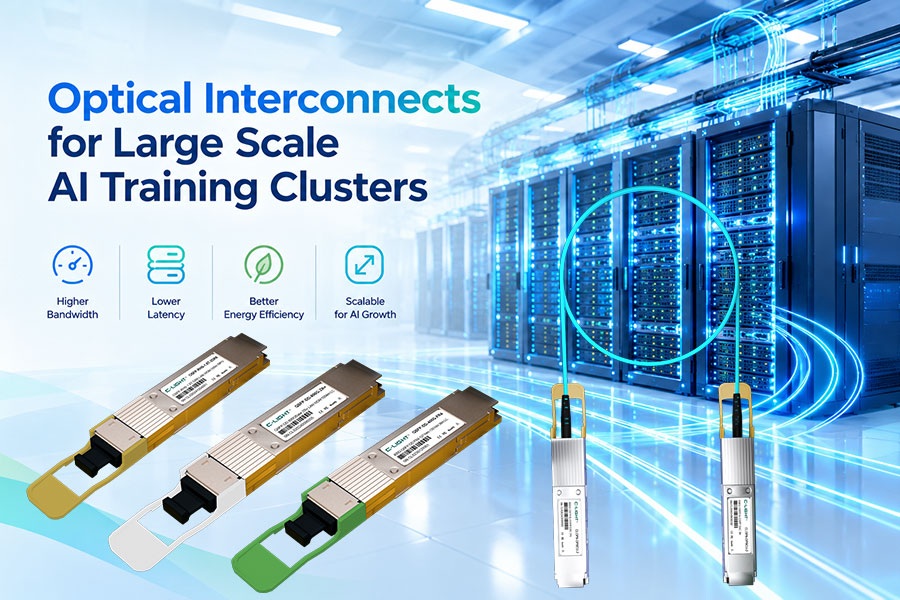
AEC technology integrates active electronic components to improve signal transmission performance. It provides an efficient solution between traditional DAC and optical connectivity for high-density AI networks.
7. C-LIGHT High-Bandwidth Optical Connectivity Solutions
C-LIGHT provides advanced optical interconnect solutions designed for next-generation AI data center infrastructure.
400G Optical Transceivers
800G Optical Modules
1.6T Optical Modules
DAC and AOC Solutions
Active Electrical Cable (AEC)
Liquid Cooling Optical Solutions
These solutions help AI data centers achieve higher bandwidth, improved scalability, and enhanced network efficiency.
8. Future Outlook of Optical Networks in AI Infrastructure
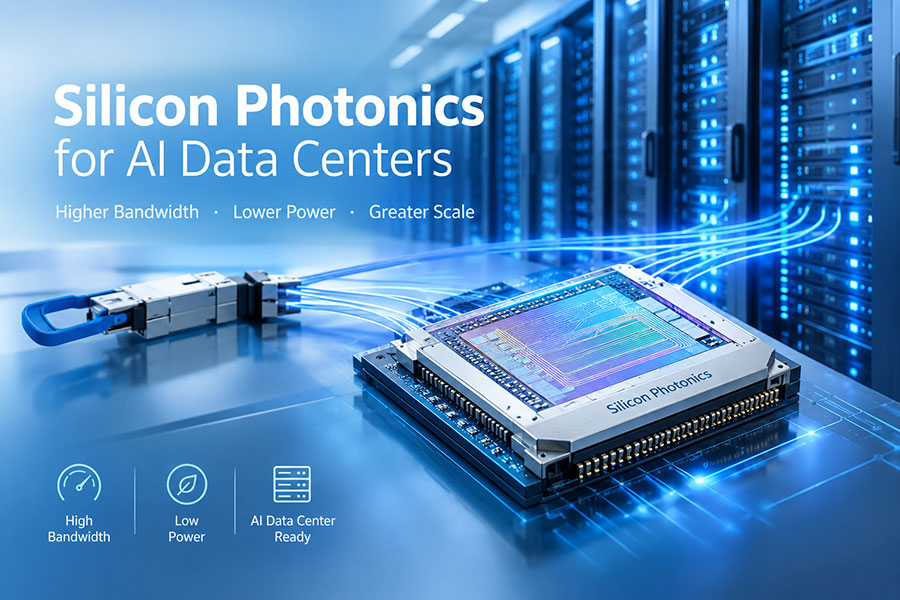
The future of AI data centers will depend on continuous innovation in optical networking technologies. Higher-speed optical modules, silicon photonics, co-packaged optics (CPO), and advanced thermal management will become important drivers for next-generation AI infrastructure.
High-bandwidth optical networks are reshaping AI data centers by providing the performance, scalability, and efficiency required for the future of intelligent computing.
9.High-Bandwidth Optical Networks Q&A
Q1: Why do AI data centers need high-bandwidth optical networks?
Answer: AI workloads require massive data exchange between GPUs, servers, and switches. High-bandwidth optical networks provide higher capacity, lower latency, and better scalability.
Q2: What optical speeds are used in AI data centers?
Answer: Modern AI data centers mainly use 400G and 800G optical modules, while 1.6T optical modules are being developed for future large-scale AI clusters.
Q3: Why are 800G optical modules important?
Answer: 800G optical modules provide higher bandwidth density and support large-scale AI fabric networks with improved efficiency.
Q4: What is the role of 1.6T optical modules?
Answer: 1.6T optical modules are designed for future AI clusters requiring extremely high bandwidth and efficient data transmission.
Q5: How does liquid cooling improve optical module performance?
Answer: Liquid cooling helps reduce thermal challenges caused by high-power optical modules and improves long-term reliability.
Q6: What are the differences between DAC, AOC, and AEC?
Answer: DAC is suitable for short-distance connections, AOC provides longer optical transmission, and AEC improves electrical signal performance for AI networks.
Q7: Will optical connectivity replace copper completely?
Answer: Optical and electrical solutions will coexist. Optical technology dominates high-bandwidth applications, while copper remains suitable for short-distance connections.
Q8: What technologies will shape future AI networks?
Answer: Future AI networks will be driven by 1.6T optical modules, silicon photonics, CPO, liquid cooling, and advanced optical interconnect technologies.
 >
>

 >
>
 >
>
 >
>
 >
>
 >
>
 >
>
 >
>