TEL:+86 132 6656 7067




GPON and EPON are two major Passive Optical Network technologies used to provide fiber-based access networks. Both use a point-to-multipoint architecture in which an Optical Line Terminal (OLT) communicates with multiple Optical Network Units (ONUs or ONTs) through passive optical splitters.
Although GPON and EPON have similar physical network structures, they differ significantly in protocol architecture, frame format, bandwidth efficiency, upstream scheduling, equipment design, and deployment history. Understanding these differences is important when selecting OLTs, ONUs, optical modules, splitters, and fiber infrastructure.
1. What Is GPON?
GPON stands for Gigabit Passive Optical Network. It is a PON technology standardized by the ITU-T G.984 series and designed to provide high-capacity fiber access for residential, enterprise, and operator networks.
GPON typically provides approximately 2.488 Gb/s downstream bandwidth and 1.244 Gb/s upstream bandwidth at the PON interface. Its architecture supports different service types, including Internet access, voice, video, and business services.
2. What Is EPON?
EPON stands for Ethernet Passive Optical Network. It is based on IEEE Ethernet standards and was developed to carry Ethernet traffic directly over a passive optical access network.
Traditional EPON provides 1.25 Gb/s line rates in both downstream and upstream directions. Because Ethernet is the native service format, EPON has a relatively direct relationship with conventional Ethernet switching technology.
3. GPON vs EPON at a Glance
| Feature | GPON | EPON |
|---|---|---|
| Standard family | ITU-T G.984 | IEEE 802.3ah |
| Typical downstream line rate | 2.488 Gb/s | 1.25 Gb/s |
| Typical upstream line rate | 1.244 Gb/s | 1.25 Gb/s |
| Protocol foundation | GEM-based PON architecture | Ethernet-based architecture |
| Traffic structure | Encapsulated service traffic | Ethernet frames |
| Bandwidth efficiency | Higher in many access scenarios | Simple Ethernet-oriented transport |
| Typical use | Telecom and fiber broadband access | Ethernet-oriented access networks |
| OLT/ONU compatibility | Requires GPON-compatible equipment | Requires EPON-compatible equipment |
4. GPON and EPON Use the Same Basic PON Architecture
Both technologies use an OLT on the service-provider side, passive optical splitters in the optical distribution network, and ONUs or ONTs at the customer side.
The passive splitter does not perform active switching or signal regeneration. Instead, downstream optical signals are distributed to multiple subscribers, while upstream signals from different ONUs share the same optical path through time-based transmission control.
5. OLT and ONU Roles
The OLT is the central access device that connects the PON system to the provider network. It manages optical transmission, subscriber connections, bandwidth allocation, and upstream traffic scheduling.
The ONU or ONT converts the PON optical interface into customer-facing services such as Ethernet, Wi-Fi, voice, or other access interfaces.
6. The Biggest Architectural Difference
The fundamental difference between GPON and EPON is their protocol approach.
GPON was designed specifically as a broadband PON technology with its own transport framework, including GEM, which allows different service types to be carried efficiently.
EPON extends the Ethernet model into the passive optical access network, making Ethernet frames the primary traffic unit.
7. GPON Uses GEM Encapsulation
GPON uses GPON Encapsulation Method (GEM) to transport customer traffic across the PON.
GEM can carry Ethernet and other service traffic while providing logical channels and traffic-management mechanisms. This allows the GPON system to separate different services and apply specific QoS policies.
8. EPON Uses Ethernet Frames
EPON is more directly aligned with Ethernet networking. Customer traffic is carried using Ethernet frames, while the PON system adds the necessary control and access mechanisms for shared upstream transmission.
This architecture can simplify integration with Ethernet-based networks and equipment.
9. GPON Downstream Bandwidth
The common GPON downstream line rate is 2.488 Gb/s, which is substantially higher than the 1.25 Gb/s line rate of traditional EPON.
However, line rate should not be treated as the actual bandwidth available to one subscriber. Multiple ONUs share the same PON interface through optical splitting and bandwidth scheduling.
10. EPON Downstream Bandwidth
Traditional EPON operates at a 1.25 Gb/s downstream line rate.
Because EPON uses an Ethernet-oriented architecture, the relationship between the optical access layer and Ethernet traffic is relatively straightforward, although protocol overhead means usable payload throughput is lower than the physical line rate.
11. Upstream Transmission
GPON and EPON both use a shared upstream fiber. Multiple ONUs cannot transmit freely at the same time because simultaneous transmissions would interfere with one another.
The OLT therefore coordinates upstream transmission using time-based bandwidth allocation mechanisms.
12. GPON Dynamic Bandwidth Allocation
GPON uses Dynamic Bandwidth Allocation (DBA) to distribute upstream transmission opportunities among ONUs.
The OLT can dynamically adjust upstream bandwidth according to traffic requirements and service policies. This allows bandwidth to be shared efficiently among subscribers with different traffic patterns.
13. EPON Dynamic Bandwidth Allocation
EPON also supports dynamic bandwidth allocation through its Multipoint Control Protocol mechanisms.
The OLT determines when individual ONUs are allowed to transmit and can allocate upstream time according to queue status, bandwidth requirements, and network policies.
14. GPON vs EPON Efficiency
The physical line rates alone do not completely determine network efficiency. Protocol overhead, framing, bandwidth allocation, guard times, optical power budget, and traffic patterns all influence actual usable throughput.
GPON was specifically designed around a broadband PON transport framework, while EPON benefits from the simplicity of carrying Ethernet traffic directly.
15. GPON Service Flexibility
GPON can support multiple service categories through its transport and QoS mechanisms.
This makes it well suited to operator networks where Internet access, voice, IPTV, enterprise services, and other traffic classes may need to coexist on the same access infrastructure.
16. EPON and Ethernet Integration
One of EPON's major characteristics is its close relationship with Ethernet.
For networks already built around Ethernet switching and access equipment, EPON can provide a relatively simple transition from an Ethernet aggregation network to fiber access.
17. GPON vs EPON Fiber Infrastructure
At the physical layer, both systems can use single-mode fiber and passive optical splitters.
The same basic fiber infrastructure concept can therefore support either technology, but the optical modules, OLT interfaces, ONUs, wavelength plan, power budget, and management system must match the selected PON technology.
18. Optical Wavelengths
GPON and EPON use different wavelength plans depending on the specific implementation and coexistence requirements.
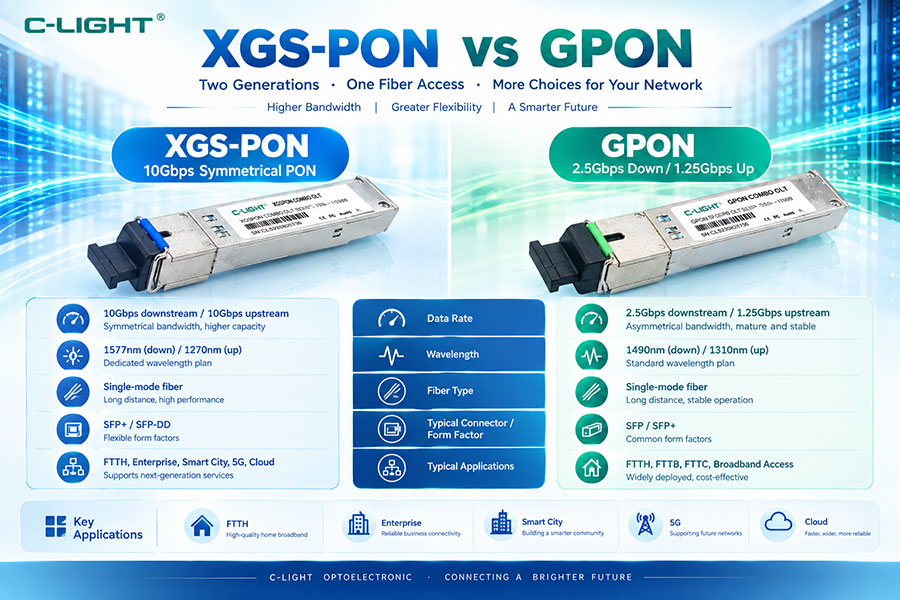
Common GPON deployments use approximately 1490 nm downstream and 1310 nm upstream, while EPON deployments traditionally use approximately 1490 nm downstream and 1310 nm upstream as well. Exact wavelength ranges depend on the applicable standard and optical implementation.
19. GPON Optical Modules
GPON optical modules are designed specifically for GPON OLT or ONU applications. Their optical parameters include transmit power, receiver sensitivity, wavelength, optical budget, and monitoring functions.
For example, GPON ONU SFP modules can integrate directly into compatible network equipment and provide the optical interface required for GPON access.
20. EPON Optical Modules
EPON optical modules are designed for EPON OLT or ONU equipment and follow the optical requirements of the corresponding EPON implementation.
Although GPON and EPON modules can look physically similar, they should not be considered interchangeable merely because both use SFP-style packaging.
21. GPON vs EPON Interoperability
GPON and EPON are separate technologies with different protocol stacks and management mechanisms.
A GPON OLT normally requires a GPON-compatible ONU, while an EPON OLT requires an EPON-compatible ONU. Physical connector compatibility does not guarantee protocol interoperability.
22. Can a GPON ONU Work with EPON?
A conventional GPON ONU cannot simply be connected to an EPON OLT and expected to operate normally.
Some products are designed as dual-mode or hybrid PON devices and can support both technologies, but this capability must be explicitly specified by the manufacturer.
23. Split Ratio
Both GPON and EPON can use passive optical splitters with different split ratios.
Common deployments may use 1:32 or 1:64 configurations, while higher split ratios can also be implemented when the optical power budget and network design permit them.
The practical split ratio depends on optical budget, fiber distance, connector loss, splitter loss, engineering margin, and the requirements of the selected optical modules.
24. Optical Power Budget
Optical power budget is an important factor in both GPON and EPON networks.
The available budget must cover fiber attenuation, splitter loss, connector loss, splice loss, and engineering margin. A higher split ratio generally introduces greater splitter loss and therefore places greater demands on the optical link budget.
25. GPON DBA and QoS
GPON provides mechanisms for service-aware bandwidth control and QoS management. This is useful when different services have different traffic priorities or latency requirements.
For operator networks carrying multiple service types, bandwidth scheduling is therefore an important part of GPON system design.
26. EPON QoS
EPON can also implement QoS through Ethernet priorities, traffic classification, bandwidth allocation, and higher-layer network policies.
The difference is largely architectural: EPON retains a strong Ethernet orientation, while GPON uses a dedicated PON transport framework.
27. GPON vs EPON Deployment
GPON has been widely deployed by telecommunications operators for fiber-to-the-home and fiber-to-the-building services.
EPON has also been widely used in access networks, particularly in environments where Ethernet-based networking has been a major design consideration.
28. FTTH Applications
Both GPON and EPON are suitable for FTTH deployments.
The selection depends on the operator's existing network architecture, equipment ecosystem, management platform, subscriber requirements, optical budget, and migration strategy.
29. Enterprise Applications
Both technologies can support enterprise access, although enterprise networks may have different requirements from residential broadband networks.
Businesses may require higher upstream bandwidth, stronger service isolation, predictable QoS, or dedicated optical connectivity. These requirements need to be considered independently of the choice between GPON and EPON.
30. GPON vs EPON Upgrade Paths
Neither technology should be evaluated only by its traditional line rate. Modern access networks increasingly use higher-speed PON generations.
GPON can evolve toward technologies such as XG-PON and XGS-PON, while the EPON ecosystem has corresponding higher-speed Ethernet PON technologies such as 10G-EPON.
31. Coexistence with Higher-Speed PON
Operators can design migration architectures in which multiple PON generations coexist on the same outside plant by using different optical wavelengths and compatible optical components.
This can allow existing fiber infrastructure to support higher-speed subscribers without immediately replacing the entire access network.
32. GPON vs EPON for Existing Networks
For an existing operator, compatibility with installed OLTs, ONUs, management systems, splitters, optical modules, and provisioning platforms can be more important than the theoretical differences between the two standards.
Replacing only the subscriber-side device does not solve an incompatibility when the OLT and ONU belong to different PON technologies.
33. Why GPON and EPON Are Sometimes Confused
Both technologies use OLTs, ONUs, passive splitters, single-mode fiber, upstream time sharing, and similar physical network topologies.
They can therefore look very similar from the outside. The important differences appear in the protocol layer, framing, management, bandwidth allocation, optical specifications, and equipment interoperability.
34. GPON vs EPON: Which Parameters Matter Most?
When comparing actual equipment, focus on more than nominal bandwidth. Important parameters include downstream and upstream line rates, optical transmit power, receiver sensitivity, optical budget, split ratio, maximum reach, connector type, wavelength plan, ONU compatibility, management features, and service support.
35. Common Selection Mistakes
A frequent mistake is assuming that all PON SFP modules are interchangeable. Another is selecting an ONU solely according to the connector or package type without checking the actual PON protocol.
Optical power budget is another common issue. Even when the OLT and ONU are protocol-compatible, excessive splitter loss, fiber attenuation, connector loss, or distance can prevent reliable operation.
36. GPON vs EPON for Optical Module Selection
When selecting a GPON or EPON optical module, verify the protocol, wavelength, data rate, transmit power, receiver sensitivity, temperature range, optical budget, connector configuration, and host compatibility.
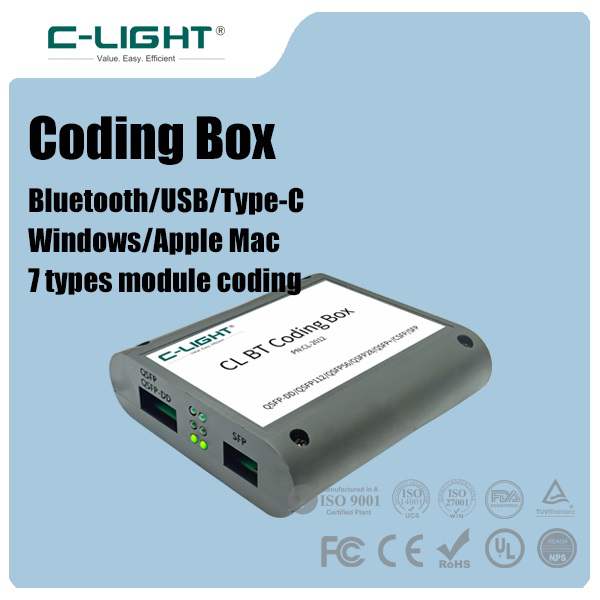
For OEM and replacement applications, EEPROM coding and host-device interoperability can also be important because the module may need to be recognized correctly by the target OLT, switch, router, or access platform.
37. GPON vs EPON Summary
| Item | GPON | EPON |
|---|---|---|
| Technology foundation | ITU-T PON | IEEE Ethernet PON |
| Typical downstream | 2.488 Gb/s | 1.25 Gb/s |
| Typical upstream | 1.244 Gb/s | 1.25 Gb/s |
| Transport model | GEM | Ethernet |
| Traffic handling | Designed for multiple service types | Strong Ethernet orientation |
| Upstream scheduling | DBA | Dynamic bandwidth allocation through EPON control mechanisms |
| Typical deployment | Telecom FTTH and broadband access | Ethernet-oriented access networks and FTTH |
| Compatibility | GPON-specific equipment | EPON-specific equipment |
38. Conclusion
GPON and EPON share the same basic passive optical access concept, but they are fundamentally different technologies at the protocol and system level. GPON provides a dedicated broadband PON transport framework with approximately 2.488 Gb/s downstream and 1.244 Gb/s upstream line rates in its common implementation, while traditional EPON provides symmetrical 1.25 Gb/s line rates with an Ethernet-oriented architecture.
For network planning, the choice should not be based on line rate alone. OLT and ONU compatibility, optical budget, split ratio, service requirements, management functions, existing infrastructure, and future migration plans should all be considered when designing a GPON or EPON network.
 >
>

 >
>
 >
>
 >
>
 >
>
 >
>
 >
>
 >
>