TEL:+86 132 6656 7067





Optical technology is expanding beyond conventional telecommunications and data-center connectivity. Advances in photonic integration, optical sensing, laser systems, wavelength control and high-speed transmission are creating new applications across industrial automation, autonomous systems, healthcare, aerospace, scientific instrumentation and advanced computing.
These applications require specialized optical components rather than a single universal product category. High-speed transceivers support digital infrastructure, while fiber sensors, photonic integrated circuits, laser sources, optical switches and precision detectors address different physical and system-level requirements. Product selection increasingly depends on the interaction between optical performance, environmental conditions, mechanical integration and application-specific interfaces.
1. Optical Technology Beyond Conventional Data Transmission
Traditional optical communication systems primarily use light to transmit digital information between network endpoints. Emerging applications extend the role of photonics into measurement, imaging, navigation, signal processing and physical interaction with the environment.
Several technological developments are driving this expansion:
Photonic integration: Multiple optical functions are combined on compact chips to reduce component size and improve integration density.
Advanced optical materials: Silicon nitride, thin-film lithium niobate, indium phosphide and other materials support different waveguide, modulation and light-generation requirements.
Precision optical detection: Improved detectors support weak-signal measurement, high-speed sensing and specialized imaging.
Optical switching: Photonic switching elements enable flexible routing of light between selected ports or channels.
Wavelength-selective technologies: Filters, multiplexers and integrated resonators provide more precise control over optical signals.
These developments are creating specialized product markets that overlap with telecommunications but often require different packaging, calibration, reliability and interface specifications.
2. Silicon Photonics and Photonic Integrated Circuits
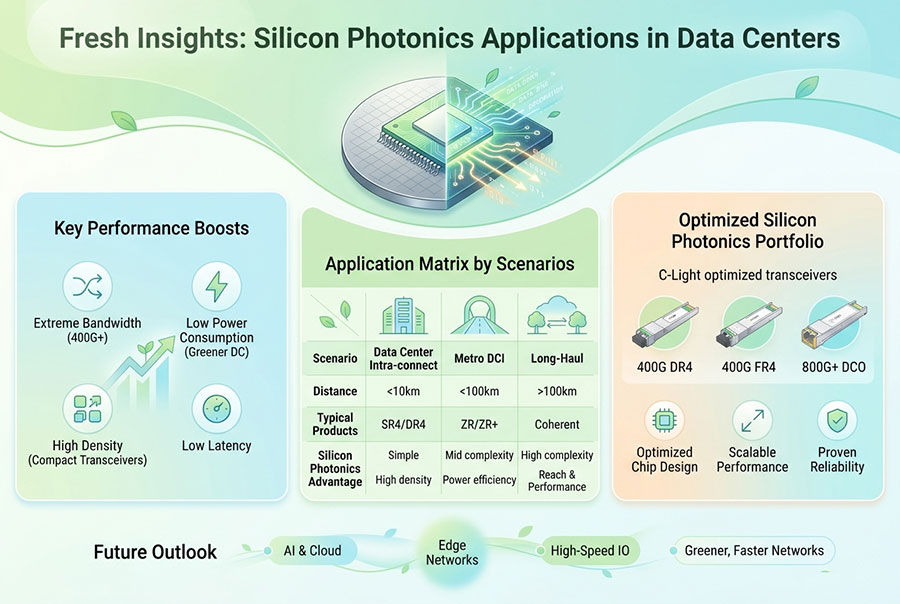
Silicon photonics integrates optical waveguides and other photonic functions onto semiconductor-based platforms. Instead of assembling every optical component as a separate device, designers can integrate multiple functions into a photonic integrated circuit (PIC).
A PIC may contain waveguides, modulators, photodetectors, filters, splitters, couplers and wavelength-management structures. Depending on the platform, external laser sources or additional semiconductor materials may be required to provide functions that silicon does not efficiently perform on its own.
Silicon photonics has established applications in high-speed optical communications and is also being developed for sensing, LiDAR, optical computing and quantum photonics.
| Photonic Component | Primary Function | Application Areas |
|---|---|---|
| Optical Waveguide | Guides light through a defined optical path | PICs, optical routing and signal processing |
| Electro-Optic Modulator | Controls optical signal properties using an electrical input | High-speed transmitters and microwave photonics |
| Photodetector | Converts incident optical power into an electrical signal | Receivers, sensing and optical measurement |
| Wavelength Filter | Selects or suppresses specific optical wavelengths | WDM systems, spectroscopy and integrated optics |
| Optical Coupler | Transfers optical power between waveguides or fibers | Fiber-to-chip interfaces and PIC packaging |
Manufacturing challenges include fiber-to-chip coupling loss, thermal sensitivity, process variation, packaging tolerances and long-term reliability. These factors determine whether a photonic circuit can move from a laboratory demonstration into a repeatable commercial product.
3. Optical Sensing for Industrial Monitoring
Optical sensing is increasingly used to monitor physical conditions in industrial equipment, infrastructure and production environments. Fiber-optic sensors can measure temperature, strain, vibration, pressure and other parameters by detecting changes in light intensity, wavelength, phase or polarization.
Unlike conventional electrical sensors, fiber-optic sensing systems can operate over long distances and provide immunity to electromagnetic interference along the sensing fiber. These properties are useful in environments containing high-voltage equipment, strong electromagnetic fields or geographically distributed assets.
Major application areas include:
Power infrastructure: Temperature and condition monitoring around transformers, substations and high-voltage equipment.
Oil and gas facilities: Distributed temperature and acoustic monitoring along pipelines and industrial installations.
Structural monitoring: Strain and vibration measurement on bridges, tunnels, buildings and large mechanical structures.
Manufacturing: Optical measurement in automated production lines and specialized machinery.
Environmental monitoring: Detection of temperature changes, chemical conditions and physical disturbances.
Specialized products include fiber Bragg grating sensors, distributed temperature sensing systems, distributed acoustic sensing systems and optical interrogation units. Their specifications depend on measurement range, spatial resolution, sampling rate, accuracy and environmental requirements.
4. LiDAR and Optical Ranging Systems
Light Detection and Ranging (LiDAR) uses emitted optical signals and reflected-light measurements to determine distance and construct spatial information. Depending on the architecture, LiDAR systems may use pulsed time-of-flight, frequency-modulated continuous-wave (FMCW) or other optical ranging techniques.
LiDAR is used in autonomous navigation, industrial robotics, surveying, infrastructure inspection, mobile mapping and environmental measurement. Different applications require different combinations of range, resolution, field of view, update rate and resistance to environmental interference.
| LiDAR Architecture | Operating Principle | Key Design Considerations |
|---|---|---|
| Time-of-Flight | Measures the time required for emitted light to return | Pulse timing, detector sensitivity and ranging accuracy |
| FMCW LiDAR | Uses frequency-modulated optical signals and coherent detection | Laser stability, chirp linearity and coherent receiver performance |
| Flash LiDAR | Illuminates a scene and captures reflected light across an array | Detector-array performance, illumination power and image resolution |
| Scanning LiDAR | Directs an optical beam across a field of view | Beam steering, scanning speed and mechanical or solid-state reliability |
Specialized optical components include laser diodes, optical phased arrays, beam-steering elements, narrowband filters, avalanche photodiodes and single-photon detectors. The selection of these components is strongly linked to the wavelength, detection architecture and target operating environment.
5. Free-Space Optical Communication
Free-space optical communication transmits information through an unguided optical path rather than a physical fiber. Optical beams can connect buildings, ground stations, aircraft, satellites and other platforms without requiring a continuous fiber route.
Potential applications include:
Building-to-building wireless optical links.
High-capacity satellite-to-satellite communication.
Ground-to-satellite and satellite-to-ground optical links.
Airborne and high-altitude platform communication.
Temporary high-bandwidth connections where fiber installation is impractical.
Free-space optical systems can provide high data rates and narrow-beam communication, but atmospheric turbulence, clouds, fog, pointing accuracy and platform movement affect link availability. Satellite systems also require precise acquisition, tracking and pointing mechanisms.
Typical specialized products include optical terminals, laser transmitters, beam expanders, acquisition and tracking assemblies, optical receivers and precision alignment systems. These are application-specific products and should not be treated as interchangeable with conventional Ethernet optical transceivers.
6. Quantum Photonics and Single-Photon Devices
Quantum photonics uses individual photons or controlled quantum states of light to support information processing, secure communication, precision measurement and specialized imaging. Unlike conventional optical communication, which generally represents information through classical signal states, quantum photonic systems require control over properties such as photon number, polarization, phase and time-bin states.
Key components include:
Single-photon sources: Generate individual photons or controlled quantum light states.
Single-photon detectors: Detect extremely weak optical signals, including individual photons.
Quantum random number generators: Use quantum optical processes to generate random values.
Quantum key distribution components: Support optical encoding, detection and measurement for quantum communication systems.
Optical delay and switching components: Manage timing and routing within quantum photonic circuits.
Superconducting nanowire single-photon detectors, avalanche photodiodes and integrated photonic circuits serve different wavelength, sensitivity and operating-temperature requirements. Detector efficiency, dark-count rate, timing jitter and system integration are important selection criteria.
Quantum photonics remains a specialized field with different levels of commercial maturity across communication, sensing and computing applications. Component specifications must be evaluated against the actual quantum protocol and optical architecture.
7. Biomedical Photonics and Optical Diagnostic Systems
Biomedical photonics uses light for imaging, measurement, diagnosis and selected therapeutic procedures. Optical techniques can provide non-invasive or minimally invasive access to biological structures and processes, depending on the wavelength, penetration depth and imaging method.
Representative technologies include:
Optical Coherence Tomography (OCT): Uses low-coherence interferometry to produce cross-sectional images of biological tissue.
Endoscopic imaging: Uses optical systems to capture images inside the body through compact instruments.
Fluorescence imaging: Detects emitted light from fluorescent markers or naturally fluorescent biological structures.
Raman spectroscopy: Uses inelastic light scattering to obtain molecular information.
Fiber-optic probes: Deliver light and collect optical signals in compact diagnostic instruments.
Specialized products include miniature optical lenses, fiber probes, laser sources, optical filters, photodetectors, spectrometers and photonic chips. Medical applications require additional attention to biocompatibility, sterilization, electrical safety, optical exposure limits and regulatory requirements.
8. Optical Spectroscopy and Chemical Detection
Optical spectroscopy identifies materials by measuring how they interact with light across selected wavelengths. Absorption, emission, reflection and scattering patterns can provide information about chemical composition, molecular structure and material condition.
Specialized optical spectroscopy systems are used in industrial process monitoring, pharmaceutical manufacturing, environmental analysis, food inspection and laboratory instrumentation.
| Technique | Measurement Principle | Typical Application |
|---|---|---|
| Absorption Spectroscopy | Measures wavelength-dependent light absorption | Gas concentration and chemical analysis |
| Raman Spectroscopy | Measures inelastic scattering from molecular vibrations | Material identification and molecular characterization |
| Fluorescence Spectroscopy | Measures light emitted after optical excitation | Biological analysis and chemical detection |
| Near-Infrared Spectroscopy | Measures absorption features in the near-infrared region | Moisture, composition and process monitoring |
| Mid-Infrared Spectroscopy | Uses molecular absorption features in the mid-infrared | Gas sensing and molecular identification |
Specialized optical products include broadband light sources, tunable lasers, wavelength filters, optical fibers, detectors and integrated spectroscopic modules. Wavelength coverage, spectral resolution, detector sensitivity and calibration stability determine system performance.
9. Optical Switching and Reconfigurable Photonic Networks
Optical switching allows light paths to be connected, disconnected or redirected between different ports. It is relevant to data-center networks, optical test systems, telecommunications transport and research environments that require flexible optical connectivity.
Unlike conventional packet switching, an optical circuit switch establishes a physical optical path between selected endpoints. This can be useful for large and predictable data flows, but it does not provide the same fine-grained packet forwarding behavior as an electronic switch.
Specialized optical switching products include:
MEMS optical switches.
Planar lightwave circuit switches.
Wavelength-selective switching components.
Optical cross-connect systems.
Fiber-optic protection switching equipment.
Optical matrix switches for testing and measurement.
Switching performance is determined by port count, insertion loss, return loss, crosstalk, switching time, repeatability and optical power handling. Large-scale systems also require control interfaces and monitoring functions to coordinate optical paths with the wider network.
10. Specialized Optical Products for Harsh Environments
Not every optical product operates in a controlled data-center environment. Industrial automation, outdoor telecommunications, transportation infrastructure, energy systems and remote monitoring installations may expose optical equipment to wider temperature ranges, vibration, dust, humidity and power fluctuations.
Specialized optical products are designed around the actual environmental and mechanical requirements of the deployment.
| Product Category | Application Environment | Key Requirements |
|---|---|---|
| Industrial Optical Transceivers | Factory automation, outdoor cabinets and industrial Ethernet | Specified temperature range, vibration tolerance and link stability |
| Ruggedized Fiber Assemblies | Transportation, energy and outdoor installations | Mechanical protection, connector durability and environmental sealing |
| Optical Protection Systems | Critical transport and access networks | Automatic path switching and continuity monitoring |
| High-Power Optical Components | Laser systems and optical amplification | Power handling, thermal stability and optical damage resistance |
| Specialized Fiber Sensors | Infrastructure and industrial process monitoring | Measurement accuracy, environmental stability and calibration |
Temperature grade alone does not establish full industrial suitability. The complete product must be evaluated for humidity, vibration, shock, contamination, power supply variation and other conditions specified by the application.
11. Optical Amplification and Specialized Transport Components
Optical amplification supports transmission over longer distances and helps maintain signal levels in optical transport networks. Different amplifier technologies serve different wavelength bands, power levels and network architectures.
Erbium-doped fiber amplifiers (EDFAs) are widely used in C-band and L-band optical transmission systems. Raman amplifiers use stimulated Raman scattering in optical fiber to provide distributed or lumped amplification. Semiconductor optical amplifiers can support specialized amplification and switching functions in selected optical systems.
Other specialized transport products include:
DWDM MUX/DEMUX: Combines or separates multiple wavelength channels on a shared fiber pair.
OADM and ROADM: Adds, drops or redirects selected wavelength channels within optical networks.
Optical Line Protection: Provides switching between optical paths when a primary route fails.
Dispersion Compensation: Addresses chromatic dispersion in systems where the selected transmission design requires it.
Optical Monitoring: Measures channel power and other parameters for transport-system supervision.
C-LIGHT WDM and OTN Solutions
The C-LIGHT WDM and OTN portfolio covers optical transport equipment and components for wavelength multiplexing, signal amplification, optical add/drop functions and network protection.
These product categories can be combined according to channel count, wavelength plan, fiber characteristics, optical budget and network topology.
12. Optical Product Selection Across Emerging Applications
Specialized optical products should be selected according to the complete system requirement. A component that performs well in a laboratory environment may not meet the mechanical, thermal or reliability requirements of an industrial installation.
| Selection Parameter | Engineering Consideration | Relevant Product Types |
|---|---|---|
| Wavelength | Match source, fiber, detector and system spectral requirements | Lasers, transceivers, filters and detectors |
| Optical Power | Maintain sufficient signal level without exceeding receiver or component limits | Amplifiers, transmitters and optical sensors |
| Bandwidth | Meet the required data rate, modulation and signal-processing performance | Optical transceivers, modulators and photodetectors |
| Insertion Loss | Account for connectors, splices, filters, couplers and switching elements | Fiber assemblies, MUX/DEMUX and optical switches |
| Environmental Conditions | Verify temperature, humidity, vibration and contamination limits | Industrial transceivers and ruggedized optical assemblies |
| Integration | Confirm mechanical dimensions, electrical interface and control requirements | Pluggable modules, PICs and optical engines |
| Reliability | Evaluate operating lifetime, stability, qualification and maintenance requirements | All application-specific optical products |
For network connectivity applications, C-LIGHT provides optical transceiver options across multiple data rates and form factors. The C-LIGHT optical transceiver portfolio can be referenced when specifying Ethernet, data-center and optical transport interfaces.
13. Future Development of Specialized Photonic Products
Emerging optical applications are moving toward higher integration, improved energy efficiency and more application-specific functionality. Photonic integrated circuits are expanding from data communication into sensing, signal processing and quantum technologies. Silicon photonics and heterogeneous integration are enabling different optical materials and functions to coexist within compact systems.
Several development directions are particularly relevant:
Integrated LiDAR: Photonic beam steering, coherent detection and compact optical ranging systems.
Optical computing: Photonic circuits for specialized signal processing and computing acceleration.
Quantum networks: Single-photon sources, detectors, optical switches and quantum-compatible transmission components.
Biomedical photonics: Miniaturized imaging, spectroscopy and fiber-optic diagnostic devices.
Advanced optical sensing: Distributed sensing and integrated spectroscopic measurement systems.
High-density optical communication: Photonic integration, co-packaged optics and next-generation optical I/O.
Commercial adoption will depend on manufacturing scalability, packaging reliability, calibration, interoperability and the availability of application-specific testing. The transition from a photonic device to a deployable product requires complete system qualification, not simply improved optical performance at component level.
Conclusion: Emerging optical applications are extending photonics into industrial sensing, LiDAR, biomedical imaging, quantum communication, optical switching and advanced computing. Each field requires specialized products with distinct wavelength, bandwidth, detection, packaging and environmental characteristics. As photonic integration advances, optical components will become increasingly important across both communication infrastructure and specialized technology systems.
For optical transceiver requirements, high-speed connectivity and specialized optical product inquiries, Contact C-LIGHT.
 >

 >
 >
 >
 >
 >
 >
 >