TEL:+86 132 6656 7067




ER and ZR are the two interfaces that carry high-capacity traffic between data centers across a metro or regional area. ER reaches 30 to 40 kilometers. ZR reaches 80 to 120 kilometers on an amplified DWDM line, and over 1000 kilometers in its extended-reach forms. The distance gap is roughly threefold on unamplified links, but the more consequential difference is the detection architecture: ER uses direct detection, and ZR uses coherent detection.
That architectural difference changes what each interface can do. ER transmits intensity-modulated PAM4 signals and recovers only the intensity at the receiver. ZR transmits coherent DP-16QAM signals and recovers the full optical field—amplitude, phase, and polarization—by mixing the incoming light with a local oscillator. The coherent DSP in ZR compensates for chromatic dispersion and polarization effects electronically, which is why ZR can span distances that would require regeneration with direct-detect optics.
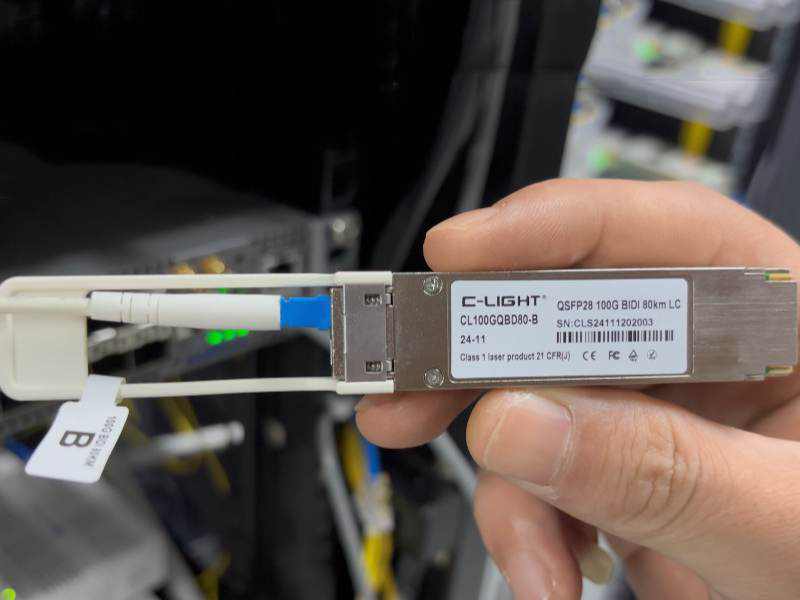
ER and ZR both use duplex LC connectors and two fibers per link. They both plug into QSFP-DD or OSFP cages. On the surface they look similar. Underneath, they are different technologies serving different segments of the transport hierarchy.
1. Detection Architecture: Direct Detect vs Coherent
ER is a direct-detect interface. The transmitter varies the intensity of the optical carrier across four levels—PAM4—and the receiver measures that intensity with a photodiode. There is no phase information in the signal, no polarization tracking, and no local oscillator. The DSP performs equalization and forward error correction, but it does not need to compensate for chromatic dispersion or polarization mode dispersion because the receiver never captures that information.
ZR is a coherent interface. The transmitter encodes information in the amplitude, phase, and polarization of the optical carrier using DP-16QAM. The receiver mixes the incoming signal with a local oscillator laser in a 90-degree optical hybrid, producing outputs that preserve the full optical field. The coherent DSP then recovers the data by compensating for chromatic dispersion, polarization mode dispersion, and carrier phase noise in the digital domain.
The practical consequence is reach. A direct-detect ER link at 30 to 40 kilometers operates near the limit of what PAM4 can achieve without dispersion compensation. A coherent ZR link at 80 to 120 kilometers handles far greater dispersion because the DSP corrects it electronically. The coherent receiver’s ability to recover phase and polarization is what enables the longer reach.
| Parameter | ER | ZR |
|---|---|---|
| Detection Method | Direct detect (intensity only) | Coherent (amplitude, phase, polarization) |
| Local Oscillator | None | Required |
| Modulation Format | PAM4 | DP-16QAM |
| Bits per Symbol | 2 | 8 |
| Polarization | Single | Dual |
| DSP Complexity | Moderate (equalization, FEC) | High (CD compensation, polarization tracking, carrier recovery) |
2. Reach and Fiber Plant
ER is rated for 30 to 40 kilometers. It uses LAN-WDM wavelengths around 1310 nm, multiplexed onto a single fiber pair. The link is point-to-point: a dedicated fiber pair connects two endpoints, and there is no line system between them. The power budget is sized for 40 kilometers of fiber loss plus connector and splice loss, with margin for aging.
ZR is rated for 80 to 120 kilometers on an amplified DWDM line. It uses a tunable laser in the C-band around 1550 nm. The module plugs into a DWDM line system that includes erbium-doped fiber amplifiers, multiplexers, and reconfigurable optical add/drop multiplexers. The amplifiers extend the reach across multiple spans, and the ROADMs route individual wavelengths to different destinations. ZR cannot operate at its rated distance without this line system.
The fiber plant requirement is the structural difference between the two. An ER link needs a dedicated fiber pair and nothing else. A ZR link needs a DWDM line system with amplification and wavelength routing. The cost and complexity of that line system are part of the ZR deployment, not the module itself.
| Parameter | ER | ZR |
|---|---|---|
| Rated Reach | 30–40 km | 80–120 km (400ZR) |
| Extended Reach | Not applicable | 1000+ km with 400ZR+ |
| Fiber Plant | Point-to-point duplex LC | DWDM line system with EDFA and ROADM |
| Wavelength | LAN-WDM around 1310 nm | DWDM C-band around 1550 nm |
| Fiber Attenuation | ~0.35 dB/km | ~0.2 dB/km |
| Amplification | Not used | EDFA on the line system |
3. Wavelength and Laser
ER uses fixed-wavelength EMLs at LAN-WDM wavelengths around 1310 nm. The 400GBASE-ER8 interface uses eight wavelengths, each carrying 50G PAM4, multiplexed onto a single fiber pair. The wavelengths are fixed by the standard and cannot be tuned. The laser is temperature-controlled to maintain wavelength stability, but it does not need to select among DWDM channels.
ZR uses a tunable laser in the C-band. The laser can select any channel on the ITU-T G.694.1 grid, which allows the module to plug into any DWDM line system and use any available wavelength. The tunable laser includes a thermoelectric cooler and a wavelength locker to maintain precise wavelength accuracy. This is one of the most significant cost and complexity differences between the two interfaces.
The wavelength band also affects fiber attenuation. ER at 1310 nm has approximately 0.35 dB/km of fiber loss. ZR at 1550 nm has approximately 0.2 dB/km. Over 80 kilometers, that difference is 12 dB, which is a substantial part of the ZR link budget. The lower attenuation at 1550 nm is one of the reasons ZR can reach farther even before amplification is considered.
| Parameter | ER | ZR |
|---|---|---|
| Wavelength Band | O-band (1310 nm) | C-band (1550 nm) |
| Wavelength Plan | LAN-WDM, fixed | DWDM, tunable |
| Laser Type | Fixed-wavelength EML | Tunable laser with TEC and wavelength locker |
| Wavelength Selection | None (fixed at manufacture) | Software-selectable on ITU grid |
| Fiber Attenuation | ~0.35 dB/km | ~0.2 dB/km |
4. Modulation and DSP
ER uses PAM4 modulation with a direct-detect DSP. The DSP performs equalization and forward error correction, but it does not need to compensate for chromatic dispersion, polarization mode dispersion, or carrier phase noise. The signal processing is simpler and consumes less power than a coherent DSP.
ZR uses DP-16QAM modulation with a coherent DSP. The DSP performs chromatic dispersion compensation, polarization tracking and demultiplexing, carrier phase recovery, adaptive equalization, and soft-decision forward error correction. These functions require significantly more computational power and consume more of the module’s power budget. The coherent DSP is the single largest power consumer in a ZR module.
The modulation format also affects spectral efficiency. A 400ZR channel carries 400G in approximately 60 GHz of spectrum. A 400GBASE-ER8 link carries 400G across eight wavelengths, each occupying its own spectral slot. In a DWDM system where spectrum is the scarce resource, coherent modulation allows more capacity per fiber.
| Parameter | ER | ZR |
|---|---|---|
| Modulation | PAM4 | DP-16QAM |
| Bits per Symbol | 2 | 8 |
| DSP Functions | Equalization, FEC | CD compensation, polarization tracking, carrier recovery, adaptive equalization, FEC |
| DSP Power Share | Moderate | Majority of module power |
| Spectral Efficiency | Lower | Higher |
5. Power Consumption
ER modules consume less power than ZR modules of comparable data rate. A 400GBASE-ER8 module typically draws 14 to 16 watts. A 400ZR module draws 15 to 20 watts, and a 400ZR+ module draws 20 to 25 watts. The difference comes from the coherent DSP, the tunable laser with its thermoelectric cooler, and the local oscillator.
At 800G, the gap narrows. An 800GBASE-ER8 module draws 20 to 24 watts, while an 800ZR module draws 20 to 25 watts. The coherent DSP is amortized over more capacity, reducing the per-gigabit power penalty. But the absolute power per module remains higher for ZR, and in a high-density switch chassis, that difference affects the thermal design.
| Module | Typical Power | Primary Power Consumers |
|---|---|---|
| 400G ER8 | 14–16 W | Eight fixed-wavelength EMLs, PAM4 DSP |
| 400ZR | 15–20 W | Coherent DSP, tunable laser, TEC, local oscillator |
| 400ZR+ | 20–25 W | Higher-performance coherent DSP, higher-power laser |
| 800G ER8 | 20–24 W | Eight 100G PAM4 EMLs, PAM4 DSP |
| 800ZR | 20–25 W | Coherent DSP at 120 GBaud, tunable laser |
6. Standard and Ecosystem
ER is defined by IEEE 802.3. The 100GBASE-ER4 interface is specified in IEEE 802.3ba, the 400GBASE-ER8 interface in IEEE 802.3bs, and the 800GBASE-ER8 interface in IEEE 802.3df. The IEEE specification defines the optical parameters, the lane count, the wavelength plan, and the connector.
ZR is defined by the Optical Internetworking Forum. The 400ZR Implementation Agreement defines an interoperable coherent interface for 400G over DWDM links up to 120 kilometers. The 800ZR Implementation Agreement extends the same model to 800G. OpenZR+ is an MSA that builds on the OIF standards, adding multi-rate operation and more powerful FEC for extended reach beyond 120 kilometers.
The two standards ecosystems are distinct. ER modules are IEEE-compliant client interfaces. ZR modules are OIF-compliant line-side interfaces. A router or switch port that supports ER cannot accept a ZR module unless the port is explicitly configured for coherent operation.
| Standard | Interface | Reach | Body |
|---|---|---|---|
| IEEE 802.3ba | 100GBASE-ER4 | 30–40 km | IEEE |
| IEEE 802.3bs | 400GBASE-ER8 | 30–40 km | IEEE |
| IEEE 802.3df | 800GBASE-ER8 | 30–40 km | IEEE |
| OIF 400ZR | 400ZR | 80–120 km | OIF |
| OIF 800ZR | 800ZR | 80–120 km | OIF |
| OpenZR+ MSA | 400ZR+, 800ZR+ | Extended | MSA |
7. Where ER Fits
ER connects data centers within a metropolitan area at distances of 30 to 40 kilometers. It uses a dedicated fiber pair and does not require a DWDM line system. The module is a direct-detect PAM4 transceiver with fixed LAN-WDM wavelengths and a duplex LC connector. It plugs into a standard client port on a router or switch.
ER is used for metro DCI where the distance exceeds what LR can cover, long campus backbones that span more than 10 kilometers, and carrier transport between a central office and a remote access point. It is the highest-reach direct-detect interface in the IEEE Ethernet family.
8. Where ZR Fits
ZR connects data centers across a region at distances of 80 to 120 kilometers on an amplified DWDM line. It uses a tunable laser and plugs into a DWDM line system with EDFAs and ROADMs. The coherent DSP compensates for the dispersion and polarization effects that accumulate over the longer span.
ZR is used for regional DCI, metro and regional transport over ROADM-based line systems, and AI scale-across deployments where compute clusters in separate buildings or campuses must be connected as a single fabric. The coherent interface is the only pluggable option that can carry 400G or 800G across these distances without regeneration.
| Application | ER | ZR |
|---|---|---|
| Metro DCI (30–40 km) | Primary | Possible |
| Regional DCI (40–120 km) | Not viable without regeneration | Primary |
| Long Campus Backbone (30–40 km) | Primary | Possible |
| AI Scale-Across (40–120 km) | Not viable | Primary |
| DWDM Line System | Not applicable | Required |
| Point-to-Point Fiber | Primary | Possible |
9. Cost Profile
ER modules cost less than ZR modules. The 400GBASE-ER8 module uses direct-detect PAM4 with fixed-wavelength lasers and a simpler DSP. The 400ZR module contains a coherent DSP, a tunable laser, a local oscillator, and a 90-degree optical hybrid, all of which add cost.
The premium for ZR over ER is substantial—roughly 2 to 3 times the module cost, depending on the vendor and the data rate. But ZR replaces an entire transport layer. A direct-detect ER link that needs to reach 80 kilometers would require regeneration equipment, which costs more and adds latency. ZR eliminates that regeneration by carrying the signal coherently across the distance in a single pluggable module.
The total cost of ownership calculation depends on the link. For a 30-kilometer link on a dedicated fiber pair, ER is the lower-cost option. For an 80-kilometer link on a DWDM line system, ZR is the only pluggable option, and its cost is compared against the cost of a transponder-based transport solution, not against ER.
| Cost Element | ER | ZR |
|---|---|---|
| Module Cost | Lower | 2–3× higher |
| Laser Type | Fixed-wavelength EML | Tunable laser with TEC |
| DSP | PAM4 DSP | Coherent DSP |
| Line System | Not required | DWDM with EDFA and ROADM |
| Regeneration | Required beyond 40 km | Eliminated for 80–120 km links |
| Total Cost (30–40 km) | Lower | Higher |
| Total Cost (80–120 km) | Not viable without regeneration | Lower than regenerated direct-detect |
10. Comparison Summary
| Dimension | ER | ZR |
|---|---|---|
| Detection | Direct detect | Coherent |
| Reach | 30–40 km | 80–120 km (400ZR) |
| Extended Reach | Not applicable | 1000+ km with 400ZR+ |
| Wavelength | LAN-WDM around 1310 nm | DWDM C-band around 1550 nm |
| Modulation | PAM4 | DP-16QAM |
| Laser | Fixed-wavelength EML | Tunable laser |
| DSP | PAM4 DSP | Coherent DSP |
| Module Power | 14–24 W | 15–25 W |
| Module Cost | Lower | Higher |
| Line System | Point-to-point | DWDM with ROADM and EDFA |
| Standard | IEEE 802.3 | OIF 400ZR / 800ZR |
| Primary Application | Metro DCI and long campus | Regional DCI and AI scale-across |
11. Selection Framework
The choice between ER and ZR is determined by distance, fiber plant, and the presence or absence of a DWDM line system.
Distance under 40 kilometers on a dedicated fiber pair: ER. The module is cheaper, lower in power, and does not require a line system.
Distance between 40 and 80 kilometers without a DWDM line system: Neither ER nor ZR is ideal. ER cannot reach without regeneration, and ZR requires a DWDM line system to operate. A regenerated ER link or a coherent-lite solution may be appropriate.
Distance between 80 and 120 kilometers on a DWDM line system: ZR. The coherent interface plugs into the line system, uses a tunable laser, and eliminates regeneration.
Distance beyond 120 kilometers on an amplified DWDM line: 400ZR+ or 800ZR+. These extended-reach coherent variants support 500 to 1000+ kilometers over amplified spans.
The presence or absence of a DWDM line system is as important as the distance. ER does not interface with a DWDM line system. ZR requires one. If the fiber plant is a dedicated point-to-point pair under 40 kilometers, ER is the appropriate interface. If the fiber plant is a DWDM line system and the link spans 80 kilometers or more, ZR is the appropriate interface.
12. Summary
ER and ZR are two interfaces that sit on opposite sides of the coherent-direct detect boundary. ER is a direct-detect PAM4 interface for 30 to 40-kilometer links on dedicated fiber pairs. ZR is a coherent interface for 80 to 120-kilometer links on DWDM line systems, with extended-reach variants that support over 1000 kilometers on amplified spans.
The reach gap is the most visible difference, but it is not the only one. ZR uses a tunable laser, a coherent DSP, and a 90-degree optical hybrid. ER uses a fixed-wavelength laser and a PAM4 DSP. ZR consumes more power and costs more per module. ER is simpler, cheaper, and lower in power for the distances it covers.
The two interfaces do not compete. ER serves the metro and long-campus segments where a dedicated fiber pair is available and the distance is under 40 kilometers. ZR serves the regional DCI and AI scale-across segments where a DWDM line system is present and the distance exceeds 40 kilometers. The choice between them is determined by the fiber plant and the distance, not by a performance comparison.
 >
>

 >
>
 >
>
 >
>
 >
>
 >
>
 >
>
 >
>