TEL:+86 132 6656 7067





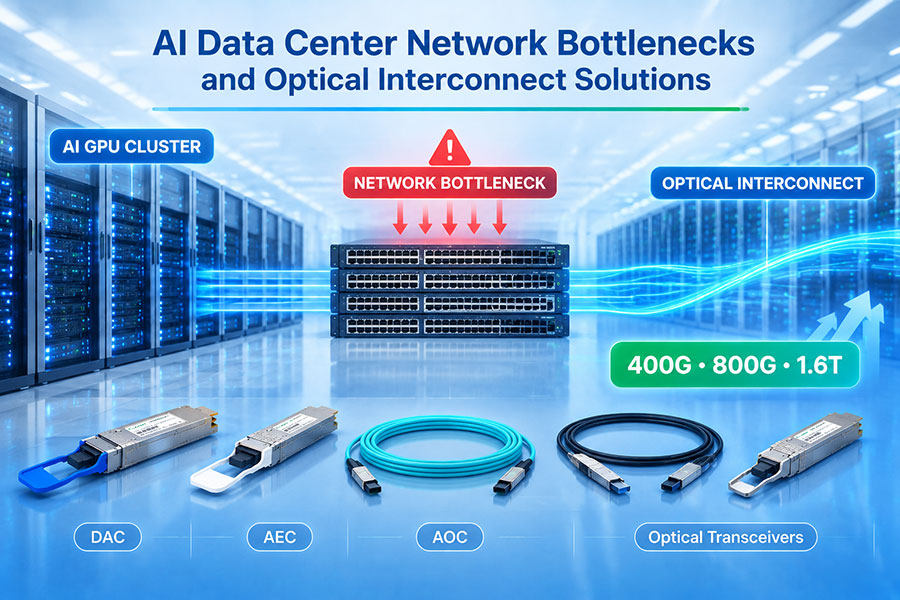
High-speed data center networks require reliable connections between switches, servers, storage systems, and AI computing infrastructure. As Ethernet and InfiniBand speeds increase from 100G to 400G and 800G, cable selection becomes increasingly important for managing transmission distance, power consumption, port density, and installation costs.
Direct Attach Copper (DAC) and Active Optical Cable (AOC) are two widely used interconnect solutions. Both integrate connectors into a fixed-length cable assembly, eliminating the need to purchase separate optical transceivers and patch cords. However, they use different transmission media and have different electrical, optical, and physical characteristics.
1. What Is a DAC Cable?
DAC stands for Direct Attach Copper. It is a high-speed cable assembly that uses copper twinax conductors to transmit electrical signals directly between compatible network ports.
Unlike a conventional optical transceiver connection, a DAC cable integrates its connector interfaces into both cable ends. This eliminates the need for separate optical modules and fiber patch cords.
DAC cables are commonly used for:
Switch-to-server connections within the same rack.
Switch-to-NIC connections in data center servers.
Top-of-rack switch interconnections.
Short-distance connections between adjacent network devices.
GPU and switch connections in AI computing clusters.
DAC products are available in passive and active configurations.
Passive DAC: Uses copper conductors without active signal-conditioning electronics in the cable assembly. It has very low power requirements and is generally selected for the shortest connections.
Active DAC: Incorporates signal-conditioning electronics to improve electrical signal performance and extend practical reach compared with passive DAC. Its power consumption and supported distance depend on the implementation.
2. What Is an AOC Cable?
AOC stands for Active Optical Cable. It combines optical transceiver components and fiber optic cable into one integrated assembly. The connectors at both ends convert electrical signals into optical signals and convert received optical signals back into electrical signals.
Unlike DAC, AOC uses optical fiber as the transmission medium. This allows it to support longer distances while maintaining a relatively lightweight and flexible cable structure.
AOC cables are commonly used in:
Switch-to-switch connections across different racks.
Data center spine-leaf network connections.
High-performance computing interconnects.
AI training clusters and GPU networks.
Storage networks requiring longer short-reach connections.
Most high-speed AOC products use multimode fiber, although the actual fiber type, wavelength, and supported distance depend on the product design.
3. DAC vs AOC: Main Technical Differences
The primary difference between DAC and AOC is their transmission medium. DAC uses electrical signals over copper conductors, while AOC uses optical signals over fiber. This affects transmission distance, power requirements, physical dimensions, and installation flexibility.
| Technical Feature | DAC Cable | AOC Cable |
|---|---|---|
| Full Name | Direct Attach Copper | Active Optical Cable |
| Transmission Medium | Copper twinax | Optical fiber |
| Signal Type | Electrical | Optical within the cable, electrical at the host interfaces |
| Signal Conversion | No optical conversion | Electrical-to-optical and optical-to-electrical |
| Typical Distance | Short, model-dependent | Longer short-reach connections |
| Power Consumption | Passive DAC requires virtually no active power | Requires power for optical conversion at both ends |
| Latency | Generally lowest | Very low, with additional conversion circuitry |
| EMI Immunity | Good, depending on cable shielding and installation | Excellent; fiber does not conduct electromagnetic interference |
| Cable Weight | Generally heavier | Generally lighter |
| Cable Flexibility | Usually thicker and less flexible | Usually thinner and easier to route |
| Cost | Generally lower | Generally higher |
| Typical Application | Short in-rack connections | Cross-rack and longer data center connections |
4. Transmission Distance: How Far Can DAC and AOC Reach?
Transmission distance is one of the most important factors when selecting between DAC and AOC. Copper cable attenuation and signal integrity limitations restrict the practical reach of DAC, particularly at higher data rates. AOC uses optical transmission to support longer cable runs.
Typical product configurations illustrate the difference:
| Data Rate | DAC Configuration | AOC Configuration | Application |
|---|---|---|---|
| 10G | Short copper connections | Longer short-reach fiber connections | Enterprise and data center networks |
| 25G | Short server connections | Rack-to-rack connections | Server and switch interconnection |
| 100G | Short-distance DAC options | Commonly available in multi-meter configurations | Data center switching |
| 400G | Typically up to a few meters | Commonly available for distances up to tens of meters | AI clusters and high-speed switching |
| 800G | Very short-distance configurations | Longer short-reach optical connections | AI and hyperscale data centers |
For example, C-LIGHT's listed 400G DAC configurations cover 0.5–3 meters, while its 400G AOC product family supports 1–30-meter configurations. These are product-specific ranges rather than universal limits for every DAC or AOC design.
5. Power Consumption and Latency
Power consumption is another major consideration in high-density network environments. Passive DAC has a clear advantage because it does not require active optical conversion or signal-processing electronics within the cable assembly.
AOC requires electrical power for its optical transmitter and receiver components at both ends. The total power depends on the data rate, optical architecture, and module implementation.
| Performance Factor | Passive DAC | Active DAC | AOC |
|---|---|---|---|
| Active Electronics | No | Yes | Yes |
| Power Requirement | Virtually zero active power | Low, implementation-dependent | Required at both ends |
| Signal Conditioning | No active conditioning | Electrical signal conditioning | Optical conversion and signal processing |
| Latency Characteristics | Lowest | Very low | Very low |
Passive DAC is generally the preferred option when minimizing power consumption and latency is critical. AOC introduces optical conversion circuitry, but its latency remains very low for typical data center interconnect applications.
For large-scale deployments, engineers should evaluate total system power rather than looking only at the cable. Cable count, switch port power budgets, thermal conditions, and network topology all influence overall energy consumption.
6. Cable Size, Weight, and Installation Flexibility
Physical cable characteristics become increasingly important as data center port density increases. Large numbers of high-speed connections can create cable congestion around switches, server racks, and cable management trays.
DAC cables generally use thicker copper conductors and shielding. At high data rates, their physical size and bend characteristics can make cable routing more challenging, especially when many connections are installed in a limited space.
AOC cables use optical fiber, which generally allows a thinner and lighter cable assembly. This can simplify cable routing between racks and reduce physical congestion in high-density installations.
| Installation Consideration | DAC | AOC |
|---|---|---|
| Cable Diameter | Generally larger | Generally smaller |
| Weight | Heavier | Lighter |
| Bend Radius | Usually larger | Usually smaller, subject to fiber specifications |
| Cable Management | More challenging in dense installations | Generally easier for longer cable runs |
| Electromagnetic Interference | Requires suitable shielding and routing | Optical fiber is immune to conducted electromagnetic interference |
7. Cost Comparison: DAC vs AOC
DAC is generally more economical for short-distance connections because its construction is simpler and passive versions do not require optical conversion components.
AOC has a higher component cost because it integrates optical transmitters, receivers, and fiber into a single cable assembly. However, the additional cost may be justified when longer reach, lower cable weight, or better electromagnetic immunity is required.
The total deployment cost should include more than the purchase price of the cable:
Initial hardware cost: DAC generally costs less for short connections.
Power requirements: Passive DAC reduces active cable power consumption.
Installation labor: AOC may simplify cable management in dense environments.
Rack layout: Longer AOC connections can provide more flexibility when equipment is distributed across racks.
Maintenance: Both cable types require appropriate handling and compatibility verification.
For a short connection between two adjacent ports, DAC is often the more cost-effective choice. For a longer connection across a data center, AOC may provide a better overall installation solution.
8. DAC vs AOC in 400G and 800G Networks
As network speeds increase, the limitations of copper transmission become more important. Higher signaling rates increase the challenges associated with insertion loss, signal attenuation, and electrical channel performance.
At 400G, DAC is widely used for short-distance connections between switches, servers, and network interface cards. AOC is useful when the required connection exceeds the practical reach of the selected copper assembly.
At 800G, cable selection becomes even more dependent on lane rate, connector design, electrical channel quality, and the host platform. Very short DAC connections remain useful, while AOC supports longer optical connections without requiring separate optical modules and patch cords.
| Network Environment | DAC Application | AOC Application |
|---|---|---|
| 400G ToR Switching | Short switch-to-server links | Longer connections between racks |
| 800G AI Clusters | Short GPU and switch interconnects | Optical links between distributed network devices |
| Leaf-Spine Architecture | Short connections within a rack | Links between leaf and spine switches where longer reach is needed |
| High-Density Server Racks | Cost-effective local connectivity | Reduced cable weight and improved routing flexibility |
9. C-LIGHT DAC and AOC Cable Solutions
C-LIGHT provides high-speed DAC and AOC cable assemblies for data center networking, enterprise infrastructure, InfiniBand systems, and AI computing environments. Available product families cover multiple data rates and connector configurations.
C-LIGHT 400G DAC supports QSFP-DD-related configurations and offers listed cable lengths from 0.5 to 3 meters. It is designed for short-distance 400G connections in data centers, enterprise networks, and high-performance computing environments.
C-LIGHT 400G AOC uses multimode fiber with 850nm optical transmission. The product family includes OSFP112, QSFP112, and QSFP-DD configurations, with listed distances from 1 to 30 meters. Breakout configurations are also available for selected interfaces.
C-LIGHT's cable portfolio includes 10G, 25G, 40G, 100G, 200G, 400G, and higher-speed interconnect solutions, alongside ACC and AEC cable families. Interface options and supported lengths vary by product model.
For customized cable assemblies, customers should confirm connector form factor, data rate, cable length, host equipment model, protocol, and breakout requirements before ordering.
10. How to Choose Between DAC and AOC
The best choice depends on the actual network layout and connection requirements. A simple selection process can help avoid unnecessary cost and compatibility problems.
| Requirement | Recommended Option | Reason |
|---|---|---|
| Very short in-rack connection | DAC | Low cost and minimal active power requirements. |
| Lowest possible cable power consumption | Passive DAC | No active optical conversion or signal-conditioning electronics. |
| Longer connection between racks | AOC | Optical fiber supports longer reach than typical passive DAC. |
| High cable density | AOC | Generally lighter and easier to route. |
| Strong electromagnetic interference immunity | AOC | Optical fiber does not conduct electromagnetic interference. |
| Lowest initial cost for short links | DAC | Simpler construction and lower component cost. |
| High-speed optical interconnection | AOC | Supports optical transmission through integrated fiber assemblies. |
Before purchasing either cable type, verify the following information:
Switch and server model compatibility.
Required data rate and supported protocol.
Connector form factor, such as SFP28, QSFP28, QSFP-DD, QSFP112, or OSFP.
Required cable length and installation route.
Passive or active cable requirements.
Breakout configuration, if required.
Operating temperature and cable installation conditions.
11. Conclusion
DAC and AOC cables serve different purposes in high-speed network infrastructure. DAC provides a simple, economical, and low-power solution for short-distance copper connections. AOC uses integrated optical components and fiber to support longer reach, lighter cable assemblies, and excellent immunity to electromagnetic interference.
For short connections inside a rack, DAC is often the practical choice. For connections between racks or installations where cable weight and routing flexibility matter, AOC can offer a more suitable solution.
As 400G and 800G networks continue to expand in AI clusters and hyperscale data centers, selecting the appropriate cable architecture helps maintain reliable connectivity while balancing power, cost, distance, and installation requirements.
C-LIGHT provides high-speed cable solutions for data centers, AI infrastructure, enterprise networks, and InfiniBand applications.
Contact C-LIGHT >

 >
 >
 >
 >
 >
 >
 >