TEL:+86 132 6656 7067





High-speed copper interconnects remain important in data centers, AI clusters, and high-performance computing systems. As Ethernet and InfiniBand interfaces move toward 400G, 800G, and 1.6T, maintaining electrical signal integrity over short cable connections becomes increasingly challenging.
Direct Attach Copper (DAC) and Active Copper Cable (ACC) are two solutions for these connections. Both use copper conductors and integrated connectors, but they differ in how electrical signals are handled. DAC relies on a passive electrical path, while ACC adds active signal-conditioning circuitry to improve transmission performance.
1. What Is a DAC Cable?
DAC stands for Direct Attach Copper. It is a factory-terminated high-speed copper cable assembly with connector modules attached to both ends. The cable typically uses shielded twinaxial copper conductors to transmit electrical signals directly between compatible network devices.
A passive DAC does not contain active signal-conditioning components in its data path. Instead, the host transmitter and receiver handle the electrical signal conditioning required for the connection.
Common DAC applications include:
Switch-to-server connections within the same rack.
Top-of-rack switch connections to network interface cards.
Short-distance links between storage and computing systems.
GPU server connections in AI infrastructure.
Short-reach Ethernet and InfiniBand interconnects.
The main advantages of passive DAC are low cost, minimal power requirements, low latency, and a relatively simple internal structure. Its primary limitation is transmission distance, which becomes more restrictive as lane speeds increase.
2. What Is an ACC Cable?
ACC stands for Active Copper Cable. It is a copper cable assembly that integrates active electronic components into the connector modules to improve electrical signal quality.
Unlike passive DAC, ACC does not rely entirely on the host equipment to compensate for cable-related signal degradation. Active circuitry helps condition the electrical signal, allowing selected ACC designs to support longer connections than comparable passive copper assemblies.
Depending on the implementation, ACC may incorporate:
Linear equalizers: Compensate for frequency-dependent channel loss.
Redriver circuits: Restore signal amplitude and improve the electrical waveform.
Pre-emphasis: Adjust signal characteristics to compensate for transmission-channel impairments.
Power-management circuitry: Supplies and controls the active components.
ACC is particularly useful when a passive DAC connection approaches its electrical channel limits but the network design still favors copper rather than optical transmission.
3. DAC vs ACC: Main Technical Differences
The most important difference is the presence of active signal-conditioning electronics. This changes the cable's power requirements, achievable reach, signal behavior, and compatibility considerations.
| Technical Feature | DAC Cable | ACC Cable |
|---|---|---|
| Full Name | Direct Attach Copper | Active Copper Cable |
| Transmission Medium | Copper twinax | Copper twinax |
| Signal Transmission | Passive electrical transmission | Active electrical transmission |
| Active Components | None in passive signal path | Signal-conditioning electronics |
| Signal Conditioning | Handled primarily by host SerDes | Additional conditioning inside cable connectors |
| Transmission Distance | Generally shorter | Can extend beyond passive DAC limits |
| Power Consumption | Virtually zero active cable power | Requires power for active circuitry |
| Latency | Very low | Very low; depends on circuitry |
| Cost | Generally lower | Generally higher |
| Signal Integrity | Dependent on cable channel and host equalization | Additional signal conditioning helps compensate for channel loss |
| Typical Application | Short in-rack connections | Short-to-medium copper connections where passive reach is insufficient |
4. Transmission Distance: How Far Can DAC and ACC Reach?
Transmission distance is one of the main reasons to consider ACC instead of passive DAC. Copper cables experience insertion loss, frequency-dependent attenuation, reflections, and crosstalk. These impairments become more difficult to manage as signaling rates increase.
Passive DAC depends on the electrical characteristics of the cable and the host SerDes. ACC adds signal-conditioning circuitry to compensate for some of these impairments, potentially extending the supported cable length.
| Data Rate | Passive DAC | ACC | Deployment Consideration |
|---|---|---|---|
| 100G | Commonly used for short connections | Available for selected extended-reach copper links | Check lane rate and electrical channel limits |
| 200G | Short-reach configurations | Can extend selected copper connections | Verify host and cable electrical specifications |
| 400G | Typically a few meters, depending on design | Can support longer configurations than passive DAC | Signal conditioning and host compatibility are important |
| 800G | Very short connections | Selected configurations can extend to several meters | Lane rate, connector design, and cable implementation matter |
For example, C-LIGHT's 800G ACC product family lists cable lengths from 0.5 to 5 meters depending on configuration. This provides additional flexibility for high-speed copper connections where a passive DAC may not meet the required reach.
5. Power Consumption and Latency
Passive DAC has a power advantage because it does not require active signal-conditioning electronics in the cable's data path. This makes it attractive for dense switch installations where many short connections are deployed simultaneously.
ACC requires electrical power for its active components. However, it can still provide a power-efficient alternative to optical connections in suitable short-reach applications.
| Performance Factor | Passive DAC | ACC |
|---|---|---|
| Active Electronics | None in signal path | Integrated signal-conditioning circuitry |
| Active Power | Virtually zero | Required; implementation-dependent |
| Signal Processing | No active cable-side conditioning | Electrical signal conditioning |
| Processing Latency | Minimal | Low, depending on circuit architecture |
| Thermal Considerations | Primarily related to cable and surrounding equipment | Active components generate additional heat |
ACC should not automatically be considered a high-latency solution. Linear signal-conditioning circuits can introduce very little additional delay compared with more complex retiming architectures. Actual latency must be confirmed from the product design and measured system performance.
6. Signal Integrity: Passive Transmission vs Active Conditioning
At high data rates, the electrical signal traveling through copper is affected by several channel impairments. These include insertion loss, return loss, crosstalk, impedance discontinuities, and inter-symbol interference.
Passive DAC does not contain active circuitry to compensate for these effects. Its performance therefore depends heavily on cable construction, shielding, connector quality, and the equalization capabilities of the host SerDes.
ACC introduces additional signal conditioning at the cable ends. A linear equalizer or redriver can compensate for selected channel losses and improve the electrical signal presented to the receiving device.
There is an important limitation: a simple redriver does not necessarily recover the original transmitted data or remove accumulated jitter. It may also amplify noise along with the desired signal. Its performance depends on the specific circuit and the quality of the incoming signal.
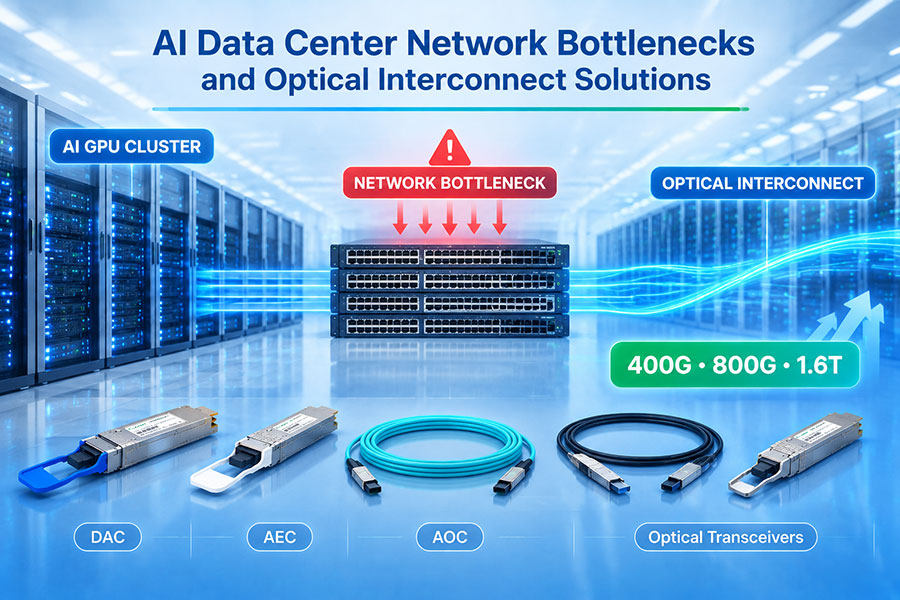
7. DAC vs ACC vs AEC: Understanding Active Copper Technologies
DAC, ACC, and AEC all use copper conductors, but they differ in their signal-processing architectures. Understanding these distinctions helps engineers select the appropriate cable for a particular electrical channel.
| Feature | DAC | ACC | AEC |
|---|---|---|---|
| Transmission Medium | Copper | Copper | Copper |
| Active Components | None in passive signal path | Redriver or linear equalizer, depending on design | Typically retimer-based electronics |
| Signal Processing | Passive transmission | Signal amplification or linear conditioning | Retiming and signal regeneration |
| Power Requirement | Virtually zero active cable power | Active power required | Active power required |
| Latency | Lowest | Very low, implementation-dependent | Depends on retimer architecture |
| Reach Potential | Shortest | Extended beyond passive DAC in suitable designs | Can support longer electrical channels |
| Typical Role | Cost-efficient short connections | Extended-reach active copper | Higher-performance active electrical links |
ACC is often considered when passive DAC cannot provide sufficient reach but a full retimer-based AEC is not necessary. AEC may be more suitable when the electrical channel requires stronger signal recovery and regeneration.
The exact distinction must be checked against the manufacturer's block diagram and datasheet because product terminology and internal implementations can vary.
8. Applications in 400G and 800G AI Data Centers
AI training systems and high-performance computing environments require large numbers of high-speed connections between GPUs, network adapters, switches, and storage systems. Copper interconnects remain useful for short connections because they can offer low latency and avoid optical conversion.
DAC applications
Short GPU server-to-switch connections.
Server-to-NIC links within the same rack.
Short top-of-rack switch connections.
Cost-sensitive high-density electrical interconnects.
ACC applications
High-speed links where passive DAC reach is insufficient.
Selected connections between adjacent racks.
400G and 800G short-reach copper interconnects.
AI and HPC systems requiring additional electrical signal conditioning.
At higher data rates, the decision should be based on measured channel performance rather than cable type alone. Host SerDes capability, connector quality, PCB routing, and the active cable's electrical design all influence link reliability.
9. C-LIGHT 800G ACC and High-Speed Copper Cable Solutions
C-LIGHT provides high-speed copper interconnect solutions for data centers, AI computing infrastructure, cloud networks, and InfiniBand systems. Its cable portfolio includes passive DAC, active ACC, AEC, and AOC configurations.
C-LIGHT's 800G ACC product family is designed for high-bandwidth copper interconnections in AI data centers and high-performance computing environments. Available configurations include QSFP-DD and OSFP112 interfaces, with selected breakout options for connecting 800G ports to 400G and 200G interfaces.
The product page lists cable lengths from 0.5 to 5 meters depending on the configuration.
C-LIGHT's 800G DAC family provides passive copper connectivity for compatible high-speed network equipment. It is intended for short-reach connections where low power consumption and a direct electrical path are important.
C-LIGHT's product range includes 800G DAC, 800G ACC, 800G AEC, and other high-speed cable solutions. These technologies address different electrical channel requirements and deployment distances.
When selecting a cable, customers should provide the switch or server model, connector form factor, required data rate, protocol, cable length, and breakout configuration. Compatibility should be confirmed for both endpoints and the specific cable implementation.
10. How to Choose Between DAC and ACC
The right cable depends on the required distance, electrical channel quality, power budget, and host equipment capabilities.
| Deployment Requirement | Recommended Option | Selection Reason |
|---|---|---|
| Very short in-rack connection | DAC | Simple construction, low cost, and minimal power. |
| Lowest possible cable power | Passive DAC | No active signal-conditioning components. |
| Passive copper reach is insufficient | ACC | Active conditioning can extend practical copper reach. |
| Additional signal regeneration is required | AEC | Retimer-based processing can recover and regenerate the signal. |
| Longer connection requiring optical transmission | AOC or optical transceivers | Fiber supports longer distances than typical copper assemblies. |
| High-density AI network deployment | DAC or ACC, depending on reach | Selection depends on channel performance, port layout, and power budget. |
Before deployment, engineers should verify:
Host switch, NIC, or server compatibility.
Supported Ethernet or InfiniBand protocol.
Connector form factor, such as QSFP-DD, QSFP112, or OSFP.
Electrical lane rate and cable length.
Active cable power and thermal requirements.
Signal-conditioning architecture and host equalization support.
Breakout mapping and endpoint compatibility.
BER and link stability under actual operating conditions.
11. Conclusion
DAC and ACC are both copper-based interconnect solutions, but they serve different electrical transmission requirements. Passive DAC offers a simple, low-cost, low-power connection for short distances. ACC adds active signal-conditioning electronics to improve signal quality and extend the practical reach of copper links.
For short connections within a rack, passive DAC is often the most economical option. When a connection exceeds the practical limits of passive copper but still falls within the supported reach of an active copper design, ACC can provide a useful alternative.
For more demanding electrical channels, AEC may offer additional signal recovery through retiming, while AOC and optical transceivers provide alternatives when longer reach is required. Selecting the correct solution requires evaluating the complete link, including cable architecture, host SerDes, connector interfaces, power, and system compatibility.
Contact C-LIGHT for high-speed copper interconnect options, product specifications, compatibility evaluation, and customized cable requirements.
Contact C-LIGHT >

 >
 >
 >
 >
 >
 >
 >