TEL:+86 132 6656 7067




1. Introduction
DAC cables and fiber optic connections are both widely used for high-speed networking. The main difference is the transmission medium: DAC uses copper twinaxial cable, while fiber uses optical transmission through multimode or single-mode fiber with separate optical transceivers.
2. What Is a DAC Cable?
DAC stands for Direct Attach Copper. A DAC cable is a fixed-length cable assembly with high-speed connectors attached at both ends. Passive DAC relies mainly on the copper path, while active DAC adds signal-conditioning electronics to extend reach.
3. What Is a Fiber Connection?
A fiber connection normally consists of optical transceivers installed in the network equipment and a separate fiber optic cable connecting the transceivers. The optical path can use multimode fiber (MMF) or single-mode fiber (SMF).
4. Basic Transmission Principle
DAC carries electrical signals directly through copper conductors:
Host → Electrical Signal → Copper DAC → Host
A fiber link converts electrical data into light and then back into an electrical signal:
Host → Optical Transceiver → Light → Fiber → Optical Transceiver → Host
5. DAC vs Fiber Architecture
| Feature | DAC | Fiber |
|---|---|---|
| Transmission Medium | Copper twinax | Optical fiber |
| Conversion | Electrical only | Electrical to optical to electrical |
| Cable Structure | Fixed cable assembly | Separate cable and transceivers |
| Typical Reach | Short reach | Short to long reach |
| Upgrade Flexibility | More limited | Higher |
6. Reach Difference
Reach is one of the clearest differences. DAC is normally used for short connections within a rack or between closely positioned devices. At higher data rates, copper reach becomes increasingly constrained by insertion loss and signal integrity.
7. Typical DAC Reach
Passive DACs are commonly available in short lengths such as 1m to 5m. Active copper designs can extend the usable distance further, with the exact reach depending on the data rate and cable architecture.
8. Fiber Reach
Fiber supports a much wider range of distances. Short-reach multimode links can cover data center connections, while single-mode solutions can extend from kilometers to much longer distances depending on the optical transceiver and standard.
9. 10G DAC vs Fiber
At 10GbE, DAC is commonly used for short switch-to-server or switch-to-switch connections. Fiber provides more flexibility when the link must extend beyond practical copper distances or needs to pass through structured cabling.
10. 25G DAC vs Fiber
25G DAC is widely used for short data center server connections. Fiber becomes more attractive when longer reach, higher cable-management flexibility, or future network expansion is required.
11. 100G DAC vs Fiber
100G DAC can be used for short high-bandwidth connections, including breakout architectures. Fiber-based 100G solutions provide greater reach and a broader selection of optical interfaces such as SR4, DR, LR4, and other architectures.
12. 400G DAC vs Fiber
At 400G, copper reach becomes more restrictive because of the high electrical bandwidth involved. Passive and active DAC solutions can serve short connections, while optical transceivers provide substantially greater reach and more deployment flexibility.
13. 800G DAC vs Fiber
800G DAC is primarily intended for very short high-speed interconnects. Depending on the implementation, passive and active copper assemblies can support several meters, while fiber-based 800G solutions cover a wider range of reach and network architectures.
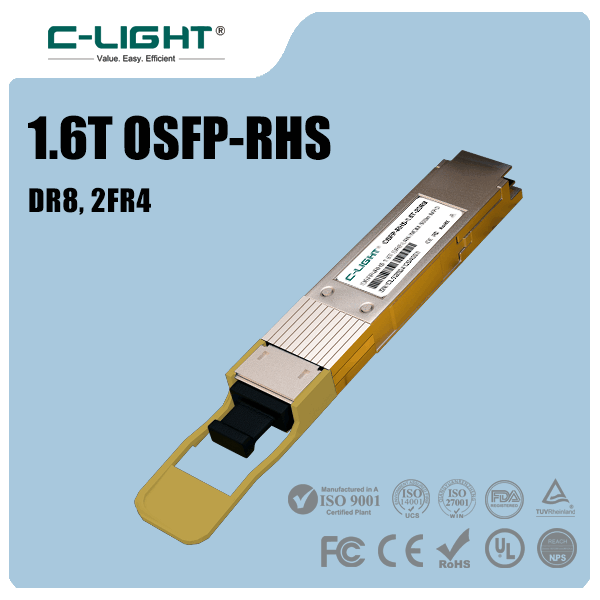
14. 1.6T DAC vs Fiber
At 1.6T, the electrical channel becomes even more demanding. Copper solutions are therefore generally focused on very short connections, while optical architectures provide a path to longer reach and greater cabling flexibility.
15. Power Consumption
One of the major advantages of passive DAC is low power consumption because there are no active optical components in the signal path. Cisco documentation, for example, reports passive DAC power below 0.5W in a 100G deployment example.
16. Active DAC Power
Active DAC adds signal-conditioning electronics and therefore consumes more power than passive DAC. The exact power depends on the cable speed, equalization architecture, and implementation.
17. Fiber Transceiver Power
Fiber links require optical transceivers with lasers, photodetectors, drivers, receivers, and other electronics. As a result, the transceiver side generally consumes more power than a passive DAC connection.
18. Latency
Both DAC and fiber can provide very low latency. DAC does not require optical conversion, while fiber links add transceiver conversion stages. In practice, the difference is usually small compared with the overall network path and depends on the specific architecture.
19. Signal Integrity
DAC performance is strongly affected by copper attenuation, insertion loss, crosstalk, impedance, connector quality, and cable length. These effects become increasingly important as lane rates rise.
20. Fiber Signal Integrity
Fiber is not subject to the same electrical insertion-loss limitations as copper, but optical links have their own constraints, including transmitter power, receiver sensitivity, dispersion, connector loss, and optical link budget.
21. Electromagnetic Interference
Fiber is inherently immune to electromagnetic interference along the optical path because information is carried by light. DAC uses electrical signaling and can be more sensitive to electromagnetic conditions depending on the installation environment.
22. Cable Weight
Copper DAC cables are generally heavier and thicker than comparable fiber cables, especially at high lane counts. In dense racks, cable weight can place additional mechanical stress on connectors and make cable management more difficult.
23. Cable Diameter and Airflow
Large bundles of copper cables can occupy significant rack space and restrict airflow. Fiber cabling is generally thinner and lighter, making it easier to manage in high-density installations.
24. Bend Radius
DAC requires attention to cable stiffness and bend radius, particularly at higher data rates. Fiber cables also have minimum bend-radius requirements, but their smaller diameter can provide more flexibility in dense cable-routing environments.
25. Installation Method
DAC is simple to deploy because the connectors and cable are already assembled. A fiber architecture requires transceivers, fiber patch cables, and sometimes additional patch panels or structured cabling components.
26. Upgrade Flexibility
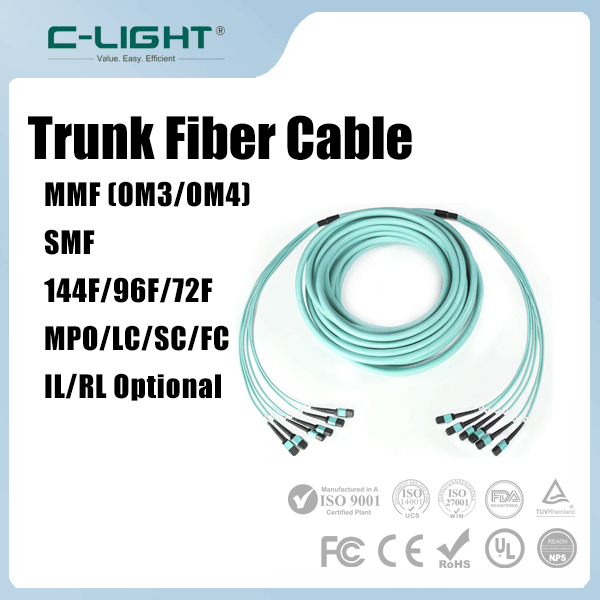
Fiber has an important advantage in infrastructure flexibility. The same fiber cabling can potentially support different generations of optical transceivers, allowing operators to upgrade the modules without replacing the entire fiber infrastructure when optical and connector requirements remain compatible.
27. Replaceability
DAC is a fixed-length assembly, so changing the connection length or cable type normally requires replacing the complete cable. With fiber, the transceiver and fiber cable are separate components and can be replaced independently.
28. Structured Cabling
Fiber is well suited to structured cabling systems using patch panels, trunks, and cross-connects. DAC is better suited to direct, short point-to-point connections where fixed cable lengths are acceptable.
29. Port Density
DAC can provide efficient short-reach connectivity, but large numbers of copper cables can quickly increase cable bulk. Fiber cabling can be easier to scale in very high-density environments where many optical links must pass through a limited cable-routing space.
30. Cost
DAC is generally less expensive for short fixed-length connections because it avoids separate optical transceivers and uses a simple copper transmission path. Fiber usually has a higher initial component cost because optical transceivers and fiber infrastructure are required.
31. Total Cost of Ownership
The lowest initial cost does not always determine the long-term cost. Fiber can reduce future cabling replacement requirements when networks are upgraded to higher speeds or longer distances, while DAC can remain economical when the topology and cable lengths are stable.
32. DAC and Breakout Connections
DAC is commonly used in breakout architectures, such as a high-speed switch port connecting to multiple lower-speed server or NIC ports. Cisco documentation lists examples including 100G to 4×25G DAC configurations.
33. Fiber Breakout Connections
Fiber can also support breakout architectures. Depending on the transceiver and cable design, one high-speed optical interface can be divided into multiple lower-speed optical links.
34. DAC for GPU-to-Switch Connections
DAC can be useful for short GPU or server-to-switch connections where devices are physically close and the required distance fits within the copper link budget. This is particularly relevant in compact high-density racks.
35. Fiber for AI Networks
Fiber becomes increasingly useful as AI clusters expand across racks, rows, and data halls. Longer reach, lower cable weight, and greater infrastructure flexibility make optical connectivity suitable for larger network fabrics.
36. DAC and AI Cluster Density
High-speed DAC can reduce connection cost and power for short links, but large numbers of copper cables can create weight, bend-radius, and airflow challenges. These factors become increasingly important as AI rack density rises.
37. Fiber Types
Fiber-based links can use multimode fiber for short-reach applications or single-mode fiber for longer distances. The appropriate transceiver and fiber combination depends on wavelength, reach, connector type, and optical standard.
38. DAC vs Fiber Maintenance
DAC maintenance is relatively straightforward because the cable is a single assembly. Fiber networks require additional attention to optical connectors, cleanliness, polarity, fiber routing, and transceiver condition.
39. Compatibility
DAC compatibility depends on the host port, data rate, lane configuration, cable coding, and supported standard. Fiber compatibility additionally requires matching optical wavelength, fiber type, connector, reach, optical budget, and transceiver specifications.
40. When to Use DAC
DAC is generally appropriate for short, fixed-length connections where low cost, low power, and simple installation are important. Typical examples include server-to-ToR, switch-to-switch, and breakout connections within the same rack or nearby equipment.
41. When to Use Fiber
Fiber is more suitable when reach, cable density, structured cabling, electromagnetic isolation, or future upgrade flexibility is important. It is widely used for links between racks, rows, network layers, and data centers.
42. DAC vs Fiber Comparison
| Category | DAC | Fiber |
|---|---|---|
| Medium | Copper | Optical fiber |
| Typical Reach | Very short | Short to long |
| Initial Cost | Lower | Higher |
| Passive Power | Very low | Requires optical transceivers |
| Weight | Higher | Lower |
| EMI Immunity | Electrical path | Optical path |
| Infrastructure Flexibility | Lower | Higher |
| Best Fit | Short fixed links | Flexible and longer links |
43. DAC vs AOC vs Fiber
DAC should not be confused with AOC. DAC uses copper, while AOC uses optical fiber with optical transceiver electronics permanently integrated into the cable assembly. AOC sits between traditional DAC and separate transceiver-plus-fiber architectures in terms of deployment model.
44. Frequently Asked Questions
Q1. What is the main difference between DAC and fiber?
Q2. Is DAC cheaper than fiber?
Q3. Which has longer reach, DAC or fiber?
Q4. Does DAC consume less power than fiber?
Q5. Is fiber better for high-density AI data centers?
Q6. Can DAC support 400G and 800G?
Q7. Is DAC lower latency than fiber?
Q8. Can existing fiber cabling be reused during a network upgrade?
45. Summary
DAC and fiber serve different roles in high-speed network design. DAC provides a simple, low-power, and cost-effective solution for short fixed connections, making it useful for server-to-switch, switch-to-switch, and breakout links. Fiber requires optical transceivers but offers greater reach, lower cable weight, better electromagnetic isolation, structured-cabling flexibility, and a broader upgrade path. As network speeds move from 100G to 400G, 800G, and 1.6T, the practical differences in reach, signal integrity, thermal conditions, cable density, and infrastructure flexibility become increasingly important. The appropriate choice depends on the link distance, network architecture, power budget, cable density, and future upgrade requirements.
 >
>

 >
>
 >
>
 >
>
 >
>
 >
>
 >
>
 >
>