TEL:+86 132 6656 7067




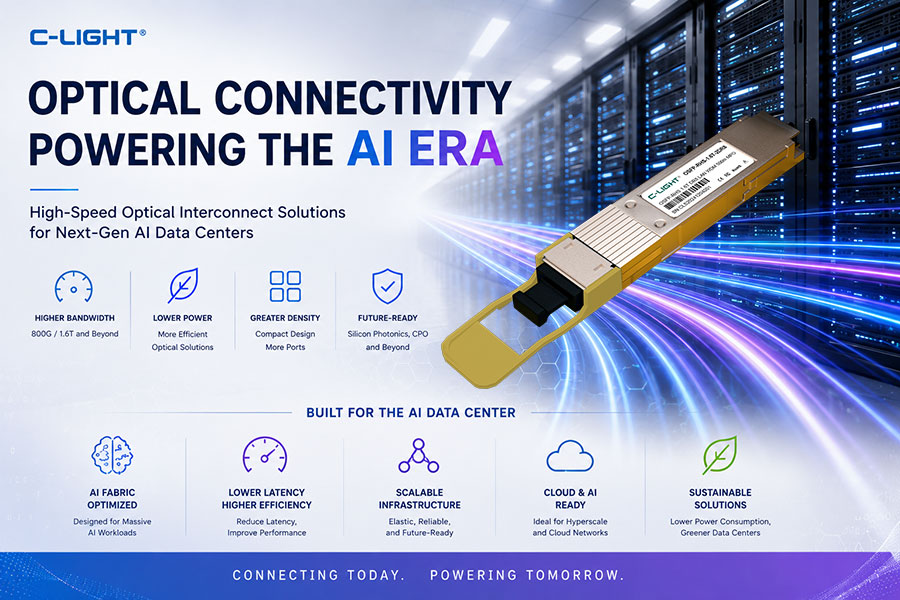
The rapid expansion of artificial intelligence is changing the architecture of modern data centers. Large-scale AI clusters require thousands of GPUs, high-performance switches, distributed storage, and increasingly complex networking fabrics. As computing performance continues to increase, the network connecting these systems has become one of the most important infrastructure layers.
This shift is creating a significant opportunity for optical communication technologies. Higher bandwidth, longer transmission distances, lower power consumption, and greater port density are becoming critical requirements for AI data center networks.
Coherent is expanding its photonics and optical communication capabilities into this rapidly growing market, leveraging its expertise in lasers, optical components, integrated circuits, and high-speed transceiver technologies. Its technology portfolio covers multiple optical platforms that can address different AI networking distances and architectures, from short-reach GPU-to-GPU connections to longer data center interconnects.
1. Why AI Data Centers Are Changing Optical Networking
Traditional data center networks were primarily designed around cloud computing, enterprise applications, storage traffic, and conventional web services. AI workloads are fundamentally different.
Large AI models require enormous amounts of data to move continuously between GPUs and networking devices. During distributed training, thousands of accelerators may operate as a coordinated computing system, creating sustained east-west traffic inside the data center.
This creates several major networking challenges:
Rapidly increasing bandwidth requirements
Increasing network port density
Lower acceptable latency
Higher power consumption from networking equipment
Increasing electrical signal loss at higher data rates
More demanding thermal management requirements
As electrical interfaces move toward higher speeds, the power and signal-integrity penalties of copper interconnects become increasingly difficult to manage. Optical connectivity therefore becomes more attractive for the high-bandwidth links that form the backbone of AI infrastructure.
2. Coherent's Advantage: A Broad Photonics Technology Stack
One of the most important characteristics of Coherent's strategy is that it is not limited to a single optical component technology.
The company has capabilities spanning semiconductor lasers, optical components, integrated circuits, transceivers, and other photonic technologies. This broad technology stack allows different optical architectures to be developed for different network requirements.
For AI data centers, this is particularly important because there is no single optical technology that is ideal for every link.
A GPU-to-GPU connection inside an AI server cluster may require a completely different solution from a connection between top-of-rack switches and spine switches, while a data center interconnect may require another optical architecture altogether.
The ability to optimize the laser, optical engine, electrical interface, packaging, and transceiver architecture together can therefore become an important competitive advantage.
3. From 400G to 800G and 1.6T
The AI networking market is accelerating the transition from 400G to 800G and subsequently toward 1.6T optical connectivity.
| Optical Speed | Typical Technology Direction | AI Networking Role |
| 400G | 100G/lane PAM4 | Established high-speed data center connectivity |
| 800G | 100G/lane or 200G/lane | Large-scale AI clusters and high-density Ethernet networks |
| 1.6T | 200G/lane | Next-generation AI networking and high-bandwidth switch platforms |
| 3.2T | Higher-speed optical lanes | Future large-scale AI infrastructure |
The transition is not simply a matter of increasing the number printed on the transceiver label. Every generation introduces new challenges in laser modulation speed, electrical signal integrity, optical coupling, thermal management, DSP architecture, packaging, and manufacturing yield.
This is why the development of high-speed optical components is becoming strategically important for AI infrastructure.
4. Laser Technology Becomes a Critical Bottleneck
At 800G and 1.6T, the optical engine must support extremely high per-lane data rates. Coherent has highlighted the importance of both VCSEL and InP-based technologies for different transmission distances and applications.
Short-reach AI connections can benefit from VCSEL technology because of its cost, power, and manufacturing advantages. Longer single-mode connections require different optical sources and architectures, where technologies such as InP-based lasers and EMLs become increasingly important.
The key point is that AI optical networking is not a one-size-fits-all market.
Short reach: Cost-effective and power-efficient optical technologies are preferred.
Medium reach: Higher-performance optical engines are required to maintain signal quality.
Longer reach: Single-mode optical technologies and higher-performance lasers become increasingly important.
Coherent has specifically described different laser technologies for AI/ML fabric links below 50 meters, switch-to-spine links extending to hundreds of meters, and longer telecommunications-access connections. :contentReference[oaicite:1]{index=1}
5. VCSEL: Still Important for Short-Reach AI Connectivity
The growth of AI networking does not mean that every optical connection will immediately move to complex single-mode architectures.
For short-distance connections, VCSEL remains an important technology because of its relatively low cost, low power consumption, and mature manufacturing ecosystem.
In AI data centers, short-reach links can represent a very large proportion of the total number of optical connections. Even a small improvement in the power consumption or cost of each connection can therefore produce a meaningful impact when multiplied across a large GPU cluster.
Coherent has developed high-speed VCSEL technology and has stated that its 100G/lane VCSEL technology is used to support 400G and 800G transceiver applications, while development toward 200G/lane VCSEL technology is intended to support future generations. :contentReference[oaicite:2]{index=2}
6. InP and EML Technologies for Higher-Speed Single-Mode Links
As transmission distance increases, single-mode fiber becomes more important. This creates demand for optical sources with higher output performance, modulation capability, and stability.
Indium phosphide (InP) technology is particularly important in high-speed optical communication because it supports advanced laser architectures for single-mode transmission.
EML technology is another important platform for high-speed optical transmission. By integrating a laser with an electro-absorption modulator, EMLs can provide high-speed modulation performance while maintaining the optical characteristics required for demanding links.
These technologies become increasingly relevant as AI networking moves toward 800G, 1.6T, and future higher-speed transceivers.
7. 200G Per Lane Changes the Architecture
One of the major technological transitions behind 1.6T networking is the move toward 200G optical lanes.
An 800G module can be implemented using multiple 100G or 200G lanes depending on the architecture. A 1.6T transceiver requires substantially higher aggregate bandwidth and therefore places significantly greater demands on every optical and electrical component.
This affects the entire transceiver design:
Laser modulation bandwidth
Driver performance
Receiver sensitivity
Optical coupling efficiency
Thermal performance
Electrical signal integrity
DSP and FEC architecture
Package design
Coherent has demonstrated 800G and 1.6T technologies based on 200G-per-lane optical architectures, illustrating the industry's movement toward higher-speed optical lanes. :contentReference[oaicite:3]{index=3}
8. Silicon Photonics Becomes Increasingly Important
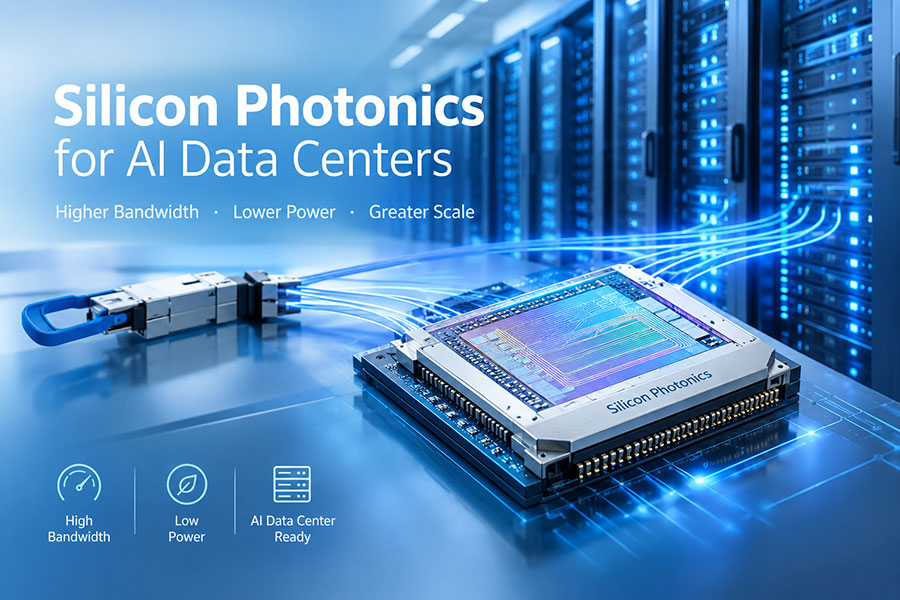
Silicon photonics is another major technology area associated with the transition to higher-speed optical networking.
Instead of treating every optical component as a separate discrete device, silicon photonics enables multiple optical functions to be integrated onto a photonic platform.
For AI data centers, the advantages can include:
Higher optical integration density
Potentially lower power consumption
Compact optical engine architectures
Scalable manufacturing
Compatibility with future high-speed optical interfaces
Coherent has introduced silicon-photonics-based transceiver technologies for AI-driven data centers and has also developed integrated driver technologies for 800G and 1.6T pluggable modules. :contentReference[oaicite:4]{index=4}
9. LPO and the Reduction of DSP Power
As optical module speeds increase, power consumption becomes one of the most important constraints.
A conventional pluggable optical transceiver may rely on DSP processing to compensate for channel impairments and maintain signal quality. However, DSPs can contribute significantly to module power consumption.
Linear Pluggable Optics (LPO) takes a different approach by reducing or eliminating some of the traditional DSP functions and relying more heavily on the host system and linear electrical-optical components.
The objective is straightforward: reduce power consumption while maintaining sufficient signal performance for short-reach and medium-reach applications.
Coherent has demonstrated 800G LPO technology, showing that its strategy extends beyond conventional DSP-based optical modules. :contentReference[oaicite:5]{index=5}
10. CPO Represents the Next Architectural Shift
The evolution from pluggable optics toward Co-Packaged Optics (CPO) represents a more fundamental architectural change.
In traditional networking equipment, the optical transceiver is installed separately from the switching ASIC. Electrical traces connect the ASIC to the pluggable optical module.
As electrical data rates increase, these traces become increasingly difficult to manage because of insertion loss, power consumption, signal integrity, and thermal constraints.
CPO moves the optical engine much closer to the switching ASIC.
This architecture can potentially reduce the length of high-speed electrical connections and improve overall system efficiency.
Coherent's technology roadmap also includes CPO-related photonics technologies, including approaches based on VCSEL architectures for AI scale-up applications. :contentReference[oaicite:6]{index=6}
11. Optical Circuit Switching and AI Networks
Optical Circuit Switching (OCS) is another area receiving increasing attention in AI data center architectures.
AI workloads are highly dynamic. The communication requirements between GPU clusters can change depending on the training workload, model architecture, and scheduling strategy.
An optical circuit switch can dynamically establish optical paths between network endpoints, potentially reducing electrical switching overhead in certain architectures.
However, OCS introduces additional optical insertion loss. This means that optical transceivers used with OCS systems may need additional link budget.
Coherent has developed 400G and 800G transceiver solutions specifically optimized for data center architectures incorporating optical circuit switches, including designs that account for additional insertion loss. :contentReference[oaicite:7]{index=7}
12. Coherent's AI Data Center Strategy Is More Than Optical Modules
It is important to understand that Coherent's expansion into AI data centers is not simply a transition from telecommunications optical modules to data center transceivers.
The more important strategy is vertical integration across multiple layers of the optical ecosystem.
Laser technology
VCSEL technology
InP-based optical sources
EML technology
Silicon photonics
Optical transceivers
High-speed driver and TIA technologies
Optical circuit switching solutions
CPO-related technologies
This broad portfolio allows Coherent to participate in multiple layers of the AI optical connectivity ecosystem rather than relying on a single product category.
13. Why 1.6T Is Only the Beginning
The move toward 1.6T optical connectivity is significant, but it should not be viewed as the final destination.
As AI accelerator performance continues to increase, network bandwidth will also need to scale. Coherent's current technology roadmap already discusses optical technologies targeting 800G, 1.6T, 3.2T, and 6.4T transceiver generations. :contentReference[oaicite:8]{index=8}
This creates a long-term technology ladder:
400G → 800G → 1.6T → 3.2T → 6.4T
Each generation will require improvements not only in optical devices but also in electrical interfaces, packaging, thermal design, optical coupling, testing, and manufacturing.
14. The Real Challenge: Power per Bit
Bandwidth alone is no longer sufficient to evaluate an optical interconnect.
For AI data centers, the more important metric is increasingly the amount of energy required to move each bit of information.
When a data center contains tens of thousands of high-speed optical links, even a small reduction in power per optical lane can generate substantial system-level benefits.
This creates strong pressure for:
Higher-efficiency lasers
Lower-power drivers and TIAs
Reduced DSP power
More efficient optical engines
Improved thermal management
Higher bandwidth per optical lane
This is one of the reasons why AI networking is accelerating the convergence of semiconductor, photonics, packaging, and networking technologies.
15. Implications for the Optical Transceiver Market
The expansion of AI infrastructure is changing the competitive landscape of the optical communication industry.
The market is gradually moving from a relatively standardized transceiver business toward a technology-intensive ecosystem where laser performance, optical integration, power efficiency, packaging, and manufacturing capabilities all matter.
Future competition will increasingly focus on several dimensions:
Higher data rates
Lower power per bit
Higher optical integration
Lower manufacturing cost
Higher production yield
Better thermal performance
Faster transition to next-generation optical standards
16. What This Means for AI Data Center Optical Connectivity
The AI data center market is creating multiple optical connectivity layers rather than one universal solution.
| Network Layer | Typical Requirement | Potential Optical Technology |
| GPU / AI Scale-Up | Very short reach, extremely high density | VCSEL, CPO, advanced optical engines |
| Scale-Out Fabric | High bandwidth and low latency | 800G / 1.6T pluggable optics |
| Switch-to-Spine | Hundreds of meters | Multimode or single-mode optical solutions |
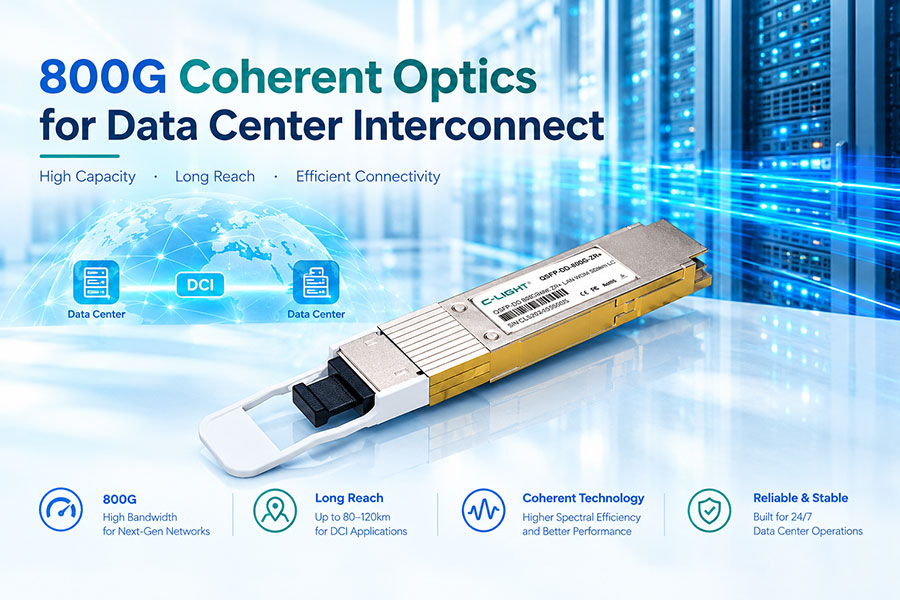
| Data Center Interconnect | Kilometers to tens of kilometers | Single-mode and coherent optical technologies |
The future AI network will therefore be a combination of different optical technologies optimized for specific distances, bandwidth requirements, power budgets, and network architectures.
17. C-LIGHT and the AI Optical Interconnect Market
The rapid transition toward AI data center networking is also creating demand for high-speed optical interconnect products across multiple generations.
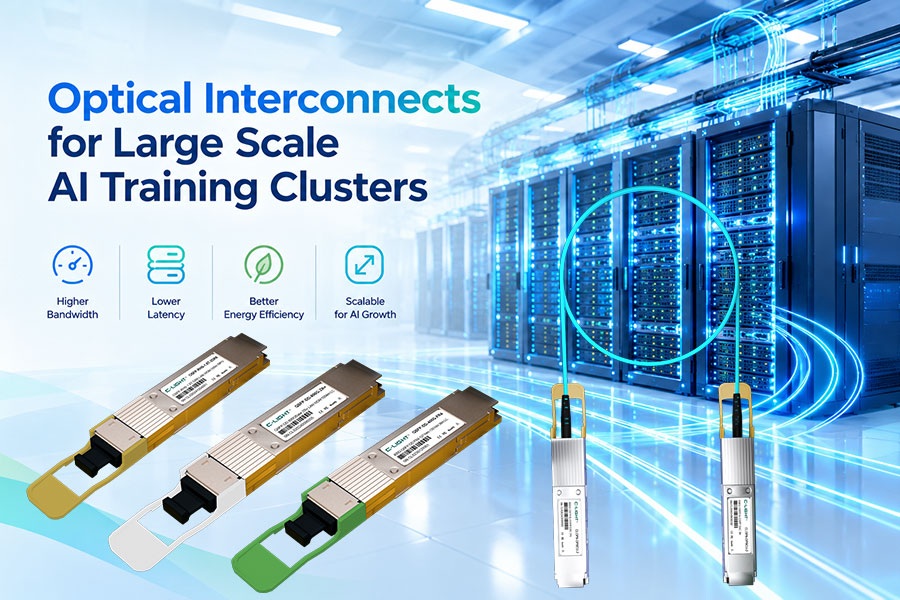
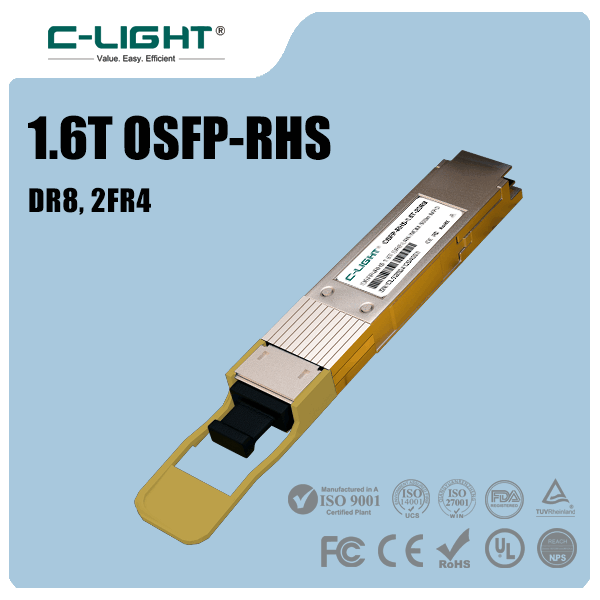
C-LIGHT provides optical connectivity solutions covering high-speed data center applications, including 400G and 800G optical transceivers as well as DAC, AOC, and AEC interconnect solutions.
For AI data center deployments, different interconnect technologies can be selected according to transmission distance, bandwidth, power consumption, system architecture, and deployment requirements.
400G optical transceivers for high-speed data center networks
800G optical modules for AI and high-performance computing environments
DAC solutions for short-distance high-density connections
AOC solutions for flexible high-speed optical connectivity
AEC solutions for active electrical interconnect applications
18. Conclusion
Coherent's expansion into the AI data center market reflects a much broader transformation taking place across the optical communication industry.
AI is pushing networking speeds beyond traditional data center requirements, while simultaneously increasing pressure on power consumption, thermal management, signal integrity, and network density.
This environment favors companies with deep expertise across lasers, optical components, integrated circuits, silicon photonics, transceivers, and optical networking systems.
The transition from 400G to 800G and 1.6T is already changing optical module architectures. Beyond 1.6T, technologies such as 200G-per-lane optics, silicon photonics, LPO, CPO, and optical circuit switching will become increasingly important.
The long-term direction is clear: AI computing is driving the optical industry from higher-speed pluggable modules toward increasingly integrated optical architectures.
400G is scaling to 800G. 800G is moving toward 1.6T. And beyond 1.6T, photonics integration will become one of the key technologies defining the next generation of AI networking.
19.Coherent Optics Expands Into the AI Data Center Market - Q&A
Q1: Why is Coherent expanding into the AI data center market?
Answer: The rapid growth of AI computing is driving strong demand for high-speed optical connectivity. Coherent can leverage its existing expertise in lasers, optical components, integrated circuits, and transceivers to address this market.
Q2: What optical technologies does Coherent use for AI data centers?
Answer: Coherent's technology portfolio includes VCSELs, InP-based lasers, EMLs, silicon photonics, high-speed optical transceivers, optical ICs, and technologies associated with CPO and optical circuit switching.
Q3: Why are 800G optical modules important for AI data centers?
Answer: AI clusters generate significantly higher network traffic than many traditional workloads. 800G optical modules provide the bandwidth required for high-density AI scale-out networks and next-generation Ethernet infrastructure.
Q4: Why is 1.6T optical connectivity becoming important?
Answer: As GPU performance and switch bandwidth increase, network interfaces must also scale. 1.6T connectivity provides a path toward higher bandwidth while reducing the number of physical ports required for the same aggregate capacity.
Q5: What role does VCSEL technology play in AI networking?
Answer: VCSEL technology is particularly suitable for short-reach optical connections because of its cost and power advantages. It can remain important for high-volume short-distance AI interconnects.
Q6: Why are InP and EML technologies important?
Answer: InP and EML technologies support high-speed single-mode optical transmission and are increasingly relevant for longer-reach and higher-performance optical links.
Q7: What is the relationship between silicon photonics and AI data centers?
Answer: Silicon photonics enables greater optical integration and can support compact, high-bandwidth optical engines. It is therefore an important technology for future 800G, 1.6T, and higher-speed optical connectivity.
Q8: How does LPO reduce optical module power consumption?
Answer: LPO reduces reliance on conventional DSP processing in suitable applications. By simplifying the signal-processing path, it can potentially reduce power consumption and latency for short- and medium-reach links.
Q9: What role could CPO play in future AI networks?
Answer: CPO places optical engines closer to switching ASICs, reducing the length of high-speed electrical connections. This can help address signal-integrity and power challenges as switch bandwidth continues to increase.
Q10: Is 1.6T the final stage of AI optical networking?
Answer: No. The industry is already developing technologies beyond 1.6T. Future generations are expected to move toward 3.2T and higher aggregate bandwidth, creating additional demand for faster optical lanes and more integrated photonic architectures.
Q11: Why is power consumption becoming so important in AI optical networks?
Answer: AI data centers can contain very large numbers of high-speed optical links. Even small improvements in power consumption per bit can produce significant system-level energy savings when multiplied across an entire AI cluster.
Q12: What is the future direction of AI optical connectivity?
Answer: AI optical connectivity is moving toward higher bandwidth, lower power consumption, higher integration, and shorter electrical paths. 800G, 1.6T, silicon photonics, LPO, CPO, and advanced optical engines are expected to be important parts of this evolution.
 >
>

 >
>
 >
>
 >
>
 >
>
 >
>
 >
>
 >
>