TEL:+86 132 6656 7067





Rising bandwidth requirements across cloud infrastructure, AI computing, metro transport, and inter-data-center connectivity are placing increasing pressure on existing fiber networks. Coherent optical technology addresses this demand by transmitting more information within each optical wavelength through advanced modulation, polarization multiplexing, and digital signal processing. It enables network operators to increase spectral efficiency, extend transmission reach, and deploy higher-capacity optical channels without proportionally increasing the number of physical fibers.
Modern coherent pluggable transceivers integrate optical transmission and reception functions with high-performance DSP in compact form factors. Technologies such as 400ZR, OpenZR+, and 800ZR support different network environments, ranging from short data center interconnects to amplified metro and regional transport systems. Selecting the appropriate coherent platform requires consideration of fiber conditions, optical reach, wavelength planning, line-system compatibility, power consumption, and total network capacity.
1. Coherent Optics in High-Capacity Network Architecture
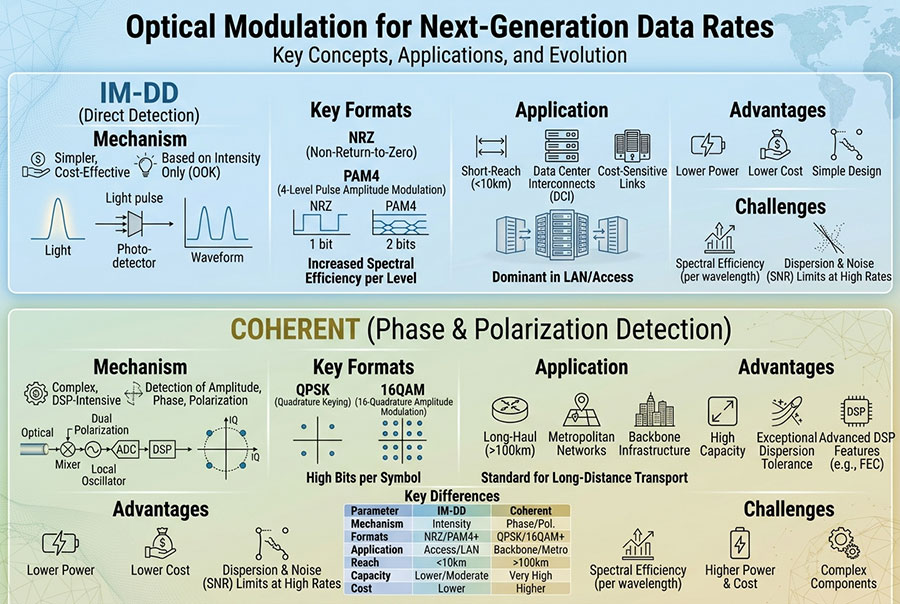
Conventional intensity-modulation direct-detection (IM-DD) systems primarily encode information through changes in optical intensity. Coherent transmission uses both the amplitude and phase of the optical signal and can also distinguish two orthogonal polarization states. This provides additional dimensions for encoding information within an optical carrier.
By recovering the complex optical field at the receiver, coherent systems can apply advanced digital processing to compensate for transmission impairments and recover high-capacity data streams. This makes coherent technology particularly valuable in applications where fiber capacity, spectral efficiency, and transmission distance are major design constraints.
Common deployment environments include:
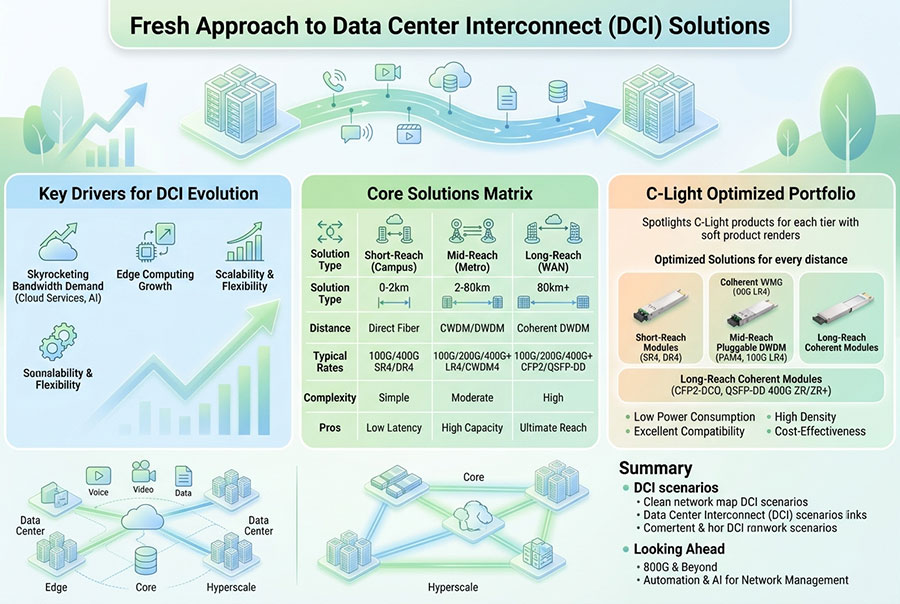
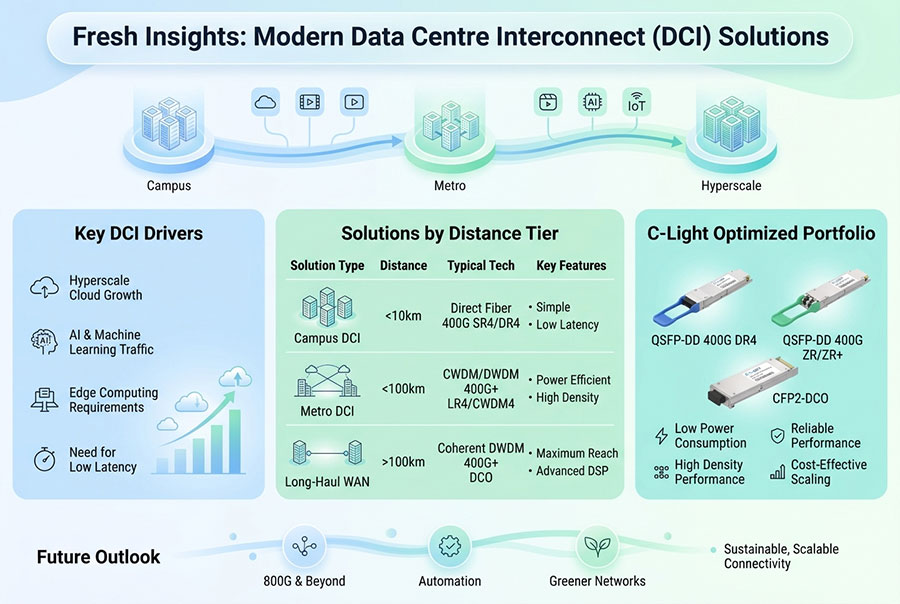
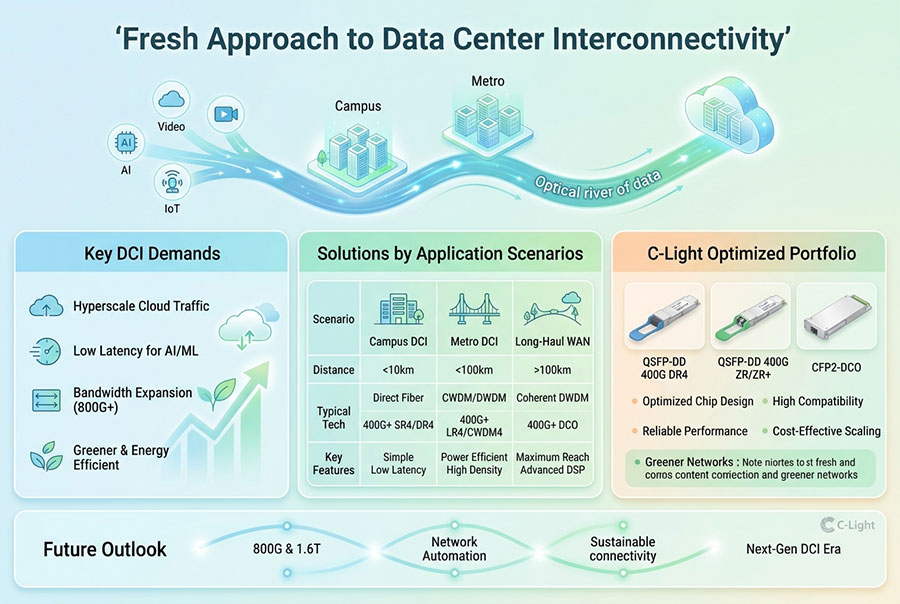
Data Center Interconnect (DCI): High-capacity optical links between geographically separated data centers.
Metro networks: Aggregation of traffic between enterprise, cloud, carrier, and access networks.
Regional transport: High-capacity wavelength channels across multi-span optical infrastructure.
Long-haul networks: Dense wavelength multiplexing over extended fiber routes with optical amplification.
AI infrastructure: High-bandwidth connections between distributed computing facilities and large-scale network hubs.
2. Coherent Modulation and Polarization Multiplexing
Coherent optical transmission increases information capacity by using more signal states within each symbol and by transmitting independent data streams over two orthogonal polarization states. The selected modulation format determines how many bits can be represented by each symbol, while polarization multiplexing increases the amount of information carried by the optical carrier.
| Modulation Format | Bits per Symbol | Typical Characteristics | Network Consideration |
|---|---|---|---|
| QPSK | 2 | Four phase states with relatively robust signal detection. | Useful for applications requiring greater optical reach and tolerance to transmission impairments. |
| 8QAM | 3 | Eight constellation states. | Provides an intermediate balance between spectral efficiency and signal quality requirements. |
| 16QAM | 4 | Sixteen amplitude and phase combinations. | Higher spectral efficiency with greater OSNR requirements than lower-order formats. |
| 64QAM | 6 | Higher-density constellation with more signal states. | Requires stronger signal quality and is more sensitive to noise and impairments. |
In dual-polarization coherent systems, two independent data streams are transmitted using orthogonal polarization states. For example, DP-QPSK carries two bits per symbol on each polarization, while DP-16QAM carries four bits per symbol on each polarization. The actual net data rate also depends on symbol rate, FEC overhead, framing, and implementation details.
3. Digital Signal Processing in Coherent Transceivers
The coherent DSP is a central component of modern digital coherent optics. It processes high-speed electrical signals at the transmitter and reconstructs the received data stream after optical transmission. Its functions support signal generation, impairment compensation, synchronization, and error correction.
Typical coherent DSP functions include:
Pulse shaping: Controls the transmitted signal spectrum and helps manage channel bandwidth.
Chromatic dispersion compensation: Compensates for wavelength-dependent propagation delay in optical fiber.
Polarization demultiplexing: Separates the two transmitted polarization channels at the receiver.
Carrier recovery: Estimates and compensates for phase and frequency differences between transmitter and receiver lasers.
Adaptive equalization: Compensates for selected linear channel impairments and signal distortion.
FEC processing: Adds and decodes error-correction information to improve transmission reliability.
DSP performance directly affects the operating envelope of a coherent module. Processing capability, power consumption, latency, and thermal behavior must be considered together when selecting pluggable coherent optics for high-density switching platforms.
4. Coherent Receiver Architecture and Optical Signal Recovery
A coherent receiver uses a local oscillator laser to mix the incoming optical signal with a reference optical field. Optical hybrids and balanced photodetectors convert the resulting interference signals into electrical components that contain amplitude and phase information.
A simplified coherent receiver signal path includes:
Optical input: The received DWDM signal enters the coherent receiver.
Local oscillator: A reference laser provides the optical field for coherent detection.
Optical hybrid: Combines the received signal and local oscillator with controlled phase relationships.
Balanced photodetection: Converts the optical interference into electrical signals.
Analog-to-digital conversion: Samples the electrical waveforms for digital processing.
Coherent DSP: Performs equalization, carrier recovery, polarization separation, and FEC decoding.
This architecture allows the receiver to recover information encoded in both phase and amplitude. It also provides digital compensation capabilities that are difficult to implement with conventional direct-detection receivers.
5. Coherent Optical Standards: 400ZR, OpenZR+ and 800ZR
Interoperability is an important factor in coherent network upgrades. Industry specifications define optical interface parameters and operating requirements so that equipment from different suppliers can work together within supported configurations.
| Technology | Primary Application | Technical Characteristics | Deployment Focus |
|---|---|---|---|
| 400ZR | High-capacity DCI | 400G coherent interface with defined interoperability requirements. | Point-to-point data center interconnects and compatible DWDM systems. |
| OpenZR+ | Extended-reach coherent transport | Multi-rate coherent operation with broader application and line-system options. | Metro, regional, and selected amplified optical networks. |
| 800ZR | Next-generation high-capacity DCI | Single-wavelength 800G coherent interface specifications. | High-capacity DCI and suitable DWDM applications. |
| 800ZR+ | Extended coherent transport configurations | Implementation-dependent modes and operating parameters. | Applications requiring additional reach or line-system flexibility. |
400ZR established an important interoperable coherent interface for high-capacity DCI. OpenZR+ extends the application space through additional operating modes and reach options. The OIF 800G coherent work addresses single-wavelength 800G links for both amplified DWDM applications and shorter unamplified connections.
These specifications should not be treated as interchangeable product labels. A module's modulation format, FEC, optical output power, host interface, wavelength range, and line-system requirements must be checked against the relevant implementation agreement and equipment documentation.
6. DWDM Integration and Wavelength Capacity
Coherent pluggable transceivers are frequently deployed in dense wavelength division multiplexing systems. DWDM allows multiple optical channels at different wavelengths to share a single fiber pair or fiber route, increasing aggregate capacity without requiring a separate fiber for every data stream.
Tunable coherent modules can operate on selected wavelengths within supported optical bands. This flexibility simplifies wavelength assignment and can reduce the need to maintain large inventories of fixed-wavelength modules.
A coherent DWDM link may include:
Coherent pluggable transceivers installed in routers or switches.
DWDM multiplexers and demultiplexers.
Optical amplifiers such as EDFAs.
ROADM nodes for wavelength routing and network reconfiguration.
Optical monitoring and line-system management equipment.
Single-mode fiber infrastructure with suitable dispersion and loss characteristics.
The transceiver and line system must be engineered as a complete optical channel. Wavelength spacing, launch power, amplifier gain, filter passbands, OSNR, and total path loss all influence transmission performance.
7. Optical Reach, OSNR and Fiber Impairments
Coherent transmission can compensate for several important fiber impairments, but it does not eliminate the physical limitations of the optical channel. Reach depends on the combined effects of fiber attenuation, optical amplification, noise accumulation, nonlinear propagation, filtering, and the receiver's performance.
Important design parameters include:
Optical Signal-to-Noise Ratio (OSNR): Measures signal power relative to optical noise within a defined reference bandwidth.
Chromatic dispersion: Causes different optical frequency components to propagate at different speeds.
Polarization Mode Dispersion (PMD): Creates differential propagation delay between polarization components.
Fiber attenuation: Reduces optical power along the transmission path.
Nonlinear effects: Include self-phase modulation, cross-phase modulation, and four-wave mixing.
Filter narrowing: Can distort optical signals when channels pass through multiple filtering stages.
Higher-order modulation generally requires better OSNR and a more controlled optical path. Lower-order formats such as QPSK can offer greater tolerance to noise in many operating conditions, although they carry fewer bits per symbol.
8. Coherent Pluggables and Optical Transport Architectures
Coherent technology can be deployed through traditional optical transport equipment or directly through pluggable modules installed in routers and switches. These architectures offer different levels of integration, operational flexibility, and infrastructure complexity.
| Architecture | Implementation | Typical Advantages | Design Consideration |
|---|---|---|---|
| Transponder-based | Dedicated optical transport equipment performs client adaptation and line transmission. | Centralized optical management and transport-specific functions. | Additional equipment, power, and rack space. |
| ACO | Analog coherent optics with significant coherent processing outside the optical module. | Separates selected optical functions from host-side processing. | Requires a compatible host DSP architecture. |
| DCO | Digital coherent optics integrates coherent DSP within the pluggable module. | Direct coherent connectivity from compatible routers and switches. | Module power, thermal design, host interface, and line-system compatibility. |
| Open line system | Pluggable coherent optics operate over a separately managed optical line system. | Supports multi-vendor network architectures and flexible wavelength deployment. | Requires coordinated optical engineering and interoperability validation. |
DCO modules are particularly relevant to IP-over-DWDM architectures, where coherent optical transmission can be integrated directly into compatible switching or routing platforms. This reduces dependence on separate transponder equipment in suitable network designs.
9. QSFP-DD, OSFP and CFP2 Coherent Form Factors
Coherent modules are available in several form factors. The mechanical interface, electrical host interface, cooling requirements, and power envelope determine whether a module can be deployed in a particular router, switch, or transport platform.
| Form Factor | Typical Coherent Applications | Design Considerations |
|---|---|---|
| QSFP28 | 100G coherent and OpenZR-class applications. | Compact footprint for compatible lower-rate coherent ports. |
| CFP2 | 100G, 200G, and selected 400G DCO implementations. | Established coherent transport form factor with platform-specific power and thermal requirements. |
| QSFP-DD | 400G and selected 800G coherent applications. | High-density switching platforms and host-interface compatibility. |
| OSFP | 400G and 800G coherent applications. | Thermal management and mechanical compatibility with the host platform. |
A form factor alone does not establish interoperability. Two modules with the same mechanical package may use different host interfaces, power profiles, management implementations, or optical line modes. Platform qualification should include the exact transceiver part number and supported software configuration.
10. Power Consumption and Thermal Management
Coherent DSP, high-speed digital interfaces, tunable lasers, and optical receiver circuits contribute to module power consumption. As transmission rates increase, the thermal design of coherent pluggables becomes increasingly important, especially in high-density router and switch chassis.
Thermal qualification should consider:
Maximum module power under the selected operating mode.
Host cage temperature and available airflow.
Heatsink and thermal interface design.
Chassis fan capacity and airflow direction.
Operating temperature range and module case temperature limits.
Power and thermal differences between modulation and reach configurations.
A high-capacity module may support multiple operating modes, but power consumption and thermal behavior can vary with the selected line rate and modulation format. System-level qualification should use the actual operating configuration rather than a nominal data-rate label.
11. Coherent Optics for AI Data Center Interconnect
AI infrastructure increasingly distributes compute resources across multiple data halls, campuses, and geographically separated facilities. These environments require high-capacity connections between data center networks while maintaining predictable optical performance and operational flexibility.
Coherent pluggables provide an option for carrying high-rate Ethernet traffic over single-mode fiber infrastructure. Their tunable wavelengths and high spectral efficiency are particularly useful where fiber availability is limited or where multiple high-capacity channels must share an existing optical route.
Typical AI DCI design priorities include:
Aggregate bandwidth between independent data center fabrics.
Optical reach across campus, metro, or regional routes.
Wavelength utilization and channel spacing.
Low-latency transport and predictable network behavior.
Compatibility with existing DWDM and optical amplification infrastructure.
Redundancy, route diversity, and service restoration.
Coherent optics provide the physical transmission capacity, but end-to-end application latency also depends on fiber propagation distance, routing, switching, queuing, and network architecture. Optical reach and application performance should therefore be evaluated separately.
12. C-LIGHT Coherent Optical Transceiver Portfolio
C-LIGHT provides DWDM digital coherent optical transceivers across multiple data rates and form factors. The portfolio includes 100G, 200G, 400G, and 800G DCO solutions for data center interconnect, metro transport, regional networks, and high-capacity optical backbone applications.
The C-LIGHT 800G DCO QSFP-DD and OSFP portfolio includes tunable C-band coherent modules for high-capacity DWDM connectivity. Listed configurations include 800ZR and 800ZR+ operating modes, with product-specific reach options and optical interfaces.
The product matrix includes 800G QSFP-DD and OSFP variants, with selected configurations supporting host-side rate arrangements such as 1 × 800G, 2 × 400G, 4 × 200G, and 8 × 100G. These are host interface operating options and should not be interpreted as passive optical breakout functions.
C-LIGHT's 400G DCO transceiver portfolio includes QSFP-DD and CFP2 configurations with tunable C-band DWDM wavelengths. Listed operating options include different reach classes and coherent modulation modes for DCI, metro, and regional transport applications.
Selected QSFP-DD configurations are listed with 400ZR++ and multi-rate host options. CFP2 versions provide additional choices for transport platforms requiring a dedicated coherent module format.
The C-LIGHT 200G and 100G DCO modules extend coherent connectivity to lower-rate optical transport applications. The product matrix lists 200G CFP2 DCO options and 100G CFP2 DCO and QSFP28 Open ZR configurations.
These modules can be considered for network upgrades where existing fiber routes, transport equipment, or bandwidth requirements do not justify immediate migration to higher-rate coherent interfaces.
Product reach values and supported operating modes are configuration-specific. Final selection should verify the exact part number, modulation format, line rate, host interface, optical output power, wavelength range, FEC mode, and compatibility with the target line system.
13. Engineering Considerations for Coherent Network Upgrades
Coherent technology can increase fiber utilization and simplify high-capacity transport architectures, but a successful upgrade requires coordinated planning across the optical layer, switching platform, and network management system.
| Design Area | Key Parameters | Engineering Objective |
|---|---|---|
| Transmission capacity | Line rate, symbol rate, modulation format, and FEC overhead. | Achieve the required net client capacity. |
| Optical channel | OSNR, launch power, wavelength, channel spacing, and filter bandwidth. | Maintain adequate signal quality across the route. |
| Fiber infrastructure | Fiber type, attenuation, span length, dispersion, and connector loss. | Validate the physical transmission path. |
| Line system | EDFA gain, ROADM configuration, channel loading, and amplifier noise. | Maintain optical performance across all spans. |
| Host platform | Form factor, electrical interface, power, cooling, and firmware support. | Ensure module and equipment compatibility. |
| Interoperability | Standards compliance, FEC, management interface, and optical operating mode. | Establish stable operation across equipment vendors. |
| Network operations | Alarm monitoring, performance metrics, wavelength assignment, and restoration. | Support reliable operation and future expansion. |
Before deployment, operators should validate the optical path using engineering calculations and, where necessary, laboratory or field interoperability testing. The assessment should include both nominal operating conditions and the expected channel loading and impairment conditions of the live network.
14. Conclusion
Coherent optical technology is a major foundation for high-capacity network upgrades. By combining advanced modulation, polarization multiplexing, coherent detection, and digital signal processing, it increases the amount of information carried by each optical wavelength and supports higher-capacity DCI, metro, regional, and long-haul networks.
The transition from 400ZR and OpenZR+ toward 800G coherent interfaces creates additional opportunities for bandwidth scaling and more flexible optical transport. However, modulation format, OSNR, optical reach, line-system compatibility, host interfaces, power consumption, and thermal performance must be evaluated as part of the complete network design.
For 100G to 800G DCO transceivers, tunable DWDM solutions, and coherent optical connectivity requirements, Contact C-LIGHT.
 >

 >
 >
 >
 >
 >
 >
 >