TEL:+86 132 6656 7067




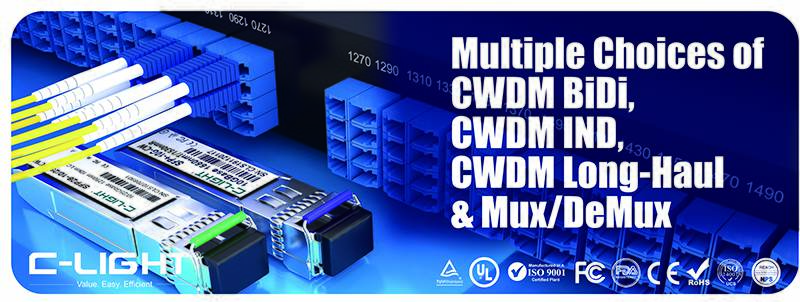
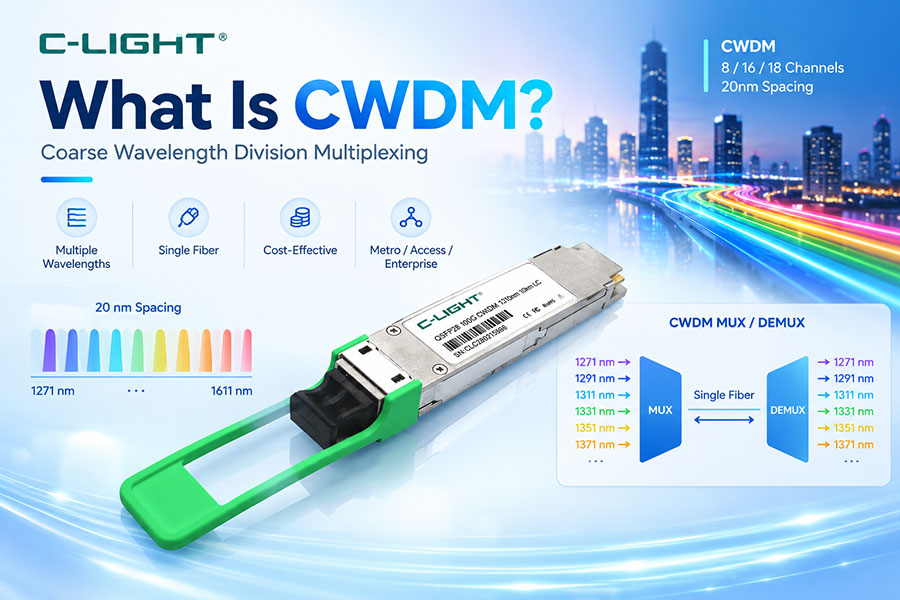
CWDM stands for Coarse Wavelength Division Multiplexing. It is an optical technology that multiplexes multiple optical signals of different wavelengths onto a single fiber for transmission. At the transmitting end, a multiplexer combines these signals, which are then coupled into a single optical fiber. At the receiving end, a demultiplexer separates the different wavelength signals, directing each to its corresponding receiving device.
The channel wavelength spacing in CWDM is relatively wide, typically 20 nanometers. The ITU-T standard defines 18 wavelength channels for CWDM systems within the range from 1270 nm to 1610 nm. However, in practical applications, due to higher attenuation in certain bands of the fiber and components, the most commonly used are 8 or 16 channels within the 1470 nm to 1610 nm range.
Working Principle and Key Components of a CWDM System
A typical CWDM system mainly consists of the following parts:
●Transmitter (Optical Transponder Unit, OTU): Each independent service signal (e.g., Ethernet, SDH) is modulated onto a laser operating at a specific wavelength. CWDM lasers are typically uncooled Distributed Feedback (DFB) lasers, which significantly reduces costs.
●Multiplexer (Mux): Combines multiple optical signals of different wavelengths onto a single trunk fiber without interference.
●Optical Fiber Transmission Link: Usually standard single-mode fiber (SSMF). Due to the wide wavelength range of CWDM, attention must be paid to potential "water peak" attenuation in the E-band (1360-1460 nm). Modern low-water-peak fibers can support full-band transmission.
●Demultiplexer (Demux): At the receiving end, precisely separates the combined multi-wavelength signal back into individual wavelength signals.
●Receiver: Each wavelength's optical signal is detected by its corresponding optical receiver and converted back to the original electrical service signal.
●The workflow can be simplified as: Multiple electrical signals → Modulation onto different wavelength optical carriers → Multiplexing → Fiber transmission → Demultiplexing → Demodulation into multiple electrical signals.
Core Advantages and Technical Characteristics of CWDM
The popularity of CWDM is primarily due to its excellent balance between cost, power consumption, and complexity:
Significant Cost-Effectiveness:
●Lower Laser Cost: The 20nm wide channel spacing allows the use of lasers without temperature control. While standard DWDM lasers require precise temperature stabilization, CWDM lasers are uncooled, drastically reducing device cost and power consumption (typically 1/3 to 1/2 of a DWDM laser's power).
●Lower Filter Cost: The wide channel spacing reduces the manufacturing complexity and cost of multiplexers and demultiplexers.
●Low Power Consumption and Compact Size: The absence of cooling and complex control circuits results in lower power consumption for CWDM optical modules and equipment, along with a more compact form factor. This makes them ideal for space- and power-constrained environments like access points or data centers.
●Simple Deployment and Maintenance: The system design is relatively straightforward. Installation, commissioning, and operational requirements are lower than for DWDM, reducing the technical skill threshold for maintenance personnel.
Flexible Capacity Upgrade: Initially, only a few wavelength channels can be deployed based on service demands. When future service grows, capacity can be smoothly expanded by simply adding optical modules of the corresponding wavelengths at both ends, without modifying the fiber infrastructure, thus protecting the initial investment.
Limitations of CWDM
Naturally, CWDM is not a universal solution; its design trade-offs come with inherent limitations:
●Shorter Transmission Distance: Due to the use of wide spacing and uncooled lasers, its dispersion tolerance and wavelength stability are inferior to DWDM. It typically supports distances up to 80 km and is difficult to use for long-haul trunk lines without repeater amplification.
●Limited Total Capacity: Constrained by the available spectrum and wide spacing, a single fiber can support a maximum of 18 channels (commonly 8 or 16). With each channel supporting rates up to 10Gbps or 25Gbps, the total capacity is on the order of hundreds of Gbps, lower than the Tbps-level capacity of DWDM.
Typical Application Scenarios
Leveraging its cost-performance advantage, CWDM is widely used in the following areas:
●Metropolitan Area Networks (MAN) and Regional Aggregation Networks: Connecting different data centers, base station controllers, and core network nodes within a city is the primary application for CWDM. It addresses fiber resource scarcity in metro areas at a lower cost.
●5G Fronthaul and Midhaul Networks: In 5G Radio Access Networks (RAN), high-capacity, low-latency connections are required between the Distributed Unit (DU)/Centralized Unit (CU) and the Active Antenna Unit (AAU). CWDM is a classic solution for realizing "multiple services over one fiber" in fronthaul, conserving fiber resources.
●Enterprise and Campus Networks: Connecting data centers, servers, and storage equipment distributed across buildings in large enterprises or campuses, providing high-bandwidth, high-reliability private networks.
●CATV with Overlaid Data Services: Independent bidirectional data channels can be added over existing CATV fiber lines using CWDM technology for service upgrade.
●Protocol-Transparent Transport Platform: As a physical layer technology, CWDM can transparently carry various protocols like Ethernet, SDH/SONET, and Fibre Channel, enabling multi-service convergence transport.
CWDM vs. DWDM: Key Decision Factors
CWDM is often compared with Dense Wavelength Division Multiplexing (DWDM). DWDM uses much narrower channel spacing (typically 0.8nm, 0.4nm, or less), allowing multiplexing of 80, 96, or even more channels within the C-band (around 1530-1565nm). It supports ultra-long-haul (thousands of kilometers) and capacity transmission, but at significantly higher cost, power consumption, and complexity.
Selection Guidelines:
Choose CWDM when requirements involve short distances (typically ≤ 80 km), medium capacity (≤ 18 channels), high priority on cost and power consumption, and a need for simple deployment.
Choose DWDM when requirements involve ultra-long distances, massive capacity (e.g., telecom backbone, submarine cables), and higher investment and operational complexity are acceptable.
Both can also be used in combination, e.g., employing DWDM in the metro core and CWDM in the access and aggregation layers, forming a complementary hierarchical network.
In summary, Coarse Wavelength Division Multiplexing is an elegant engineering compromise in the field of optical fiber communication. It does not pursue performance but accurately targets the urgent needs for economy, practicality, and ease of use in metropolitan and short-reach access scenarios. As a mature, reliable, and low-cost fiber resource multiplier, CWDM will continue to play an indispensable foundational role in connecting the digital world across the "last mile" and even the "intermediate tens of kilometers," providing a solid physical layer foundation for high-bandwidth connectivity.
CWDM Optical Fiber Communication FAQ
Q1: What is CWDM optical fiber communication?
Answer: CWDM (Coarse Wavelength Division Multiplexing) is an optical communication technology that combines multiple optical signals with different wavelengths onto a single fiber for transmission. At the receiving end, a CWDM demultiplexer separates each wavelength channel and restores the original optical signals. This technology improves fiber utilization and increases network capacity without deploying additional fiber cables. (c-light.com)
Q2: How does CWDM technology work in optical fiber networks?
Answer: CWDM technology works by assigning different wavelengths to independent data channels. Multiple optical transmitters send signals at different wavelengths, and a CWDM MUX combines these signals into one fiber. After transmission, the CWDM DEMUX separates each wavelength and sends them to corresponding receivers. This allows multiple services to share the same fiber infrastructure. (c-light.com)
Q3: What are the main components of a CWDM optical communication system?
Answer: A typical CWDM optical communication system consists of:
CWDM optical transceivers
CWDM MUX/DEMUX devices
Single-mode optical fiber
Optical transmitters and receivers
The CWDM MUX combines multiple wavelength channels, while the DEMUX separates them at the destination side. Together, these components provide efficient multi-channel optical transmission. (c-light.com)
Q4: What are the advantages of CWDM optical communication?
Answer: CWDM optical communication provides several advantages:
Improved fiber resource utilization
Lower deployment cost
Lower power consumption
Simple network architecture
Easier installation and maintenance
Flexible capacity expansion
Because CWDM does not require complex wavelength stabilization technology, it offers a cost-effective solution for metro and access networks. (c-light.com)
Q5: How many wavelengths can CWDM support?
Answer: According to the ITU-T G.694.2 standard, CWDM supports up to 18 wavelength channels from 1270nm to 1610nm with 20nm channel spacing. In practical deployments, 8-channel and 16-channel CWDM systems are commonly used depending on transmission requirements and fiber characteristics. (c-light.com)
Q6: What is the difference between CWDM and DWDM optical communication?
Answer: The main difference between CWDM and DWDM optical communication is channel spacing, capacity, and application scenarios.
CWDM uses wider wavelength spacing, resulting in lower cost, lower power consumption, and simpler deployment. It is mainly used for metro networks, access networks, and medium-distance transmission.
DWDM uses much narrower wavelength spacing, allowing more channels and higher capacity for long-distance backbone networks and high-capacity optical transport systems. (c-light.com)
Q7: What are the typical applications of CWDM optical communication?
Answer: CWDM optical communication is widely used in:
Metropolitan Area Networks (MAN)
5G fronthaul and midhaul networks
Data center interconnect (DCI)
Enterprise campus networks
Telecom access networks
CATV and video transmission networks
CWDM is especially suitable for applications that require additional bandwidth but have limited fiber resources. (c-light.com)
Q8: How do I choose the right CWDM optical solution for my network?
Answer: Choosing the right CWDM optical solution depends on several factors, including:
Required transmission distance
Number of wavelength channels
Data rate requirements
Optical budget
Fiber type
Compatible optical modules
For short and medium-distance networks requiring cost efficiency and simple deployment, CWDM is an ideal choice. For higher capacity and long-distance backbone networks, DWDM may be more suitable.
 >
>

 >
>
 >
>
 >
>
 >
>
 >
>
 >
>
 >
>