TEL:+86 132 6656 7067




Co-Packaged Optics (CPO) and eXtra-dense Pluggable Optics (XPO) are two different approaches to solving the bandwidth, power, thermal and density challenges created by next-generation AI and data center networks.
CPO moves optical engines close to or within the switch ASIC package, significantly shortening the high-speed electrical path between the switching silicon and optical conversion point. XPO takes a different approach by retaining a pluggable optical architecture while increasing module density and integrating advanced liquid cooling.
The two architectures therefore address many of the same system-level challenges, but they make different trade-offs in integration, serviceability, thermal management, electrical reach and deployment flexibility.
1. What Is CPO?
CPO stands for Co-Packaged Optics. It is an optical integration architecture in which optical engines are placed within the package-level environment of a switching ASIC.
The main objective is to shorten the high-speed electrical connection between the ASIC and optical conversion components.
By moving optics away from the front-panel location and closer to the switching silicon, CPO can reduce the electrical channel length that would otherwise be required between the ASIC and a conventional pluggable module.
2. What Is XPO?
XPO stands for eXtra-dense Pluggable Optics. It is a high-density pluggable optical architecture developed for high-bandwidth AI and data center networking.
Unlike CPO, XPO retains a removable pluggable module concept while significantly increasing optical density and adding an integrated liquid-cooling mechanism.
The XPO MSA announced in 2026 describes a 64-channel module with up to 12.8Tbps capacity and an integrated cold plate capable of cooling up to 400W per module in the announced implementation.
3. Basic Difference Between CPO and XPO
| Feature | CPO | XPO |
|---|---|---|
| Full Name | Co-Packaged Optics | eXtra-dense Pluggable Optics |
| Architecture | Highly integrated optics near or within ASIC package | High-density pluggable optics |
| Optical Location | Close to switch ASIC | Front-panel pluggable location |
| Module Replacement | Not equivalent to normal pluggable replacement | Designed to remain field-replaceable |
| Electrical Distance | Very short | Longer than CPO |
| Cooling | System/package-level thermal design | Integrated liquid cooling in the XPO architecture |
| Optical Density | Very high potential | Very high front-panel density |
| Serviceability | More system dependent | Pluggable service model |
| Main Focus | Deep ASIC-to-optics integration | Extreme density while retaining pluggability |
4. CPO vs XPO: Different Architecture Strategies
CPO and XPO approach the same scaling problem from different directions.
CPO focuses on physical integration. It moves the optical conversion point much closer to the switch ASIC.
XPO focuses on increasing the capability of the pluggable module itself, allowing a very high-density optical interface to remain removable and serviceable.
5. CPO Architecture
A typical CPO architecture includes a high-performance switch ASIC, multiple optical engines, electrical and optical interfaces, package substrates or interposers and a dedicated thermal solution.
The optical engines are positioned close enough to the ASIC to substantially reduce the high-speed electrical distance.
The exact implementation varies according to the ASIC, optical engine technology, package structure and system design.
6. XPO Architecture
XPO retains the concept of a pluggable optical module but increases its physical capacity and optical density.
The announced XPO architecture supports 64 optical or electrical channels at 200Gbps-class signaling, providing an aggregate module capacity of 12.8Tbps.
The architecture also incorporates liquid cooling directly into the module or module thermal interface to handle the high thermal density associated with the increased capacity.
7. CPO vs XPO Optical Engine Location
The physical location of the optical engine is one of the most important differences.
In CPO, optical engines are positioned close to the switching ASIC at the package level.
In XPO, the optical engine remains within a high-density pluggable module located at the system front panel.
8. CPO vs XPO Electrical Path
CPO is designed specifically to reduce the electrical distance between the ASIC and the optical conversion point.
This is important because higher SerDes speeds increase PCB insertion loss, channel dispersion and signal integrity requirements.
XPO does not eliminate the front-panel electrical path in the same way. Instead, it addresses the density and thermal limitations of pluggable optics through a redesigned high-density module architecture.
9. Why Electrical Distance Matters
As electrical lane rates increase, the electrical channel between the switch ASIC and optical interface becomes more difficult to manage.
Longer channels can introduce greater insertion loss and signal degradation, requiring more advanced equalization, retiming or other signal-conditioning techniques.
Reducing this distance is therefore an important motivation behind CPO and other near-ASIC optical architectures.
10. XPO and Electrical Channel Challenges
XPO does not rely on the same physical integration strategy as CPO.
Instead, XPO increases the amount of bandwidth that can be delivered through a pluggable optical interface and combines this density with module-level thermal engineering.
This makes XPO an evolutionary extension of the pluggable approach rather than a package-level optical architecture.
11. CPO vs XPO Form Factor
CPO is primarily a packaging and integration architecture rather than a conventional front-panel module form factor.
XPO is specifically a high-density pluggable optical form factor concept.
This distinction is important because CPO and XPO address different layers of system architecture.
12. CPO vs XPO Modularity
Modularity is one of the clearest differences between the two architectures.
Traditional pluggable optics can be removed and replaced independently from the host system. XPO maintains this fundamental service model while increasing module size, bandwidth and cooling capability.
CPO integrates optical engines much more deeply into the host system, which can make field replacement and subsystem maintenance more complex.
13. CPO vs XPO Serviceability
| Service Factor | CPO | XPO |
|---|---|---|
| Field Replacement | More system dependent | Designed for pluggable replacement |
| Optical Module Independence | Lower | Higher |
| Maintenance Model | System or package level | Module level |
| Upgrade Flexibility | More dependent on host platform | More modular |
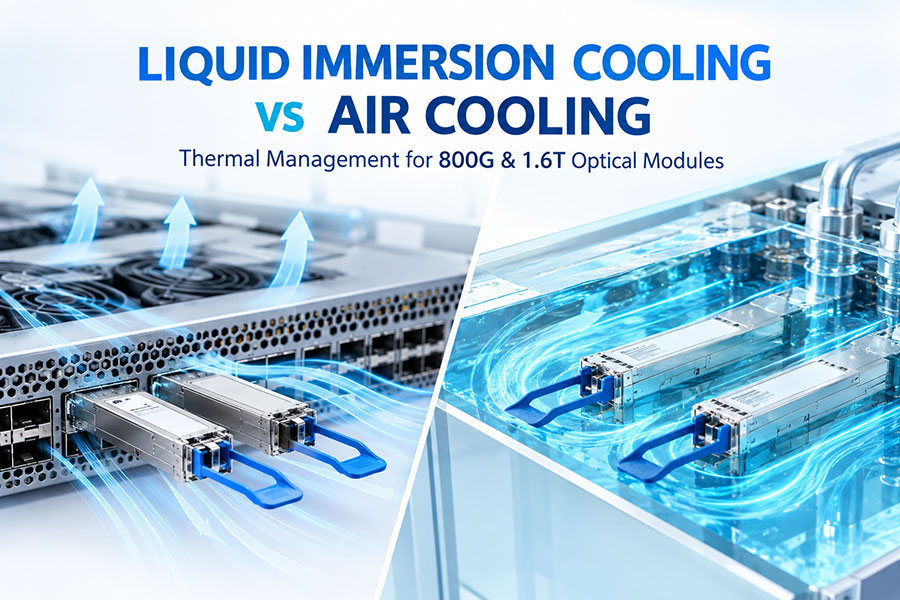
14. CPO vs XPO Cooling
Thermal management is a major consideration for both architectures.
CPO requires thermal co-design between the switching ASIC, optical engines, package and system cooling infrastructure.
XPO addresses thermal density by incorporating liquid cooling into the high-density pluggable module architecture.
The announced XPO MSA specifies an integrated cold plate designed to support modules with power levels up to 400W in the stated implementation.
15. Why Does XPO Need Liquid Cooling?
The main reason is module density.
A conventional pluggable module has limited physical space for optical and electronic components and limited thermal headroom. Increasing the number of lanes and total bandwidth substantially increases the heat generated inside the module.
XPO therefore uses integrated liquid cooling to provide a higher-capacity thermal path than conventional air-cooled pluggable designs.
16. CPO Thermal Design
CPO moves the optical engines closer to the ASIC, allowing the optics and switching silicon to be treated as part of a more integrated thermal architecture.
This can eliminate some of the thermal constraints associated with dense front-panel modules, but it does not eliminate cooling requirements.
The switch ASIC, optical engines and package still generate substantial heat and must be managed together.
17. XPO Thermal Design
XPO integrates cooling into the optical module architecture itself.
This is important because the module contains a large number of high-speed optical and electrical channels within a compact physical area.
The liquid-cooling approach allows the thermal capacity of the module to scale beyond what conventional air-cooled pluggable designs can easily accommodate.
18. CPO vs XPO Power Consumption
CPO can reduce some electrical channel losses and the associated signal-conditioning requirements by placing optics close to the ASIC.
XPO can also improve system-level power efficiency through high-density integration and advanced thermal management.
However, neither architecture has a universally fixed power advantage. Total power depends on the ASIC, optical engine, SerDes, driver, DSP or retimer architecture, cooling system and networking topology.
19. CPO vs XPO Bandwidth Density
Both CPO and XPO are designed to increase bandwidth density.
CPO achieves this by integrating large numbers of optical channels around the switching ASIC.
XPO increases the capacity of each pluggable unit. The XPO MSA announced in 2026 defines a 12.8Tbps class module using 64 channels at 200Gbps per channel.
20. XPO and Front-Panel Density
Front-panel density is a major motivation for XPO.
The announced XPO implementation is designed to provide 204.8Tbps of front-panel capacity per open compute rack unit and was presented as a fourfold density improvement compared with 1600G OSFP optics under the stated configuration.
This allows a pluggable architecture to accommodate much more aggregate bandwidth within limited rack space.
21. CPO and Optical Density
CPO can provide extremely high optical I/O density because optical engines are placed around the switching ASIC rather than occupying large front-panel cages.
The system can therefore reduce the dependence on front-panel space for high-speed optical interfaces.
The density advantage is closely connected to package design, optical engine size and the number of ASIC-to-optics connections.
22. CPO vs XPO and 400G
Both CPO and XPO can be relevant to systems using 400G optical connectivity.
However, the architectures are generally considered in different system contexts. CPO focuses on integrated switch-level optical conversion, while XPO targets extremely dense pluggable connectivity.
For conventional 400G deployments, standard pluggable optical transceivers remain widely applicable.
23. CPO vs XPO and 800G
800G increases the pressure on electrical channels, optical density and thermal management.
CPO addresses the electrical problem by moving the optical conversion point close to the ASIC.
XPO addresses the density and thermal problem by scaling the pluggable module and adding integrated liquid cooling.
Both can therefore be considered part of the broader evolution of high-speed optical interconnects.
24. CPO vs XPO and 1.6T
At 1.6T, the challenges associated with electrical signaling, thermal density and front-panel space become more significant.
CPO can shorten the electrical path substantially, while XPO provides a path to much higher-capacity pluggable optical connectivity.
The actual suitability of either architecture depends on the switch design, optical engine, cooling infrastructure and network requirements.
25. CPO vs XPO for AI Data Centers
AI data centers require very large numbers of high-bandwidth connections among GPUs, switches and other networking components.
CPO and XPO both address the physical scaling problems created by these requirements.
CPO emphasizes deep optical integration with switching silicon, while XPO preserves a pluggable service model while increasing density and thermal capacity.
26. XPO for AI Networking
XPO was designed specifically for AI networking scenarios including scale-up, scale-out, scale-across and metro-reach fabrics.
Its announced architecture supports multiple optical technologies and interface approaches rather than being limited to one specific optical reach.
This broad architecture is intended to allow high-density pluggable optics to serve multiple AI networking requirements.
27. CPO for AI Networking
CPO is aimed at systems where the electrical connection between the switch ASIC and optical interfaces has become a major bottleneck.
By integrating optical engines close to the ASIC, CPO can reduce the distance over which very high-speed electrical signals must travel.
This makes CPO particularly relevant to high-bandwidth switch platforms and tightly integrated AI networking architectures.
28. CPO vs XPO and DSP
The presence of a DSP is not determined simply by whether a system uses CPO or XPO.
Optical modules can use fully retimed, partially retimed or linear architectures depending on the design.
The announced XPO architecture supports linear, half-retimed and fully retimed interfaces, demonstrating that XPO is primarily a packaging and density concept rather than one fixed signal-processing architecture.
29. CPO vs XPO and LPO
LPO describes a linear pluggable optical architecture, while CPO describes package-level optical integration and XPO describes an ultra-high-density pluggable architecture.
These terms therefore describe different architectural dimensions.
An XPO module can use a linear architecture, while CPO can also employ optical engines designed around specific signal-processing approaches.
30. CPO vs XPO and LRO
LRO, or Linear Receive Optics, is another intermediate optical architecture in which the transmit and receive signal paths have different levels of retiming or signal processing.
XPO is capable of supporting different signal-processing configurations, including half-retimed implementations.
This means XPO can serve as a physical module architecture while LRO describes how the electrical and optical signals are processed.
31. CPO vs XPO Optical Technology
Neither CPO nor XPO requires one specific laser technology.
Depending on the application, optical engines and modules can use technologies such as VCSEL, EML, DML, silicon photonics and other advanced transmitter architectures.
The selected optical technology depends on wavelength, reach, modulation format, lane rate and optical system design.
32. CPO vs XPO Fiber Type
Both architectures can support different optical transmission architectures.
Single-mode fiber is suitable for many high-speed WDM and longer-reach applications, while multimode fiber remains relevant to certain short-reach parallel optical systems.
The fiber type is determined by the optical interface rather than by CPO or XPO alone.
33. CPO vs XPO WDM
WDM can be used in both architectures.
Multiple wavelengths can be generated and multiplexed within an optical engine or module, allowing aggregate bandwidth to be increased without requiring the same number of physical fibers.
The specific wavelength plan and optical architecture depend on the application.
34. CPO vs XPO Parallel Optics
Parallel optics transmits multiple optical lanes over multiple fibers.
This architecture can be implemented in both integrated optical engines and high-density pluggable modules.
The choice between WDM and parallel optics depends on fiber availability, reach, optical component technology and system requirements.
35. CPO vs XPO Packaging Complexity
CPO introduces significant package-level integration requirements.
The switching ASIC, optical engines, optical coupling structures and thermal components must operate together within a tightly integrated mechanical and electrical environment.
XPO moves much of the complexity into the pluggable module, including higher-density optical packaging and integrated liquid cooling.
36. CPO vs XPO Manufacturing
| Manufacturing Factor | CPO | XPO |
|---|---|---|
| Primary Integration Level | ASIC/package level | Module level |
| Optical Alignment | Highly precise | Highly precise within module |
| Thermal Integration | System/package co-design | Integrated liquid-cooled module |
| Host Platform Changes | Significant | Lower compared with CPO |
| Module Replacement | Limited compared with pluggables | Retained |
37. CPO vs XPO Interoperability
Interoperability can be approached differently in the two architectures.
Pluggable optics traditionally benefit from standardized electrical, optical and mechanical interfaces. XPO extends this philosophy into a much denser module architecture.
CPO requires tighter coordination between the switch ASIC, optical engines, package, optical interfaces and host platform.
38. CPO vs XPO Supply Chain
CPO requires close coordination among ASIC designers, optical engine suppliers, packaging companies, photonics suppliers, thermal solution providers and system manufacturers.
XPO can preserve more of the modular optical supply chain because the optics remain removable modules.
However, XPO introduces new requirements for high-density optical packaging, liquid cooling, connectors and module-level thermal interfaces.
39. CPO vs XPO Maintenance
Maintenance philosophy is different between the two architectures.
CPO treats optical integration as part of the system platform. Maintenance can therefore involve subsystem-level procedures rather than simply replacing a front-panel transceiver.
XPO preserves the ability to replace the optical module independently, which can simplify certain operational and spare-parts models.
40. CPO vs XPO Upgrade Strategy
Pluggable optics allow network operators to upgrade optical modules while retaining the host platform, provided the host supports the new module.
XPO retains this modular concept.
CPO ties the optical architecture much more closely to the switch platform, so future optical upgrades may require greater coordination with the ASIC and package design.
41. CPO vs XPO Rack Space
CPO can reduce the dependence on front-panel optical cages because the optical engines are integrated near the ASIC.
XPO instead increases the amount of bandwidth delivered through each front-panel optical position.
Both approaches therefore attempt to increase network bandwidth without simply increasing the number of traditional optical modules.
42. CPO vs XPO Reliability
Reliability must be considered at both component and system levels.
CPO reduces some external high-speed electrical connections but creates highly integrated package and optical coupling structures that must operate reliably over the system lifetime.
XPO retains modularity but introduces more complex thermal and mechanical requirements because of the increased module capacity and liquid-cooling system.
43. CPO vs XPO Latency
The latency difference depends on the complete implementation.
CPO can reduce electrical path length and may simplify some signal-conditioning stages between the ASIC and optical engine.
XPO can support linear, partially retimed or fully retimed architectures, so its latency depends on the selected module architecture.
Neither CPO nor XPO has one fixed latency value.
44. CPO vs XPO Scalability
CPO scales through deeper integration and increased optical I/O around the switching ASIC.
XPO scales by increasing the bandwidth capacity of each pluggable optical module.
The two approaches therefore provide different paths to higher aggregate switch bandwidth.
45. CPO vs XPO System Design
| System Design Factor | CPO | XPO |
|---|---|---|
| ASIC Integration | Very high | Lower |
| Front-Panel Dependence | Reduced | High |
| Pluggability | Limited | High |
| Electrical Reach | Very short | Longer |
| Module Density | Very high | Very high |
| Cooling | Package/system level | Module-level liquid cooling |
| Maintenance | More integrated | More modular |
| Platform Customization | High | Moderate |
46. When Is CPO Considered?
CPO becomes particularly relevant when electrical channel length, switch bandwidth, I/O density and system power become difficult to manage with conventional front-panel optics.
It is suited to highly integrated switch platforms where the system manufacturer can redesign the ASIC, package, optical engines and thermal architecture together.
47. When Is XPO Considered?
XPO is designed for environments where extremely high optical bandwidth density is required while maintaining a pluggable optical service model.
It can be considered when front-panel density, liquid cooling and field replaceability are important system requirements.
48. CPO vs XPO for Network Operators
For network operators, the main architectural difference is how much of the optical subsystem is integrated into the host platform.
CPO provides deep integration but requires a more tightly coupled maintenance and platform strategy.
XPO provides a high-density optical interface while preserving independent optical module replacement.
49. CPO vs XPO for Optical Module Suppliers
CPO shifts more of the optical value chain toward optical engines, photonic integration, advanced packaging and system-level optical coupling.
XPO continues to depend on module manufacturing, but requires significantly higher integration density, higher channel count and advanced thermal management.
Both architectures therefore create new opportunities for optical component and module suppliers.
50. CPO vs XPO for AI Network Architecture
AI network architectures increasingly need to balance bandwidth, power, cooling, density and maintainability at the same time.
CPO and XPO address these requirements using fundamentally different system structures.
CPO emphasizes optical integration close to the switching ASIC, while XPO emphasizes extreme-density pluggable optics with integrated liquid cooling.
51. CPO vs XPO: Are They Direct Replacements?
CPO and XPO should not be treated as direct one-to-one replacements for each other.
CPO changes where optical conversion is integrated within the system, while XPO changes the capability and density of the pluggable optical interface.
They can therefore serve different switch architectures and operational requirements.
52. CPO vs XPO: Can They Coexist?
Yes. Different network segments and system generations can use different optical architectures.
Some systems may use highly integrated optics near the switching ASIC, while other systems may use high-density pluggable optics for flexibility and field serviceability.
The two architectures can therefore coexist within the broader optical networking ecosystem.
53. CPO vs XPO: Future Development
Future optical interconnect architectures will continue to focus on bandwidth density, electrical efficiency, thermal management and system serviceability.
CPO is likely to remain important for deeply integrated high-bandwidth switching platforms.
XPO provides another path by extending the pluggable model into much higher-density and liquid-cooled applications.
Other architectures, including NPO, LPO and LRO, can also be combined with different optical engine and module packaging strategies.
54. CPO vs XPO: Final Comparison
| Category | CPO | XPO |
|---|---|---|
| Full Name | Co-Packaged Optics | eXtra-dense Pluggable Optics |
| Basic Concept | Integrate optics close to the switch ASIC | Increase pluggable optical density and thermal capacity |
| Optical Location | Package-level environment | Front-panel pluggable module |
| Electrical Path | Very short | Longer than CPO |
| Pluggability | Limited | Retained |
| Cooling | Package/system cooling | Integrated liquid cooling |
| Density Strategy | ASIC-level optical integration | High-capacity pluggable module |
| Serviceability | More system dependent | Module replacement remains possible |
| Typical Focus | Maximum ASIC-to-optics integration | Extreme pluggable density and AI networking |
CPO and XPO represent two different approaches to the same broad challenge: scaling optical bandwidth while managing electrical loss, power, thermal density and physical space.
CPO moves optical engines close to the switching ASIC to minimize the high-speed electrical path. XPO keeps the pluggable concept but significantly increases module capacity, front-panel density and cooling capability.
For next-generation 800G, 1.6T and AI networking systems, the choice depends on the complete platform architecture, including ASIC design, electrical channel requirements, cooling infrastructure, optical density, serviceability, interoperability and deployment model.
 >
>

 >
>
 >
>
 >
>
 >
>
 >
>
 >
>
 >
>