TEL:+86 132 6656 7067




Co-Packaged Optics (CPO) and Linear Pluggable Optics (LPO) are two different approaches to scaling high-speed optical interconnects for modern data centers, AI clusters, and high-performance computing systems. Both address the growing electrical and power challenges associated with higher network bandwidth, but they do so at different levels of integration.
LPO keeps the optical interface in a pluggable module while removing the conventional DSP or retimer from the module signal path. CPO moves the optical engine much closer to the switching ASIC and integrates the optics with the ASIC package or a closely coupled package structure.
The result is a fundamental trade-off between modularity and integration. LPO preserves the replaceability and deployment flexibility of pluggable optics, while CPO prioritizes shorter electrical paths, higher bandwidth density, and deeper integration between optical engines and switching silicon.
1. What Is CPO?
CPO stands for Co-Packaged Optics. In a CPO architecture, optical engines are integrated very closely with the switching ASIC, generally through a common package or tightly coupled package-level implementation.
The primary objective is to minimize the high-speed electrical distance between the ASIC SerDes and optical conversion circuitry.
2. What Is LPO?
LPO stands for Linear Pluggable Optics. An LPO module remains a removable front-panel optical module, but conventional DSP or retimer processing is removed from the main module signal path.
The host ASIC or NIC SerDes performs a larger portion of the required electrical signal conditioning, allowing the module to operate as a lower-power linear optical interface.
3. CPO vs LPO at a Glance
| Feature | CPO | LPO |
|---|---|---|
| Optical location | Integrated closely with ASIC | Front-panel pluggable module |
| ASIC-to-optics distance | Extremely short | Longer electrical path |
| Integration level | Very high | Lower |
| Module DSP | Architecture dependent | Conventional DSP/retimer removed from module signal path |
| Module replaceability | Low | High |
| Electrical signal integrity | Strong electrical-path advantage | More dependent on host-to-module channel |
| Thermal integration | Very high | Module focused |
| Manufacturing complexity | Very high | Lower |
| System flexibility | Lower | Higher |
| Typical target | Very high bandwidth switching and AI systems | High-density pluggable AI and data center links |
4. The Fundamental Difference
CPO and LPO should not be treated as two versions of the same technology.
LPO primarily defines how signal processing is handled inside a pluggable optical module. CPO primarily defines where the optical engine is physically integrated relative to the switching ASIC.
This distinction is important because a CPO system can use different signal-processing architectures, while an LPO system can be implemented in different pluggable form factors.
5. Traditional Pluggable Optics
A conventional high-speed optical architecture can be simplified as:
ASIC → PCB → Connector → Optical Module → Fiber
The high-speed electrical signal must travel from the ASIC across the host board to the front-panel optical module before optical conversion takes place.
6. LPO Architecture
A simplified LPO architecture is:
ASIC → PCB → Linear Optical Module → Fiber
The module remains pluggable, but the conventional module DSP or retimer is removed from the signal path. The host SerDes handles more of the signal-conditioning work.
7. CPO Architecture
A simplified CPO architecture is:
ASIC + Optical Engines → Fiber
The optical engines are positioned directly beside or within the ASIC package environment, greatly reducing the distance over which the highest-speed electrical signals need to travel.
8. Why CPO Reduces Electrical Reach
High-speed electrical signals experience insertion loss, reflections, crosstalk, and other impairments as they travel through PCB traces, connectors, packages, and vias.
CPO minimizes this electrical distance by placing optical conversion much closer to the ASIC SerDes.
9. LPO Electrical Reach
LPO does not eliminate the ASIC-to-module electrical path.
The signal still travels through the host PCB and connector to reach the front-panel optical module. Because the module is linear, the host SerDes needs sufficient capability to compensate for the complete electrical channel.
10. CPO and Signal Integrity
Signal integrity is one of the strongest architectural advantages of CPO.
By moving the optical conversion point very close to the ASIC, CPO reduces the PCB and connector path that must carry extremely high-speed electrical signals.
11. LPO and Signal Integrity
LPO takes a different approach. Instead of shortening the physical channel as aggressively as CPO, it allows the host ASIC to use its SerDes equalization capabilities across the linear link.
This can work effectively when the host board and electrical channel are carefully optimized.
12. Host SerDes Requirements
Both CPO and LPO depend on advanced host SerDes technology.
LPO places particularly strong requirements on the host because the module does not provide conventional retiming. CPO reduces the electrical channel length, which can make the electrical interface easier to manage at very high lane rates.
13. DSP in LPO
The LPO architecture removes the conventional DSP or retimer from the optical module signal path.
This reduces module processing power and latency, but it does not mean that the system contains no DSP or signal processing. The host ASIC or NIC can still perform sophisticated equalization and other SerDes functions.
14. DSP in CPO
CPO does not inherently mean that all DSP functions are eliminated.
The defining characteristic of CPO is the close physical integration of the optical engine with the ASIC. The signal-processing architecture depends on the specific system implementation.
15. Power Consumption
Power reduction is an important goal for both architectures, but the mechanism is different.
LPO reduces module power mainly by eliminating the conventional DSP or retimer. CPO reduces the electrical reach between the ASIC and optical engine, potentially lowering the power needed to drive and equalize long high-speed electrical channels.
16. LPO Power Advantage
The LPO module contains fewer high-power digital processing functions than a conventional retimed module.
This can make LPO attractive in systems with large numbers of optical modules where every watt of module power contributes to overall data center energy consumption.
17. CPO Power Advantage
CPO can reduce electrical interconnect power by converting the signal to optical form very close to the ASIC.
However, the total power benefit must include the optical engine, ASIC, package, cooling system, fiber interface, and other system components.
18. Power Comparison
| Architecture | Main Power Optimization | System-Level Consideration |
|---|---|---|
| Conventional DSP optics | Module signal processing | Higher module processing power |
| LPO | Remove module DSP/retimer | Greater dependence on host SerDes |
| CPO | Minimize electrical reach | Higher package and thermal integration |
19. Latency
LPO can reduce module-added latency by removing the conventional DSP processing path.
CPO can also reduce electrical-path delay and may simplify the signal path between the ASIC and optical engine. The actual end-to-end latency depends on SerDes processing, optical conversion, switch processing, fiber propagation, and network architecture.
20. LPO Latency
LPO has a relatively short module signal-processing path because there is no conventional module DSP retiming.
This can be useful in high-performance systems where low optical-link latency is an important design objective.
21. CPO Latency
CPO minimizes the physical electrical path between switching silicon and optical conversion.
Its main advantage is not simply the propagation delay of a shorter PCB trace, but the ability to reduce the need to move extremely high-speed electrical signals across a long board-level channel.
22. Thermal Management
Thermal design becomes more important as optical engine integration increases.
LPO keeps optical conversion in a removable module, while CPO moves the optical engines into the same thermal environment as the high-power ASIC.
23. LPO Thermal Architecture
In an LPO system, the optical module has its own thermal path, heatsink, cage, and airflow environment.
This allows the switch designer to maintain a relatively modular thermal structure and isolate many module-level thermal issues from the main board.
24. CPO Thermal Architecture
CPO creates a more tightly coupled thermal environment.
The optical engines are located next to a high-power ASIC, so the package, optical engine, heat spreader, board, and system cooling solution must all be designed together.
25. Why CPO Thermal Design Is Difficult
Optical components generally operate within specific temperature limits, while high-performance switching ASICs can generate substantial heat.
CPO therefore requires careful thermal isolation, heat spreading, airflow, packaging, and optical reliability design.
26. Serviceability
Serviceability is one of the clearest differences between LPO and CPO.
LPO preserves the removable optical module concept, while CPO integrates optical engines much more deeply into the switch assembly.
27. LPO Serviceability
A failed LPO module can generally be removed and replaced without replacing the entire switch board.
This makes LPO attractive for large-scale data centers where rapid field replacement is important.
28. CPO Serviceability
CPO reduces the independence of the optical engine from the ASIC package.
A failure in the optical engine or package can therefore require board-level or system-level service rather than a simple module replacement.
29. Front-Panel Density
One reason to consider CPO is the limitation of conventional front-panel optical ports.
As aggregate switch bandwidth increases, placing all optical interfaces at the front panel can create significant connector, module, airflow, and cabling constraints.
30. LPO and Front-Panel Density
LPO retains the front-panel pluggable architecture.
This provides excellent serviceability and upgrade flexibility, but high-bandwidth systems still need to manage front-panel module density, power, airflow, and cable routing.
31. CPO and Front-Panel Density
CPO can distribute optical interfaces around the ASIC package rather than concentrating all optical conversion at the front panel.
This can increase the relationship between optical bandwidth and ASIC I/O density while reducing the dependence on conventional high-density front-panel modules.
32. Fiber Routing
Both architectures still require external optical fiber, but the internal fiber-routing challenge is different.
LPO routes fiber directly from front-panel modules. CPO requires fiber paths from densely integrated optical engines toward external optical connections.
33. LPO Fiber Management
LPO uses familiar transceiver and fiber-cabling practices.
Different optical modules can use parallel-fiber or WDM architectures and can connect through interfaces such as MPO-family connectors or duplex LC depending on the optical design.
34. CPO Fiber Management
CPO requires careful routing of optical fibers or fiber assemblies from near-package optical engines.
Mechanical bend radius, optical coupling, connectorization, strain management, and assembly tolerances can become major design considerations.
35. Manufacturing Complexity
LPO can use existing pluggable optical manufacturing models while simplifying the module signal-processing architecture.
CPO requires much tighter coordination between ASIC packaging, optical engines, substrate design, fiber coupling, thermal management, testing, and assembly.
36. Packaging Requirements
Packaging is a major system-level issue for CPO.
The optical engine and ASIC must maintain electrical, optical, mechanical, and thermal performance within a tightly integrated package structure.
37. LPO Packaging
LPO retains the mechanical separation between the switch ASIC and optical module.
The module can be manufactured, tested, shipped, installed, and replaced as an independent component.
38. CPO Packaging
CPO requires optical and electrical components to work together at much tighter mechanical tolerances.
Optical coupling, substrate routing, package deformation, thermal cycling, and assembly yield can therefore become important factors in system manufacturing.
39. Cost
LPO can reduce module cost by eliminating the DSP and simplifying the optical module electronics.
CPO can potentially reduce some system interconnect costs by shortening electrical paths and increasing bandwidth density, but the package and manufacturing requirements are significantly more complex.
For both architectures, total system cost is more meaningful than the price of an individual optical component.
40. Upgrade Flexibility
LPO provides high flexibility because optical modules can be replaced independently.
CPO ties the optical architecture much more closely to the ASIC package and board, so major technology upgrades can require a larger system redesign.
41. LPO and Network Migration
LPO supports incremental optical upgrades because different generations of optical modules can potentially be installed as the system evolves, provided that the host platform supports the required electrical and optical interfaces.
This is useful during transitions between different reach classes and network speeds.
42. CPO and Network Migration
CPO migration is more tightly connected to ASIC generations and package architectures.
Changing the optical engine may require modifications to the package, substrate, fiber interface, thermal design, or switch platform.
43. 800G LPO
800G is an important application area for LPO.
The LPO MSA has published 100 Gb/s-per-lane specifications covering configurations up to 800G, with the architecture targeting lower power, cost, and latency than retimed pluggable optics.
44. 800G CPO
800G can also be implemented in CPO architectures.
At this bandwidth level, the main CPO benefit comes from moving the optical engine closer to the switching ASIC and reducing the electrical channel between the two.
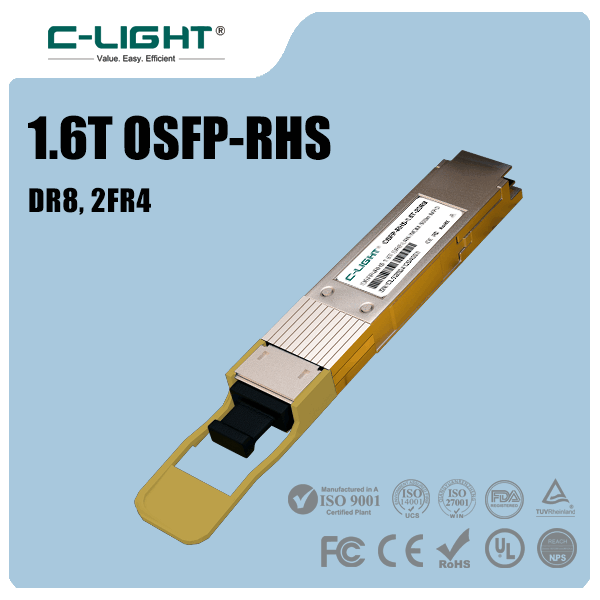
45. 1.6T LPO
1.6T increases the challenge for pluggable linear optics because higher lane rates make the host electrical channel more difficult to support.
LPO remains attractive because it reduces module power, but the host SerDes and PCB must provide sufficient electrical margin.
46. 1.6T CPO
1.6T is also a major target for near-ASIC optical architectures.
The higher electrical lane rate makes short electrical paths increasingly important, which is one reason CPO is being considered for next-generation switching systems.
47. 200G-Per-Lane Signaling
When electrical interfaces move toward 200G-per-lane operation, PCB loss, connector loss, crosstalk, package parasitics, and equalization become major constraints.
CPO directly attacks the electrical-distance problem, while LPO depends more strongly on the host SerDes to compensate for the existing electrical channel.
48. Future Higher-Speed Systems
As aggregate bandwidth continues to increase, the industry is evaluating multiple optical architectures rather than relying on one universal solution.
LPO, CPO, NPO, and other approaches can each occupy different positions depending on lane rate, electrical reach, power, thermal limits, and deployment requirements.
49. CPO vs LPO for AI Networks
AI clusters place heavy demands on communication bandwidth between accelerators, NICs, switches, and other network components.
LPO can reduce optical module power while preserving pluggability. CPO can reduce the electrical distance between optical engines and switching silicon while increasing integration and bandwidth density.
50. CPO vs LPO: Main Trade-Off
| Design Factor | CPO | LPO |
|---|---|---|
| Optical integration | Very high | Lower |
| Electrical path | Extremely short | Longer |
| Module power | Potentially low at system level | Low at module level |
| Module latency | Architecture dependent | Low |
| Front-panel dependence | Reduced | Retained |
| Serviceability | Lower | High |
| Manufacturing complexity | Very high | Lower |
| Thermal integration | Very high | Moderate |
| Upgrade flexibility | Lower | Higher |
| System integration | Very high | Moderate |
51. CPO vs LPO Is Not a Simple Replacement Relationship
CPO should not be considered a universal replacement for LPO.
LPO retains important operational advantages such as pluggability, independent module replacement, and easier field maintenance. CPO provides deeper integration and shorter electrical reach, but requires significant system-level changes.
52. LPO Is Not Simply a Lower-End CPO
LPO and CPO solve different engineering problems.
LPO focuses on reducing the power and latency of pluggable optics by removing conventional module DSP. CPO focuses on reducing electrical distance and increasing the integration between optics and switching silicon.
53. CPO vs LPO Selection Factors
When comparing CPO and LPO, evaluate:
ASIC SerDes capability, electrical channel loss, lane rate, optical engine power, thermal capacity, front-panel density, serviceability, optical interface, fiber routing, manufacturing requirements, interoperability, system cost, and upgrade strategy.
54. Which Architecture Fits an Existing Switch?
LPO generally requires less fundamental mechanical and board-level change because it maintains the pluggable optical architecture.
CPO requires a much more substantial redesign of the switch architecture because the optical engines are integrated near the ASIC package.
55. Which Architecture Fits Future High-Speed ASICs?
As electrical lane rates become increasingly high, near-ASIC optical architectures can become more attractive because electrical reach becomes a stronger system constraint.
At the same time, LPO remains relevant where pluggability, serviceability, and lower module power are more important than maximum optical integration.
56. CPO vs LPO Summary
| Category | CPO | LPO |
|---|---|---|
| Full name | Co-Packaged Optics | Linear Pluggable Optics |
| Primary concept | Integrate optical engines closely with ASIC | Remove conventional DSP from pluggable module |
| Optical location | Near or within ASIC package | Front-panel pluggable module |
| Electrical distance | Extremely short | Longer |
| Signal processing | Architecture dependent | Primarily host-side for linear operation |
| Module power | System architecture dependent | Lower than conventional retimed optics |
| Latency | Architecture dependent | Lower module-added latency |
| Serviceability | Lower | High |
| Thermal complexity | Very high | Lower |
| Manufacturing complexity | Very high | Moderate |
| Upgrade flexibility | Lower | Higher |
| 800G suitability | Yes | Yes |
| 1.6T suitability | Strong potential | Strong potential |
| Typical focus | Maximum integration and shorter electrical reach | Low-power, low-latency pluggable optics |
57. Conclusion
CPO and LPO address the scaling challenges of high-speed optical networking from different directions. CPO brings optical engines very close to the switching ASIC, minimizing the electrical path and enabling higher levels of bandwidth density and system integration. LPO keeps optics in a pluggable module while removing conventional DSP processing, reducing module power, latency, and complexity.
The key trade-off is between integration and modularity. CPO can provide stronger electrical-path advantages as lane rates increase, but it introduces more demanding packaging, thermal, manufacturing, fiber-routing, and serviceability requirements. LPO preserves the familiar pluggable architecture and can be deployed with less fundamental system redesign, but it remains more dependent on the host electrical channel and SerDes.
For 800G and 1.6T AI and data center networks, both architectures have important roles. LPO is attractive when low module power, low latency, and field replaceability are priorities. CPO becomes increasingly relevant when electrical reach, bandwidth density, and system-level integration become dominant constraints.
As optical and electrical lane rates continue to increase, the industry is likely to use a combination of LPO, CPO, NPO, and other optical-engine architectures rather than relying on one approach for every network.
 >
>

 >
>
 >
>
 >
>
 >
>
 >
>
 >
>
 >
>