TEL:+86 132 6656 7067




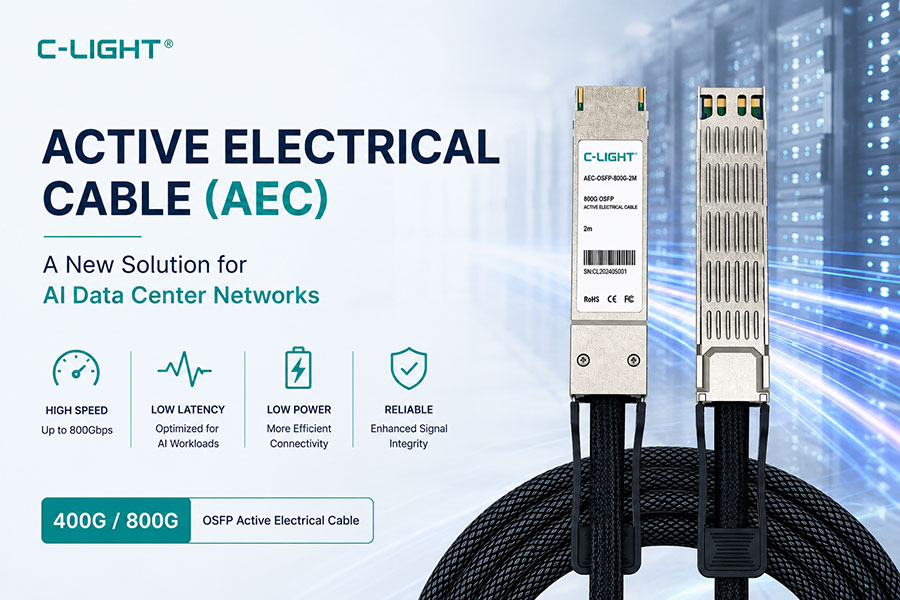
As AI workloads continue to increase network bandwidth requirements, data center interconnects are moving toward higher speeds, lower power consumption, and greater port density. Active Electrical Cable (AEC) has emerged as an important connectivity solution between high-speed network devices, especially in 400G, 800G, and next-generation 1.6T AI data center networks.
Compared with traditional Direct Attach Copper (DAC), AEC integrates active electronic components into the cable assembly to improve signal integrity over longer electrical links. This makes AEC particularly suitable for high-speed connections where passive copper cabling becomes increasingly difficult to manage.
1. What Is Active Electrical Cable (AEC)?
Active Electrical Cable, commonly abbreviated as AEC, is a high-speed electrical interconnect that uses active signal-conditioning components inside the cable assembly.
Unlike passive DAC, which relies primarily on the electrical characteristics of the copper cable, AEC uses active electronics to compensate for signal loss and degradation. The result is a more robust electrical connection for high-speed data transmission.
A typical AEC includes:
Copper conductors
High-speed signal-conditioning components
Connectors such as QSFP, QSFP-DD or OSFP
Power management circuitry
High-speed electrical interfaces
This architecture allows AEC to provide higher-speed connectivity while maintaining the advantages of copper-based interconnects.
2. Why AI Data Centers Need AEC
AI data centers are fundamentally changing the requirements for network interconnects. GPU clusters require extremely high bandwidth and low latency connections between GPUs, switches, servers, and storage systems.
As network speeds increase from 400G to 800G and toward 1.6T, passive copper cables face increasing challenges related to insertion loss, signal attenuation, crosstalk, and power efficiency.
AEC provides a middle ground between passive copper and optical connectivity.
Higher performance than conventional passive DAC
Lower cost than many optical interconnect solutions
Low latency for AI cluster communication
Efficient short-distance rack and row connectivity
Improved signal integrity at high data rates
3. AEC vs DAC vs AOC
AEC, DAC, and AOC are all used for high-speed data center interconnection, but they are designed for different application requirements.
| Technology | Transmission Medium | Signal Processing | Typical Advantage |
|---|---|---|---|
| DAC | Copper | Passive | Low cost and low latency |
| AEC | Copper | Active | Improved signal integrity and longer electrical reach |
| AOC | Optical Fiber | Active optical | Longer reach and strong EMI immunity |
For very short connections, DAC can remain an economical option. When electrical reach and signal integrity become more challenging, AEC can provide a practical alternative. For longer distances, AOC and optical transceivers become more attractive.
4. How AEC Works
The fundamental principle of AEC is to compensate for the signal degradation introduced by the electrical transmission path.
At high data rates, electrical signals experience increasing attenuation and distortion as they travel through copper. AEC incorporates active signal-conditioning technology to improve the quality of the transmitted electrical signal.
The basic signal path can be understood as:
Switch / GPU → AEC Connector → Active Signal Conditioning → Copper Cable → Active Signal Conditioning → AEC Connector → Switch / GPU
The active circuitry helps maintain signal quality and enables higher-speed electrical transmission than a comparable passive cable design.
5. AEC in 400G AI Networks
400G Ethernet has become an important building block for modern data center networks. AEC can be used for short-distance connections between switches, servers, and other high-bandwidth equipment.
In 400G environments, AEC can help simplify high-density cabling while maintaining low latency and relatively low power consumption.
Typical applications include:
400G switch-to-server connections
400G switch-to-switch connections
AI server interconnection
High-performance computing clusters
Data center rack-level networking
6. 800G AEC for AI Data Centers
800G AEC Cable | OSFP QSFP-DD Active Electrical Cable for Data Centers丨C-LIGHT
As AI clusters move toward 800G networking, the requirements placed on electrical interconnects become significantly more demanding.
800G AEC solutions are designed to support high-speed electrical connectivity while addressing the signal integrity challenges associated with next-generation network interfaces.
For AI infrastructure, 800G AEC can be considered for connections where the distance is short enough for copper but the bandwidth is too high for conventional passive DAC designs.
This makes 800G AEC particularly relevant to:
AI GPU clusters
High-performance computing
800G Ethernet switches
Server-to-switch interconnection
Rack-scale AI networking
7. AEC and 1.6T Network Evolution
The transition toward 1.6T networking introduces even greater challenges for electrical signal transmission.
At 1.6Tbps, each electrical lane must operate at extremely high signaling rates. This places strict requirements on PCB design, connectors, cable construction, signal conditioning, thermal management, and system-level interoperability.
AEC is therefore expected to remain an important technology for selected short-reach interconnect applications as data center architectures evolve toward 1.6T.
However, the optimal solution will depend on distance, power budget, port density, thermal conditions, and the architecture of the AI cluster.
8. Key Advantages of AEC
8.1 Improved Signal Integrity
Active signal conditioning helps compensate for electrical losses and maintain signal quality at high data rates.
8.2 Low Latency
AEC maintains an electrical transmission path, making it suitable for applications where extremely low latency is important.
8.3 Lower Cost for Short-Reach Links
For suitable short-distance applications, AEC can provide a cost-effective alternative to optical solutions.
8.4 High Port Density
AEC can support high-density switch and server deployments, which is particularly important in AI racks where thousands of high-speed connections may be required.
8.5 Simplified Cabling
Pre-terminated cable assemblies reduce the complexity associated with individual transceiver and fiber connections.
9. AEC Power Consumption
Power efficiency is one of the most important considerations in AI data centers.
Unlike passive DAC, AEC requires power for its active electronics. However, the overall system-level power consumption can still be attractive for short-reach applications because AEC avoids the optical conversion stages required by optical interconnects.
When evaluating AEC, engineers should consider:
Power consumption per cable
Total rack-level cable count
Switch port power budget
Thermal density
Cooling requirements
10. AEC and AI Cluster Architecture
Modern AI infrastructure typically consists of GPU servers, high-speed Ethernet or InfiniBand switches, optical modules, copper interconnects, and fiber infrastructure.
AEC is most valuable in the short-reach portion of this architecture.
GPU Server → AEC → AI Switch
For longer connections, optical solutions can be used to extend the network beyond the practical electrical reach of copper.
This creates a hybrid architecture in which DAC, AEC, AOC, and optical transceivers work together rather than competing as a single technology.
11. AEC Applications
AI data centers
GPU clusters
HPC networks
Cloud data centers
High-speed Ethernet networks
Server-to-switch connections
Switch-to-switch short-reach connections
Rack-scale networking
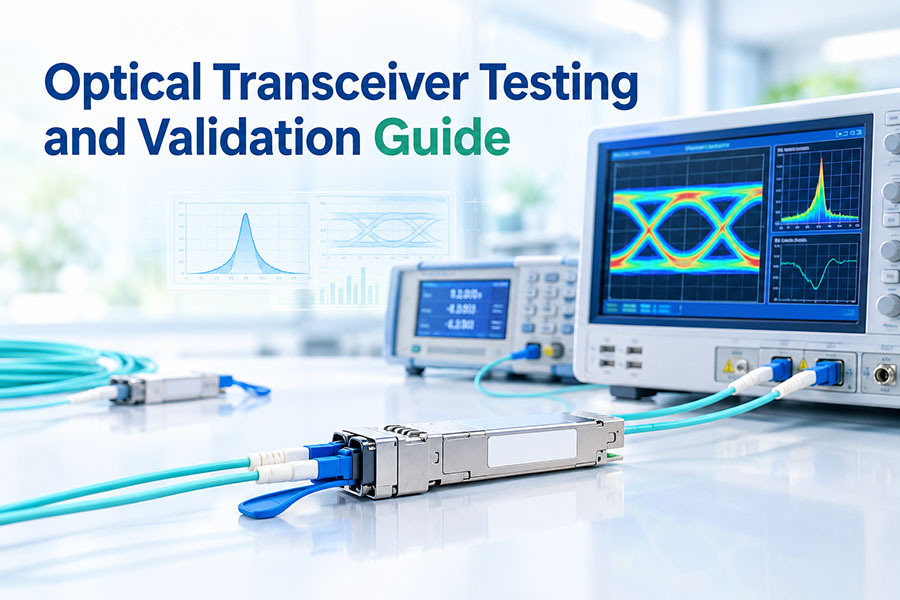
12. AEC Testing and Validation
High-speed AEC products require extensive electrical and system-level validation before deployment.
Important testing areas include:
Eye diagram testing
Bit Error Rate (BER)
Insertion loss
Return loss
Crosstalk
Jitter
Signal integrity
Power consumption
Thermal performance
Host compatibility
For 800G and future 1.6T products, validation becomes increasingly important because small signal-quality issues can have a significant impact on system reliability.
13. AEC and C-LIGHT Solutions
C-LIGHT focuses on high-speed optical and electrical interconnect solutions for modern data center and AI networking environments.
Its high-speed interconnect portfolio can include AEC solutions for different network generations, including 400G, 800G, and next-generation high-bandwidth applications.
For AI data center deployments, AEC can be combined with C-LIGHT optical transceivers, DAC, AOC, and other interconnect products to create a flexible connectivity architecture.
Product Placement: This section can be used to insert the relevant C-LIGHT 400G, 800G, and 1.6T AEC product cards or product links.
14. How to Choose AEC for an AI Data Center
Selecting an AEC solution requires more than simply matching the data rate.
Data Rate: Select 400G, 800G, or higher-speed solutions according to the network architecture.
Reach: Confirm that the electrical distance is within the cable's supported range.
Power: Evaluate cable power consumption together with the switch and rack power budget.
Compatibility: Verify compatibility with switches, GPUs, NICs, and network platforms.
Thermal Environment: Consider cable density and cooling conditions in high-power AI racks.
Mechanical Design: Select appropriate connector types and cable configurations for the rack architecture.
15. The Future of AEC
The rapid expansion of AI computing is creating unprecedented demand for high-bandwidth, low-latency interconnects.
AEC is positioned between passive copper and optical connectivity, providing a practical solution for specific short-reach applications. As 800G becomes increasingly common and 1.6T networking develops, active electrical technologies will continue to evolve in areas such as signal conditioning, power efficiency, thermal management, and system integration.
At the same time, optical technologies will continue to dominate longer-reach and increasingly demanding interconnect applications. The future data center is therefore likely to use a combination of DAC, AEC, AOC, optical transceivers, and eventually CPO.
16. Q&A Active Electrical Cable
Q1: What is an Active Electrical Cable (AEC)?
Answer: AEC is a high-speed electrical cable with integrated active signal-conditioning components designed to improve signal integrity and support high-bandwidth short-reach connections.
Q2: What is the difference between AEC and DAC?
Answer: DAC is generally passive, while AEC incorporates active electronics to compensate for signal loss and improve performance at higher speeds or longer electrical reaches.
Q3: Is AEC suitable for AI data centers?
Answer: Yes. AEC is particularly suitable for short-reach, high-bandwidth connections between AI servers, GPUs, NICs, and high-speed switches.
Q4: Can AEC support 800G networks?
Answer: Yes. 800G AEC is designed for high-speed electrical interconnect applications in AI clusters, HPC systems, and high-density data centers.
Q5: Is AEC faster than optical fiber?
Answer: AEC and optical interconnects are designed for different applications. AEC provides very low-latency electrical connectivity for short distances, while optical solutions generally provide greater reach and stronger immunity to electromagnetic interference.
Q6: Does AEC consume power?
Answer: Yes. Unlike passive DAC, AEC contains active electronics and therefore requires power. Its power efficiency should be evaluated as part of the overall data center network design.
Q7: What applications use AEC?
Answer: Common applications include AI GPU clusters, HPC systems, Ethernet data centers, server-to-switch connections, switch-to-switch links, and rack-scale networking.
Q8: Will AEC replace optical transceivers?
Answer: No. AEC is better viewed as a complementary technology. Copper-based AEC is suitable for selected short-reach links, while optical transceivers remain essential for longer distances and many high-density network architectures.
17. Conclusion
Active Electrical Cable is becoming an important option for high-speed AI data center interconnects. By combining the low latency and cost advantages of copper with active signal conditioning, AEC addresses some of the limitations of passive DAC at higher data rates.
As networks evolve from 400G to 800G and toward 1.6T, AEC, AOC, DAC, and optical transceivers will increasingly operate as complementary technologies. For AI data centers, selecting the right combination according to bandwidth, reach, power, density, and thermal requirements will be essential for building efficient next-generation networks.
 >
>

 >
>
 >
>
 >
>
 >
>
 >
>
 >
>
 >
>