TEL:+86 132 6656 7067





High-speed data center networks rely on reliable connections between switches, servers, storage systems, and AI computing infrastructure. As Ethernet and InfiniBand interfaces advance to 400G and 800G, choosing the right cable architecture becomes increasingly important for managing transmission distance, power consumption, cable density, and signal integrity.
Active Optical Cable (AOC) and Active Copper Cable (ACC) are two solutions for short-reach, high-bandwidth interconnections. Although both integrate active components into their connector assemblies, they use fundamentally different transmission media. AOC converts electrical signals into optical signals and transmits data through fiber, whereas ACC maintains electrical transmission through copper with active signal conditioning.
1. What Is an AOC Cable?
AOC stands for Active Optical Cable. It is an integrated cable assembly that combines optical transmitter and receiver components with fiber optic cable. The optical conversion components are built into the connectors at both ends, so users do not need to install separate optical transceivers and fiber patch cords.
At the transmitting end, electrical signals from a switch or server are converted into optical signals. These signals travel through optical fiber and are converted back into electrical signals at the receiving end.
AOC cables are commonly used for:
Switch-to-switch connections across racks.
High-speed server and storage interconnections.
AI training clusters and GPU networking.
High-performance computing systems.
Data center links requiring longer reach than typical copper cable assemblies.
Most data center AOC products use multimode fiber and short-wavelength optical components, although the exact fiber type, wavelength, and supported reach depend on the product design.
2. What Is an ACC Cable?
ACC stands for Active Copper Cable. It is a copper cable assembly that integrates active electronic components into its connectors to condition electrical signals.
Unlike AOC, ACC does not convert data into optical signals. The data remains electrical throughout the connection and travels through copper conductors. Active circuitry helps compensate for channel loss and improve the electrical signal presented to the receiving device.
Depending on the implementation, ACC may incorporate:
Linear equalization: Compensates for frequency-dependent signal attenuation.
Redriver circuits: Improve signal amplitude and compensate for selected channel impairments.
Pre-emphasis: Adjusts transmitted signal characteristics to help offset channel loss.
Power-management circuitry: Supplies and controls the active components.
ACC is useful when a passive DAC connection cannot provide sufficient electrical margin or reach, but the application still favors a copper-based interconnect.
3. AOC vs ACC: Main Technical Differences
The most fundamental difference is the transmission medium. AOC uses fiber optic transmission, while ACC uses copper electrical transmission. This affects cable reach, electromagnetic immunity, weight, power consumption, and installation requirements.
| Technical Feature | AOC Cable | ACC Cable |
|---|---|---|
| Full Name | Active Optical Cable | Active Copper Cable |
| Transmission Medium | Optical fiber | Copper twinax |
| Signal Type Inside Cable | Optical | Electrical |
| Connector Electronics | Optical transmitters and receivers | Active electrical signal-conditioning circuits |
| Signal Conversion | Electrical-to-optical and optical-to-electrical | No optical conversion |
| Transmission Distance | Generally longer | Short-reach copper connections |
| Power Consumption | Required for optical conversion at both ends | Required for active electrical circuitry |
| Electromagnetic Interference | Optical fiber is immune to electromagnetic interference | Requires suitable copper shielding and installation |
| Cable Weight | Generally lighter | Generally heavier than fiber-based assemblies |
| Cable Flexibility | Generally thin and flexible | Depends on copper gauge and cable construction |
| Latency | Very low, with optical conversion at both ends | Very low, depending on active circuitry |
| Typical Application | Longer short-reach optical links | Extended-reach copper links |
4. Transmission Distance: AOC vs ACC
Transmission distance is one of the main reasons to choose AOC instead of ACC. Copper cables experience insertion loss and frequency-dependent attenuation, which become increasingly challenging as signaling rates increase. ACC uses active electrical conditioning to compensate for some of these impairments, but it remains a copper-based solution.
AOC uses optical fiber, which supports longer transmission distances without the same electrical attenuation limitations associated with copper cables.
| Data Rate | ACC Application | AOC Application | Deployment Consideration |
|---|---|---|---|
| 100G | Selected short copper connections | Short- to medium-reach optical links | Check the supported cable length and interface specification. |
| 200G | Short-reach active copper connections | Longer optical cable assemblies | Host compatibility and cable architecture are important. |
| 400G | Selected short-reach copper configurations | Commonly available in multi-meter configurations | Consider rack layout, signal integrity, and cable routing. |
| 800G | Short copper connections, depending on the design | Longer short-reach fiber connections | Verify the lane rate, connector type, and exact product reach. |
C-LIGHT provides specific product examples that illustrate the difference:
800G ACC: Listed configurations range from 0.5m to 5m, depending on interface and cable construction.
800G AOC: The product family lists configurations from 1m to 30m.
400G AOC: The product family lists configurations from 1m to 30m.
5. Power Consumption and Latency
Both AOC and ACC require active electronics, but their power consumption comes from different functions.
AOC requires power for optical transmitters, receivers, drivers, and associated control electronics at both ends. ACC requires power for its active electrical conditioning circuits, such as linear equalizers or redrivers.
| Performance Factor | AOC | ACC |
|---|---|---|
| Active Components | Optical engines and conversion electronics | Electrical signal-conditioning circuits |
| Power Requirement | Required at both ends | Required for active conditioning |
| Power Trend | Generally higher than ACC for comparable short-reach links | Generally lower than AOC |
| Signal Processing | Optical conversion and associated electronics | Electrical equalization or signal boosting |
| Latency Characteristics | Very low | Very low |
| Thermal Considerations | Heat from optical and electrical components | Heat from active electrical components |
ACC can offer a lower-power option for short copper connections, while AOC provides the reach and physical advantages of optical transmission. Actual power consumption must be checked against the individual product datasheet rather than assumed from the cable category alone.
Latency differences are also implementation-dependent. ACC linear conditioning circuits can have very low processing delay. AOC introduces optical conversion at both ends, but its overall latency remains very low for typical data center applications.
6. Signal Integrity and Electromagnetic Interference
AOC and ACC handle signal integrity in fundamentally different ways.
In an AOC, the electrical signal is converted into light before entering the fiber. The optical transmission path is not affected by electromagnetic interference in the same way as an electrical copper connection. This makes AOC suitable for installations with demanding electromagnetic conditions.
ACC keeps the signal in the electrical domain. Its active circuitry compensates for selected transmission impairments, including frequency-dependent attenuation. However, copper cables still require appropriate shielding, grounding, connector design, and routing.
For ACC, engineers should consider:
Copper cable insertion loss and return loss.
Signal equalization and channel compensation.
Shielding and electromagnetic compatibility.
Connector quality and impedance consistency.
Host SerDes equalization capability.
For AOC, important considerations include:
Optical transmitter and receiver compatibility.
Fiber type and supported wavelength.
Connector construction and cable handling.
Minimum bend radius and installation conditions.
Optical performance and link stability.
7. Cable Weight, Flexibility, and Installation
Physical cable characteristics become important when hundreds of high-speed connections are installed in a data center. Cable diameter, weight, bend radius, and routing flexibility can affect airflow, port access, and maintenance.
AOC generally uses thinner and lighter fiber assemblies. This can make it easier to route connections between racks or through high-density cable management systems.
ACC retains copper conductors, so its physical construction depends on copper gauge, shielding, and cable length. Active circuitry may allow selected designs to use different cable constructions, but ACC still requires copper cable handling practices.
| Installation Factor | AOC | ACC |
|---|---|---|
| Cable Material | Optical fiber | Copper conductors |
| Weight | Generally lighter | Generally heavier |
| Flexibility | Generally easier to route | Depends on copper gauge and construction |
| EMI Considerations | Immune along the optical fiber | Requires appropriate shielding |
| Installation Care | Observe fiber bend radius and connector handling | Observe copper bend radius and connector handling |
| Maintenance | Integrated assembly is generally replaced as a complete cable | Integrated assembly is generally replaced as a complete cable |
Both AOC and ACC are fixed cable assemblies with integrated electronics. Unlike a conventional optical transceiver connected to a separate patch cord, the cable and end modules are supplied as one assembly. This simplifies installation but makes cable length and connector configuration important purchasing decisions.
8. AOC vs ACC vs DAC vs AEC
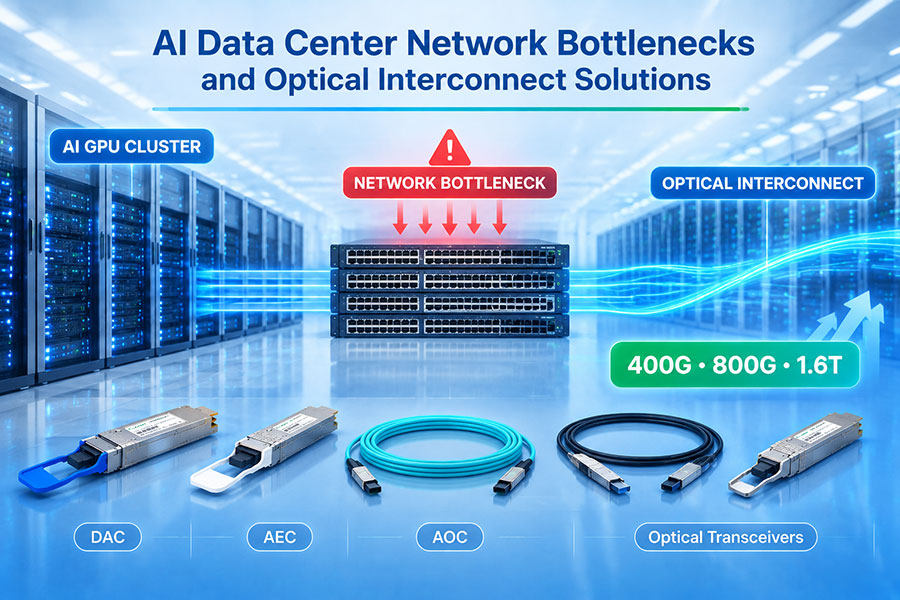
AOC and ACC are part of a broader range of high-speed interconnect technologies. DAC, ACC, AEC, and AOC each address different combinations of reach, power consumption, signal processing, and installation requirements.
| Feature | DAC | ACC | AEC | AOC |
|---|---|---|---|---|
| Transmission Medium | Copper | Copper | Copper | Optical fiber |
| Active Components | None in passive signal path | Linear equalizer or redriver | Retimer-based electronics | Optical transceivers |
| Signal Processing | Passive transmission | Electrical signal conditioning | Signal recovery and retiming | Optical conversion |
| Power Requirement | Virtually zero active cable power | Active power required | Active power required | Active power required at both ends |
| Reach Potential | Shortest | Extended copper reach | Extended electrical reach | Longer short-reach connections |
| EMI Immunity | Depends on shielding | Depends on shielding | Depends on shielding | Excellent |
| Typical Application | Very short connections | Short active copper links | High-speed electrical links requiring retiming | Longer short-reach optical links |
ACC and AEC should not be treated as the same technology. ACC typically uses linear signal conditioning, while AEC commonly uses retiming to recover and regenerate the electrical data signal. AOC uses optical transmission and therefore addresses a different physical-layer architecture.
9. Applications in 400G and 800G Data Centers
AI training clusters, hyperscale data centers, and high-performance computing systems require high-bandwidth connections between switches, servers, GPUs, and storage infrastructure. The appropriate cable depends on the physical distance, port layout, and electrical or optical interface requirements.
AOC application scenarios:
Switch-to-switch connections across different racks.
400G and 800G optical links in high-density data centers.
AI cluster networks requiring flexible optical cabling.
Connections where electromagnetic immunity is important.
Installations where lower cable weight and routing flexibility are priorities.
ACC application scenarios:
Short-distance copper connections between compatible switches.
High-speed links where passive DAC reach is insufficient.
Selected 400G and 800G server and switch interconnections.
AI and HPC systems requiring active electrical conditioning.
Deployments where copper connectivity and lower cable power are priorities.
For 800G networks, the choice should consider the actual lane rate, connector type, cable length, host SerDes capabilities, and system power budget. Neither AOC nor ACC should be selected based on the data rate alone.
10. C-LIGHT 400G and 800G AOC and ACC Cable Solutions
C-LIGHT provides active optical and active copper cable assemblies for data centers, AI computing infrastructure, InfiniBand networks, and high-performance computing. Its product range includes different form factors, cable lengths, and breakout configurations.
C-LIGHT 400G AOC uses 850nm multimode optical transmission over OM3 fiber. The listed product configurations support cable lengths from 1m to 30m and include OSFP112, QSFP112, and QSFP-DD interfaces.
Selected configurations support 400G-to-4x100G and 400G-to-2x200G breakout connections.
C-LIGHT 800G AOC provides optical connectivity for high-density data center and HPC applications. The listed product family includes QSFP-DD and OSFP112 configurations, 850nm multimode transmission, and 1m to 30m cable options.
Selected breakout configurations support 800G-to-2x400G and 800G-to-4x200G connections.
C-LIGHT 800G ACC supports high-speed copper interconnections for AI data centers, InfiniBand NDR, and high-performance computing. Available configurations include QSFP-DD and OSFP112 interfaces, with selected QSFP112 breakout options.
The listed cable lengths range from 0.5m to 5m depending on the configuration. Multiple copper gauges and connector constructions are available.
For additional cable options, including DAC, AOC, ACC, and AEC, visit the C-LIGHT High-Speed Cable Portfolio.
When evaluating compatibility, customers should confirm the switch or server model, connector form factor, protocol, required cable length, and breakout mapping. Product compatibility should be verified for the exact cable part number and both connected devices.
11. How to Choose Between AOC and ACC
The appropriate solution depends on the required transmission distance, cable installation environment, power budget, and host equipment. The following selection criteria can help guide the evaluation.
| Deployment Requirement | Option to Evaluate | Reason |
|---|---|---|
| Connection exceeds practical copper reach | AOC | Optical fiber supports longer cable runs. |
| Short-distance copper connectivity is preferred | ACC | Maintains electrical transmission with active signal conditioning. |
| Strong electromagnetic immunity is required | AOC | Optical fiber does not conduct electromagnetic interference. |
| Lower active cable power is important | ACC | Active electrical conditioning can require less power than optical conversion, depending on the products. |
| Longer cable routing between racks | AOC | Supports longer short-reach connections and generally lighter cable routing. |
| Passive DAC reach is insufficient | ACC or AOC | ACC extends copper reach; AOC provides an optical alternative. |
| High-density optical cabling | AOC | Fiber assemblies are generally thinner and lighter. |
Before deployment, engineers should verify:
Switch, server, and NIC compatibility.
Supported Ethernet or InfiniBand protocol.
Connector form factor, including QSFP-DD, QSFP112, and OSFP112.
Required data rate and cable length.
Power budget and thermal requirements.
Fiber type and optical specifications for AOC.
Copper gauge and signal-conditioning architecture for ACC.
Breakout mapping and endpoint compatibility.
12. Conclusion
AOC and ACC are both active high-speed cable technologies, but they use different transmission media and address different network requirements. AOC converts electrical signals into optical signals and transmits them through fiber, providing longer reach, lower cable weight, and excellent electromagnetic immunity. ACC maintains electrical transmission through copper and uses active signal conditioning to extend the practical reach of copper interconnects.
For longer short-reach connections, cross-rack cabling, and environments where electromagnetic interference or cable weight is a concern, AOC is a suitable option to evaluate. For short copper connections where active signal compensation is needed and optical conversion is unnecessary, ACC provides an alternative.
As 400G and 800G data center networks continue to expand, the final choice should be based on transmission distance, power consumption, signal integrity, cable management, and equipment compatibility rather than data rate alone.
C-LIGHT provides high-speed optical and copper interconnect products for AI data centers, InfiniBand networks, HPC systems, and enterprise infrastructure.
Contact C-LIGHT >

 >
 >
 >
 >
 >
 >
 >