TEL:+86 132 6656 7067




AI optical modules and telecom optical modules both enable high-speed data transmission over optical fiber, but they are optimized for different network environments. AI optical modules are commonly deployed in GPU clusters, high-performance computing systems, and hyperscale data centers, where bandwidth density, low latency, power efficiency, and thermal management are critical. Telecom optical modules are designed for access networks, metropolitan networks, backbone transmission, and long-distance optical transport, where transmission reach, optical performance, wavelength management, and interoperability are major considerations.
However, the distinction is not absolute. Modern AI infrastructure also requires long-distance data center interconnect (DCI), while telecom networks increasingly use 400G and 800G coherent pluggable optics. Understanding the differences between AI optical modules and telecom optical modules helps network engineers choose the appropriate data rate, optical technology, transmission distance, and form factor for each application.
1. What Is an AI Optical Module?
An AI optical module is an optical transceiver designed or selected for artificial intelligence infrastructure, including GPU clusters, AI training systems, inference platforms, and high-performance computing networks. These environments generate substantial east-west traffic as GPUs, switches, and storage systems exchange data during distributed computing operations.
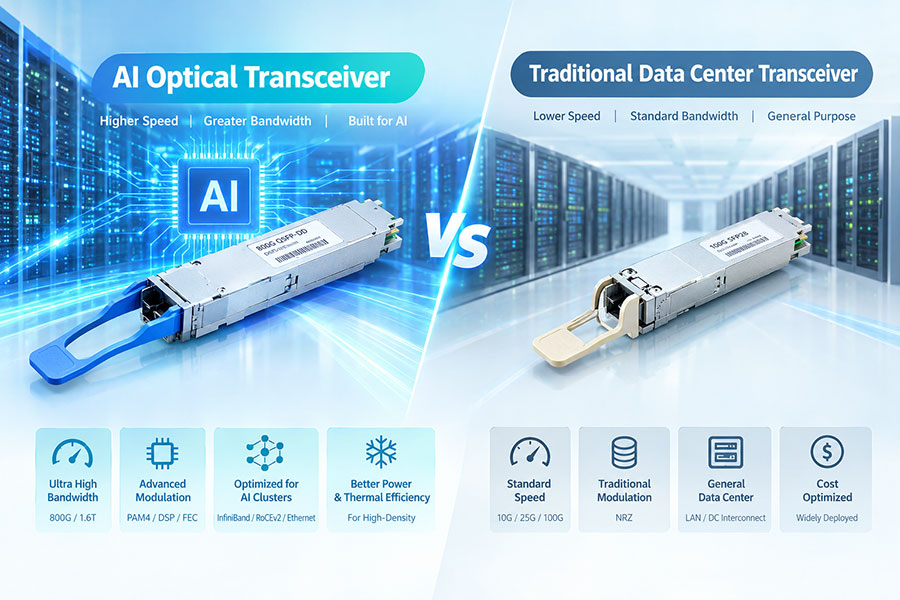
AI optical modules support high-bandwidth connections between servers, network switches, and other computing resources. Depending on the network architecture and link distance, they may use multimode or single-mode fiber, PAM4 modulation, VCSEL or EML lasers, silicon photonics, and other optical technologies.
1.1 Key Characteristics of AI Optical Modules
High bandwidth: 400G and 800G modules are widely relevant to high-speed AI networking, while 1.6T connectivity is an emerging generation.
Low power per bit: Energy efficiency matters when thousands of optical links operate simultaneously.
High port density: Compact form factors help increase switch capacity within a limited rack footprint.
Low-latency connectivity: Predictable network performance is important for distributed AI training and accelerator communication.
Thermal management: High-speed modules must operate within the power and cooling limits of densely populated switches.
Protocol compatibility: Depending on the platform, modules may support Ethernet or InfiniBand networking.
1.2 Common AI Optical Module Applications
AI optical modules are used for GPU-to-switch connectivity, switch-to-switch connections, spine-leaf networks, and high-bandwidth links between AI computing resources. Short-reach connections may use SR or DR optical modules, while longer links may use FR-class optics or coherent solutions, depending on the required reach and network design.
2. What Is a Telecom Optical Module?
A telecom optical module is an optical transceiver designed for telecommunications and optical transport networks. Typical applications include fiber access networks, metropolitan Ethernet, wavelength-division multiplexing (WDM), dense wavelength-division multiplexing (DWDM), backbone networks, and long-distance data transmission.
Telecom optical modules must meet the optical budget, transmission distance, wavelength plan, environmental conditions, and interoperability requirements of the target network. Depending on the application, they may use direct-detection optics, tunable lasers, coherent detection, or digital coherent optics (DCO).
2.1 Key Characteristics of Telecom Optical Modules
Longer transmission reach: Options range from access-network links to metropolitan, regional, and long-haul transmission.
Optical budget: Transmitter power, receiver sensitivity, dispersion, and link loss must match the network design.
Wavelength flexibility: Certain modules support fixed or tunable wavelengths for CWDM and DWDM systems.
Coherent transmission: Coherent optics can support high-capacity links over longer fiber distances.
Network interoperability: Compatibility with routers, optical transport equipment, and line systems is essential.
Operational reliability: Stable performance and appropriate environmental specifications are important for carrier infrastructure.
2.2 Common Telecom Optical Module Applications
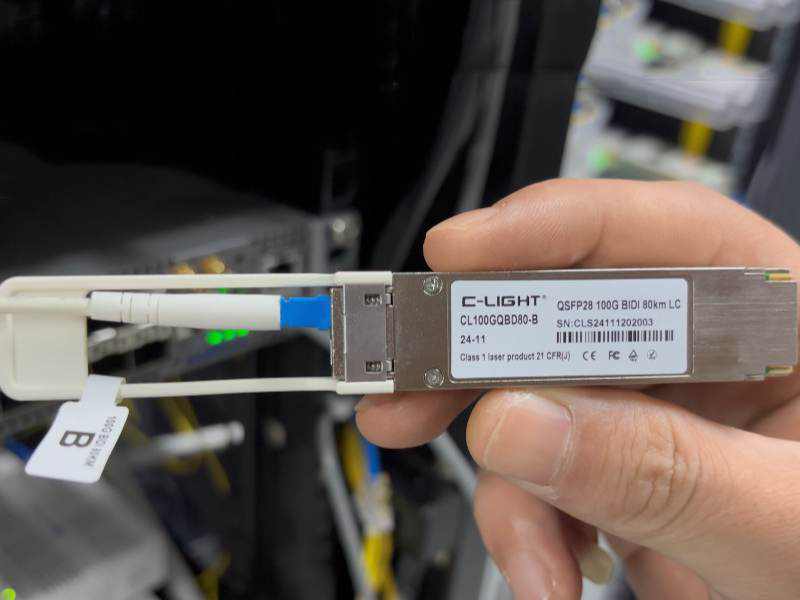
Telecom optical modules are deployed in fiber access networks, metro aggregation, optical transport systems, DWDM links, and backbone infrastructure. For example, 100G LR4 and ZR4-class products serve different link-budget and reach requirements, while coherent 400G or 800G modules may be used for high-capacity DCI and transport applications when supported by the relevant system architecture.
3. AI Optical Module vs Telecom Optical Module: Key Differences
The main difference between AI optical modules and telecom optical modules is the environment they are designed to serve. AI deployments prioritize bandwidth density, power efficiency, and high-volume connectivity within computing infrastructure. Telecom deployments place greater emphasis on optical reach, wavelength planning, transport performance, and compatibility with established network systems. These are general priorities rather than rigid rules.
| Comparison Factor | AI Optical Module | Telecom Optical Module |
|---|---|---|
| Primary Application | GPU clusters, AI training, HPC, hyperscale data centers | Access, metro, backbone, and optical transport networks |
| Bandwidth Focus | 400G, 800G, and emerging 1.6T connectivity | From lower-rate access interfaces to 400G and 800G coherent links |
| Typical Reach | Short- and medium-reach links are common; DCI may require longer reach | Ranges from access links to metro, regional, and long-haul connections |
| Traffic Pattern | High-volume east-west traffic between computing resources | Traffic aggregation, transport, and inter-network communication |
| Optical Technology | SR, DR, FR, PAM4, silicon photonics, and other suitable designs | LR, ER, ZR, WDM, and coherent optics, depending on the link |
| Wavelength | Commonly 850 nm or 1310 nm for many short- and medium-reach links; other options also exist | 1310 nm, 1550 nm bands, and tunable DWDM wavelengths, depending on the application |
| Power Efficiency | Critical at high port density and large deployment scale | Important, balanced against reach and optical performance |
| Thermal Design | High-density switch and rack cooling constraints | Host, line-system, and equipment-specific thermal requirements |
| Network Protocol | Ethernet or InfiniBand, depending on the platform | Ethernet, OTN, IP-over-DWDM, and other supported transport architectures |
| Selection Priority | Bandwidth, latency, power, density, and platform compatibility | Reach, optical budget, wavelength plan, interoperability, and reliability |
4. Bandwidth and Data Rate Requirements
AI workloads can generate intensive communication between accelerators, particularly during distributed training and synchronization. Higher-speed optical modules help increase the capacity of switch ports and reduce the number of physical links needed for a given aggregate bandwidth.
Telecom networks also require increasing bandwidth, particularly as cloud traffic, AI data movement, and inter-data-center connections grow. The difference is that telecom interfaces must often balance line rate with reach, spectral efficiency, and the capabilities of the existing optical transport system.
| Data Rate | AI Networking Role | Telecom Networking Role |
|---|---|---|
| 100G | Existing data center links and selected infrastructure connections | Access, aggregation, metro, and long-reach interfaces |
| 400G | High-speed switch and cluster connectivity | High-capacity transport and DCI, including suitable coherent solutions |
| 800G | High-density AI Ethernet and InfiniBand environments where supported | Coherent DCI and metro or regional transport, depending on the module and system |
| 1.6T | Emerging next-generation AI and data center connectivity | Future high-capacity transport applications as compatible solutions mature |
The data rate alone does not determine whether a module is suitable. Host electrical interfaces, lane configuration, fiber type, transmission distance, optical budget, and switch or router compatibility must all be verified.
5. Transmission Distance and Optical Technology
Transmission distance is one of the most important factors when comparing AI optical modules and telecom optical modules. Many AI cluster connections are within a rack, between racks, or across a data hall. Telecom networks may need to carry signals across metropolitan areas or much longer distances.
5.1 Short-Reach AI Connectivity
For short links, DAC and AOC cables may provide practical connectivity alternatives to pluggable optical transceivers. When optical modules are required, SR products commonly serve multimode links, while DR and FR products support various single-mode applications. The exact reach depends on the module specification, fiber grade, connector loss, and link design.
5.2 Long-Reach Telecom Connectivity
Telecom links may require LR or ER-class optics, ZR-class coherent modules, tunable DWDM transceivers, or other transport solutions. Coherent modules use advanced modulation and digital signal processing to improve transmission capacity over longer distances. Actual reach depends on the optical line system, fiber conditions, modulation format, and required performance margin.
5.3 AI Data Center Interconnect
AI and telecom use cases increasingly overlap in data center interconnect. When GPU infrastructure spans separate buildings, campuses, or metropolitan areas, coherent optics and WDM technologies may be more appropriate than short-reach AI transceivers. The application label should never replace an engineering review of the link budget and transport architecture.
| Link Scenario | Potential Solution | Key Consideration |
|---|---|---|
| Within a rack | DAC, AEC, or AOC | Distance, cable routing, and electrical interface compatibility |
| Between racks | SR or DR optical modules, depending on distance | Fiber type, reach, and port density |
| Across a data hall or campus | DR, FR, or other suitable single-mode optics | Actual fiber length and optical loss |
| Between data centers | FR, ZR, ZR+, or other suitable DCI solutions | Distance, coherent line-system compatibility, and total cost |
| Metro or long-haul transport | Coherent optics and DWDM transport | OSNR, dispersion, wavelength planning, and line-system design |
6. Power Consumption and Thermal Management
Power consumption is a major consideration in AI data centers because large GPU clusters can contain thousands of high-speed optical links. Even small differences in module power can influence total rack power, cooling requirements, and operating costs. Module selection should therefore consider power consumption alongside bandwidth, optical performance, and reliability.
Telecom optical modules also require careful power and thermal management. Coherent modules may integrate tunable lasers, coherent receivers, and digital signal processing, creating different power and cooling requirements from short-reach direct-detection optics. Some telecom modules prioritize longer reach and advanced optical performance, while others are optimized for lower power or smaller form factors.
Neither category is universally more power-efficient. A fair comparison should use actual specifications at the required data rate, reach, and operating conditions, including the power budget of the host equipment.
7. Reliability and Compatibility
Both AI optical modules and telecom optical modules require stable optical performance, accurate digital diagnostics, and compatibility with the intended host platform. However, their validation priorities may differ based on deployment conditions.
7.1 AI Optical Module Validation
Verify switch, NIC, and accelerator platform compatibility.
Check Ethernet or InfiniBand support and the required link configuration.
Validate power consumption, temperature limits, and cooling conditions.
Evaluate bit error rate (BER), signal integrity, and link stability.
Confirm fiber polarity, connector type, and cabling architecture.
7.2 Telecom Optical Module Validation
Verify the optical budget, receiver sensitivity, and transmitter output power.
Confirm wavelength, channel spacing, and tunability for WDM or DWDM systems.
Check dispersion tolerance, OSNR requirements, and coherent interoperability where applicable.
Validate compatibility with routers, switches, transponders, and optical line systems.
Review operating temperature, diagnostics, and network reliability requirements.
For both categories, the module's form factor alone does not guarantee compatibility. Two modules with the same connector and nominal data rate may use different host interfaces, optical specifications, firmware requirements, or application standards.
8. Cost and Total Cost of Ownership
The cost of an optical module depends on its data rate, optical technology, transmission reach, component design, production volume, and validation requirements. AI deployments often purchase large quantities of similar modules, making power consumption, port density, replacement procedures, and supply consistency important to total cost of ownership.
Telecom deployments may place greater weight on reach, wavelength flexibility, compatibility with installed optical equipment, and the cost of upgrading an existing transport network. A coherent pluggable module may reduce the need for separate transponder equipment in a suitable architecture, but this depends on the network design and supported interfaces.
The lowest unit price is not always the lowest-cost solution. Buyers should evaluate the complete link, including modules at both ends, fiber infrastructure, host equipment, power, cooling, installation, and long-term maintenance.
9. How to Choose the Right Optical Module
The best choice between an AI optical module and a telecom optical module starts with the actual network requirements rather than the product category name.
9.1 Choose for AI Data Center Networks
For GPU clusters, high-performance computing, and AI Ethernet or InfiniBand networks, prioritize the required port speed, lane configuration, link distance, power consumption, thermal performance, and host compatibility. C-LIGHT's 400G and 800G optical transceivers, DAC and AOC cables, and high-density fiber connectivity can be considered for appropriate data center applications. Emerging 1.6T solutions should be evaluated against the target platform's supported specifications.
9.2 Choose for Telecom and Optical Transport Networks
For telecom access, metro, DWDM, and backbone applications, begin with the required transmission reach, optical budget, wavelength plan, and network equipment compatibility. Depending on the architecture, suitable solutions may include 100G LR4 or ZR4-class optics, WDM transceivers, and coherent DCO modules. Confirm the exact reach and interoperability requirements before deployment.
9.3 Selection Checklist
| Selection Parameter | Questions to Confirm |
|---|---|
| Data Rate | Is the required interface 100G, 400G, 800G, 1.6T, or another rate? |
| Transmission Distance | What is the actual fiber length and total link loss? |
| Fiber Type | Does the link use multimode or single-mode fiber? |
| Wavelength | Is a fixed wavelength, tunable wavelength, or DWDM channel required? |
| Protocol | Does the host support Ethernet, InfiniBand, or the required transport interface? |
| Host Compatibility | Are the module form factor, electrical interface, and firmware supported? |
| Power and Cooling | Can the host operate the module within its power and temperature limits? |
| Interoperability | Have both ends of the link and any intermediate optical systems been validated? |
10. Conclusion
AI optical modules and telecom optical modules share the same fundamental purpose: transmitting data through optical fiber. Their primary differences come from application requirements. AI networking commonly emphasizes high bandwidth density, low power per bit, low latency, and thermal efficiency across large numbers of short- and medium-reach connections. Telecom networking often emphasizes transmission reach, optical budgets, wavelength management, coherent performance, and interoperability with optical transport systems.
These categories increasingly overlap as AI workloads extend across data centers and telecom networks adopt higher-speed interfaces. An 800G module, for example, may serve AI networking or telecom DCI when its optical technology, reach, and host interface match the application. Selecting the correct module requires a complete assessment of bandwidth, distance, fiber, power, protocol, and compatibility.
C-LIGHT provides optical connectivity solutions for data center and network infrastructure applications. When evaluating 400G, 800G, or next-generation optical connectivity, choose products based on the actual network design and verified product specifications rather than the AI or telecom label alone.
 >
>

 >
>
 >
>
 >
>
 >
>
 >
>
 >
>
 >
>