TEL:+86 132 6656 7067




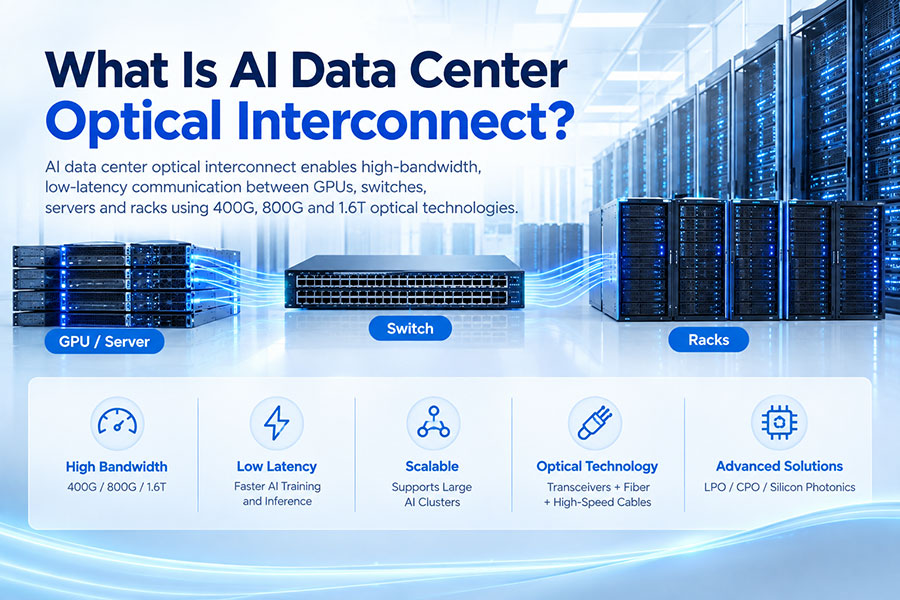
AI data center network architecture connects GPUs, servers, switches, storage, and external networks through high-bandwidth fabrics designed for distributed AI workloads. Modern architectures commonly combine Ethernet or InfiniBand, 400G and 800G connectivity, optical transceivers, DAC, AOC, AEC, and increasingly 1.6T optical technologies.
1. What Is AI Data Center Network Architecture?
AI data center network architecture defines how computing, storage, switching, and optical connectivity are organized to support large-scale artificial intelligence workloads.
Unlike conventional enterprise networks, AI networks must move extremely large volumes of data between GPUs with low latency and predictable performance.
2. Why AI Data Center Networks Are Different
AI workloads generate intensive east-west traffic. GPUs communicate continuously with other GPUs, servers, accelerators, and storage resources during training and inference.
This makes the internal network fabric just as important as the compute hardware. A high-performance GPU cluster can be underutilized when the network cannot deliver data fast enough.
3. Main Components of an AI Data Center Network
A typical AI data center network includes GPU servers, network adapters, leaf switches, spine switches, management networks, storage networks, optical interconnects, and external connectivity.
Large deployments may also include dedicated accelerator fabrics, high-speed Ethernet or InfiniBand switches, optical line systems, and multiple levels of network redundancy.
4. AI Data Center Network Layers
| Layer | Main Function |
|---|---|
| GPU/Server | Provides compute and network endpoints |
| Leaf/ToR | Connects servers and GPUs to the fabric |
| Spine | Provides high-capacity fabric connectivity |
| DCI | Connects separate data centers |
| WAN/External | Connects users, cloud services, and external networks |
5. GPU Servers in AI Networking
GPU servers are the primary compute endpoints in an AI cluster. Each server can contain multiple accelerators and one or more high-speed network adapters.
The network adapter connects the server to the switching fabric and must provide sufficient bandwidth to prevent the network from becoming the bottleneck for distributed workloads.
6. GPU-to-GPU Communication
GPU-to-GPU traffic can occur through direct accelerator interconnects inside a server or through the network fabric between servers.
Within a tightly integrated system, specialized short-distance electrical interconnects may be used. Across servers, high-speed Ethernet or InfiniBand becomes increasingly important.
7. GPU Network Adapters
Network adapters provide the interface between the GPU server and the external switching fabric. In AI systems, these adapters increasingly support 200G, 400G, 800G, or higher-speed connections.
Adapter selection must match both the switching architecture and the required network protocol.
8. Top-of-Rack Switches
Top-of-Rack switches, commonly called ToR switches, connect servers within a rack to the broader network fabric.
In AI environments, ToR or leaf switches can have a large number of high-speed ports to accommodate dense GPU server deployments.
9. Leaf-Spine Architecture
Leaf-spine is one of the most widely used architectures for scalable data center networks. Servers connect to leaf switches, while leaf switches connect to multiple spine switches.
The architecture provides predictable paths and multiple routes between endpoints, which is important for large distributed AI workloads.
10. Why AI Networks Use Leaf-Spine Design
AI workloads can generate traffic between many servers simultaneously. A traditional hierarchical network can create oversubscription and bottlenecks when east-west traffic increases.
Leaf-spine provides a more scalable switching fabric by distributing traffic across multiple spine connections.
11. Spine Switches
Spine switches form the high-capacity core of the data center fabric. They connect multiple leaf switches and provide the paths required for server-to-server and GPU-to-GPU traffic.
Spine ports often require higher bandwidth than server-facing ports because they carry aggregated traffic from many endpoints.
12. Clos Architecture for AI Data Centers
Large AI networks often use multi-stage Clos or folded-Clos architectures. These designs provide multiple equal-cost paths and can scale by adding switches and links in parallel.
The architecture is particularly useful when thousands of GPUs must communicate across a large switching fabric.
13. Scale-Up AI Architecture
Scale-up connects multiple accelerators into a tightly integrated compute system. The primary objective is extremely high-bandwidth communication between accelerators with very low latency.
Specialized electrical or optical accelerator interconnects may be used depending on the platform.
14. Scale-Out AI Architecture
Scale-out distributes AI workloads across multiple servers. The network fabric connects these servers and allows applications to use a larger pool of GPUs.
High-speed Ethernet and InfiniBand are both used for scale-out networking.
15. Scale-Across AI Architecture
Scale-across extends AI infrastructure between separate data centers. This requires long-distance optical networking rather than only short-reach server and switch connections.
Coherent optics, DWDM, and high-capacity DCI technologies become increasingly important at this layer.
16. Scale-Up vs Scale-Out vs Scale-Across
| Architecture | Primary Scope | Typical Connectivity |
|---|---|---|
| Scale-Up | Within compute system | Very short accelerator links |
| Scale-Out | Across servers and racks | Ethernet or InfiniBand |
| Scale-Across | Across facilities | Coherent optics and DCI |
17. Ethernet AI Data Center Networks
Ethernet provides a broad networking ecosystem and can support AI workloads through high-speed switching, congestion management, lossless or low-loss techniques, and advanced network adapters.
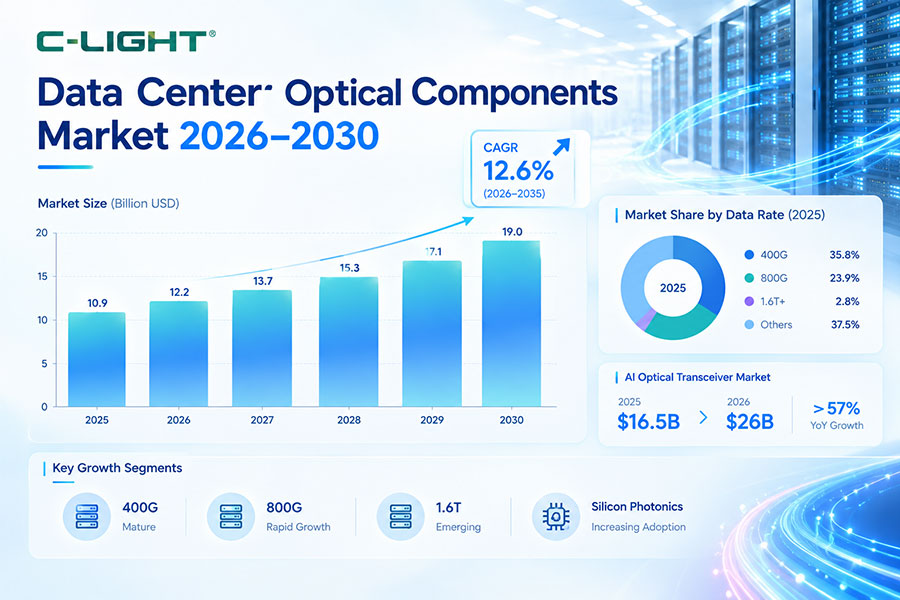
400G and 800G Ethernet are important building blocks for modern AI data center fabrics.
18. InfiniBand AI Networks
InfiniBand is widely associated with high-performance computing and AI clusters. It is designed around high throughput, low latency, and mechanisms suited to tightly coupled distributed workloads.
Optical transceivers, DAC, and active cables can all be used in compatible InfiniBand environments.
19. Ethernet vs InfiniBand
| Feature | Ethernet | InfiniBand |
|---|---|---|
| Ecosystem | Broad enterprise and cloud ecosystem | Strong HPC and AI ecosystem |
| AI use | Increasing rapidly | Established in many large AI clusters |
| Optical connectivity | Widely supported | Widely supported |
| Deployment choice | Depends on network architecture | Depends on cluster and application requirements |
20. 400G in AI Data Center Architecture
400G is an important network generation for AI infrastructure. A common implementation uses eight 50G-class PAM4 lanes, although specific architectures vary.
400G can be deployed between GPU servers and leaf switches, between switches, and in other high-bandwidth parts of the fabric.
21. 800G in AI Data Center Architecture
800G increases port bandwidth and is becoming important for large GPU clusters. A common implementation uses eight 100G-class PAM4 lanes.
Moving to 800G can increase network capacity while reducing the number of physical ports required for some aggregate traffic levels.
22. 1.6T in AI Data Center Architecture
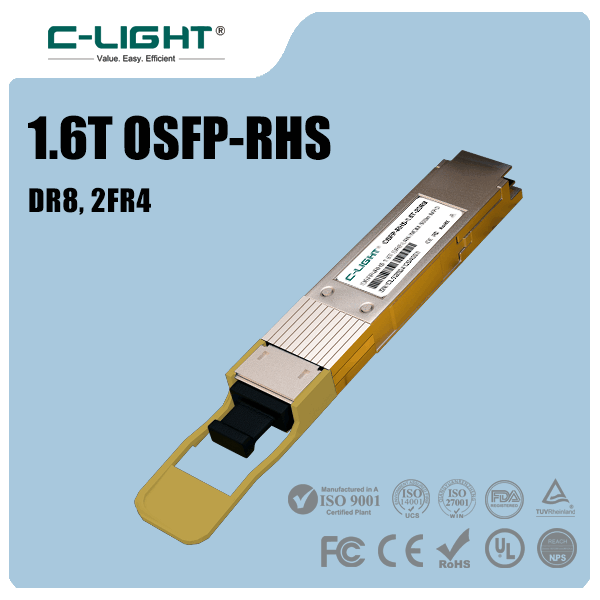
1.6T represents the next major bandwidth step for AI networking. A common electrical architecture uses eight 200G-class lanes, although implementation details vary.
At this bandwidth, signal integrity, DSP efficiency, optical engine design, thermal management, and packaging become increasingly demanding.
23. Optical Transceivers in AI Networks
Optical transceivers convert electrical data into optical signals for transmission over fiber and recover optical signals at the receiving endpoint.
Modern AI networks can use different transceiver types depending on reach, wavelength architecture, fiber type, and required bandwidth.
24. Short-Reach AI Optical Transceivers
Short-reach transceivers such as SR-class modules are commonly used for connections within data centers. Multimode fiber can be attractive when the distance is short and port density is high.
25. Single-Mode Optical Transceivers
Single-mode optical transceivers provide longer reach and are used when links extend across larger portions of a data center, campus, or DCI network.
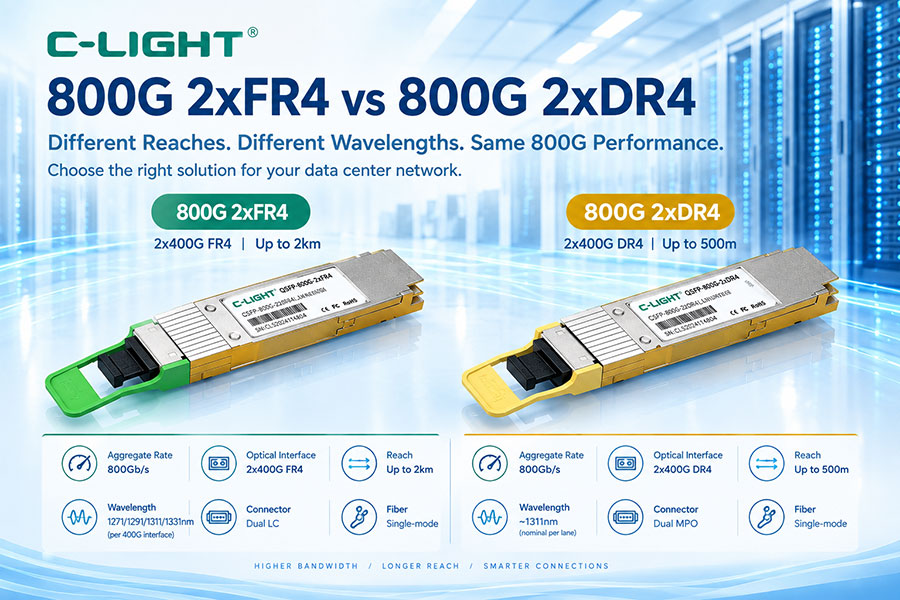
DR, FR, LR, and other optical architectures can address different reach requirements.
26. DAC in AI Data Center Architecture
Direct Attach Copper is primarily used for very short high-speed connections. Typical applications include GPU-to-switch, server-to-switch, and switch-to-switch links within the same rack.
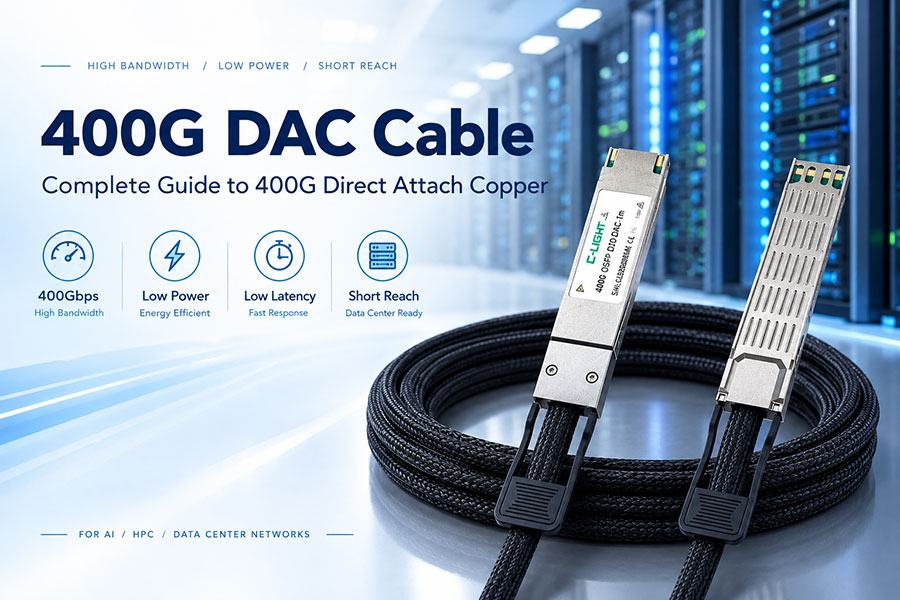
400G DAC is commonly designed for approximately 0.5m to 3m depending on the interface and cable construction.
27. AOC in AI Data Center Architecture
Active Optical Cable combines optical fiber with integrated electronics in a single cable assembly. It is useful when the required distance exceeds the practical range of passive copper.
AOC can reduce copper cable bulk while supporting longer intra-data-center connections.
28. AEC in AI Data Center Architecture
Active Electrical Cable uses signal-conditioning electronics to extend the practical range of copper connectivity.
AEC can occupy the space between passive DAC and optical connectivity for selected short-reach AI applications.
29. DAC vs AEC vs AOC
| Solution | Medium | Typical Application |
|---|---|---|
| DAC | Passive copper | Very short intra-rack |
| AEC | Active copper | Extended copper links |
| AOC | Optical fiber | Longer short-reach links |
| Optical transceiver | Optical fiber | Data center and longer links |
30. Why Optical Interconnect Is Critical for AI
As data rates increase, electrical channels become more difficult to extend over distance because of attenuation, crosstalk, reflections, and signal-integrity limitations.
Optical fiber provides a practical medium for moving high-bandwidth traffic across racks, halls, buildings, and data centers.
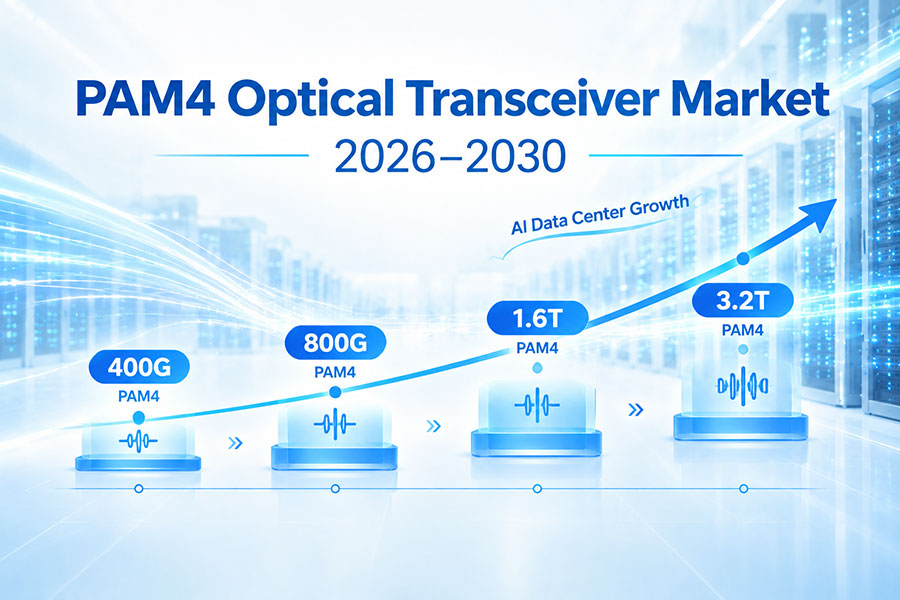
31. PAM4 in AI Networking
PAM4 increases the amount of data carried per symbol by using four signal levels. It is widely associated with 400G, 800G, and next-generation high-speed optical connectivity.
The trade-off is greater sensitivity to noise and signal distortion, which increases the importance of equalization, DSP, and FEC.
32. Optical DSP in AI Networks
DSPs process high-speed signals and can perform functions such as equalization, clock recovery, signal conditioning, lane management, and FEC-related processing depending on the implementation.
DSP power efficiency becomes particularly important at 800G and 1.6T because the number of high-speed ports in an AI switch can be very large.
33. FEC in AI Data Center Networks
Forward Error Correction adds redundancy to the transmitted data so that the receiver can correct certain errors without retransmission.
FEC can improve link robustness as signaling rates increase, although it also introduces coding overhead and processing requirements.
34. Link Margin in AI Networks
Link margin represents the difference between available system performance and the minimum performance required for reliable operation.
AI data center links should maintain sufficient margin for temperature variations, connector loss, cable aging, manufacturing variation, and other real-world conditions.
35. Network Topology and Oversubscription
AI network architecture must ensure that the total uplink capacity is sufficient for the expected workload. Excessive oversubscription can create congestion even when individual links operate at their nominal bandwidth.
Large AI fabrics often use high-radix switches and multiple parallel paths to reduce bottlenecks.
36. Non-Blocking AI Networks
A non-blocking architecture aims to provide sufficient network capacity so that multiple simultaneous connections can operate without a persistent internal bandwidth bottleneck.
Achieving this at thousands-of-GPU scale requires careful planning of switch ports, link counts, topology, and optical connectivity.
37. East-West Traffic in AI Data Centers
East-west traffic refers to communication between servers and internal network resources rather than traffic entering or leaving the data center.
AI training can generate extremely high east-west traffic because large numbers of GPUs may exchange data during distributed computation.
38. North-South Traffic
North-south traffic describes communication between the data center and external networks, users, cloud services, or other systems.
Although important, north-south traffic may require a different architecture from the GPU-facing east-west fabric.
39. Storage Networking for AI
AI systems require access to large datasets and model repositories. Storage networks therefore need sufficient throughput to prevent data loading from becoming a compute bottleneck.
High-speed Ethernet, specialized storage protocols, and optical connectivity may all be used depending on the architecture.
40. AI Data Center Network and Distributed Storage
When storage is distributed across multiple servers or facilities, the network becomes a critical part of the storage architecture.
Optical links help provide the bandwidth needed to transfer datasets and model checkpoints across large-scale infrastructure.
41. Network Congestion in AI Clusters
AI traffic can be bursty and synchronized. Many GPUs may send traffic at nearly the same time, creating temporary congestion across network paths.
Network architecture must therefore consider congestion control, buffering, load balancing, routing, and traffic scheduling.
42. Load Balancing
AI network fabrics often rely on multiple equal-cost paths. Effective load balancing distributes traffic across these paths and reduces the probability that one link becomes overloaded while another remains underutilized.
43. Optical Port Density
Switch port density is a major factor in AI network design. Higher-speed optical modules can provide more bandwidth per physical port, helping reduce port count for a given aggregate capacity.
44. Thermal Design of AI Network Switches
AI switches can contain many high-speed optical ports and high-performance switching ASICs. The resulting thermal load requires careful cooling, airflow, heat-sink design, and power planning.
45. Power Consumption per Port
Power consumption must be evaluated at the module, switch, and network levels. The most useful metric is often power per transmitted bit rather than power per module alone.
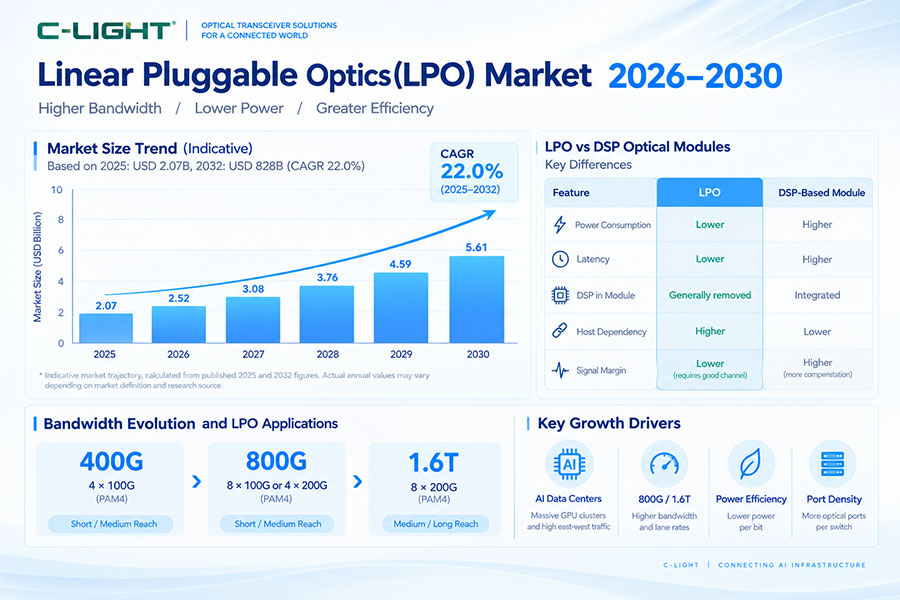
46. LPO in AI Data Center Architecture
Linear-drive pluggable optics aim to reduce or remove some retiming DSP functions in suitable short-reach applications.
LPO can reduce power consumption, but it places greater importance on host electrical signal quality, optical link design, interoperability, and system-level validation.
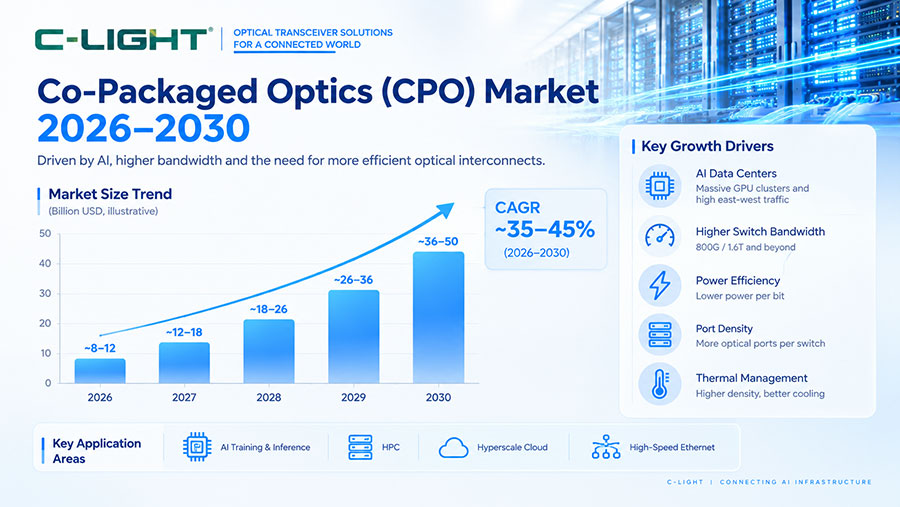
47. CPO in AI Data Center Architecture
Co-Packaged Optics places optical engines closer to the switching ASIC. This reduces the electrical distance between the switch silicon and optical interfaces.
CPO is being developed for architectures where traditional pluggable electrical channels become increasingly difficult to scale.
48. Pluggable Optics vs CPO
| Feature | Pluggable Optics | CPO |
|---|---|---|
| Serviceability | High | More complex |
| Upgrade flexibility | High | Lower |
| Electrical path | Longer | Shorter |
| Integration | External module | Switch-package integrated |
| Current role | Mainstream deployment architecture | Emerging high-bandwidth architecture |
49. AI Data Center Network Redundancy
Large GPU clusters require multiple network paths to avoid a single link or switch becoming a point of failure.
Redundant leaf-spine connections, diverse routes, multi-pathing, and resilient switching architectures can improve network availability.
50. Optical Link Monitoring
Monitoring optical transmit power, receive power, temperature, module status, link errors, and other diagnostics helps operators detect degrading connections.
51. Network Telemetry
Advanced AI data center operations increasingly rely on telemetry from switches, network adapters, optical modules, and applications.
Combining optical and network-level telemetry can help identify whether a performance problem originates from congestion, signal quality, hardware, or the optical path.
52. AI Data Center Network Security
Security remains important even when the majority of traffic is internal. Network segmentation, access controls, authentication, encryption, and secure management help protect AI infrastructure and its datasets.
53. Physical Layer Testing
Optical and electrical testing should verify link quality before a large GPU cluster is placed into production. Important measurements can include BER, optical power, wavelength, insertion loss, eye quality, temperature, and module diagnostics.
54. Interoperability Testing
AI data centers often use equipment from several vendors. The switch, NIC, optical module, cable, firmware, and management system must operate correctly as a complete solution.
55. Vendor Coding
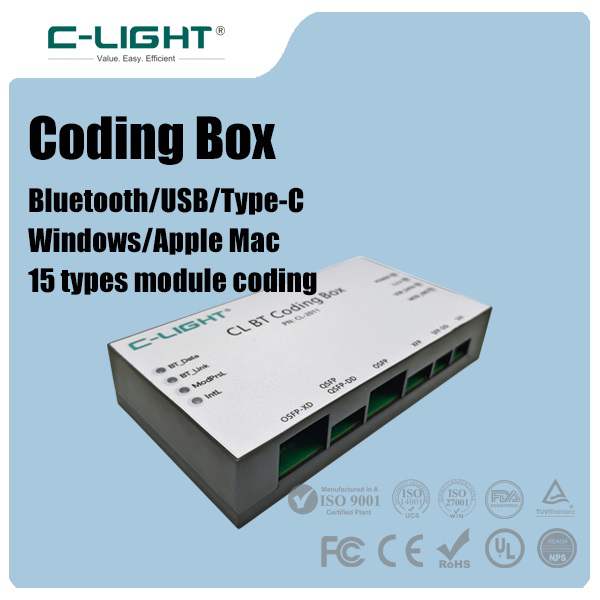
Some switches and network adapters use transceiver identification or vendor coding mechanisms. Correct coding may therefore be necessary for module recognition and successful deployment.
56. Network Upgrade from 400G to 800G
Moving from 400G to 800G can require changes across several layers, including switches, NICs, optical modules, cables, breakout architecture, and thermal planning.
The upgrade should be treated as a system-level change rather than a simple transceiver replacement.
57. Network Upgrade from 800G to 1.6T
The transition from 800G to 1.6T introduces even greater electrical and optical demands. Higher baud rates, power density, thermal constraints, signal integrity, and host interface bandwidth must all be considered.
58. AI Data Center Network Architecture by Distance
| Connection | Typical Technology |
|---|---|
| Within server | Specialized electrical accelerator interconnect |
| GPU server to switch | DAC, AEC, AOC, or optical transceiver |
| Rack to rack | AOC or optical transceiver |
| Data center fabric | 400G/800G optical connectivity |
| Metro DCI | Coherent pluggable optics |
| Long-distance DCI | Coherent optics, DWDM, ROADM, amplification |
59. AI Data Center Network Architecture Example
A simplified architecture can be represented as:
GPU Servers → Network Adapters → Leaf Switches → Spine Switches → DCI/Border Network → Coherent Optical Link → Remote Data Center
Each stage can use a different connectivity technology according to physical distance and bandwidth requirements.
60. Role of Optical Interconnect by Network Layer
Optical connectivity is not equally important at every layer. DAC may be appropriate for short server connections, optical transceivers for rack and fabric links, and coherent optics for long-distance DCI.
This layered approach allows the network to use the simplest suitable technology at each physical distance.
61. AI Data Center Network Design Principles
A scalable architecture should prioritize bandwidth, low latency, predictable paths, redundancy, power efficiency, thermal management, interoperability, and operational visibility.
62. Bandwidth Planning
Network bandwidth should be planned according to GPU count, accelerator generation, network adapter speed, switching capacity, application traffic patterns, and expected future expansion.
63. Latency Planning
Latency is particularly important for distributed AI workloads that require frequent communication between GPUs.
Network architecture should therefore minimize unnecessary hops and avoid placing tightly synchronized workloads across unnecessarily long physical distances.
64. Fiber Planning
Large AI data centers require extensive fiber infrastructure. Fiber count, connector type, cable routing, patch panels, bend radius, cleaning, and labeling should be planned before deployment.
65. Copper Planning
DAC and AEC can reduce optical conversion requirements for short links, but cable weight, bend radius, connector density, and airflow should be considered when large numbers of copper connections are deployed.
66. Cooling and Cable Management
AI racks can have very high power density. Cable routing should avoid blocking airflow around GPUs, switches, and power components.
The selection of thinner DAC assemblies, AOC, and appropriately sized optical cables can help simplify high-density cable management.
67. Network Architecture and Power Efficiency
Every network layer contributes to total energy consumption. Efficient switch ASICs, optical modules, DSPs, cable assemblies, and cooling systems can improve the overall energy efficiency of the AI data center.
68. AI DCI and Multi-Site Architecture
Large-scale AI infrastructure may span several geographically separated data centers. These sites can be connected through coherent 400G, 800G, and emerging 1.6T optical technologies over DWDM infrastructure.
69. Long-Distance Optical Networking for AI
Long-distance AI DCI requires much more than a high-speed optical module. Fiber loss, OSNR, dispersion, optical amplification, ROADM filtering, route diversity, and latency all need to be considered.
70. Future AI Data Center Network Architecture
Future AI networks will likely continue moving toward higher bandwidth per port, higher-radix switching, denser optical connectivity, lower power per bit, and closer integration between switching silicon and optical engines.
400G and 800G remain important, while 1.6T and emerging optical architectures will support the next generation of large GPU clusters.
71. Key AI Networking Trends
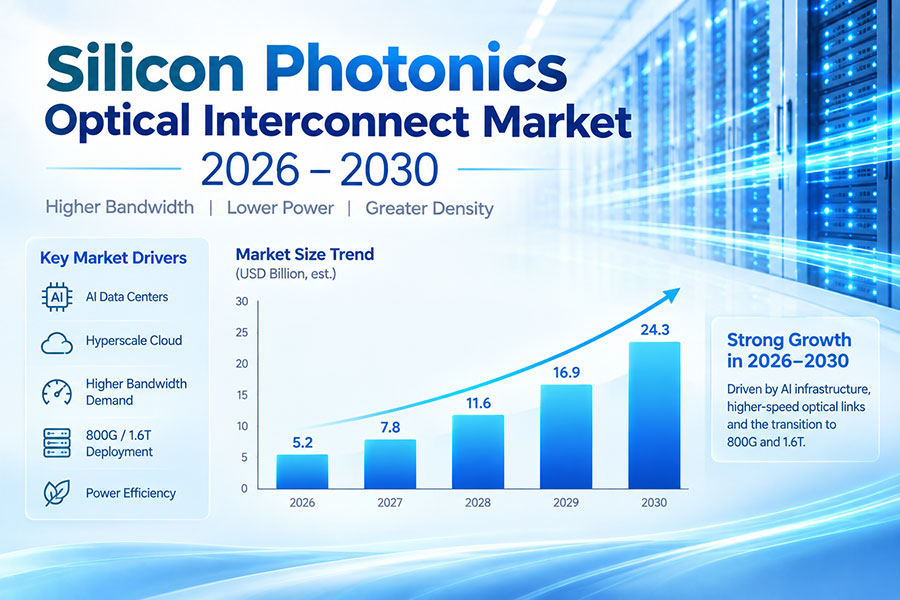
Major technology trends include 800G expansion, 1.6T deployment, advanced PAM4 DSPs, LPO, CPO, silicon photonics, high-density optical engines, coherent DCI, and greater network automation.
72. Main Challenges
The main challenges include power consumption, thermal density, signal integrity, congestion, optical loss, interoperability, network complexity, cable density, and the increasing cost of operating very large GPU fabrics.
73. How to Design an AI Data Center Network
Start with the GPU count, workload requirements, network protocol, expected traffic patterns, and target bandwidth. Then determine the switching topology and select the appropriate combination of electrical and optical interconnects.
Finally, validate power, thermal performance, latency, redundancy, optical margins, interoperability, and future upgrade paths.
74. AI Data Center Network Architecture Checklist
| Item | Key Consideration |
|---|---|
| GPU count | Current and planned scale |
| Protocol | Ethernet or InfiniBand |
| Port speed | 400G, 800G, 1.6T or required speed |
| Topology | Leaf-spine, Clos, or other architecture |
| Interconnect | DAC, AEC, AOC, optical transceiver, coherent optics |
| Latency | Application and synchronization requirements |
| Power | Port and system power budget |
| Thermals | Switch, module, rack, and cooling capacity |
| Scalability | Expansion to future GPU generations |
| Reliability | Redundancy and route diversity |
75. Conclusion
AI data center network architecture is fundamentally different from conventional enterprise networking because GPU clusters generate enormous volumes of east-west traffic that require high bandwidth, low latency, predictable performance, and scalable switching.
Modern architectures combine specialized accelerator connectivity, Ethernet or InfiniBand, leaf-spine and Clos fabrics, 400G and 800G optical networking, DAC, AEC, AOC, and high-speed optical transceivers. As AI clusters expand, 1.6T, LPO, CPO, silicon photonics, and coherent DCI technologies will become increasingly important.
The best architecture is not based on one connectivity technology. It combines different electrical and optical solutions according to distance, bandwidth, topology, power, thermal constraints, latency, and future scaling requirements.
 >
>

 >
>
 >
>
 >
>
 >
>
 >
>
 >
>
 >
>