TEL:+86 132 6656 7067




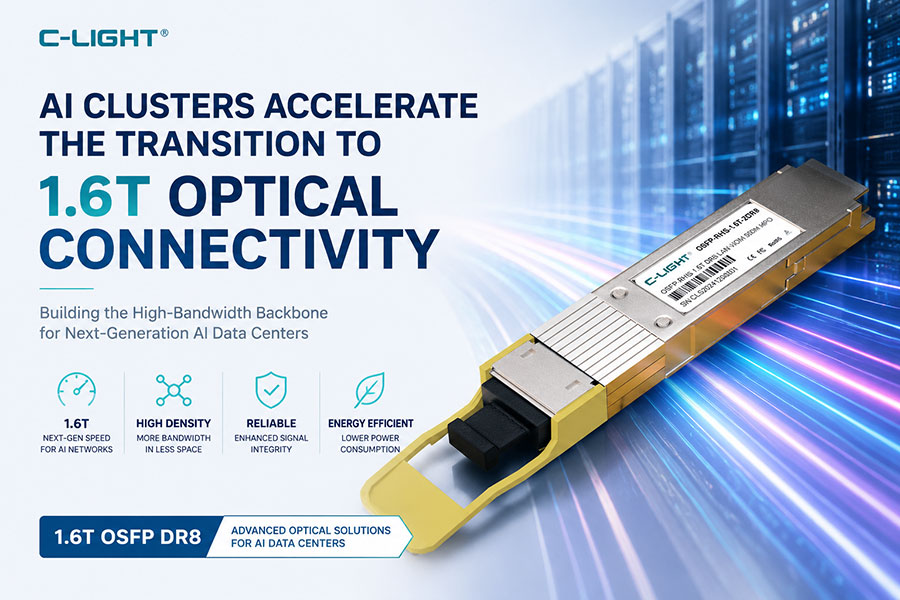
Artificial intelligence is reshaping data center network architecture at an unprecedented pace. The rapid deployment of GPU clusters, large-scale AI training systems, and distributed inference infrastructure is creating much higher bandwidth requirements between compute nodes, switches, and storage systems. As 400G and 800G optical connectivity continue to expand, the industry is increasingly moving toward 1.6T optical connectivity for next-generation AI clusters.
The transition to 1.6T is not simply a matter of increasing the data rate of an optical transceiver. It involves coordinated improvements in optical engines, electrical interfaces, signal integrity, thermal management, packaging, fiber connectivity, and network architecture.
1. Why AI Clusters Are Driving Higher Optical Bandwidth
Traditional data center networks were largely designed around relatively predictable traffic patterns. AI clusters are different. Thousands of GPUs may operate together on the same workload, creating intensive east-west traffic between compute nodes and network switches.
As GPU performance increases, network bandwidth must scale accordingly. A cluster with thousands of accelerators can generate enormous volumes of data during model training, parameter synchronization, collective communication, and distributed inference.
This creates a clear bandwidth evolution:
100G: Widely deployed in previous generations of data center networks.
200G: Provides higher bandwidth for increasingly demanding server and switch connections.
400G: Became an important generation for high-performance data center interconnects.
800G: Increasingly important for AI clusters and high-performance Ethernet or InfiniBand networks.
1.6T: Emerging as the next major bandwidth generation for large-scale AI fabrics.
The key driver is not only the bandwidth required by an individual GPU server. It is the aggregate traffic generated by the entire AI fabric.
2. From 800G to 1.6T Optical Connectivity
800G optical modules generally use multiple high-speed electrical and optical lanes to achieve the required aggregate bandwidth. Moving to 1.6T requires the industry to increase the bandwidth per lane, increase the number of lanes, or combine both approaches.
A simplified evolution can be represented as:
400G → 800G → 1.6T → 3.2T
Each generation introduces new requirements for modulation, electrical signaling, optical engines, DSPs, thermal design, and connector technology.
For 1.6T applications, higher-speed electrical signaling becomes particularly important. Technologies such as PAM4 allow more bits to be transmitted per symbol compared with conventional NRZ signaling, helping increase bandwidth without proportionally increasing the number of physical lanes.
3. The Role of PAM4 in 1.6T Networking
PAM4 has become a fundamental technology for high-speed optical connectivity. Instead of using two signal levels as in NRZ, PAM4 uses four amplitude levels, allowing two bits to be represented by each symbol.
This improves the data rate within a given channel bandwidth, but it also creates stricter requirements for signal quality.
At 1.6T, the electrical and optical channels must deal with issues including:
Higher insertion loss
Greater sensitivity to crosstalk
More demanding return-loss requirements
Higher jitter sensitivity
Stricter eye-opening requirements
More complex equalization and signal processing
As a result, 1.6T optical connectivity requires a complete system-level approach rather than simply increasing the nominal transmission speed.
4. 1.6T Optical Modules and AI Network Architecture
In large AI clusters, optical modules are used extensively between servers, leaf switches, spine switches, and other network elements. The exact architecture depends on the network topology and the required transmission distance.
Short-reach connections inside data centers can use parallel multimode or single-mode optical technologies, while longer connections may require single-mode solutions with more advanced optical components.
The most important consideration is matching the optical module to the network architecture.
4.1 Server-to-Switch Connections
AI servers require extremely high bandwidth connections to network switches. As accelerator bandwidth increases, 800G and eventually 1.6T interfaces can reduce the number of physical connections required for a given aggregate bandwidth.
4.2 Switch-to-Switch Connections
Switch-to-switch links are another major application for high-speed optical modules. Spine-leaf architectures can contain a large number of high-bandwidth connections, making optical density and power efficiency critical considerations.
4.3 AI Fabric Connectivity
AI fabrics rely heavily on low-latency and high-throughput communication. Whether the network uses Ethernet with RoCE or other high-performance interconnect technologies, optical connectivity becomes an important part of the overall system performance.
5. Why Optical Connectivity Is Critical for AI Clusters
Electrical connectivity remains important for very short distances, but optical technology offers significant advantages as bandwidth and transmission distances increase.
Optical interconnects provide:
High aggregate bandwidth
Longer transmission distance
Lower transmission loss over longer links
High port density
Strong scalability for large AI fabrics
For massive GPU clusters, these characteristics make optical interconnects increasingly important as network speeds move beyond 800G.
6. 1.6T Optical Connectivity Is More Than a Transceiver Upgrade
The transition to 1.6T affects the complete data center interconnect ecosystem.
6.1 Optical Engine
The optical engine must support higher aggregate data rates while maintaining sufficient optical power, receiver sensitivity, and signal quality.
6.2 DSP and Signal Processing
High-speed PAM4 transmission requires sophisticated signal processing. DSP technology plays an important role in compensating for channel impairments and maintaining reliable transmission.
6.3 Thermal Management
Higher-speed optical modules can increase power consumption and thermal density. This is especially important in AI data centers where rack power density is already rising rapidly.
Efficient heat dissipation therefore becomes a major consideration for 1.6T module design.
6.4 Electrical Channel Design
At higher speeds, PCB traces, connectors, packages, and cables all contribute to channel loss. Signal integrity must be evaluated across the complete electrical path.
6.5 Fiber Infrastructure
The optical infrastructure must also scale with the bandwidth of the network. Fiber type, connector density, polarity, insertion loss, and cable management can all affect the deployment of high-speed AI networks.
7. 1.6T Optical Modules and the Evolution of Data Center Interconnects
The move toward 1.6T is part of a broader evolution in data center optical connectivity.
Instead of treating optical modules as independent components, modern AI data centers increasingly consider the complete interconnect system:
GPU → NIC → DAC/AEC → Switch → Optical Module → Fiber → Optical Module → Switch
Different parts of this path may use different interconnect technologies depending on distance, bandwidth, power consumption, and cost.
For very short connections, DAC and AEC can provide practical high-speed connectivity. Optical transceivers become increasingly valuable as the transmission distance increases.
8. DAC, AEC and Optical Modules in AI Networks
The development of 1.6T optical connectivity does not mean that optical modules will replace all other interconnect technologies.
Instead, AI data centers are likely to use a combination of technologies.
| Technology | Typical Role | Main Advantage |
|---|---|---|
| DAC | Very short-reach connections | Low cost and simple architecture |
| AEC | Short-reach high-speed connections | Active signal conditioning with improved reach |
| AOC | Short-to-medium reach optical connectivity | Lower weight and optical transmission |
| Optical Transceiver | Medium and longer data center links | Scalable bandwidth and transmission distance |
This combination allows network designers to select the appropriate interconnect technology according to distance and bandwidth requirements.
9. C-LIGHT Solutions for High-Speed AI Connectivity
C-LIGHT provides optical transceivers and high-speed interconnect solutions for data center and AI networking applications. Its portfolio covers multiple generations of connectivity, supporting the transition from conventional high-speed networking toward 400G, 800G, and next-generation 1.6T architectures.
Relevant solutions include:
400G optical transceivers for high-bandwidth data center networks
800G optical transceivers for AI clusters and high-performance switching
1.6T optical connectivity solutions for next-generation AI infrastructure
High-speed DAC solutions for short-reach connections
AEC solutions for active electrical connectivity in AI data centers
AOC solutions for short- and medium-reach optical interconnects
The combination of optical modules and high-speed copper-based interconnect technologies enables network designers to build flexible AI connectivity architectures according to bandwidth, distance, power, and cost requirements.
10. Challenges in the Transition to 1.6T
Although 1.6T provides a significant increase in network capacity, deployment introduces several technical challenges.
10.1 Power Consumption
As data rates increase, module power becomes an increasingly important design parameter. High-density AI switches may contain hundreds of high-speed optical ports, making even a small increase in power per port significant at the system level.
10.2 Thermal Density
AI data centers already face increasing thermal challenges. High-speed optical modules must therefore be designed for efficient heat dissipation and stable operation under high-density conditions.
10.3 Signal Integrity
Higher-speed electrical interfaces have smaller signal margins. PCB design, connectors, cables, packages, and optical module interfaces must all be carefully optimized.
10.4 Manufacturing and Testing
1.6T devices require more advanced testing methods. Eye diagrams, BER, jitter, insertion loss, return loss, crosstalk, optical power, receiver sensitivity, and other parameters become increasingly important during qualification.
11. From 1.6T to 3.2T: The Next Step
The transition to 1.6T should be viewed as part of a continuous bandwidth evolution rather than the final destination.
As AI accelerator performance continues to increase, network bandwidth requirements will continue to grow. The industry is already looking beyond 1.6T toward 3.2T-class connectivity.
This future evolution may involve:
Higher-speed electrical lanes
Advanced PAM4 and future modulation technologies
More efficient optical engines
Co-packaged optics
Linear-drive optical technologies
Higher-density fiber connectivity
Improved thermal solutions
The fundamental objective remains the same: deliver more bandwidth while controlling power consumption, latency, thermal load, and deployment complexity.
12. The Future of Optical Connectivity in AI Data Centers
AI clusters are fundamentally changing the requirements of data center networking. As accelerator counts increase and AI workloads become more distributed, network performance is becoming increasingly important to overall cluster efficiency.
800G represents an important stage in this evolution, while 1.6T is emerging as a critical next-generation connectivity target for larger AI systems.
The future optical network will likely combine 1.6T optical transceivers, 800G and 400G modules, AEC, AOC, DAC, advanced silicon photonics, and eventually CPO to create a scalable interconnect architecture.
For optical component manufacturers and data center operators, the transition to 1.6T is therefore not simply a speed upgrade. It represents a broader shift toward higher-density, higher-efficiency, and more scalable AI networking infrastructure.
13.Frequently Asked Questions (FAQ)
Q1. Why are AI clusters driving the transition to 1.6T optical connectivity?
Answer: AI clusters generate massive east-west traffic between GPUs, servers, and switches. As accelerator performance and cluster size increase, 800G connectivity may not provide sufficient aggregate bandwidth for future systems, creating demand for 1.6T interfaces.
Q2. What is the difference between 800G and 1.6T optical connectivity?
Answer: The primary difference is aggregate bandwidth. A 1.6T connection provides approximately twice the nominal bandwidth of an 800G connection, helping increase network capacity and potentially reduce the number of physical links required.
Q3. What role does PAM4 play in 1.6T optical modules?
Answer: PAM4 uses four signal levels to transmit two bits per symbol. It increases the amount of data that can be transmitted within a given bandwidth, making it an important signaling technology for high-speed 800G and 1.6T connectivity.
Q4. Will 1.6T optical modules replace DAC and AEC?
Answer: No. DAC and AEC remain useful for short-reach connections where their cost, power, and deployment characteristics are advantageous. Optical transceivers become more important as transmission distance and bandwidth requirements increase.
Q5. What are the major challenges of deploying 1.6T optical connectivity?
Answer: Major challenges include power consumption, thermal management, signal integrity, optical performance, high-speed electrical interfaces, testing requirements, and the overall cost of high-density deployment.
Q6. Is 1.6T mainly designed for AI data centers?
Answer: AI data centers are one of the strongest drivers of 1.6T development because AI clusters require extremely high bandwidth and low-latency networking. However, other high-performance computing and data-intensive applications can also benefit from 1.6T connectivity.
Q7. What optical technologies can support future 1.6T networks?
Answer: Future 1.6T networks can involve advanced optical engines, silicon photonics, higher-speed PAM4 signaling, single-mode and multimode optical solutions, and emerging architectures such as LPO and CPO.
Q8. What products are relevant to AI 1.6T connectivity?
Answer: Relevant products include 1.6T optical modules, 800G and 400G optical transceivers, high-speed DAC, AEC, and AOC solutions. The appropriate solution depends on transmission distance, bandwidth, power consumption, network architecture, and deployment requirements.
Conclusion
The rapid expansion of AI clusters is accelerating the evolution of data center networks from 400G and 800G toward 1.6T optical connectivity. Higher accelerator performance, larger GPU clusters, and increasingly demanding AI workloads are creating a need for greater bandwidth density and more efficient interconnect architectures.
1.6T is therefore becoming an important milestone in the development of next-generation AI data centers. The transition will involve not only optical transceivers but also PAM4 signaling, silicon photonics, AEC, AOC, DAC, advanced thermal management, and eventually CPO technologies.
As AI infrastructure continues to scale, high-speed optical connectivity will remain a fundamental technology for building efficient, scalable, and future-ready data center networks.
 >
>

 >
>
 >
>
 >
>
 >
>
 >
>
 >
>
 >
>