TEL:+86 132 6656 7067





High-speed data center networks depend on reliable connections between switches, servers, GPUs, and storage systems. As bandwidth requirements increase from 100G and 400G to 800G and beyond, cable selection directly affects transmission distance, power consumption, signal integrity, cable density, and deployment cost.
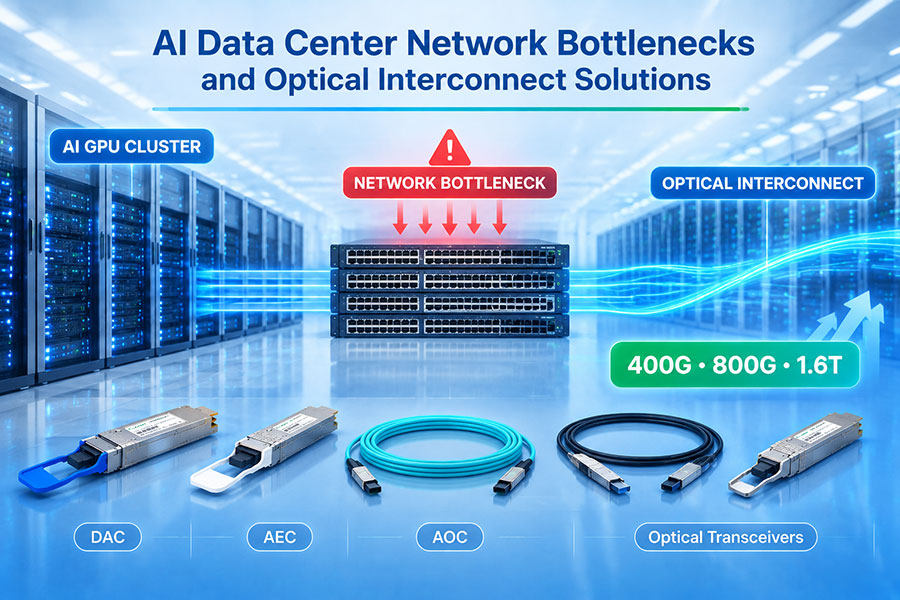
Direct Attach Copper (DAC), Active Electrical Cable (AEC), and Active Optical Cable (AOC) address different connectivity requirements. DAC provides a simple passive copper connection, AEC adds active signal processing to extend electrical reach, and AOC uses optical fiber for longer cable runs and improved electromagnetic interference immunity.
1. What Are DAC, AEC, and AOC Cables?
DAC uses copper conductors with fixed connectors at both ends. Passive DAC transmits electrical signals directly without active signal-processing components in the cable assembly.
Primary advantage: Low power consumption, low latency, and economical short-distance connectivity.
AEC uses copper conductors with integrated active electronics, commonly including retimers, to recover and retransmit high-speed electrical signals.
Primary advantage: Improved signal integrity and extended electrical reach compared with passive DAC.
AOC integrates optical engines and fiber into a complete cable assembly. Electrical signals are converted into optical signals at the transmitting end and converted back at the receiving end.
Primary advantage: Longer reach, lower cable weight, and strong immunity to electromagnetic interference along the fiber path.
2. How Do the Three Cable Technologies Work?
The main architectural difference is the medium used to carry data and the amount of signal processing integrated into the cable assembly.
Passive DAC signal path
Passive DAC carries electrical signals directly through copper. Since it does not require active electronics for signal conditioning, it has very low cable power consumption and a simple architecture. Its practical reach is limited by electrical channel performance.
AEC signal path
AEC integrates active signal-processing components into the cable ends. A retimer can recover clock and data timing and retransmit a regenerated signal, helping manage channel loss and signal degradation over a longer electrical connection.
AOC signal path
AOC converts electrical data into optical signals for transmission through fiber. The integrated optical engines at both ends provide a complete cable solution without requiring separate optical transceivers and fiber patch cords.
3. DAC vs AEC vs AOC: Technical Comparison
| Parameter | DAC | AEC | AOC |
|---|---|---|---|
| Transmission Medium | Copper | Copper | Optical fiber |
| Active Electronics | Not in passive DAC | Yes | Yes, optical engines at both ends |
| Signal Processing | None in passive DAC | Typically retiming and signal conditioning | Electrical-to-optical and optical-to-electrical conversion |
| Power Consumption | Lowest for passive DAC | Requires power for active circuitry | Requires power for optical engines |
| Latency | Typically the lowest | Includes retimer processing latency | Includes optical conversion and electronic processing |
| Transmission Reach | Shortest | Longer electrical reach than comparable passive DAC designs | Generally the longest of these three cable types |
| EMI Immunity | Depends on cable shielding and installation | Depends on cable shielding and installation | High along the optical fiber path |
| Cable Weight | Generally heavier and thicker | Varies by conductor gauge and design | Generally lighter and more flexible |
| Cost Structure | Generally lowest | Higher than passive DAC | Generally higher due to optical components |
| Typical Application | Short intra-rack links | Extended copper connections | Longer short-reach optical links |
These are general technology characteristics. Actual performance depends on the cable design, data rate, connector type, host electrical interface, and product qualification. Active DAC variants also exist, so the power and signal-processing characteristics of a specific DAC should be checked before comparison.
4. Transmission Distance: When Does Each Cable Make Sense?
Distance is one of the most important factors when selecting a high-speed interconnect. Passive DAC is most effective when the devices are close together and the electrical channel meets the required signal-integrity limits. AEC adds active signal processing to extend copper reach. AOC uses fiber to support longer connections without relying on a high-speed electrical signal across the full cable length.
| Cable Type | Typical Deployment Range | Distance Considerations |
|---|---|---|
| Passive DAC | Short connections, commonly around 1–3 m depending on speed and design | Limited by insertion loss, crosstalk, and the host electrical channel. |
| AEC | Several meters; specific 800G products can support up to 5 m | Retimer-based processing helps extend the usable electrical channel. |
| AOC | Commonly available in lengths from several meters to tens of meters | Fiber supports longer reach and more flexible cable routing. |
These ranges are indicative rather than universal limits. For example, C-LIGHT's listed 800G DAC configurations include 1.5–3 m options, while its 800G AEC product lists configurations up to 5 m. Its 800G AOC product range includes lengths up to 30 m. The available length depends on the specific interface and product configuration.
Use passive DAC when the electrical channel supports the required data rate. Consider AEC when more copper reach or signal recovery is needed. Choose AOC when the link distance, cable routing, or electromagnetic environment favors optical transmission.
5. Power Consumption and Latency
Power efficiency and latency become increasingly important as data center port counts and network bandwidth increase. The three technologies have different power and processing requirements.
DAC: Passive DAC does not require active signal-processing electronics inside the cable assembly. It therefore generally provides the lowest cable power consumption and the simplest signal path. This makes it attractive for dense, short-distance connections.
AEC: AEC requires power for its integrated retimer and signal-conditioning circuitry. The retimer adds processing latency, but it can improve signal integrity where a passive electrical channel is insufficient.
AOC: AOC requires power for the optical engines at both ends. Its fiber transmission path avoids the electrical attenuation and crosstalk limitations associated with long copper conductors, although the optical conversion circuitry contributes to total power consumption and latency.
| Design Priority | Typical Advantage | Important Trade-Off |
|---|---|---|
| Lowest cable power | Passive DAC | Limited electrical reach |
| Low-latency electrical connection | Passive DAC | Requires sufficient channel margin |
| Extended copper reach | AEC | Active power and retimer latency |
| Optical transmission and EMI immunity | AOC | Optical engine power and higher cable cost |
Power figures should be compared using the same measurement boundary. Some specifications report power per end, while others report the complete cable assembly. Actual consumption and latency vary by product and data rate.
6. Signal Integrity and Electromagnetic Interference
Electrical signal integrity becomes more challenging as data rates increase. Insertion loss, return loss, crosstalk, connector quality, and jitter all affect whether a copper link can operate reliably.
DAC: Passive DAC depends on the electrical quality of the complete channel. Cable construction, shielding, conductor gauge, connector design, and length all influence performance. At higher data rates, the available electrical margin can become a limiting factor.
AEC: AEC uses active electronics to improve the usable electrical channel. Retimer-based designs can recover and retransmit data, helping address accumulated signal degradation. However, AEC remains a copper connection and still requires suitable shielding and electromagnetic compatibility.
AOC: AOC carries data optically through the fiber section. Optical transmission is highly resistant to electromagnetic interference along that path and does not experience copper-style electrical crosstalk between adjacent fiber links. The electronic interfaces at each end still require appropriate system design.
For installations with strong electromagnetic interference, dense cable bundles, or longer cable routes, AOC can offer practical advantages over copper-based connections.
7. DAC, AEC, and AOC in 400G and 800G Networks
At 400G and 800G, cable selection becomes closely tied to switch architecture, server design, port density, and the electrical capabilities of the host platform.
| Network Generation | DAC Application | AEC Application | AOC Application |
|---|---|---|---|
| 400G | Short server-to-switch and intra-rack connections | Selected copper links requiring additional signal conditioning | Optical connections between racks or equipment areas |
| 800G | Very short links within qualified electrical reach | High-speed copper links requiring retiming and extended reach | Optical links requiring greater reach and flexible routing |
| AI and HPC clusters | Short connections where power efficiency is a priority | GPU and switch connections where active electrical reach is needed | Optical links across racks and high-density network areas |
At 800G, the electrical channel becomes particularly demanding. Passive DAC remains useful for very short connections, while AEC can provide additional signal-processing capability. AOC offers an optical alternative when copper reach, cable weight, or EMI considerations become more important.
These solutions can coexist within one network. A data center may use DAC for connections inside a rack, AEC for selected longer copper links, and AOC for optical connections between racks.
8. How to Choose the Right Cable
The best cable is the one that meets the required link performance without adding unnecessary power, cost, or installation complexity.
| Deployment Requirement | Preferred Option | Selection Reason |
|---|---|---|
| Very short connection with minimum power | Passive DAC | No active cable electronics are required. |
| Low-cost intra-rack cabling | Passive DAC | Simple construction and economical deployment. |
| More copper reach than passive DAC supports | AEC | Active signal processing helps maintain electrical signal quality. |
| Longer cable routing between equipment areas | AOC | Fiber supports longer reach and flexible installation. |
| Strong EMI concerns | AOC | Optical fiber is immune to electromagnetic interference along the transmission path. |
| Lower cable weight and easier routing | AOC | Fiber assemblies are generally lighter than comparable high-speed copper cables. |
| Short high-speed link requiring signal recovery | AEC | Retimer-based processing can provide additional electrical channel margin. |
Before selecting a cable, confirm the following technical details:
Data rate: Verify support for the required 100G, 200G, 400G, or 800G interface.
Connector form factor: Confirm QSFP28, QSFP56, QSFP-DD, QSFP112, OSFP, or another required interface.
Transmission distance: Match the cable length to the qualified reach of the product and host platform.
Protocol: Check Ethernet, InfiniBand, or other required protocol support.
Power and thermal limits: Confirm the cable's active power requirements and operating temperature.
Compatibility: Validate the cable against the exact switch, NIC, server, or accelerator model.
9. C-LIGHT DAC, AEC, and AOC Product Solutions
C-LIGHT provides high-speed interconnect solutions for data centers, AI computing infrastructure, and high-performance networking. Its product portfolio includes DAC, AEC, and AOC cable assemblies for different transmission distances and deployment requirements.
C-LIGHT's 800G DAC is designed for short-distance data center connections. Listed configurations include 1.5–3 m options, with QSFP-DD and OSFP-related interface configurations.
Application: Short server-to-switch, GPU-to-switch, and intra-rack links where passive electrical reach is sufficient.
View 800G DACThe 800G AEC integrates retimer chips and Gearbox technology for supported 400G/800G dual-rate operation. Listed configurations include lengths up to 5 m and OSFP/QSFP-DD interface options.
Application: AI server clusters, GPU interconnects, and high-speed electrical links requiring additional signal recovery.
View 800G AECC-LIGHT's 800G AOC uses optical fiber for high-bandwidth short-reach connectivity. The listed product range includes 850 nm multimode fiber configurations and lengths up to 30 m.
Application: Optical connections between servers, switches, and equipment areas where greater cable reach or EMI immunity is required.
View 800G AOCFor additional options across 400G, 800G, and other data rates, visit the C-LIGHT AOC, DAC, AEC, and ACC product portfolio.
10. Frequently Asked Questions
DAC uses copper for passive electrical transmission, AEC uses copper with integrated active signal-processing electronics, and AOC uses optical fiber with integrated optical conversion at both ends.
Passive DAC generally has the lowest cable power consumption because it does not require active signal-processing or optical components. AEC and AOC require power for their integrated electronics.
They can support the same nominal data rate. AEC is not inherently faster than DAC; its main advantage is active signal processing that can extend the usable electrical reach under suitable conditions.
AOC generally supports longer cable runs than copper-based AEC and provides strong EMI immunity along the fiber path. AEC remains useful when copper connectivity is preferred and the required distance falls within the product's qualified reach.
Yes. All three technologies have 800G implementations. Their practical reach, power consumption, connector configurations, and system compatibility differ, so the specific product specification must be checked.
Not in every application. AEC can replace an optical connection in selected short-distance links where copper reach and signal integrity are sufficient. AOC remains more suitable when longer optical reach, lower cable weight, or EMI immunity is required.
Yes. DAC and AOC are commonly used together because they serve different distance requirements. AEC can also be added where active copper connectivity is useful.
No. Similar connector shapes do not guarantee electrical, optical, protocol, or management compatibility. Always verify the exact cable type and supported configuration for the target equipment.
11. Conclusion
DAC, AEC, and AOC each address a different part of the high-speed data center connectivity spectrum. Passive DAC is well suited to short links where low power, low latency, and cost efficiency are priorities. AEC extends copper connectivity through active signal processing, making it useful when passive DAC cannot provide sufficient electrical reach. AOC uses optical fiber to support longer connections, lighter cabling, and strong immunity to electromagnetic interference.
For 400G and 800G AI data center networks, the most practical design is often a combination of all three. Selecting each cable according to link distance, signal requirements, power budget, and equipment compatibility helps create a more efficient and scalable interconnect architecture.
Need a High-Speed Interconnect Solution?
C-LIGHT offers DAC, AEC, AOC, and other high-speed connectivity solutions for data center and AI infrastructure. Contact the team to discuss data rate, cable length, connector configuration, and equipment compatibility.
 >

 >
 >
 >
 >
 >
 >
 >