TEL:+86 132 6656 7067





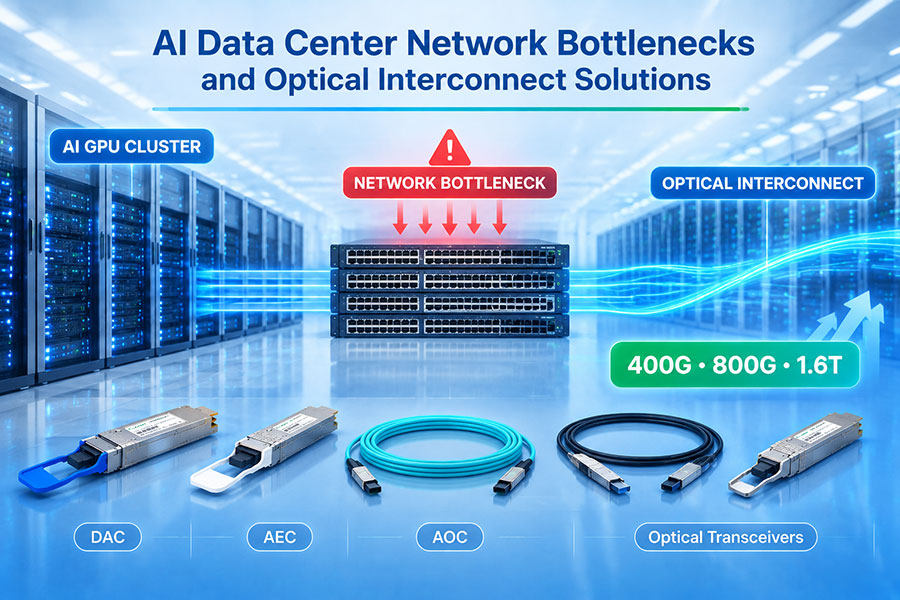
High-speed data center networks require reliable connections between switches, servers, GPUs, and storage systems. As network bandwidth moves toward 400G, 800G, and higher data rates, interconnect selection becomes increasingly important for signal integrity, power consumption, cable management, and overall system efficiency.
Active Electrical Cable (AEC), Active Optical Cable (AOC), and Active Copper Cable (ACC) address different connectivity requirements. AEC and ACC use copper transmission with integrated signal-conditioning electronics, while AOC uses optical fiber and embedded optical engines. Their differences influence achievable reach, processing architecture, power requirements, and deployment flexibility.
1. What Are AEC, AOC, and ACC Cables?
AEC – Active Electrical Cable
AEC is a copper cable assembly with integrated active electronics, commonly using retimers to recover and regenerate high-speed electrical signals.
Main purpose: Extend copper connectivity when passive electrical transmission does not provide sufficient signal margin.
AOC – Active Optical Cable
AOC integrates optical engines and fiber into a complete cable assembly. Electrical signals are converted into optical signals at the transmitting end and converted back at the receiving end.
Main purpose: Provide optical connectivity for longer cable runs, lighter routing, and strong immunity to electromagnetic interference along the fiber path.
ACC – Active Copper Cable
ACC is a copper cable assembly with active signal-conditioning electronics, commonly using redrivers or linear equalizers to compensate for channel loss.
Main purpose: Extend copper reach beyond passive DAC where linear signal conditioning is sufficient.
2. How Do the Three Cable Technologies Work?
The primary difference is the transmission medium and the way each cable handles signal degradation.
AEC: Retimer-based electrical transmission
AEC commonly uses retimer technology to recover clock and data timing, condition the received signal, and retransmit a regenerated electrical signal. This helps manage accumulated channel degradation and can provide additional signal-integrity margin.
AOC: Optical transmission
AOC converts electrical signals into optical signals for transmission through fiber. The optical engines at both ends provide an integrated connection, eliminating the need to purchase separate pluggable optical transceivers and fiber patch cords for that link.
ACC: Redriver-based electrical transmission
ACC commonly uses linear equalization or redriver circuits to compensate for electrical channel loss. Unlike a conventional retimer, a redriver does not normally perform full clock-and-data recovery and retransmission. Its performance therefore depends more directly on the quality of the incoming signal and the characteristics of the complete channel.
3. AEC vs AOC vs ACC: Core Technical Comparison
| Parameter | AEC | AOC | ACC |
|---|---|---|---|
| Full Name | Active Electrical Cable | Active Optical Cable | Active Copper Cable |
| Transmission Medium | Copper | Optical fiber | Copper |
| Active Components | Retimer and signal-conditioning electronics | Optical transmitters and receivers | Redriver or linear equalizer |
| Signal Processing | Typically CDR, retiming, and equalization | Electrical-to-optical and optical-to-electrical conversion | Typically linear signal conditioning |
| Signal Regeneration | Retimer-based signal recovery | Optical conversion at both ends | Signal boosting and equalization |
| Transmission Reach | Generally longer than comparable ACC designs | Generally the longest of these three options | Generally shorter than comparable AEC designs |
| Power Consumption | Requires power for retimer electronics | Requires power for optical engines | Requires power for signal-conditioning electronics |
| Latency | Includes retimer processing latency | Includes optical conversion and electronic processing | Generally very low signal-conditioning latency |
| EMI Immunity | Depends on copper shielding and installation | High along the fiber transmission path | Depends on copper shielding and installation |
| Cable Weight | Depends on conductor and assembly design | Generally lighter than comparable copper assemblies | Depends on conductor and assembly design |
| Typical Application | High-speed electrical links requiring stronger signal recovery | Longer short-reach optical connections | Short active copper links requiring moderate signal conditioning |
These are typical architectural characteristics, not universal product specifications. ACC terminology and implementation can vary across manufacturers. Always confirm the actual signal-conditioning chipset, cable length, power requirements, and host compatibility in the product datasheet.
4. Retimer vs Redriver: The Main Difference Between AEC and ACC
AEC and ACC both use copper conductors, but their active electronics perform different functions.
| Technical Aspect | AEC Retimer | ACC Redriver |
|---|---|---|
| Clock Recovery | Typically performs clock and data recovery | Does not normally perform full CDR |
| Signal Processing | Recovers and retransmits data | Applies analog equalization or amplification |
| Noise Handling | Can regenerate a cleaner output signal when properly designed | May amplify existing noise along with the signal |
| Channel Requirements | Designed for more demanding electrical channels | Suitable when linear conditioning provides sufficient margin |
| Processing Complexity | Generally higher | Generally lower |
| Typical Trade-Off | More signal recovery capability, with additional power and latency | Simpler processing, generally lower power and latency |
A retimer can recover timing and retransmit data, while a redriver primarily compensates for channel loss. This distinction helps explain why AEC is often selected when more electrical signal recovery is required, whereas ACC can be attractive when a simpler active solution is sufficient.
5. Transmission Distance and Cable Reach
Transmission distance is a major factor in selecting between AEC, AOC, and ACC. Copper reach is affected by insertion loss, crosstalk, connector performance, conductor design, and signal-conditioning capability. Optical reach depends on the fiber type, optical budget, wavelength, and the specifications of the integrated optical engines.
| Cable Type | General Reach Position | Important Considerations |
|---|---|---|
| ACC | Short active copper connections | Reach depends on redriver performance, channel loss, and cable construction. |
| AEC | Extended copper connections | Retiming can support more demanding electrical channels than linear conditioning alone. |
| AOC | Longer short-reach optical connections | Fiber supports longer routing distances without carrying high-speed electrical signals through the full cable length. |
For a specific example, C-LIGHT lists its 800G AEC configurations up to 5 meters, its 800G ACC configurations up to 5 meters depending on the interface, and its 800G AOC configurations up to 30 meters. These are product-specific ranges, not universal limits for each technology.
Do not assume every AEC is longer than every ACC, or that every AOC supports the same distance. Compare products at the same data rate, connector configuration, protocol, and host platform. The qualified cable specification is more important than the technology label alone.
6. Power Consumption and Latency
Power consumption and latency influence the operating cost and performance of large-scale data center networks. Each cable architecture introduces a different amount of active processing.
AEC: Retimer-based processing requires power for clock recovery, signal conditioning, and data retransmission. It also introduces processing latency. This additional complexity can be justified when a link needs more electrical signal recovery margin.
AOC: Optical engines at both ends require electrical power for optical transmission and reception. The fiber section carries optical signals, but the integrated electronics still contribute to the cable assembly's total power and latency.
ACC: Redriver-based conditioning generally uses less processing than full retiming. It can therefore offer a lower-complexity active copper option, although actual power depends on the chipset, data rate, and cable implementation.
| Evaluation Factor | AEC | AOC | ACC |
|---|---|---|---|
| Active Power | Retimer-dependent | Optical-engine-dependent | Redriver-dependent |
| Processing Latency | Retimer processing | Optical and electrical conversion | Linear signal-conditioning delay |
| Power Optimization | Depends on retimer architecture and operating rate | Depends on optical engine design and link configuration | Depends on equalizer and driver implementation |
| System-Level Impact | Consider cable power and thermal load at both ends | Consider optical-engine power and cooling | Consider active electronics and copper cable thermal behavior |
Power figures should be compared using the same measurement boundary. Some datasheets specify consumption per end, while others specify the complete cable assembly. There is no reliable universal power or latency ranking without comparing specific products under the same operating conditions.
7. EMI Immunity, Cable Weight, and Installation
Physical cable characteristics matter in high-density racks, where cable routing, airflow, bend radius, and electromagnetic conditions can affect system operation.
AEC and ACC: Both use copper transmission and require suitable shielding and installation practices. Their cable diameter, flexibility, and weight depend on conductor gauge, shielding, connector design, and active electronics.
AOC: The optical fiber transmission path is immune to electromagnetic interference. AOC assemblies are generally lighter and more flexible than comparable high-speed copper cables, which can simplify cable routing in dense environments. The optical connectors and active ends still require appropriate handling and installation.
| Installation Factor | AEC | AOC | ACC |
|---|---|---|---|
| EMI Along Transmission Path | Requires copper shielding | Optical fiber is immune to EMI | Requires copper shielding |
| Cable Flexibility | Depends on copper construction | Generally high | Depends on copper construction |
| Weight | Depends on cable gauge and assembly | Generally lighter | Depends on cable gauge and assembly |
| Airflow Considerations | Check cable bundle size and routing | Can simplify dense cable routing | Check cable bundle size and routing |
8. Applications in 400G and 800G Data Center Networks
Modern AI clusters and high-performance computing environments combine copper and optical interconnects to connect servers, GPUs, switches, and network equipment. AEC, AOC, and ACC can all play a role in the same network architecture.
| Application | Potential Cable Choice | Selection Reason |
|---|---|---|
| Very short GPU-to-switch connections | ACC or AEC | Active copper can provide additional signal conditioning when passive copper is insufficient. |
| High-speed rack-level electrical links | AEC | Retimer-based signal recovery can help manage demanding electrical channels. |
| Short copper connections with moderate signal loss | ACC | Linear equalization may provide sufficient signal margin with lower processing complexity. |
| Connections between racks | AOC | Optical transmission supports longer cable runs and flexible routing. |
| High-density network areas with EMI concerns | AOC | Optical fiber avoids electrical interference along the transmission path. |
| Links requiring low-cost short copper connectivity | ACC | Can be suitable where active linear conditioning meets the channel requirements. |
For 400G and 800G systems, the cable must also match the host interface, lane mapping, protocol, and equipment qualification requirements. A cable that supports the required nominal data rate is not automatically compatible with every switch or server platform.
9. How to Choose Between AEC, AOC, and ACC
The selection process should begin with the physical distance and electrical or optical requirements of the link. The following decision guide provides a practical starting point.
| Requirement | Recommended Direction | Reason |
|---|---|---|
| Need copper connectivity with basic active signal conditioning | ACC | Redriver-based designs can compensate for channel loss without full retiming. |
| Need stronger electrical signal recovery | AEC | Retimer-based processing can recover and retransmit the data signal. |
| Need longer cable routing | AOC | Optical fiber supports longer transmission distances. |
| Need strong EMI immunity | AOC | Optical transmission is immune to electromagnetic interference along the fiber path. |
| Need to retain a copper-based architecture | AEC or ACC | Both maintain electrical transmission through copper conductors. |
| Need to reduce cable weight and simplify routing | AOC | Optical assemblies are generally lighter and more flexible. |
| Need a specific 800G connection | Validate all suitable options | Host compatibility, cable length, power, and signal requirements determine the final choice. |
Before purchasing, confirm these details:
Data rate: Verify the required 400G, 800G, or other supported rate.
Connector form factor: Check QSFP-DD, QSFP112, OSFP, or other required interfaces.
Protocol: Confirm Ethernet, InfiniBand, or the intended networking protocol.
Transmission distance: Match the cable length to the qualified product specification.
Power budget: Check the cable's active power requirements and host thermal limits.
Compatibility: Validate the exact switch, server, NIC, or accelerator model.
Management support: Confirm monitoring, identification, and management requirements where applicable.
10. C-LIGHT AEC, AOC, and ACC Cable Solutions
C-LIGHT provides high-speed interconnect solutions for data centers, AI computing infrastructure, and high-performance networking. Its active cable portfolio includes AEC, AOC, and ACC products for different transmission media, distances, and system configurations.
800G AEC Active Electrical Cable
C-LIGHT's 800G AEC uses retimer technology and supports listed configurations up to 5 meters. Available interface combinations include OSFP and QSFP-DD options.
Application: High-speed copper links in AI clusters and data center environments where additional electrical signal recovery is required.
View 800G AEC800G AOC Active Optical Cable
C-LIGHT's 800G AOC uses optical fiber with integrated optical engines. Listed configurations include 850 nm multimode fiber and cable lengths up to 30 meters.
Application: High-bandwidth optical connections between servers, switches, and equipment areas where greater reach or EMI immunity is required.
View 800G AOC800G ACC Active Copper Cable
C-LIGHT's 800G ACC provides an active copper connectivity option for short-distance, high-bandwidth links. Listed configurations vary by connector and cable specification, with options up to 5 meters.
Application: Short active copper links where the specified signal-conditioning architecture meets the host channel requirements.
View 800G ACCFor additional high-speed connectivity options, visit the C-LIGHT AOC and DAC product portfolio.
11. Frequently Asked Questions
AEC and ACC both use copper transmission, but AEC commonly uses retimers while ACC commonly uses redrivers or linear equalizers. AOC uses optical fiber with integrated optical engines at both ends.
Neither is universally better. AEC is generally suitable when stronger signal recovery is needed, while ACC can be appropriate when linear signal conditioning provides sufficient electrical margin with lower processing complexity.
AOC generally supports longer cable runs than copper-based AEC and provides strong EMI immunity along the fiber path. AEC remains useful for qualified copper connections where optical transmission is unnecessary or not preferred.
There is no universal ranking between AEC, AOC, and ACC. Power depends on the active chipset, data rate, cable design, and measurement boundary. Compare the actual product specifications under equivalent conditions.
Yes. Both use copper conductors for data transmission. Their primary architectural difference is the active signal-conditioning method integrated into the cable assembly.
AOC can replace a copper connection when the system supports the optical interface and the optical cable meets the required distance and performance specifications. It is not automatically interchangeable with AEC or ACC.
Yes. All three technologies have 800G product implementations. However, supported lengths, connector combinations, protocols, and equipment compatibility vary by product.
No. Similar connector form factors do not guarantee electrical, optical, protocol, or management compatibility. Always check the cable type and supported configuration against the target equipment.
12. Conclusion
AEC, AOC, and ACC serve different requirements in high-speed data center networks. AEC uses retimer-based signal recovery to extend copper connectivity, ACC uses redriver-based conditioning for active copper links, and AOC uses optical fiber to provide longer reach and strong electromagnetic interference immunity.
For short copper connections where linear signal conditioning is sufficient, ACC can be a practical option. When a link needs stronger electrical signal recovery, AEC may be more appropriate. For longer routing distances, lighter cabling, or environments with EMI concerns, AOC offers clear advantages.
In 400G and 800G AI data center architectures, these technologies can complement one another. The final choice should be based on qualified transmission distance, signal integrity, power budget, cable installation requirements, and host compatibility.
Looking for AEC, AOC, or ACC Cable Solutions?
C-LIGHT provides high-speed active cable solutions for AI data centers, Ethernet networks, and high-performance computing. Contact the team to discuss data rate, connector type, cable length, and equipment compatibility.
 >

 >
 >
 >
 >
 >
 >
 >