TEL:+86 132 6656 7067




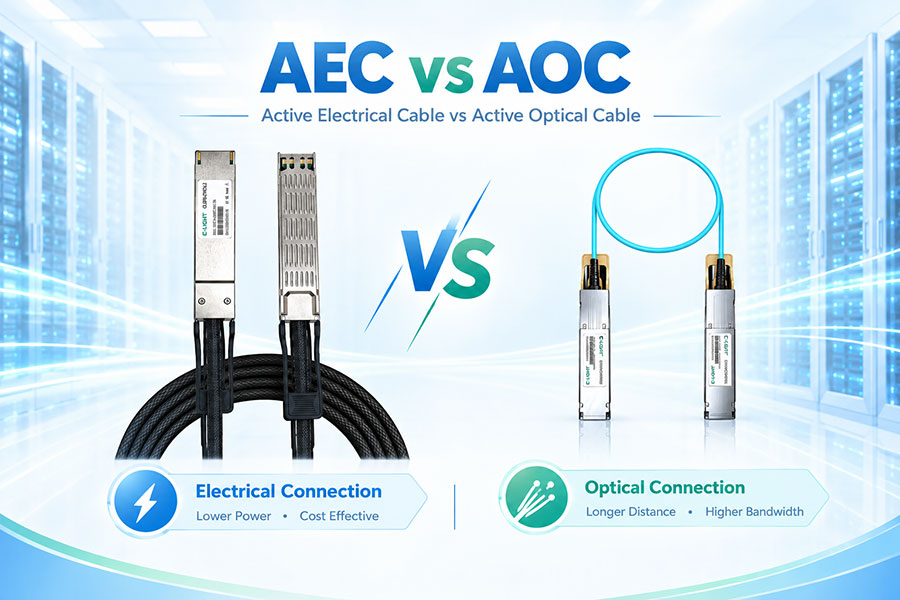
Active Electrical Cable (AEC) and Active Optical Cable (AOC) are two important high-speed cable solutions used in data centers, high-performance computing and AI networks. Both are active cable assemblies with transceiver electronics integrated into the cable ends, but they use completely different transmission media.
AEC uses copper conductors with active electronic components to improve signal integrity and extend the practical reach of high-speed electrical connections. AOC uses optical fiber and active optical components to convert electrical signals into optical signals and back again.
The choice between AEC and AOC depends on transmission distance, bandwidth, power consumption, latency, cable weight, electromagnetic interference, cost, routing requirements and the overall network architecture.
1. What Is AEC?
AEC stands for Active Electrical Cable. It is a high-speed copper cable assembly with active electronics integrated into one or both ends.
The copper conductors carry the electrical signal, while active components help compensate for channel loss and maintain signal quality over a longer distance than a typical passive DAC.
AEC is commonly used in high-speed data center connections where copper is still practical but passive electrical transmission has become difficult.
2. What Is AOC?
AOC stands for Active Optical Cable. It uses optical fiber as the transmission medium and active optical components at the cable ends.
The electrical signal is converted into an optical signal at the transmitter end, transmitted through the fiber, and converted back into an electrical signal at the receiver end.
AOC provides the benefits of optical transmission while maintaining a fixed cable assembly with integrated transceiver electronics.
3. Basic Difference Between AEC and AOC
| Feature | AEC | AOC |
|---|---|---|
| Full Name | Active Electrical Cable | Active Optical Cable |
| Transmission Medium | Copper | Optical Fiber |
| Signal Type in Cable | Electrical | Optical |
| Active Components | Equalization, retiming or signal-conditioning electronics depending on design | Optical transmitters, receivers and related electronics |
| Typical Reach | Short to medium | Short to longer |
| Weight | Generally heavier | Generally lighter |
| EMI Immunity | Lower than optical fiber | Very high |
| Power | Active electronics required | Active electro-optics required |
| Cost | Generally lower for suitable short-reach links | Generally higher |
| Typical Use | Short high-speed data center connections | Longer high-speed data center connections |
4. AEC vs AOC: Transmission Medium
The fundamental difference is the medium used to carry the signal.
AEC keeps the signal in the electrical domain across the cable and uses active electronics to compensate for channel loss.
AOC converts the signal to light and uses optical fiber to carry it between the cable ends.
5. How Does AEC Work?
In a typical AEC, the host electrical signal enters the cable assembly and is processed by active electronics at the cable end.
The electronics can provide signal conditioning such as equalization or retiming depending on the cable architecture.
The conditioned electrical signal then travels through the copper conductors to the opposite end.
6. How Does AOC Work?
In an AOC, the electrical signal from the host enters the electronics integrated into one end of the cable.
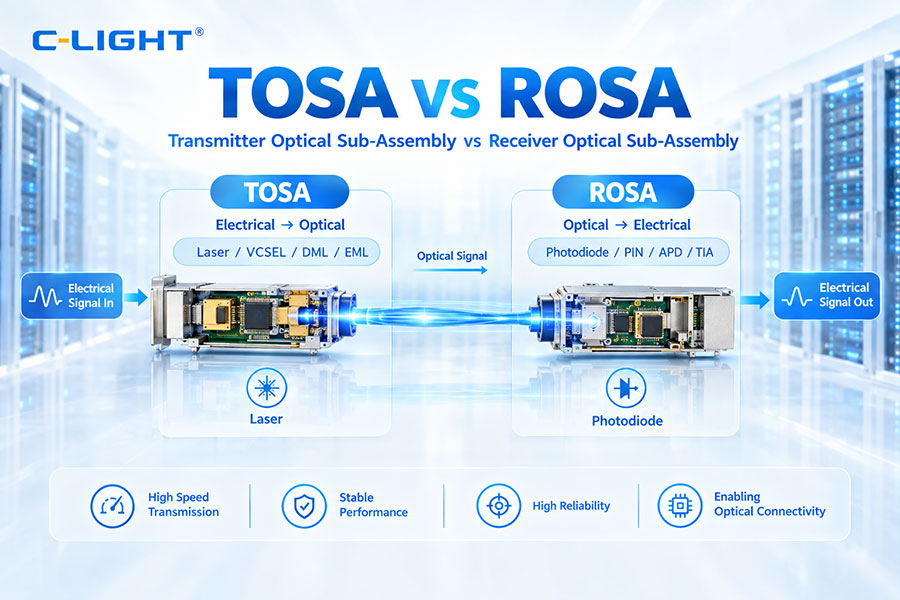
The transmitter converts the electrical signal into an optical signal.
The optical signal travels through the fiber to the opposite end, where a receiver converts it back into an electrical signal for the host device.
7. AEC vs AOC Signal Path
| Stage | AEC | AOC |
|---|---|---|
| Host Output | Electrical | Electrical |
| Cable-End Processing | Electrical signal conditioning | Electrical-to-optical conversion |
| Transmission Medium | Copper | Optical fiber |
| Remote-End Processing | Electrical signal conditioning | Optical-to-electrical conversion |
| Host Input | Electrical | Electrical |
8. AEC vs DAC
AEC and DAC are both copper-based cable technologies, but they are not the same.
A passive DAC carries the electrical signal directly through copper without active signal-conditioning electronics.
AEC adds active electronics to compensate for electrical channel limitations and extend the practical reach of the cable.
9. AEC vs Passive DAC
| Feature | Passive DAC | AEC |
|---|---|---|
| Medium | Copper | Copper |
| Active Electronics | No | Yes |
| Signal Conditioning | Minimal | Active |
| Reach | Very short | Longer than passive DAC |
| Power | Very low | Higher |
| Cost | Lower | Higher |
10. AEC vs AOC and Electrical Signal Integrity
High-speed electrical signals lose energy as they travel through copper conductors, connectors and other discontinuities.
At higher data rates, insertion loss and inter-symbol interference become more significant.
AEC uses active electronics to compensate for some of these electrical impairments.
11. AOC and Optical Signal Integrity
AOC avoids the long electrical transmission path inside the cable by using optical fiber.
Once the signal has been converted into light, fiber provides low-loss transmission and high immunity to electromagnetic interference.
This makes AOC attractive when electrical transmission becomes difficult over the required cable length.
12. AEC vs AOC Transmission Distance
| Solution | Typical Reach Category |
|---|---|
| Passive DAC | Very short |
| AEC | Short to medium |
| AOC | Short to longer |
Actual cable reach varies by data rate, cable construction, transceiver technology, switch compatibility and manufacturer specification.
13. How Long Can an AEC Be?
AEC is typically used where the distance is too long for a passive DAC but still suitable for high-speed copper transmission.
Commercial AEC implementations can cover several meters and, depending on the generation and architecture, may extend further.
Because AEC reach is not defined by one universal number, the manufacturer's validated length should always be checked.
14. How Long Can an AOC Be?
AOC can support cable lengths beyond the practical range of many copper assemblies.
Commercial AOCs are available in different lengths, from short rack-level connections to substantially longer data center links.
The actual supported reach depends on the optical technology and product specification.
15. AEC vs AOC for Very Short Links
For very short connections, AEC may provide an efficient alternative to optical cabling because copper remains practical and the cable can be relatively simple to deploy.
AOC can also be used for short links, especially when low weight, EMI immunity or future bandwidth scaling is important.
16. AEC vs AOC for Medium-Length Links
As distance increases, electrical loss becomes a more important factor.
AEC can extend the practical range of copper by adding active equalization or related signal-conditioning functions.
AOC becomes increasingly attractive when the electrical channel approaches the limits of practical copper implementation.
17. AEC vs AOC for Longer Links
AOC is generally more suitable for longer high-speed cable assemblies because optical fiber has significantly lower transmission loss over distance than high-speed copper.
AEC remains useful for distances where active copper transmission still satisfies the required signal-integrity and power constraints.
18. AEC vs AOC Power Consumption
Both AEC and AOC consume power because both contain active components.
AEC power is associated primarily with electrical signal-conditioning devices, while AOC power includes electro-optical conversion components and associated electronics.
Actual power consumption varies significantly by lane rate and cable architecture.
19. Which Uses More Power: AEC or AOC?
There is no universal fixed answer because power depends on the specific implementation.
AEC can have a lower power requirement than an equivalent AOC for suitable short-reach applications because it avoids optical conversion.
However, the difference depends on the cable generation, lane rate and active electronics used in both assemblies.
20. AEC vs AOC Latency
Both AEC and AOC can provide very low latency compared with network devices that perform substantial packet processing.
AEC may have a low latency advantage in some implementations because it keeps the transmission electrically coded and can avoid optical conversion stages.
AOC conversion latency is typically very small, but exact values depend on the active electronics at the cable ends.
21. AEC vs AOC Electromagnetic Interference
One of the clearest advantages of AOC is electromagnetic immunity.
Optical fiber does not conduct electrical current and is therefore highly resistant to electromagnetic interference.
AEC uses copper conductors and can be more susceptible to electromagnetic coupling, although cable shielding and system design can reduce these effects.
22. AEC vs AOC EMI Comparison
| Factor | AEC | AOC |
|---|---|---|
| Electrical Conductor | Yes | No |
| EMI Immunity | Lower | Very high |
| Ground Loop Risk | Requires consideration | Optical isolation |
| High-EMI Environment | More challenging | Well suited |
23. AEC vs AOC Weight
Copper conductors become relatively heavy as cable length and conductor size increase.
Optical fiber is much lighter than copper for comparable high-bandwidth transmission distances.
Therefore, AOC generally provides a significant weight advantage for longer cable assemblies.
24. AEC vs AOC Cable Flexibility
Cable flexibility depends on the cable construction, conductor size, fiber type and protective jacket.
AOC is often easier to route for longer high-density connections because optical fiber does not require the same large copper conductor cross-section.
AEC can be easier to handle for short connections where cable length is limited.
25. AEC vs AOC Cable Diameter
AEC cable diameter depends on the number of copper conductors and the electrical performance required at the target data rate.
AOC can achieve a relatively small diameter because optical fiber can carry very high bandwidth without large conductive cores.
The actual cable diameter is manufacturer-specific.
26. AEC vs AOC Bend Radius
Cable bend radius is determined by the cable construction rather than simply the AEC or AOC category.
Both cable types should be routed according to the manufacturer's minimum bend-radius specification.
Optical fibers are sensitive to excessive bending, while copper cables can also experience signal degradation or mechanical stress when routed beyond their specified limits.
27. AEC vs AOC Installation
Both AEC and AOC are fixed cable assemblies designed to simplify installation.
They do not require separate transceiver modules and patch cables at every connection point.
This can reduce the number of components and simplify short-reach deployment.
28. AEC vs AOC Cost
AEC is often more cost-effective for short-reach links where copper transmission remains practical.
AOC generally costs more because it incorporates optical transmitters, receivers and optical fiber.
However, total deployment cost should also include cable weight, routing, rack space, power and maintenance.
29. AEC vs AOC Cost Structure
| Cost Factor | AEC | AOC |
|---|---|---|
| Transmission Medium | Copper | Optical Fiber |
| Active Components | Electrical | Optoelectronic |
| Initial Cable Cost | Often lower | Often higher |
| Long-Distance Cabling | Can become less practical | Often more practical |
| Routing Weight | Higher | Lower |
30. AEC vs AOC Reliability
Both AEC and AOC can provide reliable operation when designed, manufactured and operated within their specified conditions.
Reliability depends on cable construction, active electronics, connector quality, thermal conditions, operating temperature and manufacturing quality.
The use of copper or fiber alone does not determine overall reliability.
31. AEC vs AOC Connector Reliability
The connectors on both cable types can experience mechanical wear, contamination and insertion-related damage.
Because AEC and AOC are fixed assemblies, connector handling is generally performed during installation rather than repeatedly patching the cable itself.
Connector cleanliness and proper insertion are important for both electrical and optical connections.
32. AEC vs AOC Signal Conditioning
AEC relies on active electrical components to compensate for channel impairments.
AOC moves the signal into the optical domain, reducing the impact of electrical transmission loss along the main cable path.
Both approaches therefore use active technology, but the active functions are fundamentally different.
33. AEC and Retiming
Some AEC architectures use retiming or signal regeneration functions to restore the quality of high-speed electrical signals.
This can extend the usable electrical path compared with passive copper.
The exact implementation depends on the AEC design and target host interface.
34. AEC and Equalization
Equalization is used to compensate for frequency-dependent loss and inter-symbol interference in the electrical path.
AEC can integrate equalization to maintain the required signal quality over the cable length.
35. AOC and Optical Transmitters
An AOC contains optical transmitters that convert electrical signals into optical signals.
The transmitter technology can vary according to data rate, wavelength and optical architecture.
VCSEL-based transmitters are common in many short-reach optical cable designs.
36. AOC and Optical Receivers
The receiving end of an AOC contains optical receivers that convert the optical signal back into an electrical signal.
Photodetectors, amplifiers and related circuitry are used to recover the incoming data.
37. AEC vs AOC and Form Factor
AEC and AOC are cable assembly categories rather than one specific form factor.
They can be manufactured with connectors and electrical interfaces suitable for different generations of high-speed networking.
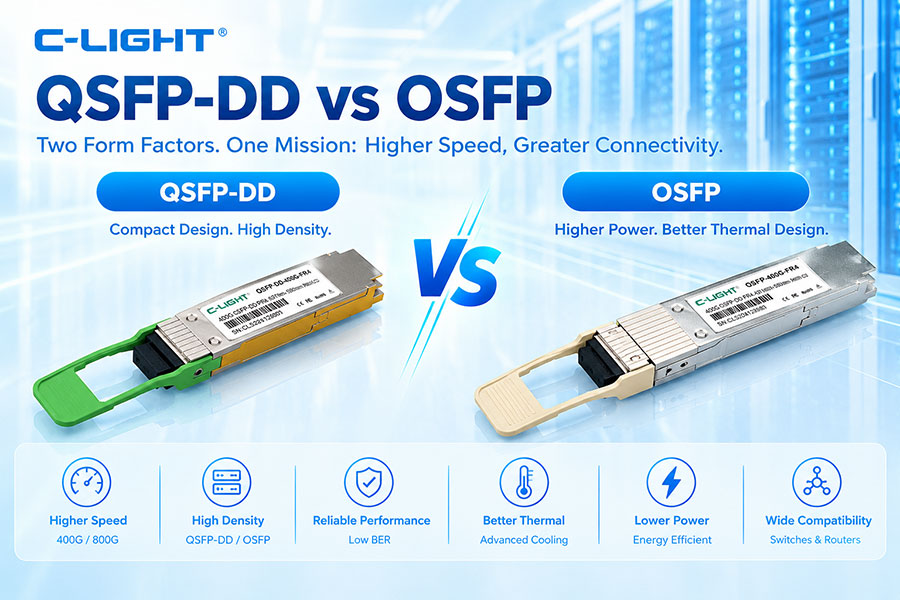
Common high-speed implementations can use connectors associated with QSFP, QSFP-DD or OSFP architectures depending on the application.
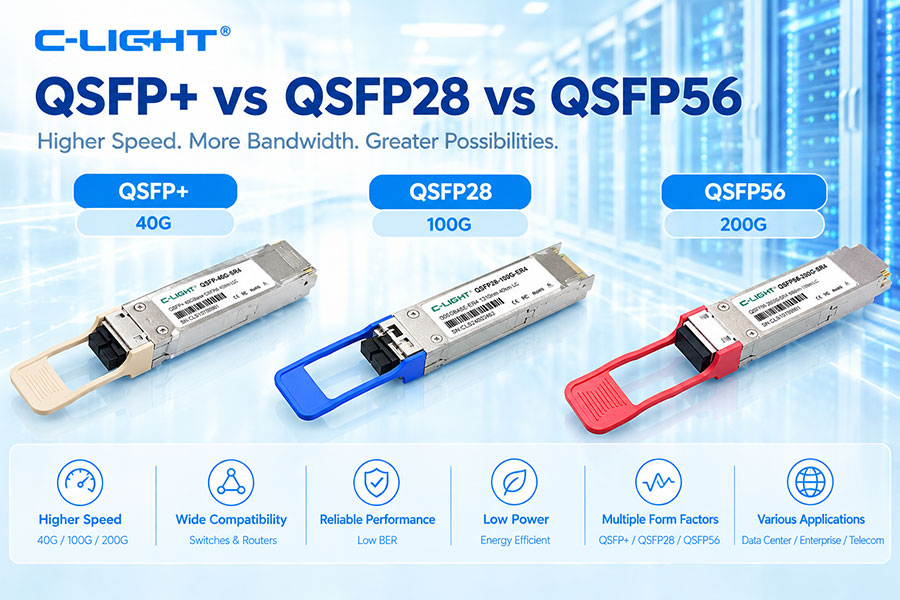
38. AEC vs AOC and QSFP
QSFP-based cable assemblies can be used for multiple high-speed applications.
AEC and AOC products with QSFP-family interfaces can provide multiple electrical or optical lanes within one fixed cable assembly.
39. AEC vs AOC and QSFP-DD
QSFP-DD supports high-density multi-lane electrical interfaces.
Both AEC and AOC can be designed using compatible QSFP-DD connectors and lane configurations depending on the required data rate.
The cable medium remains the main difference: copper for AEC and fiber for AOC.
40. AEC vs AOC and OSFP
OSFP is another high-speed pluggable interface architecture that can be used with fixed cable assemblies.
800G and higher-speed AEC or AOC solutions can use OSFP-family connectors when supported by the host equipment.
41. AEC vs AOC for 400G
400G AEC and AOC products are both used for high-speed data center connections.
AEC can be suitable for short electrical connections where copper provides an efficient solution.
AOC can provide greater reach and lower cable weight when optical transmission is preferred.
42. AEC vs AOC for 800G
800G increases the pressure on electrical signal integrity and cable power.
AEC can extend the practical range of copper transmission through active signal conditioning.
AOC avoids high-speed electrical transmission through the main cable and can therefore support longer or more demanding physical connections.
43. AEC vs AOC for 1.6T
At 1.6T, electrical lane rates and signal-integrity requirements become even more demanding.
Advanced AEC architectures can be considered for short high-speed connections where copper remains practical.
AOC can provide optical transmission for links where electrical loss, cable weight or EMI becomes more challenging.
44. Why Is AEC Important for 800G?
800G creates significant challenges for passive copper cables.
As lane rates increase, passive DAC reach becomes shorter because electrical attenuation and signal distortion increase.
AEC adds active signal conditioning that can extend the useful range of copper connections while maintaining a fixed cable assembly.
45. Why Is AOC Important for 800G?
AOC allows 800G signals to travel through optical fiber rather than high-loss copper conductors.
This can provide longer reach, lower cable weight and strong immunity to electromagnetic interference.
AOC is therefore useful when a high-speed cable must span a greater physical distance.
46. AEC vs AOC for AI Data Centers
AI data centers contain large numbers of GPUs and high-bandwidth network switches.
Connections can range from extremely short links inside a rack to longer connections between racks.
AEC and AOC can therefore occupy different positions within the same AI infrastructure.
47. AEC for GPU and Switch Connections
AEC can be useful for short high-speed connections between GPUs, servers, switches and other networking equipment when copper reach is sufficient.
The active electronics can extend the range beyond what passive DAC can support at the same data rate.
48. AOC for AI Cluster Connections
AOC is useful when connections need greater physical reach or lower cable weight.
In large AI clusters, reducing cable bulk can simplify rack routing and cable management.
Optical isolation can also be beneficial in environments with substantial electrical noise.
49. AEC vs AOC for Server-to-Switch Links
| Factor | AEC | AOC |
|---|---|---|
| Short Rack-Level Links | Suitable | Suitable |
| Longer Rack Connections | Possible within specified reach | Suitable |
| Cable Weight | Higher | Lower |
| EMI Immunity | Lower | Higher |
| Initial Cost | Often lower | Often higher |
50. AEC vs AOC for Switch-to-Switch Links
Switch-to-switch links can require different cable lengths depending on rack architecture and network topology.
AEC may be appropriate for short connections, while AOC provides greater flexibility where the physical distance increases.
The choice should be based on the validated cable reach and power requirements.
51. AEC vs AOC for Top-of-Rack Networking
Top-of-rack switches often connect many servers located in the same rack.
Because these links are usually short, AEC can provide a practical high-speed copper solution when passive DAC no longer provides sufficient reach.
AOC can also be used where low cable weight, optical isolation or greater reach is preferred.
52. AEC vs AOC for Spine-Leaf Networks
Spine-leaf networks can contain links between racks, rows and network layers.
As the physical distance grows, AOC becomes increasingly relevant because optical fiber maintains signal quality over greater distances.
AEC remains applicable to shorter inter-switch connections within its supported reach.
53. AEC vs AOC and Cable Management
Cable management becomes increasingly difficult as the number of high-speed links increases.
AEC cables can be heavier and stiffer because of the copper conductors.
AOC cables generally provide lower weight and easier routing for longer connections, helping reduce cable-management complexity in dense installations.
54. AEC vs AOC and Rack Density
Dense AI racks can contain hundreds of high-speed connections.
Cable weight and volume can become important physical constraints.
AOC can reduce the mechanical burden of large cable bundles, while AEC can provide efficient short-distance connectivity.
55. AEC vs AOC and Power Density
The power consumed by each active cable matters when many cables are deployed in one rack.
Even a relatively small difference per cable can become substantial when multiplied across hundreds or thousands of connections.
Actual system impact depends on the individual AEC and AOC design.
56. AEC vs AOC and Thermal Management
Active cable electronics generate heat at the ends of the cable.
In high-density installations, hundreds of active cables can contribute to overall rack thermal load.
Lower-power cable architectures can therefore be valuable as network density increases.
57. AEC vs AOC and Signal Integrity
AEC relies on advanced electrical signal conditioning to compensate for copper-channel impairments.
AOC reduces the length of the high-speed electrical path by converting the signal to optics at the cable end.
For longer distances, the optical medium can provide a significant signal-integrity advantage.
58. AEC vs AOC and EMI in AI Data Centers
AI systems contain high-current power systems, GPUs, switching ASICs, voltage regulators and cooling equipment.
This creates an electrically complex environment.
AOC provides optical isolation along the transmission path, making it highly resistant to electromagnetic interference.
59. AEC vs AOC and Security
Optical and electrical cables can both be used in secure networking environments.
Optical fiber does not radiate electromagnetic energy in the same way as copper conductors, which can provide advantages in certain specialized environments.
However, physical security, network encryption and system access controls remain separate security considerations.
60. AEC vs AOC and Maintenance
Both AEC and AOC are fixed cable assemblies, so a failure generally requires replacing the complete cable assembly.
This differs from separate pluggable transceivers and interchangeable passive fiber or copper cables.
Cable inventory should therefore be matched to the specific connector, length, protocol and host compatibility requirements.
61. AEC vs AOC Interoperability
Compatibility depends on the host electrical interface, data rate, lane configuration, connector and cable coding or implementation.
The fact that both cables use the same physical connector does not guarantee interoperability.
Vendor-specific validation can be important for high-speed applications.
62. AEC vs AOC and Protocol Compatibility
AEC and AOC are transmission cable technologies rather than communication protocols.
They can carry Ethernet and other high-speed electrical interfaces when the cable is designed for the required signal characteristics.
The host device must support the specific cable architecture and operating rate.
63. AEC vs AOC and BER Performance
Bit error rate is an important indicator of high-speed link quality.
AEC relies on electrical signal conditioning to maintain the required BER over copper.
AOC uses optical transmission and can avoid some of the electrical-channel losses associated with long copper connections.
64. AEC vs AOC and FEC
FEC is a communication-layer error-correction mechanism and should not be confused with the active electronics inside an AEC or AOC.
An AEC can use equalization or retiming without necessarily implementing FEC.
Likewise, an AOC can contain optical conversion electronics without integrating FEC.
65. AEC vs AOC and PAM4
Modern high-speed AEC and AOC products can support PAM4-based interfaces when the cable-end electronics and transmission medium are designed for the required signaling rate.
PAM4 is the modulation or signaling format, while AEC and AOC describe the physical cable architecture.
66. AEC vs AOC for 112G-Class Lanes
112G-class electrical lanes place significant demands on copper cable signal integrity.
AEC can use active equalization or retiming to extend the usable electrical reach.
AOC can convert the high-speed electrical signal into optical transmission and therefore avoid the same copper-channel loss across the cable.
67. AEC vs AOC for 224G-Class Lanes
224G-class signaling creates even more demanding electrical channel requirements.
Advanced AEC technology can potentially support selected short connections, but the design margin becomes more difficult as lane rates increase.
AOC avoids the long electrical transmission path inside the cable and can therefore become increasingly attractive for longer high-speed connections.
68. AEC vs AOC for 1.6T AI Networks
1.6T network interfaces increase the need for efficient high-speed cable solutions.
AEC can support short links where copper remains practical and active signal conditioning can provide the required performance.
AOC can provide a longer-reach optical alternative with lower weight and strong EMI immunity.
69. AEC vs AOC for High-Density AI Fabrics
| Requirement | AEC | AOC |
|---|---|---|
| Very Short Reach | Strong fit | Suitable |
| Longer Reach | Limited by electrical design | Strong fit |
| Low Cable Weight | Moderate | Strong |
| EMI Immunity | Moderate | Strong |
| Low Initial Cost | Often favorable | Often higher |
| High-Speed Electrical Channel | Requires active conditioning | Converted to optical |
70. AEC vs AOC: Main Advantages of AEC
AEC provides several important benefits for high-speed short-reach connectivity.
It retains copper transmission, can offer lower cost than optical cable solutions in appropriate applications and extends the reach of passive copper through active signal conditioning.
AEC is especially useful when the required distance remains within the practical range of active electrical transmission.
71. AEC vs AOC: Main Advantages of AOC
AOC provides the advantages of optical fiber, including lower weight, longer reach, high electromagnetic immunity and strong scalability for high-bandwidth transmission.
It is particularly useful when electrical cable loss, cable bulk or EMI becomes a major concern.
72. When Should You Choose AEC?
AEC is generally considered when the connection is short enough for copper, but passive DAC cannot provide sufficient signal quality.
It can be a practical solution for high-speed server-to-switch and switch-to-switch connections where cost, low latency and copper infrastructure are important.
73. When Should You Choose AOC?
AOC is generally considered when the required distance exceeds the practical range of passive or active copper, or when low cable weight and EMI immunity are important.
It is especially suitable for dense data center and AI network environments where many high-speed links must be routed across larger physical distances.
74. AEC vs AOC Selection Factors
| Selection Factor | AEC | AOC |
|---|---|---|
| Distance | Short to medium | Short to longer |
| Cost | Often lower | Often higher |
| Weight | Higher | Lower |
| EMI | More sensitive | Highly immune |
| Electrical Complexity | Active compensation required | Electrical-to-optical conversion |
| Cable Management | More demanding at longer lengths | Generally easier for longer lengths |
| Short Rack Links | Well suited | Suitable |
| Longer Data Center Links | Limited by design | Well suited |
75. AEC vs AOC: 400G Application Comparison
| Application | AEC | AOC |
|---|---|---|
| 400G Short Rack Link | Suitable | Suitable |
| 400G Server-to-Switch | Suitable for supported lengths | Suitable |
| 400G Switch-to-Switch | Suitable for short links | Suitable for longer links |
| High EMI Environment | More challenging | Suitable |
76. AEC vs AOC: 800G Application Comparison
| Application | AEC | AOC |
|---|---|---|
| 800G Very Short Link | Suitable | Suitable |
| 800G Rack-Level Connection | Suitable within validated reach | Suitable |
| 800G Longer Connection | More limited | More suitable |
| Low Cable Weight Requirement | Less favorable | More favorable |
77. AEC vs AOC: 1.6T Application Comparison
1.6T raises the requirements for cable bandwidth and signal integrity.
AEC can be used for carefully defined short-reach applications when the electrical channel and active electronics can support the required lane rate.
AOC provides a different scaling path by moving the cable transmission into the optical domain.
78. AEC vs AOC in AI Data Center Cabling
AI data centers can use both technologies within different network segments.
AEC can address dense short-reach connections where copper is practical, while AOC can handle longer links where cable weight, electrical loss or EMI makes optical transmission more attractive.
79. AEC vs AOC: Future Development
As data rates move beyond 800G toward 1.6T and higher, the electrical challenges of copper transmission will continue to increase.
AEC technology is therefore expected to focus on more advanced equalization, lower-power active electronics and support for higher lane rates.
AOC technology will continue to evolve through higher-speed optical components, improved power efficiency, greater density and advanced optical integration.
80. AEC vs AOC: Final Comparison
| Category | AEC | AOC |
|---|---|---|
| Full Name | Active Electrical Cable | Active Optical Cable |
| Transmission Medium | Copper | Optical Fiber |
| Active Function | Electrical equalization or signal conditioning | Electrical-optical conversion |
| Typical Reach | Short to medium | Short to longer |
| Weight | Generally heavier | Generally lighter |
| EMI Immunity | Lower | Very high |
| Power | Active electrical electronics | Active electro-optical electronics |
| Cost | Often lower | Often higher |
| Short-Reach Data Center | Strong fit | Strong fit |
| Longer High-Speed Links | More limited | Strong fit |
AEC and AOC are both active cable technologies designed to solve high-speed connectivity challenges, but they use different transmission media. AEC keeps the signal in the electrical domain and uses active electronics to compensate for copper-channel loss. AOC converts the signal into optical form and transmits it through fiber.
AEC is particularly useful for short high-speed links where copper remains practical and a passive DAC cannot provide sufficient signal integrity. AOC is more suitable when the required reach, cable weight, EMI immunity or electrical channel performance makes optical transmission attractive.
For 400G, 800G and emerging 1.6T AI and data center networks, both technologies can coexist. The appropriate choice depends on link distance, lane rate, power budget, cable management, thermal conditions, host compatibility and the specific requirements of the network architecture.
 >
>

 >
>
 >
>
 >
>
 >
>
 >
>
 >
>
 >
>