TEL:+86 132 6656 7067





High-speed copper interconnects remain important in AI clusters, high-performance computing systems, and data center switching architectures. As transmission rates increase, passive copper cables face tighter signal-integrity and distance constraints. Active Electrical Cables (AEC) and Active Copper Cables (ACC) address these challenges through different signal-conditioning approaches.
The main distinction is how each cable handles signal degradation. ACC commonly uses redriver-based linear signal conditioning, while AEC typically incorporates retiming and clock-and-data recovery. This difference affects achievable reach, signal quality, power requirements, latency, and system cost.
1. What Is an AEC Cable?
An Active Electrical Cable (AEC) is a copper cable assembly with active electronic components integrated into its connector ends. It is designed to improve high-speed electrical signal transmission when a passive DAC cannot provide sufficient signal margin over the required cable length.
AEC commonly uses retimer technology to recover the incoming data and clock information, condition the signal, and retransmit a regenerated electrical signal. This process helps compensate for channel loss and accumulated signal degradation.
Depending on the design, AEC assemblies may include retiming and additional equalization or gearbox functions. The exact architecture, supported data rates, and host requirements should be confirmed from the product specification.
2. What Is an ACC Cable?
An Active Copper Cable (ACC) is also a copper-based active interconnect. It integrates signal-conditioning electronics to compensate for attenuation and improve transmission performance beyond what a comparable passive cable can support.
ACC commonly uses redrivers or linear equalization circuits. These components boost and compensate for the electrical signal without performing the full clock-and-data recovery and retiming process associated with a conventional retimer-based AEC.
Because ACC relies on linear signal conditioning, its performance depends on the quality of the incoming signal and the complete electrical channel. It can offer a practical balance between passive DAC and more complex retimer-based solutions.
3. AEC vs ACC: Core Technical Differences
Both technologies use copper conductors and active electronics, but their signal-processing architectures are different. The following table summarizes their typical characteristics.
| Parameter | AEC | ACC |
|---|---|---|
| Full Name | Active Electrical Cable | Active Copper Cable |
| Transmission Medium | Copper | Copper |
| Common Signal Processing | Retiming, CDR, and equalization | Redriver and linear equalization |
| Signal Regeneration | Typically recovers and retransmits the signal | Primarily conditions and boosts the electrical signal |
| Signal Integrity | Generally provides stronger signal recovery | Depends more directly on the quality of the incoming signal and channel |
| Transmission Reach | Generally supports longer reach than comparable ACC designs | Generally shorter than comparable retimer-based AEC designs |
| Power Consumption | Typically higher due to retiming circuitry | Typically lower, depending on implementation |
| Latency | Includes retimer processing latency | Generally very low because it does not perform full retiming |
| Cost and Complexity | Generally higher | Generally lower |
| Typical Application | High-speed links requiring additional signal recovery margin | Shorter active copper links where linear conditioning is sufficient |
These are common architectural differences rather than universal performance guarantees. Some products use proprietary signal-conditioning designs, so actual reach, power, and latency must be evaluated using the specified cable assembly and host platform.
4. Retimer vs Redriver: Why the Difference Matters
AEC: Retimer-Based Processing
A retimer recovers clock and data timing, makes decisions about the received data, and retransmits a newly conditioned signal.
Performs clock and data recovery.
Can reduce the impact of accumulated channel degradation.
Supports demanding electrical channels.
Adds processing complexity, power, and latency.
ACC: Redriver-Based Processing
A redriver applies analog signal conditioning, such as equalization and amplification, to compensate for channel loss.
Does not normally perform full CDR-based retiming.
Preserves a simpler signal path.
Can extend reach beyond passive copper.
Also amplifies residual noise and distortion present in the signal.
The distinction is important at high data rates. A redriver can compensate for attenuation, but it cannot fully remove accumulated noise or timing uncertainty in the same way that a retimer can recover and retransmit data. AEC therefore tends to provide more signal-integrity margin when the electrical channel becomes challenging.
5. Transmission Distance and Data Rate
Transmission reach is one of the main reasons to choose between AEC and ACC. As lane speeds increase, insertion loss, connector performance, crosstalk, and signal integrity become more demanding. The appropriate cable length depends on the complete channel design rather than the cable category alone.
| Consideration | AEC | ACC |
|---|---|---|
| Passive DAC Replacement | Suitable when more extensive signal recovery is needed | Suitable when linear conditioning provides sufficient margin |
| High-Speed Operation | Retiming can help manage demanding electrical channels | Performance depends on channel loss and equalization capability |
| Longer Copper Runs | Generally offers more reach potential | Typically more limited than comparable AEC designs |
| Distance Qualification | Requires validation at the target data rate and host interface | Requires validation at the target data rate and host interface |
For example, C-LIGHT's 800G AEC product lists supported configurations from short lengths up to 5 meters, including OSFP and QSFP-DD interface combinations. This is a product-specific specification, not a universal AEC distance limit.
At 800G and other high-speed rates, buyers should confirm the exact cable length, connector combination, lane mapping, host compatibility, and supported protocol before deployment.
6. Power Consumption and Latency
Power and latency are important when deploying large numbers of active cables in GPU clusters and high-density switching environments.
Power consumption: AEC typically requires more processing resources because its retimer circuitry performs clock and data recovery. ACC commonly uses simpler linear signal-conditioning electronics and may therefore consume less power. Actual consumption varies with data rate, chip architecture, cable length, and operating conditions.
Latency: ACC generally introduces less processing latency because it does not perform full retiming. AEC adds retimer processing latency, although the exact value depends on the device architecture and operating mode.
When comparing specifications, check whether the stated power figure applies to one cable end, both ends, or the complete cable assembly. Comparing figures with different measurement boundaries can produce misleading conclusions.
7. AEC vs ACC in AI Data Centers and HPC Networks
AI training clusters and high-performance computing systems require high-bandwidth connections between GPUs, servers, switches, and accelerator platforms. Copper interconnects remain useful for short-distance connections where electrical compatibility and cable management can be maintained.
AEC applications:
High-speed GPU-to-switch connections within dense server environments.
Rack-level links requiring additional signal recovery margin.
800G InfiniBand and Ethernet interconnects where supported by the platform.
High-density systems where a qualified longer copper assembly can reduce the need for optical links.
ACC applications:
Short active copper connections between compatible network devices.
Switch-to-server links where linear signal conditioning meets the channel requirements.
Cost-sensitive deployments that need more reach than passive DAC.
High-speed rack connections where lower processing complexity is preferred.
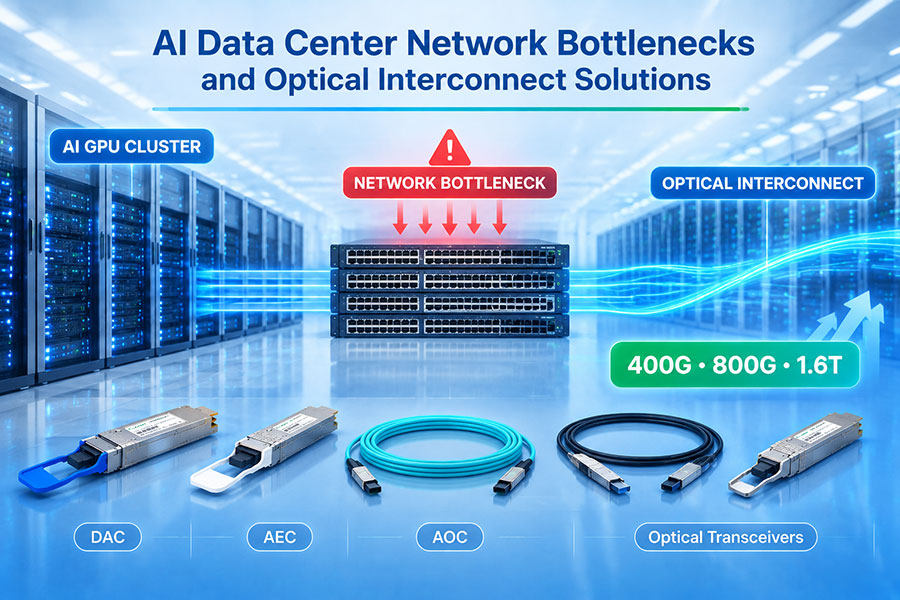
Neither technology is suitable for every connection. For longer distances, high electromagnetic-interference exposure, or routing between separate equipment areas, optical solutions such as AOC or pluggable optical transceivers may be more appropriate.
8. How to Choose Between AEC and ACC
The selection should begin with the required data rate, cable length, host interface, and system qualification requirements.
| Deployment Requirement | Recommended Direction | Reason |
|---|---|---|
| More signal recovery margin | AEC | Retimer-based signal regeneration can better handle demanding electrical channels. |
| Lower processing latency | ACC | Linear signal conditioning generally avoids full retimer processing. |
| Lower active-cable power target | ACC | Typically uses simpler signal-conditioning circuitry. |
| Longer copper reach | AEC | Retiming generally provides more reach potential than comparable redriver-based designs. |
| Cost-sensitive active copper deployment | ACC | Can provide a simpler active solution when the channel requirements allow it. |
| Compatibility with a specific 800G platform | Validate both options | Host support and qualified cable configurations determine actual interoperability. |
Before ordering, verify the connector form factor, electrical interface, protocol, cable length, power budget, firmware or management requirements, and compatibility list. A mechanically compatible cable is not necessarily electrically or operationally compatible.
9. C-LIGHT AEC and ACC Cable Solutions
C-LIGHT provides high-speed interconnect solutions for data center, AI computing, and high-performance networking applications. Its AEC and ACC product portfolio supports different copper-cabling requirements across high-speed network architectures.
800G AEC Active Electrical Cable
The C-LIGHT 800G AEC uses integrated retimer technology for high-speed electrical signal recovery. The product page lists configurations up to 5 meters and OSFP/QSFP-DD interface options.
Key features:
800Gbps data rate configurations.
Retimer-based signal conditioning.
Listed cable lengths up to 5 meters.
Designed for AI server clusters and high-speed interconnects.
800G ACC Active Copper Cable
C-LIGHT's 800G ACC solution is part of its active copper cable portfolio. It is intended for short-reach, high-bandwidth electrical interconnect applications where the specified signal-conditioning architecture meets the host channel requirements.
Selection considerations:
800G interface requirements.
Supported connector and cable configurations.
Host platform compatibility.
Specified power and transmission distance.
For additional high-speed interconnect options, visit the C-LIGHT AOC, DAC, AEC, and ACC product portfolio.
10. Frequently Asked Questions About AEC vs ACC
AEC commonly uses retimers to recover and retransmit electrical signals, while ACC typically uses redrivers or linear equalizers to compensate for signal loss. This gives AEC greater signal-recovery capability in many demanding channels.
Not in every application. AEC is generally more suitable when stronger signal recovery or longer copper reach is required. ACC can be a practical option when its signal-conditioning capability meets the channel requirements with lower complexity.
ACC generally has lower processing latency because it does not perform full CDR-based retiming. Actual latency depends on the specific signal-conditioning components and cable design.
AEC typically consumes more power because retimer circuitry performs additional signal processing. However, actual power must be checked against the manufacturer's specifications and measurement conditions.
Both can extend electrical connectivity beyond the practical reach of passive DAC in suitable configurations. However, they are not automatic replacements. The required distance, host signal quality, power budget, and equipment compatibility must be evaluated.
No. Even when they use the same connector form factor and data rate, their internal electronics, power requirements, management behavior, and host compatibility may differ. Always confirm the qualified cable type for the target equipment.
11. Conclusion
AEC and ACC are two active copper interconnect approaches designed to support high-speed data transmission beyond the practical limits of passive copper cabling. Their key difference lies in signal processing: AEC commonly uses retiming and clock-data recovery for stronger signal regeneration, while ACC uses redriver-based conditioning to compensate for electrical channel loss.
AEC is generally the stronger candidate when signal integrity and copper reach are the primary concerns. ACC is often attractive when lower processing complexity, power, and cost are priorities and the channel remains within its operating limits. The best choice depends on the actual data rate, distance, host platform, and validated cable specifications.
Looking for AEC or ACC Cable Solutions?
C-LIGHT provides high-speed copper interconnect options for 400G, 800G, and next-generation data center architectures. Contact the team to discuss interface requirements, cable length, compatibility, and customized configurations.
 >

 >
 >
 >
 >
 >
 >
 >