TEL:+86 132 6656 7067




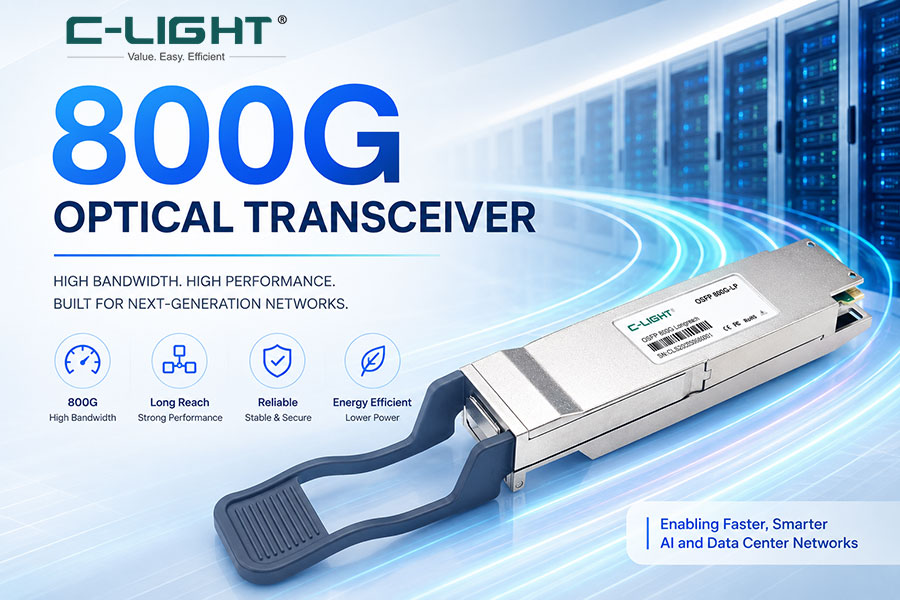
The rapid expansion of artificial intelligence, hyperscale data centers, and high-performance computing is accelerating demand for higher-bandwidth optical connectivity. As AI clusters scale to thousands of GPUs and accelerators, networks must move increasingly large volumes of data between compute nodes, switches, storage systems, and data center facilities.
This evolution is driving optical connectivity from traditional 100G and 400G solutions toward 800G and 1.6T technologies. Among these generations, 800G optical transceivers have become an important transition point for next-generation data center networking, providing higher bandwidth per port while maintaining the flexibility of pluggable optical architectures.
1. What Is an 800G Optical Transceiver?
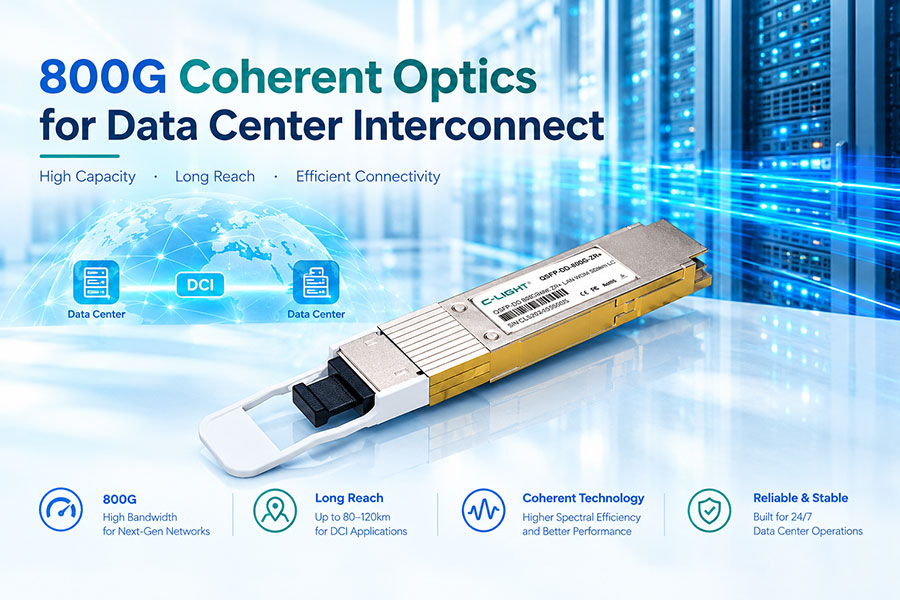
An 800G optical transceiver is a high-speed optical module designed to provide an aggregate data rate of up to 800Gb/s. It converts electrical signals from switches, servers, or network devices into optical signals for transmission through fiber, and converts received optical signals back into electrical signals.
A typical 800G optical transceiver may integrate several key components, including:
High-speed electrical interface
DSP or signal-processing circuitry
Optical transmitter
Optical receiver
Laser or photonic engine
Driver and TIA components
Monitoring and control circuitry
Thermal management components
The specific architecture depends on transmission distance, optical technology, form factor, lane configuration, and application requirements.
2. Why Is 800G Important for AI Data Centers?
AI workloads are generating unprecedented communication requirements between GPUs, switches, storage systems, and computing nodes. During distributed AI training and inference, large volumes of data must move continuously between interconnected accelerators.
As AI clusters become larger, network bandwidth can become a critical performance limitation. Moving from 400G to 800G allows network operators to provide significantly more bandwidth per port and increase overall network capacity.
800G optical connectivity can help data centers:
Increase network bandwidth
Support larger GPU clusters
Increase switch port capacity
Improve network density
Reduce the number of physical ports required for equivalent aggregate bandwidth
Prepare infrastructure for future 1.6T upgrades
3. 400G, 800G and 1.6T Optical Connectivity
800G should not be considered an immediate replacement for 400G. Instead, these technologies represent different stages of the optical networking evolution.
| Generation | Typical Applications | Network Position |
|---|---|---|
| 400G | Data centers, cloud networks, Ethernet | Mature high-speed connectivity |
| 800G | AI clusters, hyperscale data centers, high-speed Ethernet | Current high-growth generation |
| 1.6T | Next-generation AI and high-performance networks | Emerging next-generation technology |
The overall development path can be summarized as:
400G → 800G → 1.6T → 3.2T
Different generations will continue to coexist because network operators have different requirements for bandwidth, reach, cost, power consumption, and infrastructure compatibility.
4. Key Technologies Behind 800G Optical Transceivers
4.1 PAM4 Signaling
PAM4 is one of the key technologies enabling high-speed 800G connectivity. Unlike NRZ signaling, which uses two signal levels, PAM4 uses four amplitude levels and can transmit two bits per symbol.
This approach increases data throughput without requiring the same proportional increase in symbol rate. However, PAM4 also introduces stricter requirements for signal integrity, equalization, noise control, and error correction.
Important electrical performance parameters include:
Insertion loss
Return loss
Crosstalk
Jitter
Signal-to-noise ratio
Equalization performance
FEC performance
4.2 DSP Technology
Digital signal processors play an important role in high-speed optical modules. DSPs can perform functions such as equalization, signal recovery, and error management.
As electrical lane speeds continue to increase, DSP performance becomes increasingly important to maintaining reliable communication while controlling power consumption and latency.
4.3 Optical Engines and Silicon Photonics
Optical engines are becoming increasingly important as optical modules move toward higher bandwidth and greater integration.
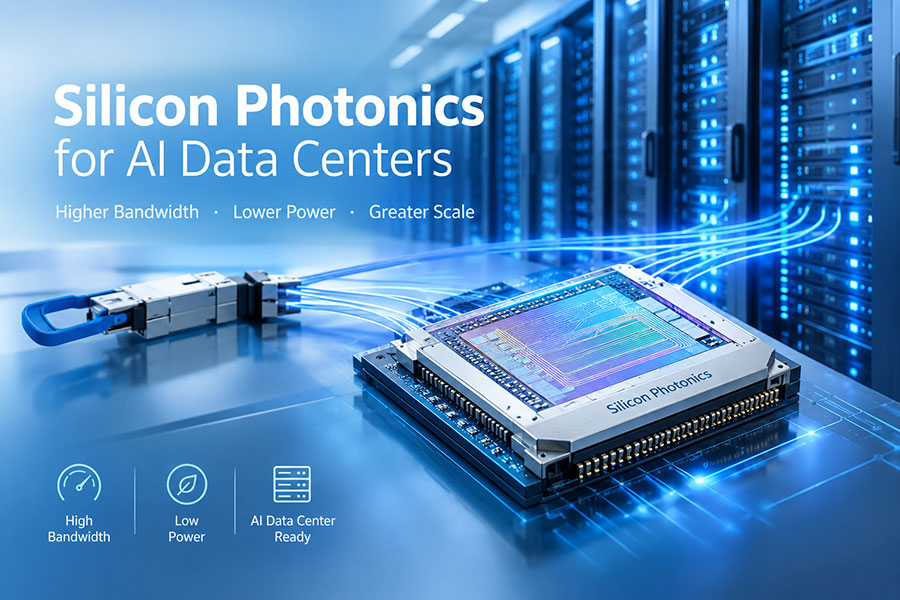
Silicon photonics is also gaining attention because it can integrate multiple optical functions into compact photonic integrated circuits. This can support higher optical density and potentially improve manufacturing scalability for future generations of optical modules.
5. 800G Optical Module Lane Architecture
800G optical transceivers can use different lane configurations depending on the module architecture and application.
Common approaches include:
8 × 100G lanes
4 × 200G lanes
Parallel optical architectures
Wavelength-multiplexed architectures
The transition toward higher per-lane speeds is particularly important for the development of 1.6T optical modules. Rather than continuously increasing the number of optical lanes, future architectures increasingly depend on higher-speed individual lanes.
6. Common 800G Optical Transceiver Types
6.1 800G SR8
800G SR8 is designed for short-reach applications and typically uses multimode fiber. It can be suitable for high-density data center connections where the distance between network devices is relatively short.
6.2 800G DR8
800G DR8 uses parallel single-mode optical transmission and is designed for longer reach than typical multimode solutions. It is particularly relevant to AI and data center networks that use single-mode fiber infrastructure.
6.3 800G 2×FR4
800G 2×FR4 uses multiple optical wavelengths to achieve high-speed transmission over longer distances than short-reach multimode solutions. It can be used for switch-to-switch and other data center connectivity applications.
6.4 800G 2×LR4
For longer single-mode fiber connections, wavelength-multiplexed architectures can provide extended reach while maintaining an 800G aggregate data rate.
The appropriate optical architecture should be selected according to transmission distance, fiber type, network topology, power budget, and cost requirements.
7. OSFP and QSFP-DD for 800G
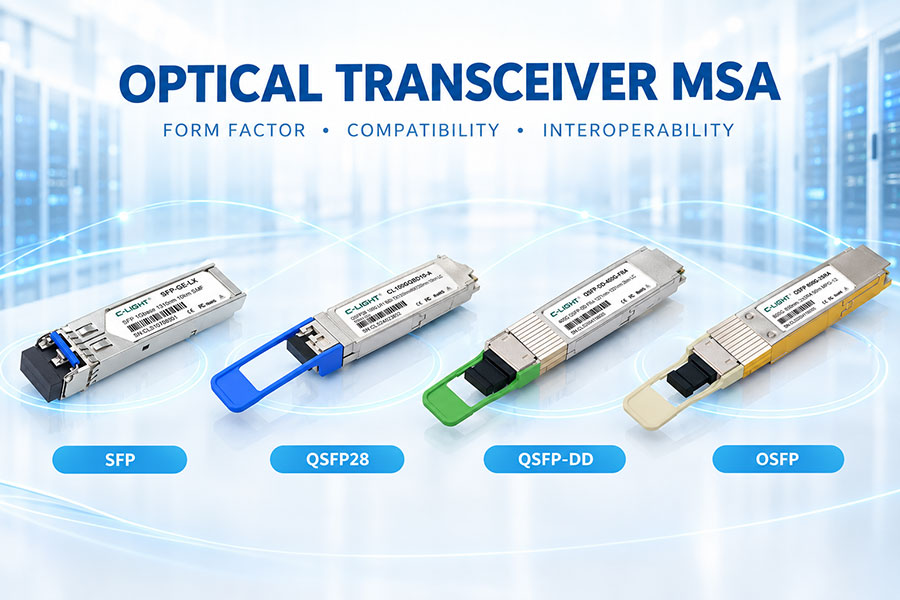
Form factor is another important consideration for 800G optical transceivers. OSFP and QSFP-DD are two major pluggable approaches used in high-speed networking.
OSFP provides a larger physical envelope, which can provide additional space for thermal management and high-power optical components.
QSFP-DD maintains a smaller form factor and offers strong compatibility with existing QSFP-based networking infrastructure.
The choice between OSFP and QSFP-DD depends on the switch platform, port density, thermal design, power budget, and overall system architecture.
8. Power Consumption and Thermal Management
Power consumption has become an increasingly important consideration as optical module speeds increase.
Higher bandwidth can require more sophisticated DSPs, optical engines, drivers, and thermal solutions. When hundreds of high-speed optical ports are installed in a large switch environment, even a small increase in power consumption per module can create a significant system-level thermal challenge.
AI data center optical designs therefore need to consider:
Power consumption per port
Thermal resistance
Airflow
Module operating temperature
Switch power budget
Rack-level power density
9. 800G Optical Transceivers in AI Cluster Networking
AI clusters are one of the major application areas driving demand for 800G optical connectivity.
A large AI infrastructure may require high-speed connections between:
GPU servers
Network switches
Storage systems
Compute nodes
Spine and leaf switches
As the number of GPUs increases, the number of high-speed network connections also grows rapidly. This makes optical bandwidth, port density, power efficiency, and link reliability increasingly important.
10. 800G in Scale-Out and Scale-Up Networks
10.1 Scale-Out Networking
Scale-out networks connect large numbers of servers and accelerators through high-speed Ethernet or other networking fabrics.
800G optical transceivers can support high-bandwidth connections between switches, servers, and network fabrics.
10.2 Scale-Up Networking
Scale-up architectures focus on high-bandwidth communication among tightly coupled accelerators. These environments place greater emphasis on bandwidth, latency, power efficiency, and optical integration.
As accelerator performance continues to increase, optical connectivity is becoming increasingly important in both scale-out and scale-up network architectures.
11. 800G Optical Transceiver Market Trends
11.1 AI Is Accelerating 800G Adoption
The rapid expansion of AI infrastructure is one of the strongest drivers of high-speed optical transceiver demand.
Large GPU clusters require high-bandwidth connections between computing and networking components, creating strong demand for 800G and higher-speed optical solutions.
11.2 800G Is Becoming a Major Transition Point
The optical networking market is moving from mature 400G solutions toward 800G, while 1.6T technologies are beginning to enter the next stage of deployment.
This creates a multi-generation market in which 400G, 800G, and 1.6T solutions can coexist depending on application requirements.
11.3 Higher-Speed Lanes Are Becoming More Important
The evolution from 800G to 1.6T is not simply a matter of adding more optical lanes. Higher per-lane data rates are becoming increasingly important.
This creates new requirements for:
High-speed DSPs
Optical engines
Laser technology
Electrical channels
Connectors
FEC
Thermal management
12. 800G and the Transition to 1.6T
800G is an important step toward 1.6T optical connectivity.
The transition can be represented as:
400G → 800G → 1.6T → 3.2T
As the industry moves toward 1.6T, 200G-per-lane technologies are becoming increasingly important. This places additional demands on optical components, electrical interfaces, DSPs, packaging, and thermal management.
For data center operators, the transition is not simply about increasing the optical data rate. The entire network infrastructure must evolve together, including switches, optical modules, cables, connectors, power systems, and cooling.
13. 800G Optical Transceivers vs DAC, AOC and AEC
Optical transceivers are only one part of the high-speed AI interconnect ecosystem.
Depending on distance and application requirements, AI data centers can also use DAC, AOC, and AEC solutions.
DAC: Suitable for very short-distance connections with simple architecture and low cost.
AEC: Uses active electrical signal conditioning to extend the practical reach of high-speed electrical connectivity.
AOC: Uses optical transmission inside an integrated cable assembly for suitable short- and medium-reach applications.
Optical Transceiver: Provides flexible optical connectivity for higher-bandwidth and longer-reach networking applications.
As a result, future AI networks are likely to use a combination of optical transceivers, DAC, AOC, and AEC rather than relying on a single connectivity technology.
14. Key Challenges for 800G Optical Transceivers
14.1 Power Efficiency
Higher bandwidth increases the need to reduce power consumption per transmitted bit. Improving power efficiency will remain an important development target.
14.2 Thermal Management
High-density optical ports generate additional heat inside switches and racks. Thermal design therefore becomes increasingly important as 800G and 1.6T deployments expand.
14.3 Optical Component Supply
Lasers, EMLs, DSPs, optical engines, and other components must scale alongside increasing demand for high-speed optical modules.
14.4 Manufacturing and Testing
Higher-speed modules require increasingly strict manufacturing tolerances and testing procedures. Signal integrity, optical performance, interoperability, and reliability all become more important at higher data rates.
14.5 Network Interoperability
Multi-vendor AI and data center networks require reliable interoperability between switches, optical modules, cables, and other networking components.
15. C-LIGHT 800G Optical Connectivity Solutions
C-LIGHT provides high-speed optical connectivity solutions for modern data center, AI networking, and high-performance computing applications.
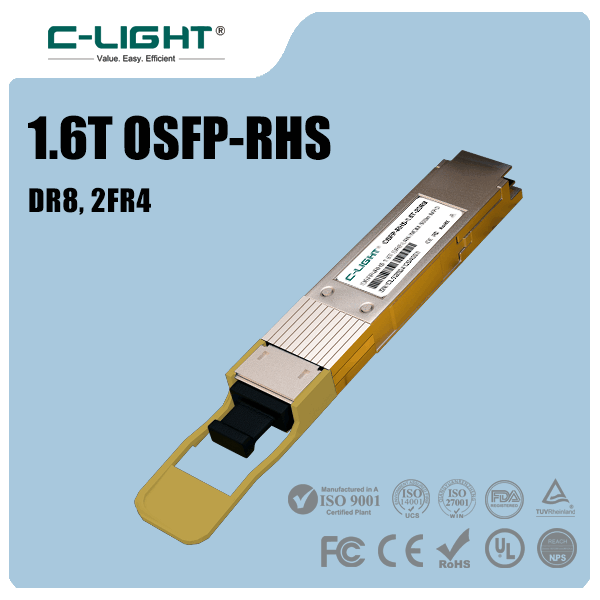
The portfolio covers multiple generations of high-speed connectivity, including 400G, 800G, and 1.6T optical solutions, allowing network designers to select suitable products according to bandwidth, transmission distance, form factor, and deployment requirements.
C-LIGHT's high-speed connectivity portfolio can support applications including:
AI data centers
GPU cluster networking
High-performance computing
Hyperscale data centers
High-speed Ethernet
Data center interconnect
In addition to optical transceivers, C-LIGHT also provides DAC, AOC, and AEC solutions for short-reach and high-density connectivity requirements.
16. Future Outlook for 800G Optical Transceivers
The 800G optical transceiver market is entering an important stage of development as AI infrastructure and hyperscale data centers continue to expand.
At the same time, the industry is already preparing for the next generation of 1.6T and higher-speed optical connectivity.
Future developments are expected to focus on:
Higher optical bandwidth
Lower power consumption
Higher optical density
Improved thermal performance
Advanced silicon photonics
Higher-speed electrical lanes
Advanced DSP and signal processing
LPO and CPO architectures
Pluggable 800G optical transceivers are expected to remain an important part of the transition because they provide a balance between bandwidth, flexibility, serviceability, and deployment maturity.
17. Conclusion
800G optical transceivers have become an important technology in the evolution of high-speed data center networking.
Driven by AI clusters, hyperscale infrastructure, and increasing accelerator bandwidth, the market is moving from 400G toward 800G and eventually 1.6T and beyond.
However, the future of optical connectivity is not determined by bandwidth alone. Power consumption, thermal management, signal integrity, optical component technology, network density, interoperability, and total system cost will all influence the adoption of different solutions.
For data center operators, the key consideration is increasingly how efficiently the entire network can move data at scale. In this environment, 800G represents an important bridge between established 400G infrastructure and the next generation of 1.6T optical connectivity.
18.800G Optical Transceiver Q&A
Q1: What is an 800G optical transceiver?
Answer: An 800G optical transceiver is a high-speed optical module designed to provide up to 800Gb/s aggregate data transmission. It converts electrical signals into optical signals and optical signals back into electrical signals.
Q2: Why are 800G optical transceivers important for AI data centers?
Answer: AI clusters require extremely high bandwidth between GPUs, switches, storage systems, and computing nodes. 800G optical transceivers provide higher bandwidth per port and help support larger and denser AI networking infrastructures.
Q3: Is 800G replacing 400G optical transceivers?
Answer: Not immediately. 400G and 800G will coexist for different applications. 400G remains suitable for many existing data center and Ethernet networks, while 800G is increasingly used for AI clusters, hyperscale data centers, and other high-bandwidth applications.
Q4: What is the difference between 800G and 1.6T optical modules?
Answer: 800G provides up to 800Gb/s aggregate bandwidth, while 1.6T targets approximately twice that capacity. The transition to 1.6T also requires higher-speed electrical and optical lanes, more advanced DSPs, improved thermal management, and higher-performance optical components.
Q5: What form factors are used for 800G optical transceivers?
Answer: OSFP and QSFP-DD are two important pluggable form factors used for high-speed optical networking. The appropriate form factor depends on switch design, port density, thermal requirements, power budget, and system compatibility.
Q6: What technologies are used in 800G optical transceivers?
Answer: Key technologies include PAM4 signaling, high-speed DSPs, advanced lasers, optical engines, TIA and driver components, silicon photonics, and advanced thermal management technologies.
Q7: What are the common types of 800G optical transceivers?
Answer: Common architectures include 800G SR8, 800G DR8, 800G 2×FR4, and 800G 2×LR4. These solutions are designed for different transmission distances, fiber types, and data center network architectures.
Q8: How does 800G compare with DAC, AOC and AEC?
Answer: DAC is generally used for very short-distance connections, while AEC uses active electrical signal conditioning and AOC integrates optical transmission into a cable assembly. 800G optical transceivers provide greater flexibility for high-bandwidth optical links and longer transmission distances.
Q9: What are the main challenges of 800G optical transceivers?
Answer: Major challenges include power consumption, thermal management, signal integrity, optical component supply, manufacturing yield, testing requirements, interoperability, and overall deployment cost.
Q10: What is the future development direction after 800G?
Answer: The next major step is 1.6T optical connectivity, followed by higher-speed technologies such as 3.2T. Silicon photonics, LPO, CPO, higher-speed electrical lanes, and more efficient optical engines are expected to play important roles in future optical networks.
 >
>

 >
>
 >
>
 >
>
 >
>
 >
>
 >
>
 >
>