TEL:+86 132 6656 7067




The transition from 400G to 800G optical connectivity is becoming an important step in the development of high-performance data center networks. AI clusters, cloud computing platforms, high-performance computing (HPC), and large-scale Ethernet fabrics require substantially more bandwidth between servers, switches, and storage systems.
An 800G optical transceiver provides an aggregate data rate of 800Gbps and is designed to address high-bandwidth network connections where 400G may no longer provide sufficient port capacity. The technology involves multiple optical lanes, high-speed electrical interfaces, advanced optical components, and digital signal processing.
1. What Is an 800G Optical Transceiver?
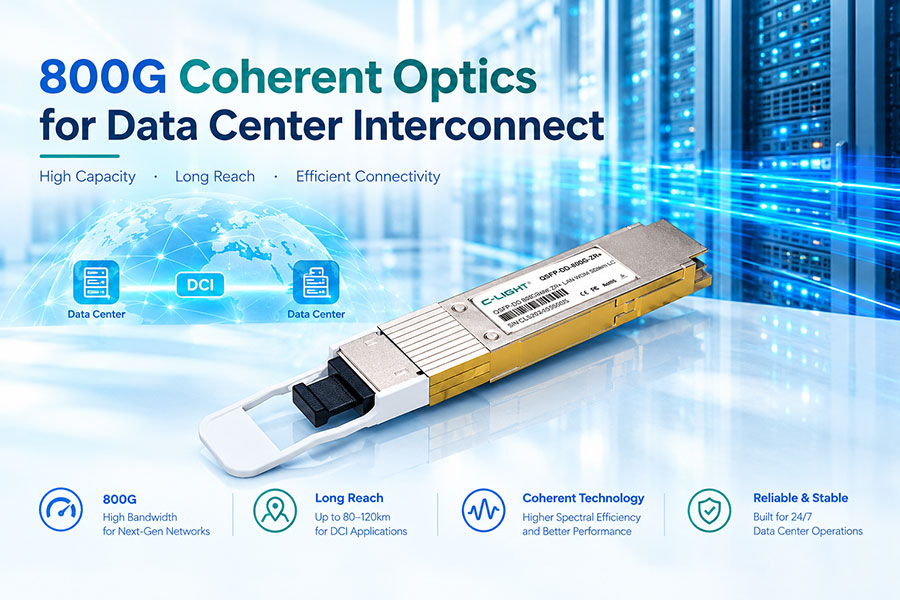
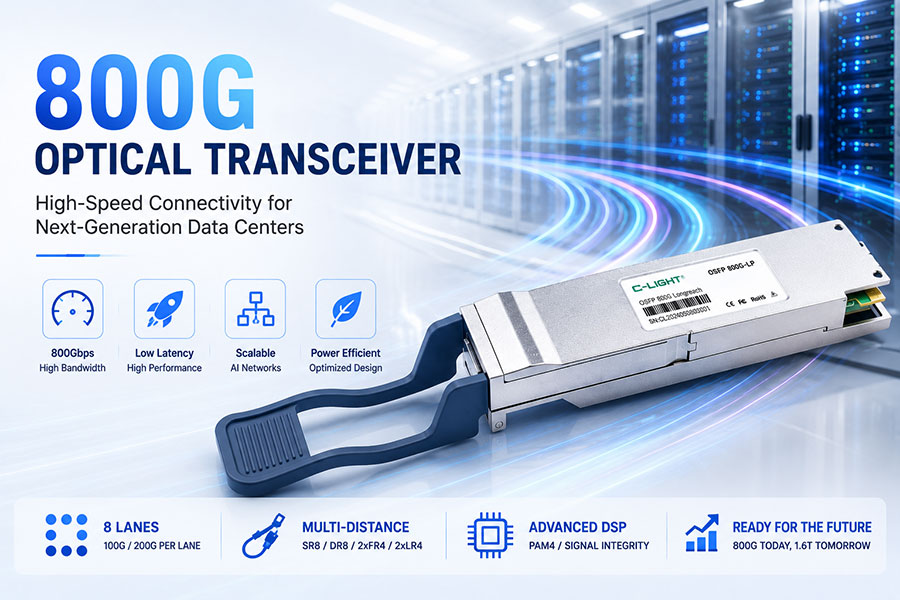
An 800G optical transceiver is a pluggable optical networking module capable of transmitting and receiving data at an aggregate rate of up to 800Gbps. It converts high-speed electrical signals from networking equipment into optical signals for transmission over fiber and converts received optical signals back into electrical signals.
800G transceivers are typically deployed in high-capacity switches, routers, servers, AI clusters, and data center interconnect environments. The actual transmission distance and optical configuration depend on the specific module type, wavelength, fiber type, lane configuration, and application.
Compared with a 400G module, an 800G module can provide approximately twice the aggregate port bandwidth, allowing network equipment to increase bandwidth without simply doubling the number of physical ports.
2. Why 800G Optical Transceivers Are Important
AI and accelerated computing workloads generate large volumes of east-west traffic between computing nodes. GPU servers may need to exchange model data, synchronization information, intermediate results, and storage traffic across the network.
As accelerator clusters become larger, the network fabric must provide sufficient bandwidth and low-latency connectivity to prevent the network from becoming a bottleneck.
800G optical connectivity addresses this requirement by increasing the capacity of individual network links. It can also help reduce the number of physical ports and cables required to deliver a given amount of aggregate bandwidth.
The value of 800G therefore extends beyond the transceiver itself. It is part of a broader transition involving high-speed switch ASICs, SerDes technology, optical engines, fiber connectivity, network architectures, and thermal management.
3. How Does an 800G Optical Transceiver Work?
An 800G optical transceiver contains electrical and optical components that work together to provide bidirectional communication.
Electrical interface: Receives high-speed electrical data from the host system.
DSP: Processes and conditions high-speed signals and can perform functions such as equalization and signal recovery.
Optical transmitter: Uses lasers and associated driver circuitry to convert electrical signals into optical signals.
Optical receiver: Uses photodetectors and receiver circuitry to convert incoming optical signals back into electrical signals.
Management interface: Provides monitoring and control functions for parameters such as module status and operating conditions.
The exact architecture varies between module designs. Different 800G products may use different lane counts, modulation formats, wavelengths, optical engines, and form factors.
4. 800G Optical Lane Configurations
One of the most important concepts in 800G optical technology is lane configuration. The 800Gbps aggregate rate is achieved by combining multiple high-speed lanes.
A common architecture uses 8 lanes at approximately 100Gbps per lane. Another approach uses 4 lanes at approximately 200Gbps per lane. The exact implementation depends on the electrical and optical standards supported by the module and host platform.
The transition toward 200G-per-lane technology is particularly important because increasing bandwidth per lane provides a path toward higher aggregate speeds without continuously increasing the total number of lanes.
Future 1.6T optical connectivity can similarly use higher-speed optical lanes, with 400G-per-lane architectures representing one potential approach to achieving 1.6Tbps aggregate bandwidth.
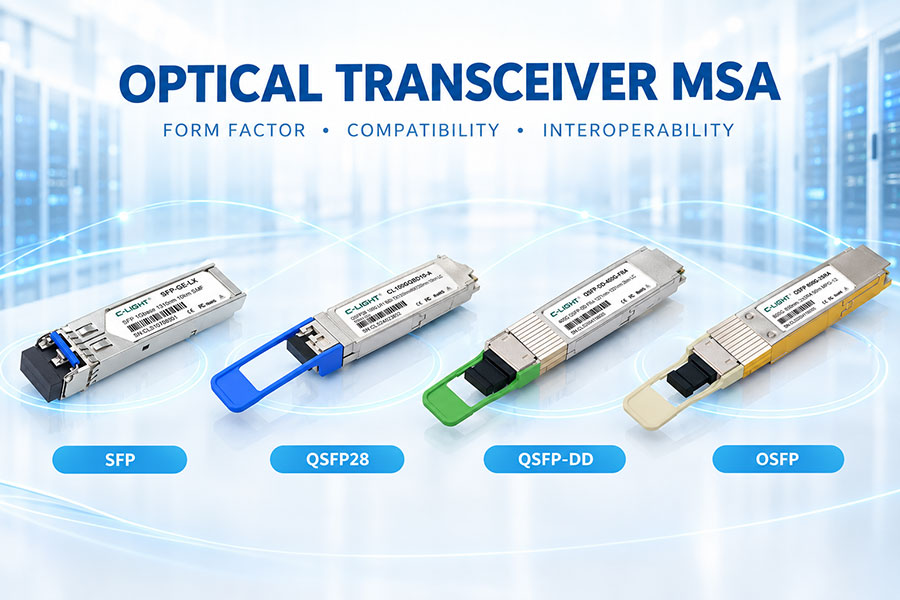
5. 800G Optical Transceiver Form Factors
Form factor determines the mechanical dimensions, electrical interface, thermal characteristics, and system integration requirements of an optical transceiver.
OSFP and QSFP-related form factors are both relevant to high-speed networking, but their physical dimensions and platform compatibility are different.
OSFP is widely associated with high-speed data center applications and provides a larger module envelope than traditional QSFP designs. The additional space can be useful for thermal management and high-speed optical components.
QSFP form factors provide a more compact design and have a long history in data center networking. Different QSFP generations support different electrical interfaces and bandwidth levels.
When selecting an 800G module, the form factor must match the host switch or networking platform. A module should not be selected based only on its advertised data rate.
6. Common 800G Optical Transceiver Types
800G modules can be designed for different transmission distances and fiber environments. Common categories include short-reach multimode solutions and longer-reach single-mode solutions.
6.1 800G SR8
800G SR8 is designed for short-reach data center connections using multimode fiber. The architecture typically uses multiple optical lanes and parallel fiber connections.
SR solutions are suitable for applications where the connected equipment is located within relatively short data center distances. Their primary advantages include high bandwidth and efficient short-reach connectivity.
6.2 800G DR8
800G DR8 is generally designed for single-mode fiber and longer reach than SR solutions. It typically uses eight optical lanes and parallel single-mode fiber connectivity.
DR8 can be considered for high-density connections between switches and other network equipment where single-mode fiber infrastructure is preferred.
6.3 800G 2xFR4
800G 2xFR4 architectures use multiple optical wavelengths to provide 800Gbps connectivity over single-mode fiber. The design can simplify certain fiber connectivity requirements compared with architectures using a larger number of individual optical fibers.
6.4 800G 2xLR4
800G 2xLR4 is intended for longer-reach single-mode applications. Compared with short-reach designs, longer-reach modules place greater requirements on optical power, receiver sensitivity, link budget, dispersion management, and overall optical performance.
7. 800G Multimode vs. Single-Mode Connectivity
Fiber selection is an important part of an 800G network design.
Multimode fiber (MMF) is commonly used for shorter data center connections. It can provide a practical solution for short-reach links and is widely deployed in data center environments.
Single-mode fiber (SMF) is typically selected when longer transmission distances are required. It provides a larger optical transmission window and supports longer-reach applications.
The choice between MMF and SMF depends on the distance, existing cabling infrastructure, module type, optical budget, and network architecture.
8. 800G Optical Transceiver Modulation Technology
Modulation technology determines how information is encoded onto the optical signal. At high data rates, the industry has moved beyond traditional NRZ signaling toward higher-order modulation formats.
PAM4 is an important technology for modern high-speed optical networking. PAM4 uses four signal levels to transmit two bits per symbol, increasing the amount of data carried by each symbol compared with two-level NRZ signaling.
Using PAM4 helps enable higher data rates while maintaining a manageable number of electrical and optical lanes. However, PAM4 also introduces tighter requirements for signal integrity, noise performance, linearity, equalization, and receiver design.
9. The Role of DSP in 800G Optical Modules
Digital signal processing is a critical part of many high-speed optical transceivers.
An optical DSP can perform functions such as equalization, clock and data recovery, signal conditioning, monitoring, and error-related processing. These functions help compensate for impairments introduced by the electrical and optical transmission path.
As the lane rate increases from 100G to 200G and beyond, DSP performance becomes increasingly important. Module designers must balance signal quality, processing capability, power consumption, latency, and thermal requirements.
10. 800G and Signal Integrity
At 800G speeds, signal integrity becomes a major engineering consideration throughout the system.
Important electrical parameters include insertion loss, return loss, crosstalk, jitter, channel loss, and eye opening. Poor electrical performance can reduce the available signal margin and make reliable data transmission more difficult.
Optical parameters are equally important. Transmitter optical power, receiver sensitivity, extinction ratio, optical modulation amplitude, wavelength characteristics, and total link budget all contribute to link performance.
For this reason, 800G module development requires coordinated electrical, optical, mechanical, thermal, and firmware engineering.
11. 800G Optical Link Budget
The optical link budget represents the available optical power margin between the transmitter and receiver.
A simplified link budget can be considered as:
Link Budget = Transmitter Output Power − Receiver Sensitivity
Actual system calculations also need to account for fiber attenuation, connector loss, splice loss, patch-panel loss, wavelength-dependent effects, and other penalties.
A sufficient link budget is necessary to maintain reliable operation over the intended transmission distance. Different 800G module types therefore have different optical specifications and reach capabilities.
12. 800G Power Consumption and Thermal Management
Power consumption becomes increasingly important as network speeds increase. An 800G module contains high-speed electrical and optical components operating simultaneously, and the resulting heat must be effectively managed.
Thermal design can include optimized module packaging, heat dissipation structures, airflow management, and improvements in optical and DSP efficiency.
In high-density AI data centers, hundreds or thousands of optical modules may operate simultaneously. Even relatively small differences in power consumption per module can therefore affect the total thermal load of the network.
This is one reason why future optical technologies are increasingly focused not only on higher bandwidth but also on bandwidth-per-watt efficiency.
13. 800G Optical Transceivers in AI Data Centers
AI clusters create particularly demanding networking conditions because large numbers of accelerators communicate continuously across the network fabric.
800G optical transceivers can provide high-bandwidth connections between AI servers and network switches, as well as between different switching layers.
In an Ethernet-based AI fabric, 800G ports can be used to build high-capacity connections between switches and compute nodes. The exact topology depends on the switch architecture, accelerator platform, network protocol, and deployment scale.
800G connectivity is therefore an important building block for scalable AI networking rather than a standalone solution to AI network performance.
14. 800G vs. 400G Optical Transceivers
400G and 800G modules serve different stages of network bandwidth scaling.
| Feature | 400G | 800G |
|---|---|---|
| Aggregate data rate | 400Gbps | 800Gbps |
| Typical application | Data center and high-performance networking | High-density data center and AI networking |
| Lane technology | Multiple high-speed electrical/optical lanes | Multiple high-speed electrical/optical lanes |
| Fiber options | MMF and SMF depending on module type | MMF and SMF depending on module type |
| Port density | High | Higher aggregate bandwidth per port |
The transition from 400G to 800G does not mean that 400G becomes obsolete. Both generations can coexist in data centers depending on switch capabilities, network topology, transmission distance, and deployment requirements.
15. 800G vs. 1.6T Optical Connectivity
1.6T represents the next major increase in aggregate bandwidth after 800G. The transition requires higher electrical and optical lane rates, improved signal integrity, more efficient DSPs, and advanced thermal management.
800G remains an important generation for current high-speed network architectures, while 1.6T is being developed to support future systems with even greater bandwidth requirements.
The two technologies should therefore be viewed as part of an evolutionary bandwidth roadmap rather than as competing technologies that must immediately replace one another.
16. 800G Optical Transceivers and AECs
Optical transceivers and Active Electrical Cables (AECs) address different connectivity requirements.
AECs use active electrical components to improve signal transmission over short electrical connections. They can be useful for short-reach connections where optical transmission may not be necessary.
Optical transceivers become increasingly useful when the required distance, bandwidth, or network architecture favors fiber connectivity.
AI data centers can therefore use both AECs and optical transceivers, with the appropriate technology selected according to connection distance, power, cost, density, and system requirements.
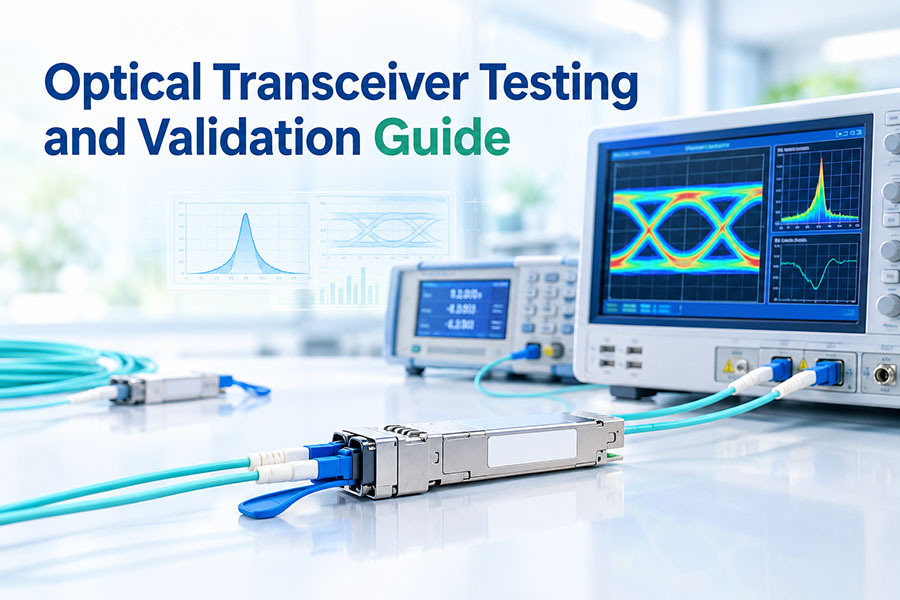
17. 800G Optical Transceiver Testing
Testing is essential for validating the performance and reliability of high-speed optical modules.
Electrical testing can include eye diagrams, insertion loss, return loss, crosstalk, jitter, and high-speed channel measurements.
Optical testing can include transmitter optical power, receiver sensitivity, wavelength, extinction ratio, optical modulation amplitude, and other optical performance parameters.
BER testing using patterns such as PRBS31 can also be used to evaluate high-speed data transmission performance.
Thermal testing, interoperability testing, firmware validation, and long-duration reliability testing provide additional information about module behavior under practical operating conditions.
18. 800G Optical Transceiver Compatibility
Compatibility is an important consideration when deploying 800G modules. A module must be compatible with the host platform's form factor, electrical interface, firmware or management requirements, optical interface, and supported operating specifications.
Network operators should verify compatibility with the specific switch, router, NIC, or other host equipment before deployment.
Interoperability can also depend on the optical standard, fiber configuration, wavelength plan, link distance, and the characteristics of the two connected modules.
19. C-LIGHT 800G Optical Transceiver Solutions
C-LIGHT provides high-speed optical connectivity products for data center and networking applications, including 800G optical transceiver solutions.
C-LIGHT 800G products can be designed for high-bandwidth data center applications and different optical connectivity requirements. Depending on the product configuration, solutions can address short-reach and other data center interconnect scenarios.
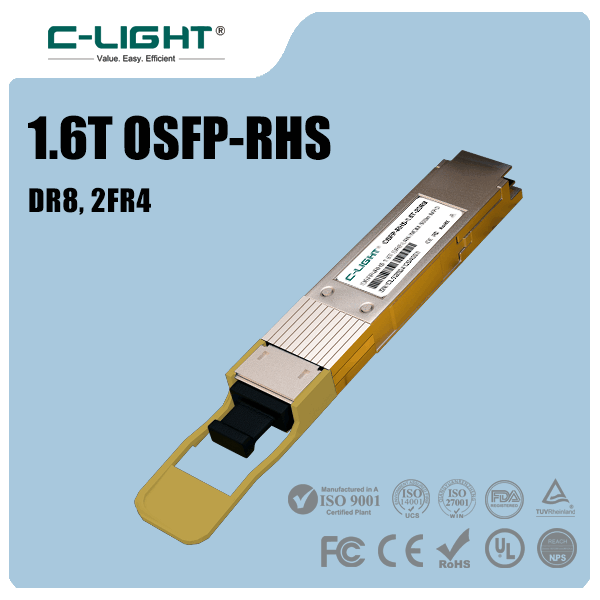
The C-LIGHT portfolio also includes other high-speed connectivity technologies, including 400G optical transceivers, 1.6T optical technologies, and Active Electrical Cable solutions. This enables different interconnect technologies to be considered according to network bandwidth, distance, density, and system architecture.
20. Future Development of 800G Optical Connectivity
The development of 800G optical technology is closely connected with the broader evolution of AI and high-performance data center networks.
Future development is expected to focus on higher lane rates, lower power consumption, improved optical integration, more efficient DSP architectures, advanced packaging, and greater network density.
400G-per-lane technologies provide a potential path toward 1.6T and future higher-speed optical connectivity. At the same time, technologies such as co-packaged optics (CPO), silicon photonics, linear-drive optics, and other optical architectures are being explored for different parts of the network.
The most appropriate technology will depend on the specific requirements of each generation of network equipment and data center architecture.
21.Conclusion
800G optical transceivers represent an important step in the evolution of high-speed data center connectivity. By providing 800Gbps aggregate bandwidth, they can support the increasing traffic generated by AI clusters, cloud computing, HPC, and high-capacity Ethernet networks.
The technology combines high-speed electrical interfaces, optical engines, lasers, photodetectors, DSPs, advanced modulation, and thermal management. Different module types, including SR8, DR8, 2xFR4, and other configurations, address different transmission distances and fiber environments.
800G is also part of a broader transition from 400G toward 1.6T and higher-speed connectivity. As AI infrastructure continues to scale, optical transceivers, AECs, CPO, silicon photonics, and other interconnect technologies will each have roles to play in building higher-bandwidth and more scalable data center networks.
22.800G Optical Transceiver Frequently Asked Questions
1. What is an 800G optical transceiver?
Answer: An 800G optical transceiver is a networking module designed to provide an aggregate data rate of up to 800Gbps. It converts electrical signals into optical signals for transmission over fiber and converts received optical signals back into electrical signals.
2. What is the difference between 400G and 800G optical transceivers?
Answer: The main difference is aggregate bandwidth. A 400G module provides 400Gbps, while an 800G module provides 800Gbps. The two generations can coexist in data center networks depending on the equipment and application requirements.
3. Is 800G optical transceiver technology based on PAM4?
Answer: Many modern 800G optical transceivers use PAM4 signaling to achieve high data rates per electrical or optical lane. The exact implementation depends on the module architecture and applicable technology or standard.
4. What are common 800G optical transceiver types?
Answer: Common configurations include 800G SR8, DR8, 2xFR4, and other module designs. They differ in fiber type, optical architecture, transmission distance, wavelength configuration, and connector arrangement.
5. What fiber is used with 800G optical transceivers?
Answer: Both multimode fiber and single-mode fiber can be used, depending on the module type. Short-reach SR solutions commonly use multimode fiber, while many longer-reach solutions use single-mode fiber.
6. What is the role of DSP in an 800G optical module?
Answer: DSP technology can perform signal processing functions such as equalization, clock and data recovery, signal conditioning, monitoring, and error-related processing. It helps manage the signal integrity requirements associated with high-speed transmission.
7. Can 800G optical transceivers be used in AI data centers?
Answer: Yes. 800G optical transceivers are designed for high-bandwidth networking applications and can be used in AI data center architectures where compatible switches, servers, fiber infrastructure, and network interfaces support the required configuration.
8. What should be considered when selecting an 800G optical transceiver?
Answer: Key factors include host form factor, data rate, transmission distance, fiber type, connector configuration, optical link budget, power consumption, thermal conditions, electrical interface, management requirements, and platform compatibility.
9. What is the relationship between 800G and 1.6T optical connectivity?
Answer: 1.6T is the next major aggregate bandwidth step after 800G. Higher lane rates, including 400G-per-lane technologies, can provide a path toward 1.6T architectures. Both generations are part of the broader evolution of high-speed data center networking.
10. Does 800G optical connectivity replace AECs?
Answer: No. AECs and optical transceivers address different connectivity requirements. AECs can be suitable for certain short-reach electrical connections, while optical transceivers are useful when fiber connectivity, greater reach, or specific high-bandwidth requirements are needed.
 >
>

 >
>
 >
>
 >
>
 >
>
 >
>
 >
>
 >
>