TEL:+86 132 6656 7067




800G LPO optical transceivers are designed for high-bandwidth AI networks and data center interconnects where optical module power, latency, density, and signal integrity are critical. By moving more signal-processing responsibility into the host ASIC and using a linear electrical interface between the host and optical module, LPO can reduce the processing and power overhead traditionally associated with retimed optical transceivers.
1. What Is an 800G LPO Optical Transceiver?
800G LPO, or 800G Linear Pluggable Optics, is a high-speed optical transceiver architecture designed to transmit up to 800Gb/s through a pluggable optical module without relying on a conventional retimer or DSP inside the module.
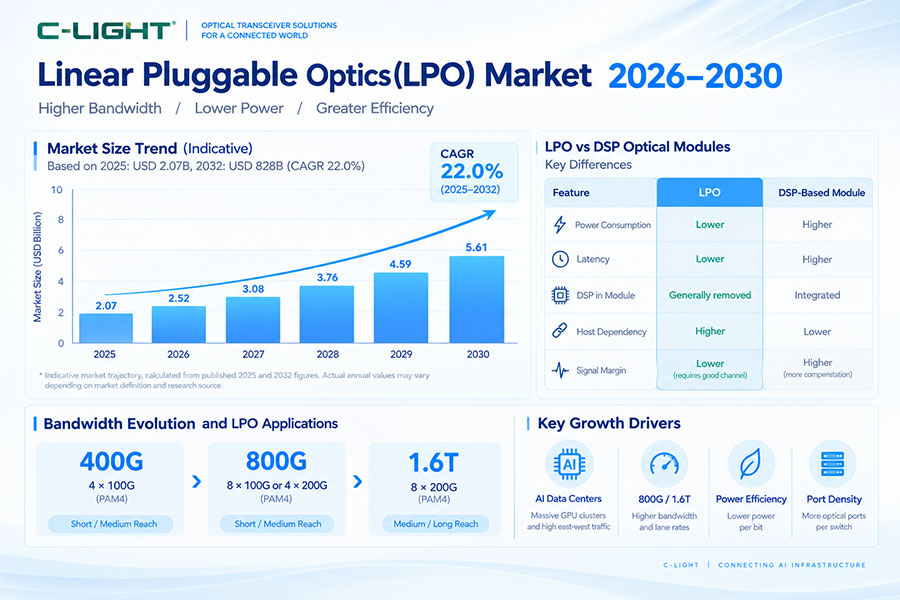
In a traditional retimed optical transceiver, the electrical signal from the switch or NIC is received by the module DSP. The DSP performs signal conditioning, equalization, clock recovery, and other processing before driving the optical engine.
In an LPO architecture, much of this processing is shifted toward the host ASIC. The optical module uses a more linear electrical path, typically consisting of high-speed linear drivers on the transmit side and sensitive receiver components such as TIAs on the receive side.
The basic concept can be represented as:
Host ASIC → Electrical Channel → DSP/CDR → Optical Engine → Fiber
Host ASIC / SerDes → Linear Driver → Optical Engine → Fiber
The exact implementation varies by module, host platform, optical technology, and link design, but the central objective is to reduce unnecessary signal-processing stages inside the pluggable module.
2. Why 800G LPO Matters for AI Data Centers
AI clusters generate extremely high volumes of east-west traffic between GPUs, NICs, switches, storage systems, and other compute resources. As network speeds move from 400G to 800G and beyond, the power consumed by optical connectivity becomes an increasingly important part of the overall system power budget.
Thousands of high-speed optical ports can create substantial aggregate power consumption. Even a small reduction in power per optical module can become significant when multiplied across a large AI cluster.
800G LPO is therefore being considered as one approach to address several data center requirements:
Lower optical module power consumption
Reduced signal-processing overhead
Lower latency
Higher switch port density
Improved power efficiency per transmitted bit
Better thermal management
Scalable connectivity for AI and HPC networks
For AI infrastructure, the objective is not simply to increase bandwidth. Network bandwidth must scale while power, cooling, latency, and physical density remain manageable.
3. How Does 800G LPO Work?
The key difference between LPO and conventional retimed optics is where signal conditioning takes place.
3.1 Host ASIC and SerDes
The host switch ASIC or NIC contains high-speed SerDes interfaces. In an LPO architecture, the host SerDes is responsible for driving a high-speed electrical channel toward the optical module.
Modern switch ASICs increasingly provide advanced equalization and signal-processing capabilities. This makes it possible to simplify the electronics inside the optical module while maintaining the required link performance.
3.2 Linear Driver
On the transmit side, the optical module uses a linear driver to convert the electrical signal into a suitable drive signal for the optical transmitter.
Unlike a conventional architecture that can include significant digital signal processing, the LPO driver is designed to preserve the linear characteristics of the incoming signal while providing the required electrical drive capability.
3.3 Optical Engine
The optical engine converts the electrical signal into an optical signal. Depending on the module architecture, technologies such as EML, VCSEL, or silicon photonics can be used.
For 800G implementations, multiple high-speed optical lanes are combined to achieve the aggregate data rate. A common architecture uses eight 100G-class electrical or optical lanes, although the exact lane configuration depends on the implementation.
3.4 Receiver and TIA
On the receive side, the optical detector converts the incoming optical signal into an electrical signal. A transimpedance amplifier, or TIA, then converts the detector current into a usable voltage signal for the host-side electrical interface.
Because the module does not depend on a conventional DSP-based retimer, the received signal must be delivered with sufficient quality for the host ASIC to perform the required signal recovery and equalization.
4. 800G LPO vs Traditional Retimed Optical Transceivers
The most important difference is the location of signal processing.
| Item | 800G LPO | Retimed 800G Optics |
|---|---|---|
| Module DSP | Typically removed or significantly reduced | Typically included |
| Signal Processing | More responsibility on host ASIC | Shared with module DSP |
| Module Power | Potentially lower | Generally higher due to DSP processing |
| Latency | Potentially lower | Higher due to additional processing |
| Electrical Channel | More demanding | More tolerant |
| Host SerDes Requirement | High | High, but module DSP provides additional conditioning |
| System Dependency | Strong host-module dependency | More processing inside the module |
| Power Efficiency | Potentially better | More module processing overhead |
LPO does not simply eliminate electronics. Instead, it changes the distribution of signal-processing functions between the host and optical module.
5. Why Removing the Module DSP Can Reduce Power
A DSP is a complex high-speed processing device. In an optical transceiver, it can perform equalization, clock recovery, signal conditioning, monitoring, and other functions.
At 800G speeds, DSP power becomes increasingly important because the module must process multiple high-speed lanes simultaneously.
Removing the DSP from the optical module can reduce several sources of power consumption:
Digital signal processing
High-speed clocking
SerDes processing inside the module
DSP thermal dissipation
Additional power-management requirements
However, the power is not necessarily eliminated from the complete system. Some of the signal-processing workload moves into the host ASIC, which means system-level power efficiency must be evaluated rather than looking only at module power.
6. 800G LPO and PAM4 Signaling
PAM4 is an important technology for 800G optical networking.
Unlike NRZ, which uses two signal levels to represent one bit per symbol, PAM4 uses four signal levels and carries two bits per symbol. This allows a higher data rate to be achieved without proportionally doubling the symbol rate.
The advantage comes with additional signal-integrity challenges.
Because the voltage separation between PAM4 levels is smaller, PAM4 links are more sensitive to noise, loss, reflections, crosstalk, jitter, and other electrical impairments.
This becomes especially important for LPO because the electrical path between the host ASIC and optical module has less signal conditioning inside the module.
7. Signal Integrity Is Critical for 800G LPO
Signal integrity is one of the main engineering challenges of LPO.
The electrical channel between the host ASIC and optical module may include PCB traces, connectors, package transitions, vias, and other interconnect structures. At very high data rates, every section of the channel contributes insertion loss and potentially affects signal quality.
Important parameters include:
Insertion loss
Return loss
Channel bandwidth
Crosstalk
Reflection
Jitter
Noise
Equalization capability
For conventional retimed optics, the module DSP can help compensate for part of the electrical channel impairment. In an LPO design, the host SerDes must provide much more of the required compensation.
8. The Role of Host ASIC Equalization
Host-side equalization is fundamental to LPO operation.
The switch ASIC or NIC must compensate for the electrical channel between itself and the optical module. Depending on the platform, techniques such as transmitter equalization and receiver equalization can be used to maintain signal quality.
This creates a strong relationship between the LPO module and the host platform.
A conventional DSP-based transceiver can provide a greater degree of signal regeneration inside the module. An LPO module instead depends more heavily on the host SerDes architecture.
As a result, an LPO module should not be evaluated independently from the switch, NIC, PCB design, connector system, and electrical channel.
9. 800G LPO Optical Technologies
Several optical technologies can be used in an 800G LPO architecture.
9.1 EML-Based LPO
Electro-absorption modulated lasers combine a laser source and electro-absorption modulation function. EML technology has been widely used in high-speed single-mode optical applications.
EML can provide high-speed optical transmission while maintaining compatibility with established single-mode fiber architectures.
9.2 Silicon Photonics LPO
Silicon photonics integrates optical functions into a photonic integrated circuit. It can integrate components such as waveguides, modulators, optical splitters, wavelength multiplexers, and photodetectors.
For high-density 800G and future 1.6T systems, silicon photonics can provide an attractive platform for optical integration and multi-channel architectures.
9.3 VCSEL-Based LPO
VCSEL technology is commonly associated with short-reach multimode fiber applications. It can provide efficient short-distance connectivity for data center environments where MMF infrastructure is appropriate.
The appropriate optical source depends on the required reach, fiber type, wavelength, optical power budget, thermal conditions, and network architecture.
10. 800G LPO Reach Options
800G LPO is not a single optical specification. Different module types can support different transmission distances.
| Type | Typical Fiber | Application |
|---|---|---|
| 800G SR | Multimode Fiber | Short-reach AI and data center links |
| 800G DR | Single-mode Fiber | Short to medium single-mode links |
| 800G FR | Single-mode Fiber | Longer data center connections |
| 800G LPO AOC | Integrated Optical Fiber | Short-reach switch and server connectivity |
Reach should always be evaluated together with optical power, fiber attenuation, connector loss, dispersion, receiver sensitivity, and the complete link budget.
11. 800G LPO and AI GPU Clusters
AI GPU clusters create highly synchronized network traffic. GPU-to-GPU communication, parameter synchronization, gradient exchange, all-reduce, and all-to-all traffic can generate sustained high-bandwidth demand.
Optical connectivity is therefore becoming an important part of AI scale-out networks.
In large AI clusters, hundreds or thousands of optical links may operate simultaneously. This makes power per port and power per bit important network design metrics.
800G LPO can be attractive in this environment because the architecture focuses on reducing unnecessary processing inside each optical module while maintaining high-speed connectivity.
12. 800G LPO and Optical Module Thermal Management
Optical module power is directly related to thermal design.
As optical module density increases, the total heat generated around the switch front panel also increases. Higher module temperatures can affect laser performance, optical output power, receiver characteristics, and long-term reliability.
LPO can reduce the power generated inside the optical module by removing the module DSP, but thermal design remains important.
Key considerations include:
Optical engine power
Laser bias current
Driver power
TIA power
Module airflow
Heat sink design
Switch front-panel density
Ambient temperature
For high-density 800G deployments, air cooling and liquid cooling may both be considered depending on total system power and rack-level thermal requirements.
13. 800G LPO Latency
LPO can reduce latency by removing signal-processing stages from the optical module.
A conventional retimed module needs to receive the electrical signal, process it through the DSP, and regenerate the appropriate output signal. LPO provides a more direct signal path between the host SerDes and optical engine.
For AI workloads, lower latency can be valuable because distributed applications frequently exchange data between large numbers of accelerators.
However, total application latency depends on much more than the optical module. Switch ASIC processing, NIC processing, serialization, propagation delay, congestion, buffering, and software communication overhead all contribute to end-to-end latency.
14. 800G LPO vs 800G AOC
800G LPO and 800G AOC are related but represent different concepts.
| Feature | 800G LPO Transceiver | 800G AOC |
|---|---|---|
| Form Factor | Pluggable optical module | Integrated cable assembly |
| Connector | Pluggable module interface | Fixed optical connectors |
| Flexibility | High | Application-specific |
| Cable Length | Depends on optical module and fiber | Defined by cable assembly |
| Deployment | Switch-to-switch or switch-to-server | Short-reach fixed links |
| Maintenance | Individual module replacement | Complete cable replacement |
For structured network environments requiring flexible transceiver selection and fiber cabling, pluggable LPO modules can provide greater flexibility. For predefined short-reach connections, an 800G AOC can simplify deployment.
15. 800G LPO vs 800G DAC
DAC uses copper conductors and is generally intended for very short connections. LPO uses optical transmission and is therefore better suited to applications where optical fiber is required for reach, density, or electromagnetic isolation.
The choice depends on the physical distance, switch architecture, power budget, cable management, and required signal performance.
16. 800G LPO vs CPO
LPO and CPO address power and signal-integrity challenges at different levels.
LPO keeps the optical engine in a pluggable module while reducing processing electronics inside the module.
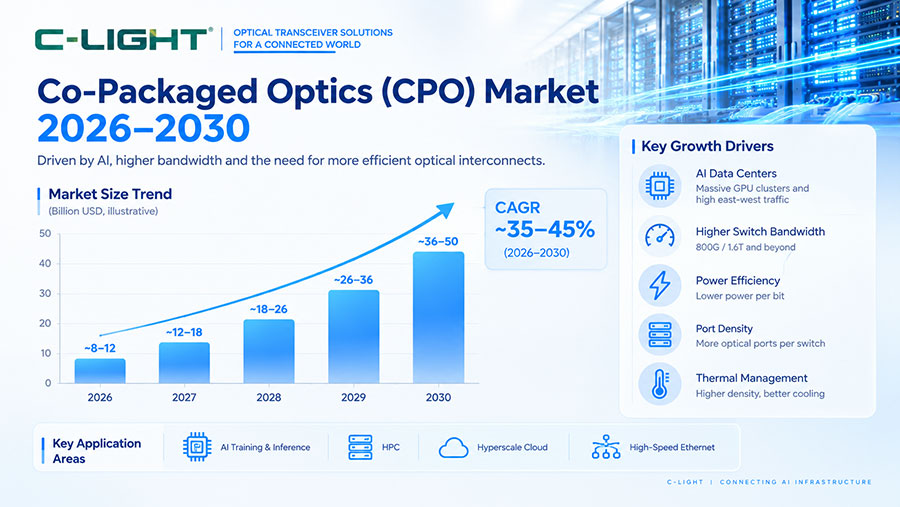
CPO, or Co-Packaged Optics, integrates optical engines much closer to the switching ASIC. This can substantially shorten the electrical path between the ASIC and optics.
| Architecture | Optical Location | Main Approach |
|---|---|---|
| Retimed Pluggable | Pluggable Module | DSP inside module |
| LPO | Pluggable Module | Linear electrical interface |
| CPO | Near / With ASIC | Short electrical path |
LPO can therefore be viewed as an intermediate architecture between conventional DSP-based pluggable optics and more deeply integrated optical architectures.
17. Main Advantages of 800G LPO
17.1 Lower Module Power
Removing the conventional DSP can reduce optical module power consumption and simplify the module electronics.
17.2 Lower Latency
The simplified signal path can reduce the processing delay associated with module-level signal regeneration.
17.3 Higher Power Efficiency
For high-density AI networks, reducing power per optical port can improve overall network energy efficiency.
17.4 High Port Density
Lower module power can help reduce the thermal pressure associated with densely populated 800G switch ports.
17.5 Suitable for AI Networking
High-bandwidth, low-latency optical links are important for GPU clusters, HPC systems, and large-scale data center networks.
18. Challenges of 800G LPO
LPO is not simply a lower-power version of a conventional optical transceiver. The simplified module architecture introduces new system-level requirements.
18.1 Electrical Channel Loss
The host-to-module electrical channel must maintain sufficient signal quality at extremely high data rates.
18.2 Host and Module Interoperability
LPO requires close coordination between the optical module, host ASIC, SerDes, PCB, connector, and system design.
18.3 Thermal Conditions
Although module power can be reduced, the host ASIC may carry additional signal-processing responsibility. Total system power must therefore be evaluated at the platform level.
18.4 Limited Application Flexibility
A DSP-based optical module can compensate for a wider range of electrical conditions. LPO depends more strongly on the characteristics of the host platform.
18.5 Link Qualification
High-speed LPO links require careful testing of insertion loss, equalization, jitter, BER, optical power, temperature, and interoperability.
19. How to Evaluate an 800G LPO Transceiver
When selecting or designing an 800G LPO optical transceiver, the module should be evaluated as part of the complete system.
Data rate and lane configuration
Optical transmission distance
Fiber type
Wavelength architecture
PAM4 performance
Host SerDes compatibility
Electrical channel loss
Optical power budget
Receiver sensitivity
BER performance
Module power consumption
Operating temperature
Thermal management
Form factor and connector
Host platform interoperability
Testing should cover both electrical and optical performance rather than evaluating only the optical output of the module.
20. Testing Requirements for 800G LPO
Testing an 800G LPO link normally requires several layers of validation.
20.1 Electrical Testing
Electrical testing evaluates the high-speed interface between the host and optical module, including insertion loss, return loss, eye quality, jitter, and channel characteristics.
20.2 Optical Testing
Optical testing evaluates transmitter output power, wavelength, extinction characteristics, receiver sensitivity, optical modulation quality, and optical power stability.
20.3 BER Testing
Bit error rate testing is used to determine whether the complete link can maintain the required transmission quality under defined operating conditions.
20.4 Temperature Testing
Temperature testing is important because laser performance, driver behavior, receiver characteristics, and electrical channel performance can change with temperature.
20.5 Interoperability Testing
Because LPO relies heavily on host SerDes performance, interoperability testing between the optical module and target switch or NIC platform is particularly important.
21. 800G LPO Applications
AI data center networks
GPU cluster interconnects
High-performance computing
800G Ethernet switches
Switch-to-switch connectivity
Switch-to-server connectivity
Data center spine-leaf networks
High-density data center fabrics
The strongest use cases are generally environments where very high bandwidth, low latency, and power efficiency are more important than universal interoperability across a wide range of host platforms.
22. 800G LPO and the Evolution Toward 1.6T
The development of 800G LPO is closely related to the industry's move toward 1.6T optical connectivity.
As data rates increase, the power consumed by DSPs, electrical interfaces, optical engines, and cooling systems becomes increasingly important. Technologies that reduce unnecessary processing and improve the efficiency of each transmitted bit can become increasingly valuable.
However, moving from 800G to 1.6T also increases the demands on SerDes, electrical channels, optical engines, packaging, thermal management, and manufacturing.
The same fundamental question remains:
LPO is one architecture being developed to address this challenge.
23. 800G LPO: Key Takeaways
800G LPO optical transceivers simplify the optical module by reducing or removing conventional DSP-based retiming and relying more heavily on the host ASIC and high-performance SerDes.
The architecture can provide potential benefits in module power, latency, and system density, making it particularly relevant to AI data centers and high-performance computing networks.
At the same time, LPO places greater requirements on electrical channel quality, host SerDes capability, signal integrity, interoperability, and system-level qualification.
For this reason, 800G LPO should not be evaluated only as an optical transceiver. It is a complete host-to-module-to-fiber architecture in which electrical design, optical design, thermal management, and system compatibility must work together.
24. Frequently Asked Questions
Q1. What does LPO mean in 800G optics?
Q2. Does 800G LPO use PAM4?
Q3. What is the main advantage of 800G LPO?
Q4. What is the difference between LPO and conventional 800G optics?
Q5. Is 800G LPO suitable for AI data centers?
Q6. What are the main challenges of 800G LPO?
Q7. Is LPO the same as CPO?
25. Summary
800G LPO optical transceivers provide a different approach to high-speed optical networking by reducing processing inside the pluggable module and leveraging the capabilities of the host ASIC and SerDes. The architecture can help address power, latency, and density challenges in AI and high-performance data center networks.
As 800G and 1.6T networks continue to develop, the balance between optical performance, electrical signal integrity, module power, thermal management, and host compatibility will remain critical to successful deployment.
 >
>

 >
>
 >
>
 >
>
 >
>
 >
>
 >
>
 >
>