TEL:+86 132 6656 7067




800G connectivity can be implemented with either high-speed Direct Attach Copper (DAC) cables or pluggable optical transceivers connected to fiber optic cabling. Both solutions can provide 800Gb/s connectivity, but they are designed for very different link environments.
800G DAC is optimized for short electrical connections and can provide very low power consumption, low latency, and a simple cable-based deployment. An 800G optical transceiver converts electrical signals to optical signals and uses fiber for transmission, making it suitable for substantially longer distances and more flexible network architectures.
1. What Is an 800G DAC?
An 800G DAC is a high-speed direct attach copper cable assembly designed to connect compatible 800G ports without separate optical transceivers and fiber patch cables.
Passive 800G DACs use copper conductors without active signal-processing components in the data path. Some active copper variants add electronic signal conditioning to extend the practical cable reach.
2. What Is an 800G Optical Transceiver?
An 800G optical transceiver is a pluggable optical module that converts electrical signals from network equipment into optical signals for transmission through fiber and converts received optical signals back into electrical signals.
800G optical transceivers are available in different optical architectures, including short-reach multimode solutions, parallel single-mode solutions, and wavelength-multiplexed solutions.
3. 800G DAC vs Optical Transceiver at a Glance
| Feature | 800G DAC | 800G Optical Transceiver |
|---|---|---|
| Transmission medium | Copper | Optical fiber |
| Optical conversion | No | Yes |
| Typical application | Very short links | Short, medium and longer reach links |
| Power consumption | Very low for passive DAC | Higher because of optical conversion |
| Latency | Very low cable contribution | Includes optical conversion and module processing |
| Cable length | Generally limited to short reach | Can extend from tens of meters to kilometers depending on optics |
| Cabling flexibility | Limited to fixed cable assembly | High because modules and fiber cables can be selected separately |
| Cost | Usually lower for very short links | Generally higher |
4. The Fundamental Difference
The fundamental difference is the transmission medium.
800G DAC sends high-speed electrical signals directly through copper. An 800G optical transceiver performs electrical-to-optical and optical-to-electrical conversion, with the signal traveling through optical fiber between the two endpoints.
This difference determines the practical reach, cabling characteristics, power requirements, and deployment flexibility of the two solutions.
5. 800G DAC Uses Copper
High-speed DAC uses twinaxial copper conductors designed to support high electrical signaling rates.
The copper path is electrically continuous between the two ends of the cable. For passive DAC, the absence of active components helps minimize both power consumption and cable latency.
6. 800G Optical Transceiver Uses Fiber
An optical transceiver uses optical fiber as the transmission medium and contains optical components such as lasers, photodetectors, drivers, receivers, and associated control electronics.
The exact optical architecture depends on the module type. Some 800G transceivers use parallel wavelengths and fibers, while others use WDM to combine several wavelengths into fewer fibers.
7. 800G DAC Reach
800G DAC is primarily intended for very short connections. Commercial 800G passive DAC implementations commonly target approximately 1 to 3 meters, although exact reach depends on the electrical interface, cable construction, and host platform.
For example, current 800G passive DAC solutions are available in multiple lengths including 0.5 m, 1 m, 1.5 m, 2 m, and 3 m for specific platforms.
8. 800G Optical Transceiver Reach
Optical transceiver reach varies greatly according to the optical architecture.
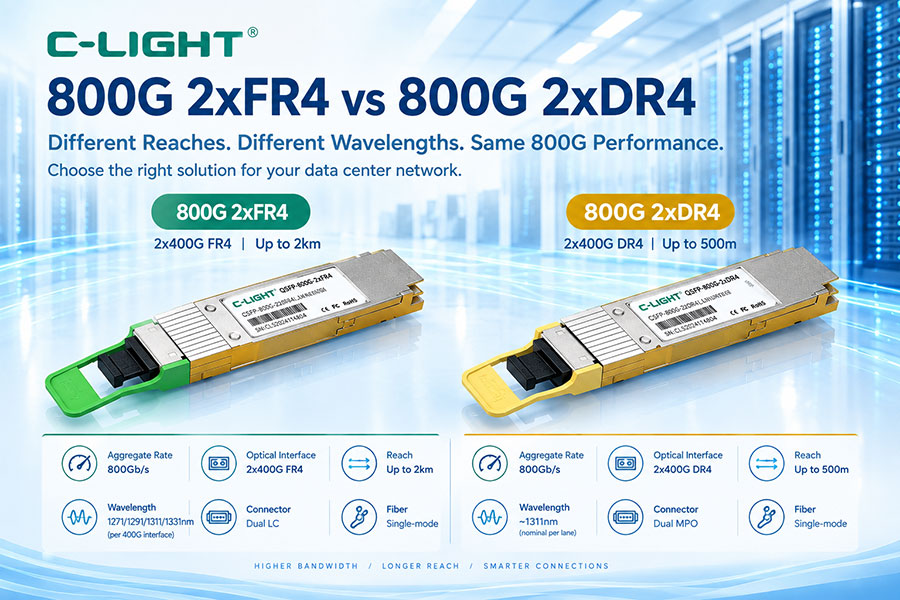
Examples of current 800G implementations include multimode links around 30 to 50 meters, parallel single-mode links around 500 meters, and 2x400G FR4 architectures reaching approximately 2 km.
Longer-reach 800G optical solutions can also be developed for applications beyond conventional data center interconnect distances.
9. DAC and Optical Reach Are Not Directly Equivalent
An 800G DAC and an 800G optical transceiver may have the same nominal data rate but completely different physical capabilities.
The 800G label identifies the supported electrical or network bandwidth, while the actual reach is determined by the transmission technology and product design.
10. 800G DAC Power Consumption
Passive DAC can operate with extremely low power consumption because the copper cable itself does not require active optical conversion.
This makes passive DAC attractive for high-density systems where hundreds or thousands of short connections can contribute significantly to the overall power budget.
11. 800G Optical Transceiver Power Consumption
An 800G optical transceiver requires electrical power for optical conversion and associated electronics.
Current commercial 800G optical transceivers can have module power consumption in the approximate 13 to 18 W range depending on optical architecture, operating mode, and implementation.
Actual power should always be evaluated from the specific module specification rather than from the 800G data rate alone.
12. Why Power Matters at 800G
As port speeds increase, the number of high-speed interfaces in a data center can grow rapidly. Even a small difference in power per connection becomes significant at scale.
This is one reason passive DAC remains attractive for short, predictable connections while optical transceivers are used when optical reach or cabling flexibility is required.
13. 800G DAC Latency
Passive DAC introduces very little latency because the signal does not need optical conversion inside the cable assembly.
The total system latency still includes the host device, switch pipeline, SerDes, buffering, and other components, but the cable itself contributes very little compared with architectures requiring optical conversion.
14. 800G Optical Transceiver Latency
An optical transceiver introduces additional latency associated with electrical-to-optical and optical-to-electrical conversion and the internal architecture of the module.
For many data center applications, this additional latency is small compared with overall system latency. However, latency can become important in high-performance AI and HPC networks where many links operate simultaneously.
15. 800G DAC Cost
Passive DAC is generally more economical than an 800G optical transceiver plus fiber cable for very short connections.
The reason is straightforward: DAC requires copper cable and connector assemblies but does not require a laser, photodetector, optical coupling system, or separate fiber cabling.
16. 800G Optical Transceiver Cost
An optical solution typically includes two pluggable transceivers plus fiber cabling.
This increases the initial component cost, but the additional cost provides significantly greater reach and cabling flexibility.
17. Total Cost of Deployment
The individual cable price should not be the only cost consideration.
A DAC can be economical for in-rack connections, while an optical transceiver solution may become more practical for longer connections where heavy copper cables would create routing, weight, or airflow problems.
18. 800G DAC Cable Density
High-speed copper cables become physically demanding as cable size and length increase.
When a large number of DACs are deployed around high-density switches, cable management can become an important engineering consideration.
19. 800G Optical Cable Density
Optical fiber is significantly lighter than equivalent high-speed copper cabling, making optical connectivity attractive for dense front-panel environments.
Smaller and lighter cables can simplify routing and help maintain access to equipment ports in high-density racks.
20. Airflow and Thermal Considerations
Cable construction can indirectly affect thermal management by occupying space around switches and servers.
Large copper cable bundles can make routing more difficult, while fiber-based connections generally allow more flexible cable management. The actual thermal impact depends on rack design, equipment airflow, cable construction, and installation density.
21. 800G DAC Connector Architecture
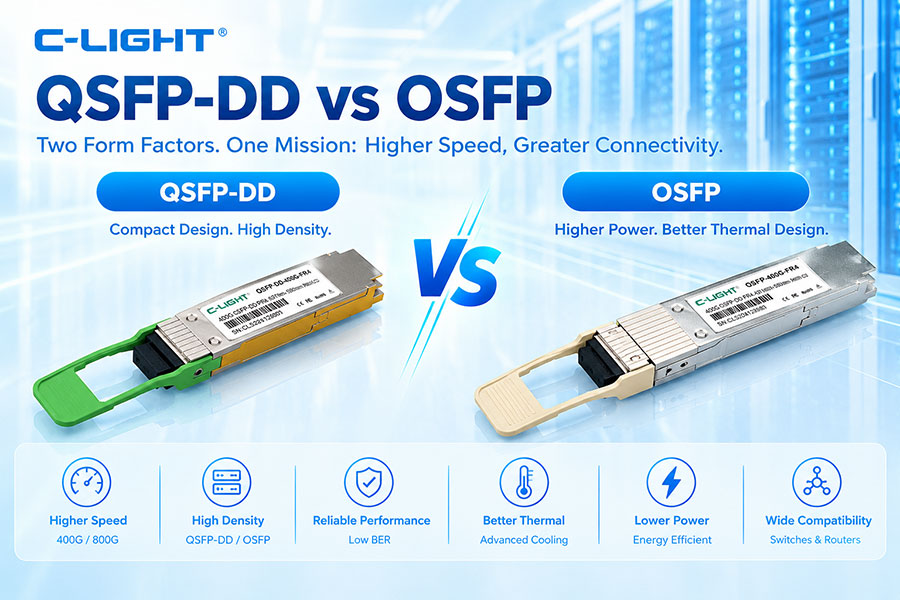
800G DAC products can use high-speed pluggable connector platforms such as OSFP, depending on the host equipment.
The connector contains the electrical lanes required to carry the 800G signal. The cable assembly is designed as a matched system for the target interface.
22. 800G Optical Transceiver Connector Architecture
800G optical transceivers can also use OSFP and other appropriate high-speed form factors.
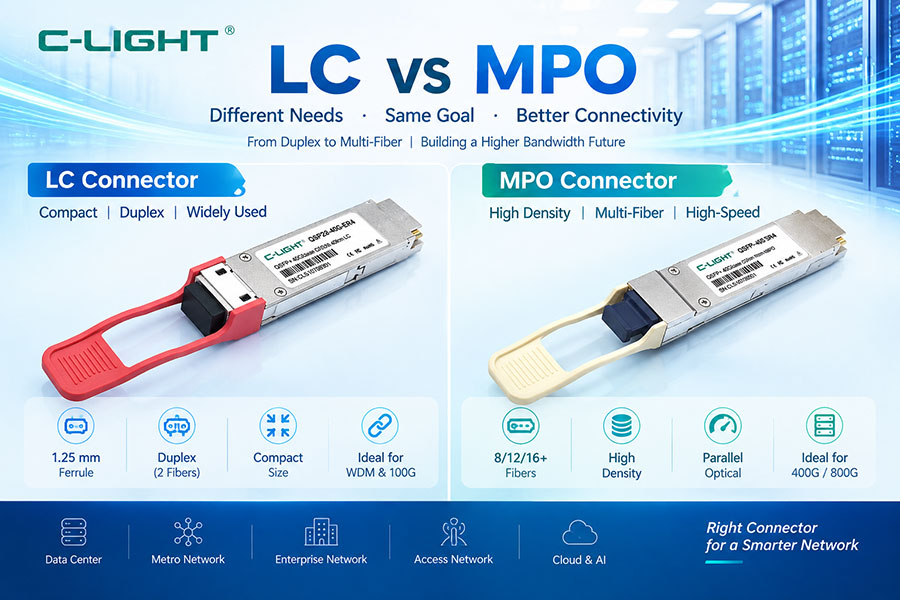
However, the connector at the equipment side and the optical connector on the network side are separate design considerations. Optical interfaces can include MPO-family connectors or duplex LC depending on the transceiver architecture.
23. 800G Parallel Optics
Some 800G optical transceivers use parallel optical lanes. In such architectures, multiple optical fibers carry individual high-speed lanes simultaneously.
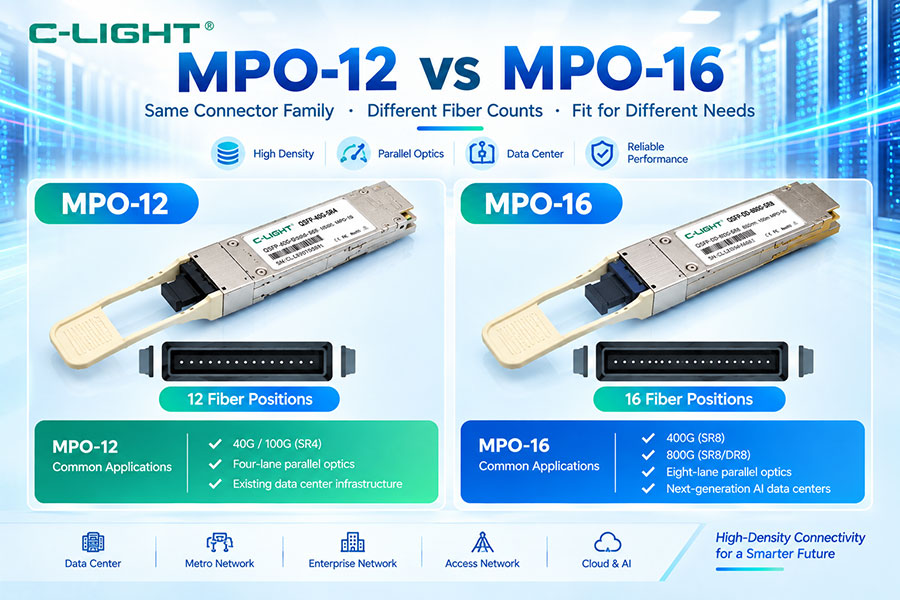
For example, 800G DR8-type architectures can use eight parallel optical lanes, while multimode implementations can use multiple parallel fibers for short-reach connectivity.
24. 800G WDM Optics
Other 800G optical architectures use wavelength division multiplexing to combine multiple wavelengths onto fewer fibers.
A 2x400G FR4 architecture, for example, can provide two 400G optical links through duplex LC interfaces, with multiple wavelengths transmitted over each fiber pair.
25. Why Optical Transceivers Offer More Reach
Optical fiber has much lower transmission loss over distance than high-speed copper in the relevant data center reach range.
Optical transmission also avoids the same electrical attenuation and electromagnetic coupling constraints that become increasingly important as copper links become longer and signaling speeds increase.
26. 800G DAC for In-Rack Connectivity
DAC is especially suitable when the connected equipment is installed close together.
Typical examples include switch-to-server, switch-to-NIC, switch-to-DPU, and switch-to-switch connections within the same rack or adjacent equipment positions.
27. 800G Optical Transceiver for Rack-to-Rack Links
Optical transceivers become more attractive when the connection extends beyond the practical range of a copper DAC.
Fiber cabling can support rack-to-rack connections while keeping cable weight and physical dimensions manageable.
28. 800G DAC for AI Clusters
AI clusters can contain large numbers of high-speed network connections between GPUs, NICs, DPUs, and switches.
For extremely short links, passive 800G DAC can reduce power consumption and cabling cost while providing the required bandwidth.
29. 800G Optical Transceivers for AI Clusters
Optical transceivers are useful when AI network connections need greater reach, higher cabling flexibility, or connectivity between racks and larger network fabrics.
The choice becomes particularly important as cluster scale increases and the physical distance between network endpoints becomes more variable.
30. 800G DAC Breakout Applications
800G DAC can also be configured as breakout cables.
A common architecture uses one 800G host connection and splits it into two 400G connections. Other lane architectures can support different breakout configurations when the host platform and cable are designed for them.
31. 800G Optical Transceiver Breakout
Optical transceivers can also support breakout networking.
For example, an 800G optical module may support 2x400G or other breakout modes depending on the electrical interface, optical architecture, and module firmware.
Breakout capability should always be checked against the exact switch, transceiver, and cable combination.
32. DAC Is a Fixed Cable Assembly
A DAC combines the cable and connector assemblies into one product.
This makes installation simple but also means that the entire cable assembly normally needs to be replaced if the cable fails or if a different cable length is required.
33. Optical Transceivers Provide Modular Connectivity
An optical transceiver separates the optical module from the fiber cable.
The transceiver can be replaced independently of the fiber infrastructure, and different fiber cable types or lengths can be selected according to the network layout.
34. Network Upgrade Flexibility
Optical transceiver architectures generally provide greater flexibility for network upgrades because the optical module and fiber cable are independent components.
DAC is more dependent on the original cable length and connector configuration, so changing the network design may require a different DAC assembly.
35. Host Compatibility
Both 800G DAC and 800G optical transceiver solutions require host-device compatibility.
Important parameters include connector form factor, lane rate, electrical interface, management interface, firmware behavior, cable or module identification, and vendor interoperability.
36. Optical Transceiver Compatibility
Optical transceiver compatibility also includes optical parameters such as wavelength, fiber type, connector type, transmit power, receive sensitivity, and supported optical reach.
A physically compatible module is not necessarily operationally compatible with every 800G switch or NIC.
37. 800G DAC vs Optical Transceiver for Troubleshooting
DAC troubleshooting usually focuses on electrical connectivity, cable integrity, host recognition, connector condition, and signal integrity.
Optical transceiver troubleshooting involves additional parameters such as Tx power, Rx power, wavelength, fiber polarity, connector cleanliness, optical loss, and module diagnostics.
38. 800G DAC vs Optical Transceiver Maintenance
DAC is relatively simple to deploy because it is a complete cable assembly. However, its fixed construction provides less flexibility when the physical network changes.
Optical transceivers require greater attention to module and fiber maintenance, but separate modules and cables make component replacement and network reconfiguration more flexible.
39. When to Choose 800G DAC
800G DAC is generally suitable when:
The link is very short, power consumption is important, low cable latency is preferred, cost needs to be controlled, and the endpoints have compatible 800G electrical interfaces.
It is particularly practical for predictable in-rack or very short switch-to-device connections.
40. When to Choose an 800G Optical Transceiver
An 800G optical transceiver is generally suitable when:
The link requires longer reach, lower cable weight, greater cabling flexibility, optical isolation, or different optical architectures such as parallel optics or WDM.
It is especially useful for rack-to-rack and larger-scale data center network connections.
41. 800G DAC vs Optical Transceiver: Key Selection Factors
| Selection Factor | 800G DAC | 800G Optical Transceiver |
|---|---|---|
| Short in-rack link | Highly suitable | Suitable |
| Longer data center link | Limited | Suitable |
| Lowest power | Strong advantage for passive DAC | Higher power requirement |
| Lowest cable cost | Usually advantageous at short distances | Higher initial cost |
| Maximum flexibility | Lower | Higher |
| Fiber infrastructure | Not required | Required |
| Cable weight | Higher | Lower |
| EMI along transmission path | Electrical transmission considerations | Optical fiber transmission |
| Component replacement | Complete assembly | Module and fiber can be replaced separately |
42. 800G DAC vs Optical Transceiver for Data Center Design
The two solutions are not necessarily competing across the entire data center.
A practical network can use 800G DAC for very short connections and 800G optical transceivers for longer links. Using each technology where its physical characteristics are most appropriate can create a more efficient overall architecture.
43. 800G DAC vs Optical Transceiver Summary
| Category | 800G DAC | 800G Optical Transceiver |
|---|---|---|
| Core technology | High-speed copper | Optical transmission |
| Optical conversion | No | Yes |
| Typical reach | Approximately 1–3 m for many passive implementations | Approximately tens of meters to kilometers depending on architecture |
| Power | Very low for passive designs | Typically several to more than ten watts depending on module |
| Latency | Very low cable contribution | Includes optical conversion contribution |
| Cost | Lower for short links | Higher but provides greater reach |
| Weight | Higher | Lower |
| Flexibility | Limited by fixed cable assembly | High through separate optics and fiber |
| Best fit | Short high-density connections | Longer and more flexible optical connectivity |
44. Conclusion
800G DAC and 800G optical transceivers provide the same headline bandwidth but address different network requirements. 800G DAC uses direct copper transmission and is particularly attractive for very short links where low power, low latency, simple installation, and cost efficiency are important. 800G optical transceivers use optical fiber and provide substantially greater reach, lighter cabling, and greater flexibility in network architecture.
For high-density AI and data center networks, the best choice depends on the actual link distance, host interface, cabling density, power budget, thermal environment, breakout architecture, and future expansion requirements. In many deployments, DAC and optical transceivers are complementary technologies rather than alternatives that must be used exclusively.
 >
>

 >
>
 >
>
 >
>
 >
>
 >
>
 >
>
 >
>