TEL:+86 132 6656 7067




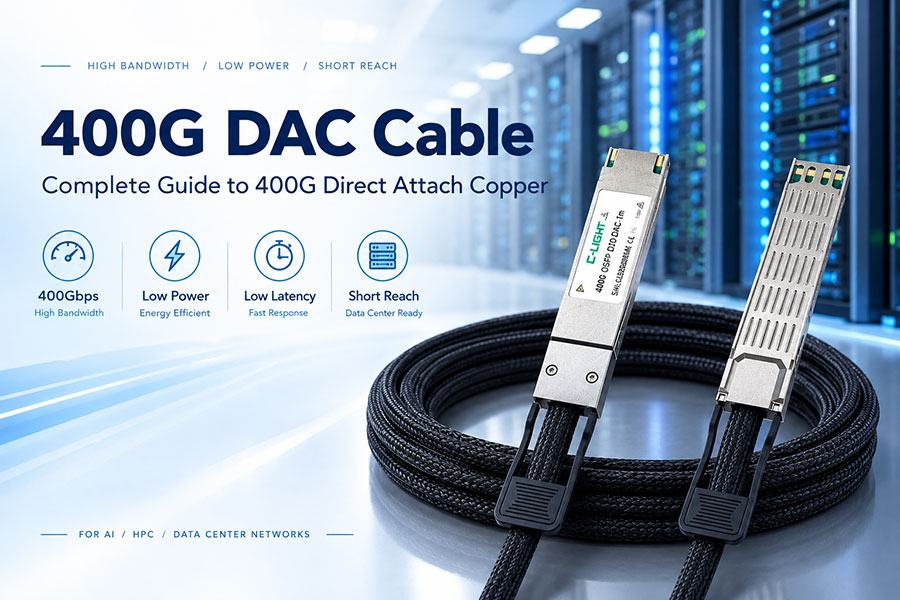
800G DAC cables provide high-speed, short-reach connectivity between GPU servers and network switches in AI data centers. With increasing GPU cluster density and higher network bandwidth requirements, 800G Direct Attach Copper (DAC) technology offers a practical interconnect option for short-distance connections where low latency, power efficiency, and cost are important.
1. What Is an 800G DAC Cable?
An 800G DAC cable is a high-speed copper interconnect designed to provide an 800Gbps connection between compatible network equipment. The cable integrates high-speed connectors and copper conductors into a single assembly, eliminating separate optical transceivers and fiber patch cables.
In AI data centers, 800G DAC cables can be used for short connections between GPU servers, network adapters, leaf switches, and other high-bandwidth equipment.
2. Why 800G DAC Is Used in AI Networks
AI clusters generate large amounts of east-west traffic between GPUs and switches. The physical interconnect must provide sufficient bandwidth without introducing unnecessary power, latency, or cost.
For short-reach links, DAC can provide a straightforward connection because the cable combines the electrical interface and transmission medium into one assembly.
800Gbps aggregate bandwidth
Low latency
Low power consumption
Direct switch-to-device connectivity
Simple installation
Reduced cabling complexity
Cost-efficient short-reach connectivity
3. GPU-to-Switch Connectivity
GPU-to-switch communication is a fundamental part of AI cluster networking. GPU servers exchange training data, gradients, parameters, and other information through high-speed network interfaces.
An 800G DAC cable can connect a high-speed network interface on a GPU server to an 800G-capable switch port when the required electrical interface and distance are supported.
| Connection | Typical Role | Interconnect |
|---|---|---|
| GPU Server → Leaf Switch | Server network access | DAC, AOC or optical transceiver |
| Leaf → Spine | High-capacity fabric | 800G optical or electrical interconnect |
| Switch → Switch | East-west traffic | DAC, AOC or optical connectivity |
| Server → Server | Direct cluster connectivity | DAC or other short-reach technology |
4. 800G DAC Lane Architecture
800G interfaces commonly use multiple high-speed electrical lanes. A widely used architecture is eight 100G-class lanes, although the exact electrical implementation depends on the host platform and interface specification.
Each lane carries a portion of the aggregate data rate, while the complete cable provides the required 800G connection between compatible endpoints.
At these speeds, electrical channel quality becomes critical. Connector performance, cable construction, insertion loss, return loss, crosstalk, and signal integrity all influence link performance.
5. PAM4 Signaling in 800G DAC
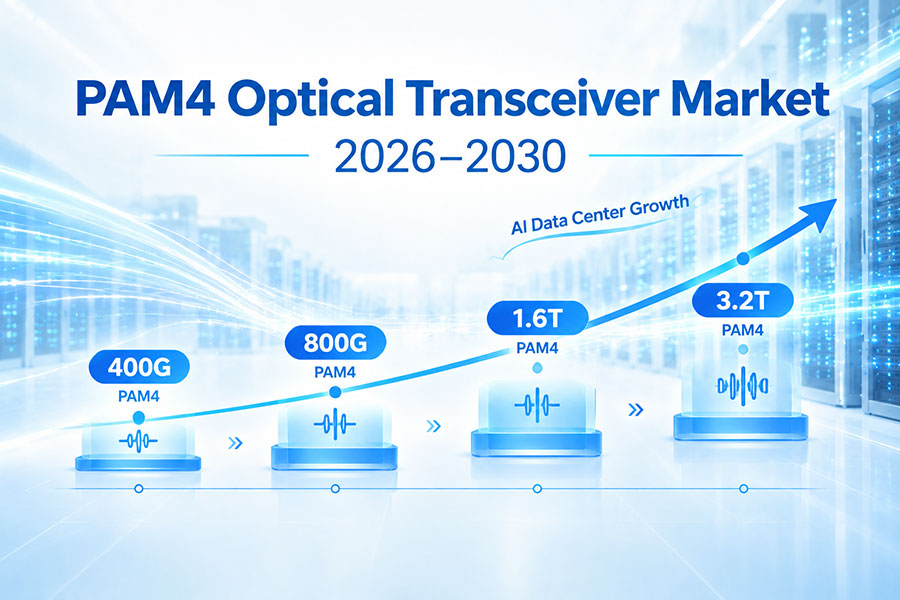
Modern 800G interfaces commonly use PAM4 signaling. PAM4 uses four voltage levels and carries two bits per symbol, allowing higher data rates within practical electrical bandwidth limits.
The smaller eye opening of PAM4 makes the signal more sensitive to noise, distortion, insertion loss, and crosstalk than traditional NRZ signaling.
For an 800G DAC connection, the cable and connectors therefore form an important part of the complete high-speed electrical channel.
6. 800G DAC vs AOC
| Feature | 800G DAC | 800G AOC |
|---|---|---|
| Transmission Medium | Copper | Optical Fiber |
| Typical Reach | Very short reach | Longer short-reach connections |
| Power | Generally low | Higher due to optical conversion |
| Latency | Very low | Low |
| Cost | Generally lower for short links | Generally higher |
| Cable Weight | Higher | Lower |
DAC is generally considered for very short connections, while AOC provides greater reach and lower cable weight when optical transmission is more suitable.
7. 800G DAC vs Optical Transceivers
DAC and optical transceivers serve different network requirements. A DAC integrates the connectors and copper cable into one assembly, while optical transceivers provide a modular optical interface that can be connected through fiber cabling.
| Feature | 800G DAC | 800G Optical Transceiver |
|---|---|---|
| Reach | Short | Short to longer reach depending on type |
| Installation | Simple cable assembly | Module plus fiber connection |
| Power | Low for short links | Depends on optical architecture |
| Flexibility | Limited by cable length | Higher |
| Typical Use | Short server and switch connections | Data-center fabric and longer links |
8. 800G DAC Cable Construction
An 800G DAC cable consists of high-speed copper conductors, shielding, connectors, and mechanical components designed to maintain signal integrity at high data rates.
The main components include:
High-speed copper conductors
High-frequency shielding
High-speed connector assemblies
Signal-conditioning components where applicable
Mechanical strain relief
Thermal and mechanical protection
Connector design and cable construction are particularly important because electrical loss increases rapidly as signaling rates increase.
9. Passive DAC and Active DAC
DAC cables can be categorized broadly as passive or active depending on the electrical architecture.
9.1 Passive DAC
Passive DAC cables do not use active signal-conditioning electronics in the cable assembly. They are generally suited to shorter distances where the host equipment can maintain sufficient signal quality across the complete channel.
9.2 Active DAC
Active DAC cables incorporate electronics that can improve the usable electrical reach or compensate for channel impairments. They can provide additional flexibility compared with passive copper cables but may consume more power.
10. Reach Considerations
The practical reach of an 800G DAC depends on cable construction, conductor characteristics, connector design, host SerDes capability, and the complete electrical channel.
DAC should generally be considered for short-reach applications rather than long-distance connections. When the required distance exceeds the electrical reach of the cable, AOC or optical transceivers become more appropriate alternatives.
11. Signal Integrity Requirements
Signal integrity is one of the most important considerations for 800G DAC deployment.
Insertion loss
Return loss
Inter-symbol interference
Near-end crosstalk
Far-end crosstalk
Connector discontinuity
Electromagnetic interference
Equalization capability
The cable cannot be evaluated independently from the host system. The switch SerDes, PCB traces, connectors, cable, and receiver together determine the final electrical performance.
12. Power Consumption of 800G DAC
Power efficiency is one reason DAC remains attractive for short-reach AI networking. Because DAC does not require optical-to-electrical and electrical-to-optical conversion, it can avoid some of the power consumption associated with optical modules.
However, power consumption varies according to whether the cable is passive or active and according to the host interface and implementation.
For large AI clusters, the difference between electrical and optical interconnect power can become significant when multiplied across a large number of ports.
13. Latency of 800G DAC
DAC provides a direct electrical path between compatible endpoints. Its short physical distance and lack of optical conversion can support very low latency.
In AI clusters, lower communication latency can be beneficial for synchronization-intensive workloads. However, overall application latency also depends on NIC processing, switch processing, network topology, congestion, software, and other system factors.
14. 800G DAC in AI GPU Clusters
AI training workloads frequently require communication among large numbers of GPUs. The network fabric must provide high aggregate bandwidth while maintaining predictable latency and congestion performance.
800G DAC can be used for short physical connections within the cluster, especially where the switch and GPU server are located close enough to meet the electrical channel requirements.
Typical applications include:
GPU server to switch
NIC to switch
Switch to switch
Leaf switch connections
Short rack-level interconnects
15. 800G DAC and AI Network Topology
Modern AI clusters commonly use leaf-spine or multi-stage Clos architectures. Short-reach electrical interconnects can be used at selected network layers, while optical links provide connectivity where longer reach or higher cabling flexibility is required.
This hybrid approach allows network designers to select DAC, AEC, AOC, or optical transceivers according to actual distance and system requirements.
16. 800G DAC vs AEC
Active Electrical Cables (AEC) extend the capabilities of copper connectivity by incorporating active signal-conditioning technology.
| Feature | DAC | AEC |
|---|---|---|
| Signal Conditioning | Passive or limited | Active |
| Reach | Very short | Extended short reach |
| Power | Very low for passive DAC | Higher |
| Complexity | Low | Higher |
| AI Application | Short server and switch links | Longer electrical cluster links |
17. Connector and Form Factor Compatibility
Before deploying an 800G DAC, the connector and form factor must match both endpoints.
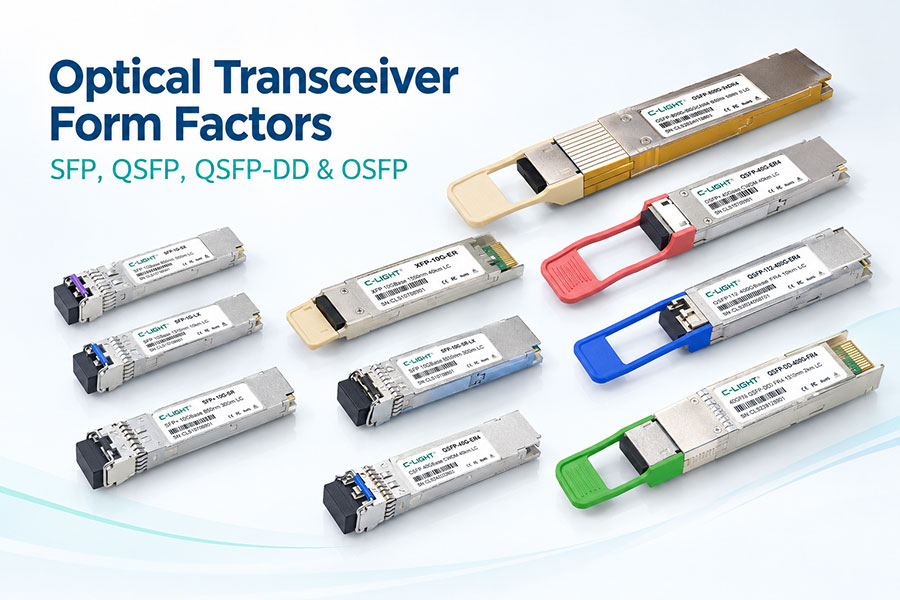
High-speed AI switches can use form factors such as OSFP or QSFP112 depending on the platform. The corresponding cable assembly must support the required mechanical interface, electrical lane configuration, management requirements, and data rate.
Compatibility should always be verified against the specific switch and network interface before deployment.
18. Testing an 800G DAC Cable
Testing should verify both electrical performance and interoperability with the intended host platform.
Insertion loss
Return loss
Crosstalk
Eye opening
BER
PAM4 signal quality
Temperature performance
Power consumption
Host interoperability
System-level testing is particularly important because an 800G cable may perform differently depending on the SerDes, PCB, connector, and switch platform used with it.
19. Troubleshooting 800G DAC Links
When an 800G DAC link fails to establish or shows poor performance, troubleshooting should begin with the physical connection and progress through the host electrical channel.
Check connector seating and cable installation.
Verify switch and NIC compatibility.
Confirm the configured link speed.
Check host port and lane configuration.
Review switch and NIC error counters.
Check BER and FEC statistics.
Inspect temperature and power conditions.
Evaluate electrical channel loss if required.
20. Cable Management in High-Density AI Racks
AI racks can contain a large number of high-speed cables. Copper DAC cables are generally thicker and heavier than optical cables, making cable routing important in high-density installations.
Proper cable management should maintain adequate bend radius, prevent excessive mechanical stress, avoid blocking airflow, and allow technicians to access equipment for maintenance.
21. When Should You Choose 800G DAC?
800G DAC is appropriate when the connection is short enough to satisfy the electrical channel requirements and when low power, low latency, simple installation, and cost efficiency are important.
It becomes less suitable as distance increases or when cable density, weight, routing flexibility, or electrical loss becomes a major limitation.
22. 800G DAC Deployment Checklist
Confirm 800G port compatibility.
Verify connector and form factor.
Determine required cable length.
Check passive or active architecture.
Verify host SerDes compatibility.
Evaluate insertion loss and signal integrity.
Check power and thermal requirements.
Validate BER and FEC performance.
Test interoperability with the target platform.
Plan cable routing and airflow.
23. Future of DAC in AI Networks
DAC will continue to serve short-reach connections as AI networks move toward higher bandwidth. However, increasing electrical signaling rates will place greater demands on cable materials, connectors, equalization, and host SerDes.
At the same time, AEC and AOC will provide alternatives for connections where passive copper cannot meet the required reach or signal-integrity requirements.
The future AI network is therefore likely to use multiple interconnect technologies rather than relying on a single physical medium.
24. Conclusion
800G DAC cables provide a practical solution for short-reach GPU-to-switch and switch-to-switch connections in AI data centers. Their low latency, low power consumption, simple deployment, and cost advantages make them useful for selected high-density AI network links.
However, 800G DAC performance depends strongly on transmission distance, host SerDes capability, cable construction, connector quality, and overall signal integrity. As AI networking advances toward 1.6T and beyond, the balance between DAC, AEC, AOC, and optical transceivers will increasingly depend on distance, bandwidth, power, density, and system architecture.
 >
>

 >
>
 >
>
 >
>
 >
>
 >
>
 >
>
 >
>