TEL:+86 132 6656 7067




Optical transceivers are available with different transmission distances to match the requirements of data centers, enterprise networks, telecom systems and high-speed interconnects. Among short- and medium-reach options, 500m and 2km optical transceivers are often considered for links that extend beyond very short rack-level connections.
The main difference between a 500m and 2km optical transceiver is the supported transmission distance. However, reach also affects fiber selection, optical budget, transmitter and receiver design, power consumption, cost and application scenarios. Understanding these differences helps network designers choose a module that provides enough margin without unnecessarily increasing system cost or complexity.
1. 500m vs 2km Optical Transceiver at a Glance
| Feature | 500m Optical Transceiver | 2km Optical Transceiver |
|---|---|---|
| Maximum Reach | Up to about 500m | Up to about 2km |
| Typical Positioning | Short-reach interconnect | Medium-reach interconnect |
| Fiber | Usually optimized for short-reach fiber links | Often designed for single-mode fiber |
| Optical Budget | Lower | Higher |
| Laser Technology | Depends on speed and module design | Depends on speed and module design |
| Power Consumption | Often lower | Often higher |
| Cost | Generally lower for comparable architectures | Generally higher |
| Typical Applications | Data center and campus short-reach links | Data center, campus and other longer optical links |
2. What Does 500m Reach Mean?
A 500m optical transceiver is designed to support optical links with a maximum distance of approximately 500 meters under specified operating conditions. The actual supported distance depends on the transceiver specification, fiber type, optical loss and installation environment.
A 500m module is often used when a 100m or similarly short-reach solution is not sufficient, but several kilometers of reach are unnecessary.
3. What Does 2km Reach Mean?
A 2km optical transceiver is designed for links extending up to approximately 2 kilometers. The additional reach requires sufficient optical power and receiver sensitivity to compensate for fiber attenuation, connector losses and other system losses.
Modules in this range are commonly considered when connections extend between racks, rows, rooms, buildings or other network locations where short-reach optics cannot provide enough distance.
4. Reach Is the Main Difference
The most obvious difference is the transmission distance. A 500m module is intended for links up to around 500 meters, while a 2km module provides substantially more reach.
The important point is that a longer-rated transceiver is not simply a 500m module with a longer specification. The optical components and link budget are designed around different transmission requirements.
5. Optical Power Budget
Optical power budget is one of the key parameters distinguishing the two solutions. It represents the amount of optical loss that the link can tolerate while maintaining the required receiver performance.
For a simplified system:
Maximum Allowable Loss = Transmitter Output Power − Receiver Sensitivity
A 2km transceiver generally needs a larger optical budget than a 500m transceiver because the longer link introduces more fiber and connection losses.
6. Fiber Attenuation Matters
Fiber attenuation increases with transmission distance. Even when the same optical fiber type is used, a 2km link experiences substantially more fiber loss than a 500m link.
The total system loss can be represented as:
Total System Loss = Fiber Loss + Connector Loss + Passive Device Loss + Other Link Losses
This is why reach specifications should always be evaluated together with the optical budget rather than by distance alone.
7. Fiber Type Differences
The appropriate fiber type depends on the specific transceiver rather than simply on the 500m or 2km distance. Shorter links can use solutions optimized for multimode or single-mode fiber, while 2km applications are commonly associated with single-mode fiber at many data rates.
Network engineers should check the module datasheet before selecting the fiber because wavelength, connector type and supported fiber category must match the transceiver.
8. Wavelength Selection
500m and 2km transceivers may use different wavelengths depending on the optical architecture and transmission speed. Common wavelength windows include 850nm, 1310nm and 1550nm, but there is no single wavelength that defines either reach category.
For longer links, 1310nm operation is frequently used because of the relatively low attenuation of single-mode fiber in that wavelength region.
9. Laser Technology
The transmitter technology depends on the optical module design and data rate. VCSEL-based solutions are commonly associated with short-reach multimode applications, while longer single-mode solutions can use technologies such as DML or EML.
However, reach should not be determined only from the laser type. The complete optical architecture, including transmitter power, receiver sensitivity, wavelength and fiber characteristics, determines the actual link capability.
10. Power Consumption
Power consumption varies by data rate, optical architecture, DSP requirements and module generation. In comparable designs, a longer-reach transceiver can require more optical power or more complex components than a short-reach module.
For large data centers containing thousands of optical modules, even small differences in power consumption can become significant at the system level.
11. Cost Difference
A 500m transceiver is often less expensive than a comparable 2km module because shorter transmission distances may require less optical budget and less complex optical components.
The actual price difference depends on speed, form factor, laser technology, DSP architecture, connector configuration and production volume.
12. 500m Optical Transceiver Applications
500m optics can be used for short- and medium-range connections where standard short-reach modules do not provide enough distance.
Typical scenarios include data center row-to-row links, equipment-room connections, campus networks and other optical connections where the physical distance is below approximately 500 meters.
13. 2km Optical Transceiver Applications
2km optics are suitable for longer connections that exceed the practical reach of many short-reach solutions.
Typical applications include connections between different data center areas, longer campus links, building-to-building interconnects and high-speed network connections requiring additional optical reach.
14. 500m vs 2km in Data Centers
Modern data centers can contain large numbers of racks distributed across substantial floor areas. A 500m transceiver may be sufficient for many internal connections, while 2km optics provide additional flexibility for longer cross-room or cross-building links.
The correct choice depends on the actual cable route, not simply the physical distance between two network devices. Fiber routing, patch panels and intermediate connection points can increase the total optical path.
15. 400G Examples
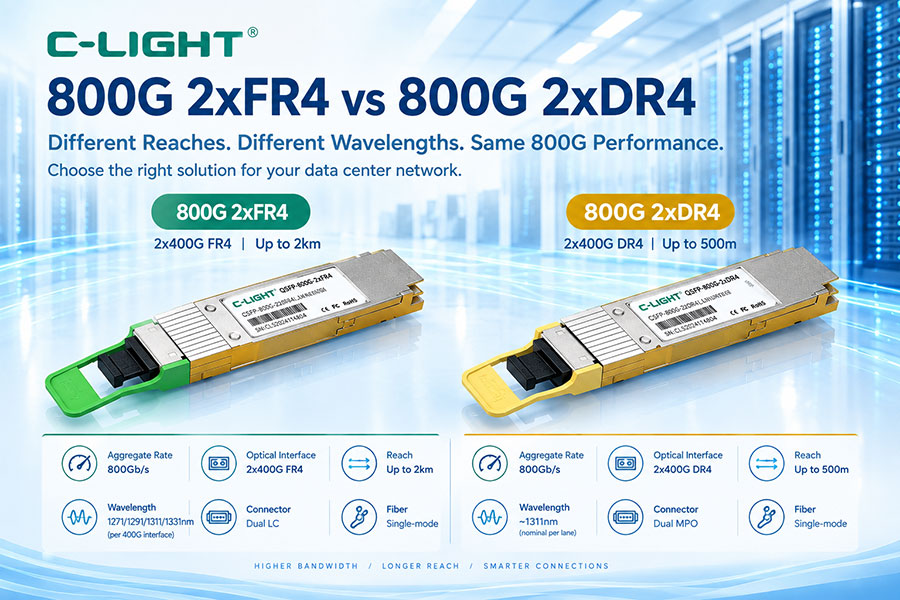
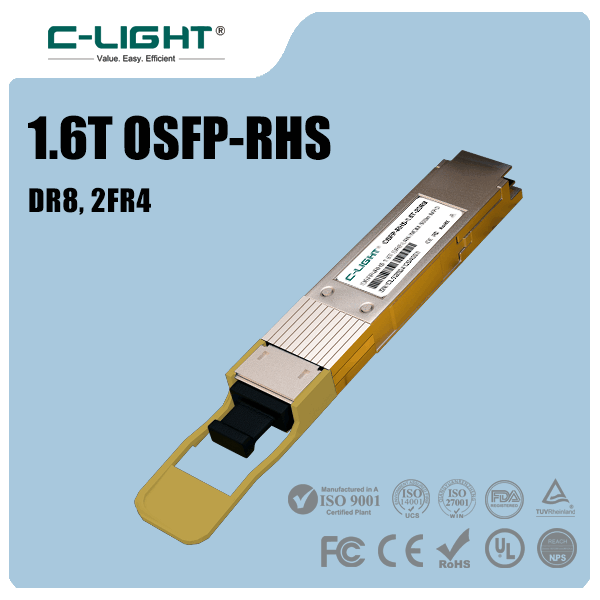
At 400G, different optical architectures illustrate why reach is closely related to module design. For example, 400G DR4 is commonly associated with short single-mode links up to around 500m, while 400G FR4 is designed for links extending to around 2km.
These modules can use the same general high-speed networking environment while targeting different reach requirements, making them a useful example of the distinction between 500m and 2km optical solutions.
16. 800G and Higher-Speed Networks
The same design principle applies as network speeds increase to 800G and beyond. Optical modules with different reach targets use different optical architectures, lane configurations and component specifications.
For example, 800G solutions designed around a 2km reach require sufficient optical performance across all lanes and must maintain the required receiver margin at the target distance.
17. Connector and Passive Losses
Link distance is not the only source of optical loss. Each connector, adapter, patch panel and passive optical device can contribute additional loss.
For a 500m link operating close to the maximum rated distance, excessive connector loss can reduce the available margin. The same principle becomes even more important for a 2km link because the fiber itself already consumes a larger portion of the optical budget.
18. Link Margin Should Not Be Ignored
Designing a link exactly at the maximum theoretical reach can leave little room for aging, connector contamination, splicing loss, additional patching or installation variation.
A practical design should maintain a reasonable optical margin rather than simply matching the nominal distance specification.
19. Can a 2km Transceiver Be Used for a 500m Link?
In many cases, a 2km-rated transceiver can operate on a shorter link, provided that the optical interface, fiber type, wavelength, connector configuration and equipment compatibility are correct.
However, using a longer-reach module for a short connection can increase cost and may provide no meaningful networking benefit. The transceiver should therefore be selected according to the actual link requirements.
20. Can a 500m Transceiver Be Used for a 2km Link?
A 500m transceiver should not be assumed to support a 2km link. The module may not provide enough optical power or receiver sensitivity to overcome the total link loss.
Even if the optical signal appears to function under certain conditions, operating beyond the specified reach does not provide a reliable design margin.
21. How to Choose Between 500m and 2km
| Network Requirement | Recommended Direction |
|---|---|
| Link is clearly below 500m | 500m-class optics may be sufficient |
| Link is close to or above 500m | Consider a longer-reach solution |
| Link approaches 2km | 2km-class optics are generally more appropriate |
| Very tight optical budget | Evaluate the module's full link budget |
| Large number of links and power-sensitive environment | Compare power consumption as well as reach |
| Future network expansion expected | Consider required margin and future cable routes |
22. Key Factors Beyond Distance
Choosing between 500m and 2km optics should not be based on distance alone. Data rate, form factor, fiber type, wavelength, optical budget, transmitter technology, receiver sensitivity, power consumption, connector configuration and network equipment compatibility all affect the final selection.
For high-speed deployments, compatibility testing is particularly important because two modules with similar reach ratings may still differ in interoperability, power requirements or host-system support.
23. 500m vs 2km Optical Transceiver: Summary
500m and 2km optical transceivers serve different reach requirements. A 500m solution is intended for shorter optical connections where a moderate reach is sufficient, while a 2km solution provides additional optical budget and is designed for longer links.
The longer reach of a 2km transceiver generally comes with differences in optical architecture, fiber requirements, power and cost. The best module for a network is therefore the one that provides the required reach and optical margin without adding unnecessary complexity or expense.
 >
>

 >
>
 >
>
 >
>
 >
>
 >
>
 >
>
 >
>