TEL:+86 132 6656 7067




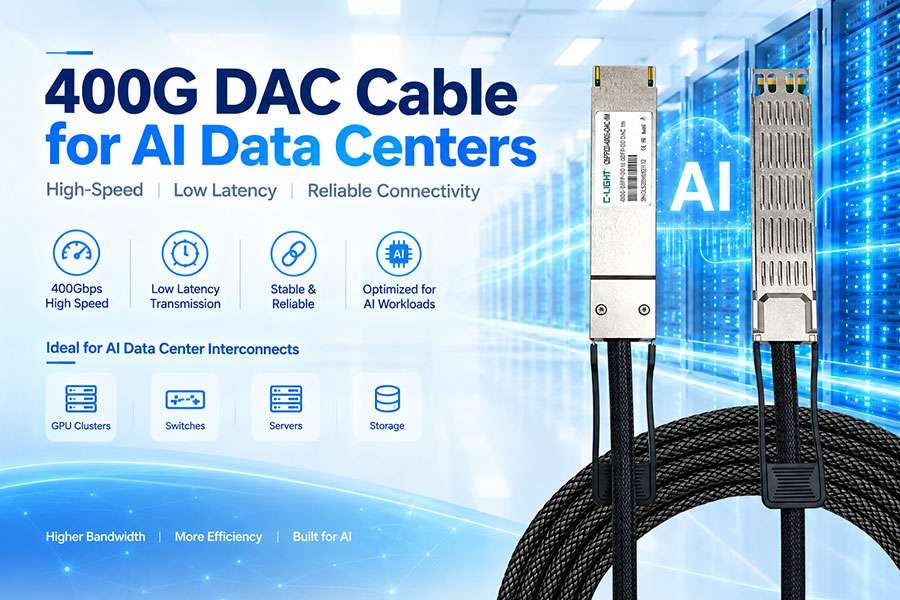
400G DAC cables provide short-reach, high-bandwidth connectivity for AI data centers, GPU clusters, high-performance computing, and modern Ethernet or InfiniBand networks. By using direct copper connections, 400G DAC can deliver low-latency and low-power connectivity for dense intra-rack architectures.
1. What Is a 400G DAC Cable?
A 400G DAC (Direct Attach Copper) cable is a high-speed copper interconnect with transceiver-style connectors permanently attached to both ends. It provides direct 400Gbps connectivity between compatible switches, servers, network adapters, GPUs, and other data center equipment.
Unlike optical transceivers, a DAC does not convert the signal into optical transmission. The electrical signal remains in the copper channel from one port to the other.
2. Why 400G DAC Is Important for AI Data Centers
AI data centers require large numbers of high-speed connections between GPU servers, network switches, compute nodes, and accelerator fabrics. The physical distance between many of these devices is short, especially inside the same rack.
400G DAC is well suited to these environments because it combines high bandwidth with short reach, low power consumption, low latency, and relatively simple deployment.
3. 400G DAC in AI GPU Clusters
GPU clusters depend on high-speed interconnects to exchange model parameters, training data, gradients, and other distributed computing traffic. Network topology therefore has a direct impact on cluster efficiency.
For short GPU-to-switch or server-to-switch links, 400G DAC can provide the required bandwidth without introducing optical conversion components into every connection.
4. Typical 400G DAC Transmission Distance
400G DAC is primarily designed for short-reach connectivity. Typical commercial products are commonly offered from about 0.5m to 3m, with the actual maximum depending on interface type, cable construction, lane speed, gauge, and signal-integrity requirements.
Selected C-LIGHT QSFP112 and OSFP112 400G DAC configurations are specified from 0.5m to 2m, while selected OSFP56 and QSFP-DD configurations extend to 3m.
5. Why 400G DAC Has Limited Reach
400Gbps electrical transmission places strict requirements on signal integrity. As the copper channel becomes longer, insertion loss, attenuation, crosstalk, reflections, and high-frequency signal distortion increase.
These effects reduce the available link margin and make it harder for the receiver to recover a clean signal. This is the main reason 400G DAC is optimized for short distances.
6. 400G DAC and PAM4 Signaling
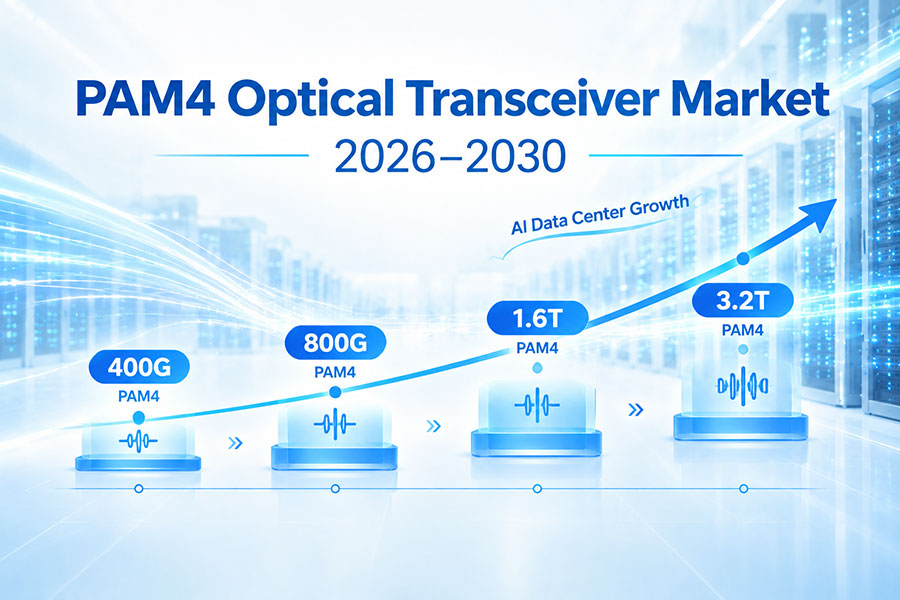
Many 400G interfaces use PAM4 signaling with four voltage levels. A common architecture uses eight lanes at approximately 50Gbps per lane to achieve 400Gbps aggregate bandwidth.
PAM4 improves bandwidth efficiency compared with NRZ, but the smaller voltage eye openings make the system more sensitive to noise and channel impairments.
7. 400G DAC for GPU-to-Switch Connectivity
GPU-to-switch connections are among the most important short-reach links in AI infrastructure. When GPU servers and high-speed switches are located within the same rack, DAC can provide a direct electrical path between the endpoints.
This approach is especially attractive when cable length remains within the validated electrical range of the host platform.
8. 400G DAC for Switch-to-Switch Connections
AI data centers also require large numbers of switch-to-switch connections. For switches positioned close together, 400G DAC can reduce the complexity and power consumption associated with optical connectivity.
The practical choice depends on port location, rack architecture, cable routing, and the required distance.
9. 400G DAC for Server-to-Switch Links
Server-to-switch connections are another common application. A 400G NIC or network adapter can connect directly to a compatible switch port using a suitable 400G DAC.
Short copper links can be particularly useful in high-density racks where servers and switches are positioned in close proximity.
10. 400G DAC for InfiniBand AI Networks
AI and HPC systems frequently use InfiniBand for high-performance node-to-node communication. 400G DAC can be used for short-reach InfiniBand connections where compatible host interfaces and cable coding are supported.
In these environments, latency, signal integrity, interoperability, and link stability are important in addition to raw bandwidth.
11. 400G DAC for Ethernet AI Networks
Ethernet-based AI infrastructure is also increasing the use of 400G connectivity. 400G DAC can connect Ethernet switches, servers, NICs, and accelerators across short physical paths.
Depending on the platform, 400G DAC may be implemented using QSFP-DD, QSFP112, OSFP112, or OSFP56 interfaces.
12. 400G DAC Form Factors for AI Data Centers
| Interface | Typical Application | Typical DAC Range |
|---|---|---|
| QSFP-DD | 400G Ethernet, server and switch connectivity | 0.5–3m |
| QSFP112 | High-speed 400G networking and AI systems | 0.5–2m |
| OSFP112 | High-density AI and data center switching | 0.5–2m |
| OSFP56 | 400G short-reach connectivity | 0.5–3m |
13. 400G DAC Passive vs Active Copper
Passive DAC relies on the copper channel itself and generally provides the lowest power consumption. Its main limitation is transmission distance.
Active copper solutions such as AEC use signal-conditioning electronics to improve electrical performance and extend the practical copper reach for selected applications.
| Feature | 400G DAC | 400G AEC |
|---|---|---|
| Transmission | Electrical | Electrical with active conditioning |
| Typical reach | Short | Longer than passive DAC |
| Power | Very low | Higher |
| Complexity | Low | Higher |
14. 400G DAC vs 400G AOC in AI Data Centers
When the connection exceeds the practical copper range, 400G AOC is often considered. AOC uses optical fiber inside the cable assembly and therefore provides better reach than a typical passive DAC.
| Feature | 400G DAC | 400G AOC |
|---|---|---|
| Medium | Copper | Optical fiber |
| Reach | Typically 0.5–3m | Typically 1–30m in current C-LIGHT configurations |
| Power | Lower | Higher |
| Best fit | Very short intra-rack links | Longer short-reach links |
15. 400G DAC and Power Consumption
Power efficiency is a major consideration in AI data centers because thousands of high-speed ports can operate simultaneously. Passive DAC has an advantage because the cable itself does not require active signal-processing electronics.
For C-LIGHT passive 400G DAC configurations, product specifications indicate very low cable power consumption, with the current product page listing power below 0.1W for the passive design.
16. 400G DAC and Latency
Short copper connections can provide very low latency because the architecture does not require optical conversion inside the cable and passive DAC does not add active signal-processing stages.
In tightly coupled AI clusters, where numerous short links operate concurrently, minimizing unnecessary processing and conversion can simplify the overall interconnect architecture.
17. 400G DAC and Signal Integrity
Signal integrity is one of the most important engineering considerations for 400G DAC. At 50Gbps-class PAM4 lane rates, small electrical impairments can have a significant impact on the receiver eye.
Important parameters include insertion loss, return loss, crosstalk, jitter, impedance control, equalization capability, and connector performance.
18. Why Cable Gauge Matters
Copper gauge affects electrical resistance, attenuation, flexibility, and cable weight. C-LIGHT 400G DAC products include configurations using 28AWG and 30AWG depending on the specific cable architecture.
A thinner cable can improve routing and airflow in high-density racks, but the electrical design still has to satisfy the required high-speed channel performance.
19. 400G DAC Cable Management in AI Racks
AI racks can contain a very large number of cables. Excess cable length increases routing complexity and can obstruct airflow around high-power CPUs, GPUs, switches, and network adapters.
Using an appropriately sized DAC helps maintain cleaner cable paths, reduces unnecessary slack, and supports better rack organization.
20. 400G DAC and High-Density Rack Design
High-density AI systems place strong emphasis on port density and thermal management. A compact copper interconnect can be advantageous where equipment is mounted close together.
However, cable management should be considered together with connector density, bend radius, airflow clearance, and serviceability.
21. 400G DAC Breakout Configurations
400G DAC is also available in breakout architectures. Depending on the interface and host platform, a 400G port can be divided into lower-speed connections such as 2x200G, 4x100G, or 8x50G.
These configurations can help connect newer high-bandwidth switches with existing lower-speed network equipment or create flexible AI cluster topologies.
22. 400G DAC for 400G-to-200G Connections
A 400G-to-2x200G DAC can split one 400G port into two 200G interfaces. This can be useful when a high-density switch needs to connect to multiple lower-speed endpoints.
The exact breakout configuration must match the host port architecture and supported lane mapping.
23. 400G DAC for 400G-to-100G Connections
Selected DAC architectures can also provide 400G-to-4x100G connectivity. This is useful for phased network upgrades where high-speed aggregation switches coexist with 100G devices.
Breakout cables should be validated as complete assemblies because electrical performance depends on the full cable structure and connector configuration.
24. 400G DAC for 400G-to-50G Connections
In some environments, 400G interfaces can be divided into multiple 50G connections. These architectures can support specialized network designs, although the availability of a specific 8x50G breakout configuration depends on the interface and vendor implementation.
25. 400G DAC in Leaf-Spine Networks
AI data centers increasingly use high-speed leaf-spine architectures to connect large numbers of servers and accelerators. Short DAC connections can be deployed where leaf and spine devices or adjacent systems are physically close.
Longer inter-rack connections generally favor AOC or optical transceivers.
26. 400G DAC and AI Network Topology
The optimal interconnect type depends strongly on topology. Short intra-rack paths favor DAC, moderate short-reach paths can use AEC or AOC, and longer links generally require optical transceivers.
This creates a practical hierarchy based on physical distance rather than treating every 400G connection as the same type of link.
27. 400G DAC Deployment by Distance
| Distance Requirement | Recommended Direction | Typical Application |
|---|---|---|
| 0.5–1m | 400G DAC | Adjacent rack devices |
| 1–2m | 400G DAC | GPU-to-switch and server-to-switch |
| 2–3m | 400G DAC where supported | Longer intra-rack paths |
| Several meters | 400G AEC or AOC | Extended short-reach links |
| 10m+ | 400G AOC or optical transceiver | Longer rack-to-rack connectivity |
28. 400G DAC Compatibility Is Critical
Connector compatibility alone does not guarantee interoperability. The switch, NIC, GPU server, network adapter, cable EEPROM, firmware, lane architecture, and electrical specifications must all be considered.
This is especially important in multi-vendor AI data centers where different equipment manufacturers may use different implementations of the same nominal 400G interface.
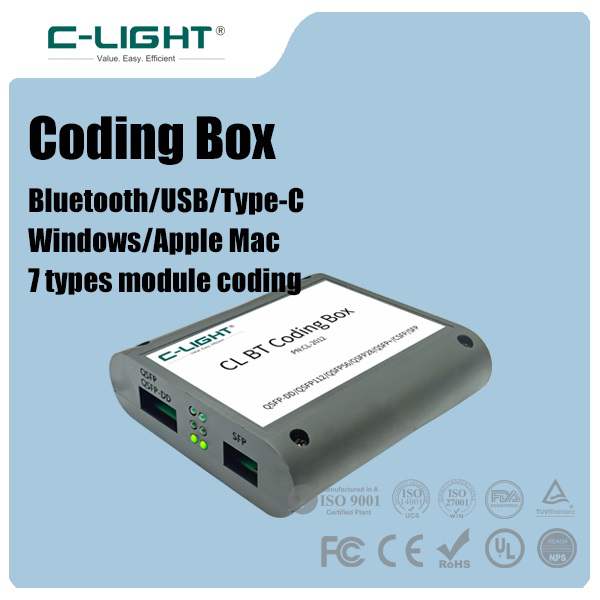
29. 400G DAC and EEPROM Coding
High-speed DAC cables can contain EEPROM information used by host equipment for identification and configuration. Vendor coding and platform recognition can therefore affect whether a cable is accepted and operates correctly.
For large AI deployments, tested interoperability and appropriate coding can be just as important as the electrical characteristics of the cable.
30. 400G DAC Testing for AI Data Centers
Production qualification may include electrical compliance, BER testing, signal-integrity validation, temperature testing, interoperability testing, and host-platform verification.
Testing the complete cable and host combination is more reliable than evaluating the copper assembly in isolation.
31. 400G DAC vs 800G DAC in AI Data Centers
As AI networking advances, 800G DAC is increasingly used where switch and accelerator platforms support 800Gbps ports. The underlying design principle remains similar: use copper for very short paths and optical connectivity for longer distances.
400G DAC remains important because many AI systems continue to use 400G network interfaces, while 400G breakout configurations also provide a practical transition path between generations.
32. 400G DAC and the Transition to 800G and 1.6T
The growth of 800G and 1.6T connectivity does not eliminate the role of 400G DAC. Instead, different link speeds can coexist in the same AI infrastructure during network upgrades.
As bandwidth increases, electrical channel loss and thermal constraints become more challenging, making careful separation of DAC, AEC, AOC, and optical transceiver applications increasingly important.
33. Why 400G DAC Remains Relevant
Despite the rapid adoption of higher-speed optical connectivity, 400G DAC remains practical for short connections because it offers a combination of bandwidth, low power, low latency, and simple installation.
Its value is highest when the equipment layout naturally produces short electrical channels.
34. C-LIGHT 400G DAC for AI Data Centers
C-LIGHT 400G DAC solutions are designed for high-bandwidth short-reach connectivity across AI data centers, HPC systems, Ethernet networks, and InfiniBand environments.
The portfolio covers QSFP112, OSFP112, OSFP56, and QSFP-DD interfaces, including direct 400G and selected breakout configurations such as 400G-to-200G, 400G-to-100G, and 400G-to-50G.
35. How to Select a 400G DAC for an AI Data Center
Selection should start with the host interface and actual physical distance. The cable should then be evaluated for electrical performance, gauge, power, bend requirements, temperature range, breakout architecture, coding, and multi-vendor compatibility.
For short, high-density GPU and switch connections, passive DAC is often the first option to evaluate. AEC, AOC, or optical transceivers become increasingly attractive as the required distance increases.
36. Conclusion
400G DAC cables are an important short-reach interconnect technology for AI data centers. Their primary value comes from combining 400Gbps bandwidth with low power, low latency, and a simple copper architecture.
For GPU-to-switch, server-to-switch, switch-to-switch, Ethernet, and InfiniBand connections within a short physical range, 400G DAC can be an efficient choice. When the distance exceeds the practical electrical limit, AEC, AOC, or optical transceivers provide more suitable alternatives.
 >
>

 >
>
 >
>
 >
>
 >
>
 >
>
 >
>
 >
>