TEL:+86 132 6656 7067




1310 nm and 1330 nm are two wavelengths in the O-band used in optical access and short-reach single-mode links. 1310 nm is the zero-dispersion wavelength of standard single-mode fiber and the standard upstream wavelength in GPON, as well as the wavelength used in duplex 10GBASE-LR and 100GBASE-LR4 links. 1330 nm is one half of the 1270/1330 nm wavelength pair used in BiDi (bidirectional) transceivers, which transmit and receive on a single fiber by separating the two directions by wavelength.
The two wavelengths serve different purposes. 1310 nm is used in conventional duplex links, where one fiber carries the transmit signal and another fiber carries the receive signal. 1330 nm is used in BiDi links, where a single fiber carries both directions, and the two endpoints use complementary wavelength pairs—one transmits at 1270 nm and receives at 1330 nm, while the other transmits at 1330 nm and receives at 1270 nm.
The differences between 1310 nm and 1330 nm affect fiber attenuation, chromatic dispersion, laser technology, transceiver design, and the applications where each wavelength is deployed. Understanding these differences clarifies why BiDi transceivers use the 1270/1330 nm pair rather than reusing 1310 nm, and how the two wavelengths fit into the broader O-band wavelength plan.
1. Wavelength Fundamentals
1310 nm and 1330 nm are both in the O-band, the original wavelength band used for single-mode fiber communications. 1310 nm is at the zero-dispersion wavelength of standard single-mode fiber. 1330 nm is slightly above the zero-dispersion point, where chromatic dispersion is small and positive.
| Parameter | 1310 nm | 1330 nm |
|---|---|---|
| Band | O-band | O-band |
| Fiber Type | Single-mode (G.652) | Single-mode (G.652) |
| Attenuation | ~0.35 dB/km | ~0.34 dB/km |
| Chromatic Dispersion | Near zero | Small positive |
| Primary Use | Duplex links, PON upstream | BiDi transceivers (paired with 1270 nm) |
2. Fiber Attenuation and Dispersion
The two wavelengths have nearly identical attenuation and dispersion characteristics, because they are only 20 nm apart in the O-band. The differences are small but must be accounted for in link budget calculations.
2.1 Attenuation
Standard single-mode fiber attenuation is approximately 0.35 dB/km at 1310 nm and approximately 0.34 dB/km at 1330 nm. The difference is negligible—about 0.2 dB over a 10 km link—and does not materially affect link design. Both wavelengths benefit from the low attenuation of the O-band, which is well below the water-peak absorption region around 1383 nm.
2.2 Chromatic Dispersion
Chromatic dispersion is near zero at 1310 nm and small positive at 1330 nm, approximately 2 to 3 ps/nm/km. The low dispersion at both wavelengths simplifies transmitter design and allows direct modulation without dispersion compensation for reaches up to 10 to 20 kilometers. The slightly higher dispersion at 1330 nm is not a limiting factor for the data rates and reaches used in BiDi transceivers.
| Parameter | 1310 nm | 1330 nm |
|---|---|---|
| Attenuation | ~0.35 dB/km | ~0.34 dB/km |
| Chromatic Dispersion | Near zero | ~2–3 ps/nm/km |
| Dispersion Impact | Minimal | Minimal at 10G/25G |
| Reach Limiting Factor | Attenuation | Attenuation |
3. Duplex vs BiDi Transmission
The fundamental difference between 1310 nm and 1330 nm is how they are used in a link. 1310 nm is the standard wavelength for duplex transmission, where two fibers carry the two directions. 1330 nm is used in BiDi transmission, where a single fiber carries both directions and the two endpoints use different wavelengths.
3.1 1310 nm in Duplex Links
In a duplex link, 1310 nm is transmitted on one fiber and received on another. The same wavelength can be used in both directions because the two directions are physically separated. This is the standard configuration for 10GBASE-LR, 100GBASE-LR4, and most PON upstream links. The transceiver has two optical ports—one transmit and one receive—and the fiber plant provides two fibers per link.
3.2 1330 nm in BiDi Links
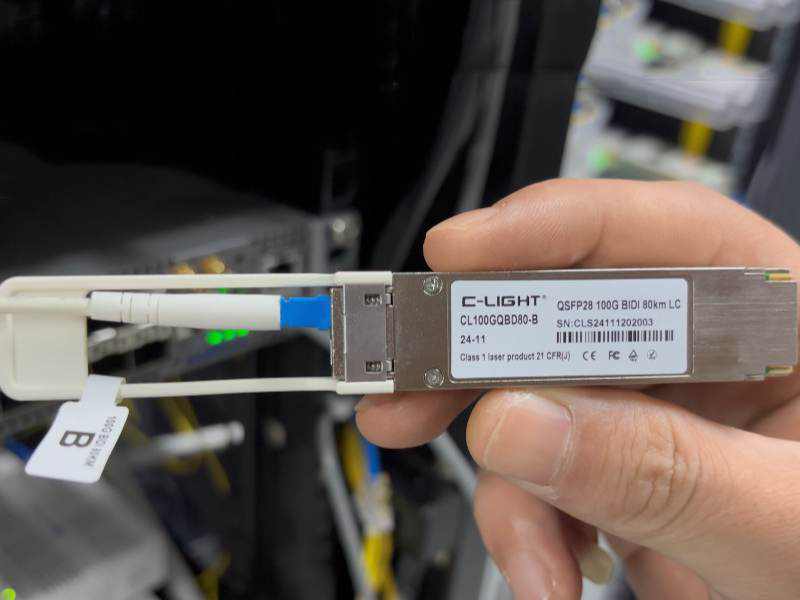
In a BiDi link, 1330 nm is transmitted in one direction and received in the other. The complementary wavelength is 1270 nm. One endpoint transmits at 1270 nm and receives at 1330 nm; the other endpoint transmits at 1330 nm and receives at 1270 nm. A wavelength division multiplexer inside each transceiver combines and separates the two wavelengths onto a single fiber. BiDi transceivers halve the fiber count compared to duplex transceivers.
| Parameter | 1310 nm | 1330 nm |
|---|---|---|
| Transmission Mode | Duplex | BiDi (single fiber) |
| Fiber Count per Link | 2 | 1 |
| Complementary Wavelength | Same (1310 nm) | 1270 nm |
| WDM in Module | No | Yes |
| Module Pairing | Any module of same type | Matched A/B pair required |
4. BiDi Wavelength Pairs
1330 nm is used in BiDi transceivers as one half of the 1270/1330 nm wavelength pair. This pair is standardized in IEEE 802.3 for 10GBASE-BX10 and in various MSA specifications for 25G BiDi. The 1270/1330 nm pair is the most common BiDi wavelength plan for reaches up to 10 km.
4.1 10G BiDi
10GBASE-BX10 uses the 1270/1330 nm pair over a single single-mode fiber, with a reach of 10 km. The module designated BX-D (downstream) transmits at 1270 nm and receives at 1330 nm. The module designated BX-U (upstream) transmits at 1330 nm and receives at 1270 nm. Together they form a matched pair.
4.2 25G BiDi
25G BiDi SFP28 modules also use the 1270/1330 nm pair for reaches up to 10 km. The higher data rate requires tighter wavelength control and higher-performance lasers, but the wavelength plan remains the same. 25G BiDi is used in 5G fronthaul and in fiber-constrained campus and metro links.
| Standard | Wavelength Pair | Reach | Application |
|---|---|---|---|
| 10GBASE-BX10 | 1270/1330 nm | 10 km | Campus, enterprise |
| 25GBASE-BX10 | 1270/1330 nm | 10 km | 5G fronthaul, campus |
| 10GBASE-BX40 | 1310/1490 nm | 40 km | Metro, regional |
| 10GBASE-BX80 | 1490/1550 nm | 80 km | Long-haul, regional |
5. Laser Sources and Transceiver Design
Both wavelengths use DFB or DML lasers for direct modulation. The difference lies in the transceiver design: BiDi transceivers at 1330 nm require an internal WDM and a pair of complementary modules, while duplex transceivers at 1310 nm are simpler and interchangeable.
5.1 1310 nm Transceiver Design
A 1310 nm duplex transceiver has a single transmitter at 1310 nm and a single receiver at 1310 nm. There is no internal WDM, because the transmit and receive paths are on separate fibers. The module is interchangeable with any other module of the same type, and there is no A/B pairing requirement.
5.2 1330 nm BiDi Transceiver Design
A 1330 nm BiDi transceiver contains a transmitter at 1330 nm and a receiver at 1270 nm, or vice versa. An internal WDM combines the outgoing transmit wavelength with the incoming receive wavelength onto a single fiber. The module must be paired with a module of the opposite type—one that transmits at 1270 nm and receives at 1330 nm. This pairing requirement adds operational complexity.
| Parameter | 1310 nm Duplex | 1330 nm BiDi |
|---|---|---|
| Transmitter Wavelength | 1310 nm | 1330 nm (or 1270 nm) |
| Receiver Wavelength | 1310 nm | 1270 nm (or 1330 nm) |
| Internal WDM | No | Yes |
| Module Pairing | Not required | Matched A/B pair required |
| Module Cost | Lower | Higher (WDM adds cost) |
6. Power Budget and Reach
The power budget of a 1310 nm duplex link and a 1330 nm BiDi link are comparable, because the fiber attenuation and dispersion are nearly identical. The BiDi link incurs an additional 1 to 2 dB of insertion loss from the internal WDM, but this is accounted for in the module specifications. Both support reaches up to 10 km at 10G and 25G.
| Parameter | 1310 nm Duplex | 1330 nm BiDi |
|---|---|---|
| Attenuation | ~0.35 dB/km | ~0.34 dB/km |
| Internal WDM Loss | None | 1–2 dB |
| Typical Reach at 10G | 10 km | 10 km |
| Typical Reach at 25G | 10 km | 10 km |
| Fiber Count per Link | 2 | 1 |
7. Applications
1310 nm and 1330 nm serve different applications. 1310 nm is the standard for duplex single-mode links; 1330 nm is used in BiDi links where fiber conservation is required.
7.1 1310 nm Applications
10GBASE-LR: 10 km duplex single-mode links.
100GBASE-LR4: 10 km with four LAN-WDM wavelengths around 1310 nm.
PON upstream: GPON upstream at 1310 nm.
Campus duplex links: Building-to-building connections under 10 km.
Data center interconnect: Short and medium reach duplex links.
7.2 1330 nm Applications
10GBASE-BX10: 10 km BiDi single-fiber links.
25GBASE-BX10: 10 km BiDi single-fiber links at 25G.
Fiber-constrained campus: Links where only one fiber is available.
5G fronthaul: Single-fiber fronthaul where fiber is scarce.
Access networks: Single-fiber drop to the premises.
| Application | 1310 nm | 1330 nm |
|---|---|---|
| Duplex 10G | Primary | Not used |
| BiDi 10G | Not used | Primary (paired with 1270 nm) |
| PON Upstream | Primary | Not used |
| Fiber-Constrained Links | Not typical | Primary |
8. Comparison Summary
| Dimension | 1310 nm | 1330 nm |
|---|---|---|
| Band | O-band | O-band |
| Transmission Mode | Duplex | BiDi (single fiber) |
| Fiber Count per Link | 2 | 1 |
| Complementary Wavelength | Same (1310 nm) | 1270 nm |
| Attenuation | ~0.35 dB/km | ~0.34 dB/km |
| Chromatic Dispersion | Near zero | ~2–3 ps/nm/km |
| Internal WDM | No | Yes |
| Module Pairing | Not required | Matched A/B pair required |
| Typical Reach | 10 km | 10 km |
| Primary Standard | 10GBASE-LR, 100GBASE-LR4, GPON | 10GBASE-BX10, 25GBASE-BX10 |
| Primary Application | Duplex campus and DCI | BiDi fiber-constrained links |
9. Selection Framework
| Evaluation Factor | Recommendation |
|---|---|
| Duplex fiber available | 1310 nm |
| Single fiber available | 1330 nm BiDi (paired with 1270 nm) |
| Fiber-constrained environment | 1330 nm BiDi |
| Standard duplex link | 1310 nm |
| PON upstream | 1310 nm |
| BiDi single-fiber link | 1330 nm |
| Module interchangeability required | 1310 nm |
| Fiber count reduction required | 1330 nm BiDi |
| Cost-sensitive duplex link | 1310 nm |
| Rapid deployment with single fiber | 1330 nm BiDi |
10. Emerging Trends
10.1 Higher-Speed BiDi
BiDi technology is expanding to higher speeds. 25G BiDi SFP28 is available, and 50G BiDi SFP56 is in development. These higher-speed BiDi modules continue to use the 1270/1330 nm wavelength pair for reaches up to 10 km, bringing fiber savings to higher-speed access and fronthaul links.
10.2 BiDi in 5G Transport
In 5G transport, BiDi is used in fronthaul and midhaul deployments where fiber to the radio site is limited. The 1270/1330 nm pair allows a single fiber to carry both downstream and upstream fronthaul traffic, reducing the fiber count required to connect each radio unit.
10.3 Coexistence with PON
The 1270/1330 nm BiDi wavelength pair is close to the PON upstream wavelength of 1310 nm. In deployments where BiDi and PON share the same fiber plant, care must be taken to avoid wavelength conflicts. The 1270/1330 nm pair is separated enough from 1310 nm to allow coexistence with proper filtering, but the coexistence must be planned carefully.
10.4 Wavelength Plans for Future Access
Future access networks may use additional wavelengths in the O-band for higher-speed PON and point-to-point links. The 1310 nm and 1330 nm wavelengths will remain in use, and coexistence with new wavelengths will be a key requirement for future optical distribution networks.
11. Summary
1310 nm and 1330 nm are two O-band wavelengths that serve different roles in optical access and short-reach single-mode links. 1310 nm is the zero-dispersion wavelength of standard single-mode fiber and the standard for duplex links, PON upstream, and 10GBASE-LR. 1330 nm is used in BiDi transceivers as one half of the 1270/1330 nm wavelength pair, enabling single-fiber bidirectional transmission.
The two wavelengths have nearly identical attenuation and dispersion characteristics because they are only 20 nm apart in the O-band. The difference lies in how they are used: 1310 nm is used in duplex links with two fibers, while 1330 nm is used in BiDi links with one fiber and a complementary 1270 nm wavelength at the other end.
1310 nm transceivers are simpler, cheaper, and interchangeable, with no pairing requirement. 1330 nm BiDi transceivers are more complex, more expensive, and require matched A/B pairs, but they halve the fiber count per link and are essential in fiber-constrained environments.
The choice between 1310 nm and 1330 nm depends on fiber availability. When two fibers are available, 1310 nm duplex is the standard choice. When only one fiber is available, 1330 nm BiDi provides full-duplex connectivity over that single fiber.
 >
>

 >
>
 >
>
 >
>
 >
>
 >
>
 >
>
 >
>