TEL:+86 132 6656 7067




Data center interconnects can range from a few kilometers between neighboring facilities to tens of kilometers across a metropolitan area. A 10km DCI and an 80km DCI may carry similar types of Ethernet traffic, but they operate under very different optical conditions.
At 10km, many DCI designs can rely on relatively straightforward single-mode optical modules. At 80km, the link budget becomes much more demanding, and high-capacity deployments may need coherent optics, advanced DSP, FEC, WDM or additional optical-line-system functions. Cisco, for example, has offered 100G coherent pluggable optics reaching up to 80km over dark fiber, while current optical-line-system platforms are being designed to extend high-capacity DCI across much longer metro and regional routes. :contentReference[oaicite:0]{index=0}
1. 10km vs 80km DCI at a Glance
| Feature | 10km DCI | 80km DCI |
|---|---|---|
| Target Reach | Up to approximately 10km | Up to approximately 80km, depending on technology and system conditions |
| Typical Network Area | Nearby buildings, campuses and short metro links | Extended metro and long-distance DCI |
| Fiber | Usually single-mode fiber | Single-mode fiber |
| Optical Budget | High | Very high |
| Typical Architecture | Direct-detect or single-lambda optics | Direct-detect or coherent optics depending on data rate |
| DSP / FEC | Depends on interface | Often more important |
| WDM | Optional depending on network design | More commonly relevant |
| Power and Complexity | Moderate | Higher |
| Typical Cost | Lower | Higher |
2. What Is a 10km Data Center Interconnect?
A 10km DCI connects two data center locations over an optical route of up to approximately 10 kilometers under the module's specified operating conditions.
This reach is useful for facilities that are separated by several kilometers but still operate within a relatively compact metropolitan footprint. Many 10km DCI implementations use single-mode Ethernet optics designed specifically for this reach class.
For example, Cisco's single-lambda 100G optical documentation identifies 100G LR as a 10km solution for connections between buildings, data centers and transport networks. :contentReference[oaicite:1]{index=1}
3. What Is an 80km Data Center Interconnect?
An 80km DCI is designed for significantly longer optical paths and can connect data centers distributed across a much larger metropolitan or regional area.
At this distance, the transmission design becomes more dependent on optical budget, dispersion tolerance, signal processing and the exact transport technology. An 80km DCI can be implemented with specialized direct-detect optics in some cases, while coherent pluggable optics provide another approach for high-capacity links.
4. Why the Distance Difference Changes the DCI Architecture
The jump from 10km to 80km represents an eightfold increase in nominal fiber distance. The resulting increase in attenuation is only one part of the challenge. Longer routes also accumulate connector and splice losses and leave less room for installation variation.
As the distance grows, the DCI design increasingly shifts from selecting an appropriate transceiver to engineering an entire optical path with adequate margin.
5. Optical Budget: The Core Technical Difference
Optical budget determines how much total loss a DCI system can tolerate while maintaining acceptable receiver performance.
A simplified calculation is:
Maximum Allowable Loss = Transmitter Output Power − Receiver Sensitivity
For a 10km link, a high-quality single-mode route can often remain within the budget of conventional long-reach Ethernet optics. An 80km route consumes substantially more of the available margin and therefore requires more careful analysis of transmitter power, receiver sensitivity and transmission conditions.
6. Fiber Loss, Connectors and Splices
Longer DCI routes accumulate more optical loss from fiber attenuation. The installed route can also include patch panels, connectors, adapters and splices that consume additional margin.
Total system loss can be expressed as:
Total System Loss = Fiber Loss + Connector Loss + Splice Loss + Passive Device Loss + Other Optical Losses
For 80km DCI, these additional losses become much more important because the fiber itself already consumes a significant part of the optical budget.
7. Fiber and Wavelength Strategy
Single-mode fiber is the normal foundation for both 10km and 80km DCI. The important difference is how the optical channel is implemented over that fiber.
10km solutions commonly use fixed wavelengths or multi-wavelength architectures suited to Ethernet interfaces. Longer DCI can introduce WDM, tunable optics or C-band operation where the network needs to carry multiple high-capacity channels across the same fiber infrastructure.
8. Direct-Detect vs Coherent DCI
For 10km DCI, direct-detect optical modules can address many Ethernet applications without the full complexity of coherent transmission.
At 80km, coherent technology becomes more relevant, especially for high-capacity links. Coherent pluggables combine advanced modulation, optical detection and DSP to recover the signal and compensate for transmission impairments.
This distinction is not absolute: the required technology depends on the data rate, optical budget and product architecture. Cisco currently documents 100G ZR coherent optics reaching up to 80km over dark fiber, while newer high-capacity platforms extend coherent DCI capabilities further. :contentReference[oaicite:2]{index=2}
9. DSP, FEC and Signal Integrity
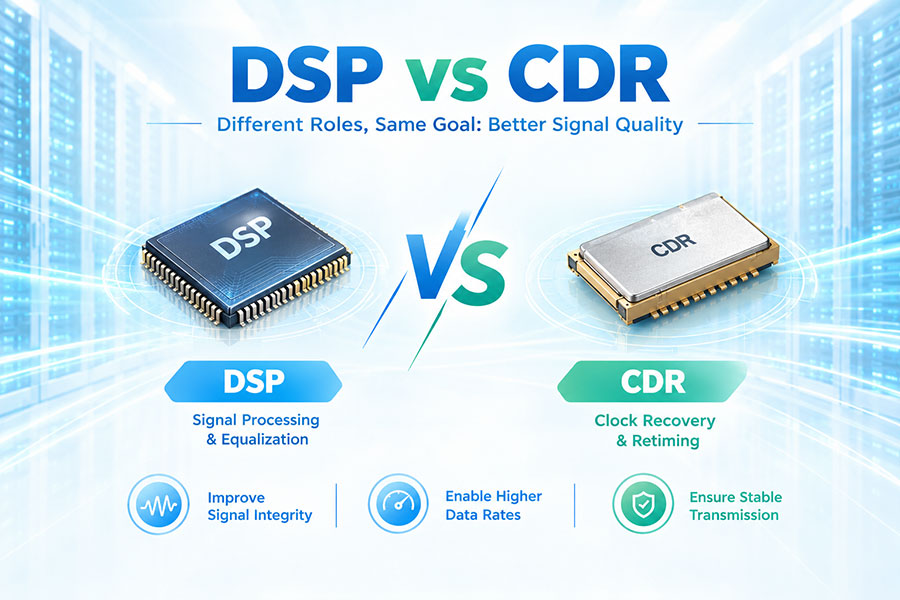
As the DCI distance and data rate increase, signal processing becomes more important. DSP can support functions such as equalization, signal recovery and impairment compensation, while FEC improves tolerance to bit errors.
A 10km link may use a relatively straightforward optical architecture depending on the interface. An 80km system is more likely to depend on advanced DSP and FEC, particularly when high-capacity coherent optics are used.
10. WDM and Optical Line Systems
Shorter 10km DCI can often be implemented as a point-to-point link between two network devices. At 80km, WDM becomes increasingly useful when multiple high-capacity channels must share the same fiber infrastructure.
Modern pluggable optical line systems are also being developed specifically for DCI, placing amplification and other transport functions closer to switches and routers. In September 2026, Coherent announced a pluggable C-band line-system platform designed for 800G ZR/ZR+ DCI and links ranging from 2km to 200km. :contentReference[oaicite:3]{index=3}
11. Power and Thermal Considerations
10km DCI modules can often fit within moderate switch power envelopes, making them practical for dense Ethernet platforms.
80km solutions may require more sophisticated optical components, DSP or coherent processing. This can result in higher module power and greater thermal requirements. The actual consumption is highly dependent on the specific transceiver generation and architecture.
12. Cost: Module vs Complete DCI System
The cost difference between 10km and 80km DCI should be evaluated at two levels.
At the module level, 80km optics generally cost more because of their greater optical performance and processing requirements. At the system level, longer DCI may also involve WDM components, amplifiers, optical line systems and additional fiber infrastructure.
A 10km route can therefore be considerably simpler when no additional optical transport equipment is required.
13. Where 10km DCI Fits Best
| Scenario | 10km DCI Characteristics |
|---|---|
| Nearby Data Centers | Suitable for facilities separated by several kilometers |
| Data Center Campus | Useful across a compact multi-building site |
| Metro Edge | Suitable for shorter metropolitan routes |
| High-Speed Ethernet | Can use standard long-reach Ethernet optics |
14. Where 80km DCI Fits Best
| Scenario | 80km DCI Characteristics |
|---|---|
| Extended Metro DCI | Connects facilities distributed across a larger metropolitan area |
| Long-Distance Site Interconnect | Provides reach well beyond conventional 10km links |
| Regional Data Center Connectivity | Can connect more widely separated facilities |
| High-Capacity DCI | Can use coherent pluggable or other long-reach optical technologies |
15. Can 80km Optics Be Used for a 10km DCI?
In many cases, yes. An 80km-rated optical module can often operate over a shorter 10km route when the fiber type, wavelength, optical interface and host equipment are compatible.
However, the additional reach may not be useful for the shorter route. Higher module cost, increased power consumption or greater system complexity can make the longer-reach solution unnecessary when a 10km module already provides sufficient margin.
16. Can 10km Optics Be Used for an 80km DCI?
A 10km-rated module should not be assumed to support an 80km route. Its optical budget and transmission architecture may be insufficient for the much longer fiber path.
An 80km link should instead be designed around a transceiver or optical system explicitly specified for the target distance and operating conditions.
17. 10km vs 80km DCI: Practical Selection
| DCI Requirement | Design Consideration |
|---|---|
| Route below 10km | Evaluate a 10km-class solution and verify optical margin |
| Route close to 10km | Include all connector, splice and patching losses |
| Route above 10km | Move to an appropriate longer-reach architecture |
| Route approaching 80km | Evaluate long-reach optics, DSP, FEC and possible coherent technology |
| Multiple high-capacity wavelengths | Consider WDM and optical line-system requirements |
| Power-sensitive deployment | Compare actual transceiver power and thermal characteristics |
18. DCI Design Factors Beyond Optical Reach
Distance is only one component of a DCI design. Network planners should also evaluate latency, route diversity, fiber availability, connector count, optical margin, data rate, Ethernet standard, transceiver interoperability and future capacity requirements.
For an 80km DCI, network architecture becomes particularly important. A direct point-to-point connection may be suitable for one deployment, while another may benefit from DWDM, optical amplification or a coherent transport platform. The appropriate design depends on the traffic model and physical infrastructure.
19. 10km vs 80km Data Center Interconnect: Summary
A 10km DCI is generally suited to relatively close data center sites and shorter metropolitan routes. It can often be implemented with conventional single-mode Ethernet optics and a comparatively straightforward point-to-point optical design.
An 80km DCI operates on a very different scale. The longer fiber path consumes more optical margin and places greater emphasis on dispersion, signal processing, FEC, wavelength management and, for many high-capacity applications, coherent transmission.
The choice between 10km and 80km should therefore be based on the complete DCI design rather than distance alone. Fiber route, optical budget, latency, power, WDM requirements, transceiver architecture and future network expansion all need to be evaluated together.
 >
>

 >
>
 >
>
 >
>
 >
>
 >
>
 >
>
 >
>