TEL:+86 132 6656 7067




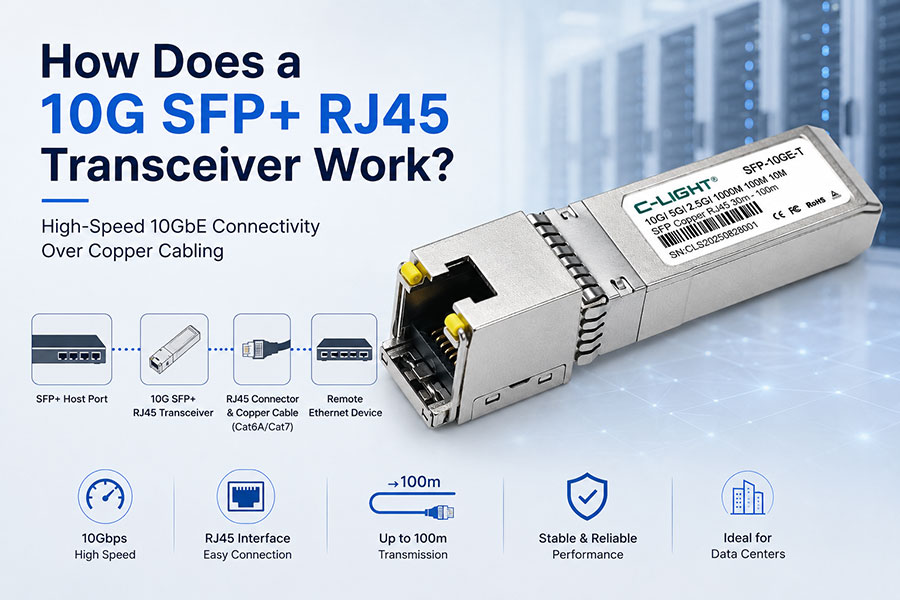
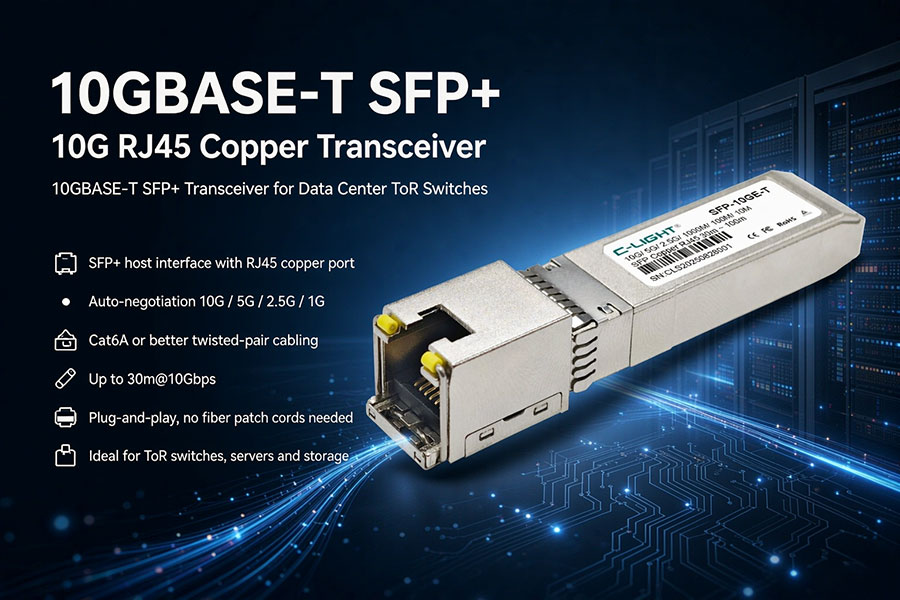
10G SFP+ RJ45 transceiver is a copper-based Ethernet module that converts the electrical interface of an SFP+ port into 10GBASE-T connectivity through an RJ45 connector. It allows switches, servers, routers, and other network devices with SFP+ ports to connect to standard twisted-pair Ethernet cabling.
1. What Is a 10G SFP+ RJ45 Transceiver?
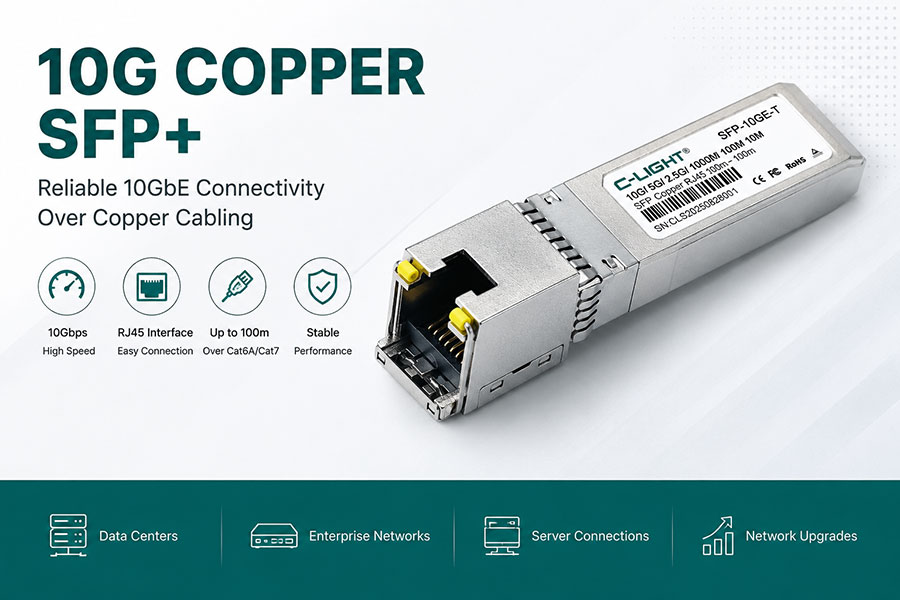
10G SFP+ RJ45 transceiver is a pluggable copper module designed for 10Gbps Ethernet connections. Instead of using an optical fiber interface, the module provides an RJ45 port for copper Ethernet cables.
The module plugs directly into an SFP+ port and communicates with the host device through the SFP+ electrical interface. On the network side, it supports 10GBASE-T signaling over twisted-pair copper cabling.
2. How Does a 10G SFP+ RJ45 Transceiver Work?
The transceiver performs electrical signal conversion between the host SFP+ interface and the 10GBASE-T copper interface.
When transmitting data, the host switch sends high-speed electrical signals to the SFP+ module. The module processes and converts these signals into 10GBASE-T signals and sends them through the RJ45 connector to the copper cable.
During reception, the process is reversed. The module receives the 10GBASE-T signal from the copper cable, processes it, and converts it into an electrical signal compatible with the host SFP+ interface.
3. 10G SFP+ RJ45 Signal Conversion
The main function of the module is not optical-to-electrical conversion because the network connection uses copper rather than optical fiber. Instead, it performs high-speed electrical signal conditioning and protocol-related conversion between the SFP+ host interface and 10GBASE-T physical layer.
This allows an SFP+ switch port to support a conventional RJ45 copper connection without replacing the network equipment.
4. 10GBASE-T Technology
10GBASE-T is the Ethernet physical-layer technology used for 10Gbps transmission over twisted-pair copper cabling. It is designed to provide high-speed Ethernet connectivity while maintaining the familiar RJ45 interface.
10GBASE-T uses advanced signal processing and multi-level modulation to transmit data over copper pairs. The module also performs functions such as equalization, echo cancellation, and crosstalk compensation to maintain signal quality.
5. Why Use an SFP+ RJ45 Module?
An SFP+ RJ45 transceiver provides flexibility when a network switch has SFP+ ports but the connected device or existing cabling uses RJ45 copper interfaces.
Instead of installing a separate fiber connection, the user can insert an SFP+ RJ45 module into the switch and connect it directly to a copper Ethernet cable.
6. Copper Interface and RJ45 Connector
The RJ45 interface provides a familiar connection for twisted-pair Ethernet cabling. Depending on the module and deployment, compatible copper cabling may include Cat6A or higher-grade twisted-pair cable.
Copper cabling is commonly used for server connections, access networks, enterprise networks, and short-distance data center links.
7. Transmission Distance
The transmission distance of a 10G SFP+ RJ45 transceiver depends on the module design, cable category, installation environment, and network conditions. Many 10GBASE-T SFP+ modules are designed for short-reach connections, commonly up to around 30m.
The specified distance of the selected transceiver and the requirements of the connected equipment should always be checked before deployment.
8. Power Consumption and Heat
Compared with optical SFP+ transceivers, 10GBASE-T RJ45 modules can require more power because of the additional signal-processing functions needed for high-speed copper transmission.
Higher power consumption also produces more heat inside the switch. When deploying multiple RJ45 SFP+ modules in a high-density system, power and thermal conditions should therefore be considered.
9. 10G SFP+ RJ45 vs 10G Optical SFP+
| Feature | 10G SFP+ RJ45 | 10G Optical SFP+ |
|---|---|---|
| Interface | RJ45 | LC or other optical interface |
| Transmission Medium | Twisted-pair copper | Optical fiber |
| Technology | 10GBASE-T | 10GBASE-SR/LR and others |
| Typical Application | Short copper connections | Short- to long-distance fiber links |
| Power | Generally higher | Generally lower |
| Cabling | Cat6A or higher | Multimode or single-mode fiber |
10. 10G SFP+ RJ45 Applications
10G SFP+ RJ45 transceivers are commonly used in environments where SFP+ switching equipment needs to connect with copper Ethernet infrastructure.
Data center server connections
Top-of-Rack (ToR) switches
Enterprise networks
Network aggregation
Storage networks
Short-distance switch-to-server links
Existing copper Ethernet infrastructure
11. 10G SFP+ RJ45 for Data Centers
In data centers, SFP+ RJ45 modules can provide a practical option for short-distance server and switch connections. They are especially useful when existing server network interfaces or structured cabling use RJ45 connections.
The module also allows network operators to use the SFP+ port density of modern switches while maintaining copper connectivity for selected links.
12. Compatibility Considerations
Before using a 10G SFP+ RJ45 transceiver, verify that the host switch, router, or server supports the module and its 10GBASE-T operating mode.
Important factors include SFP+ port compatibility, supported Ethernet standards, cable category, transmission distance, power consumption, thermal conditions, and module coding.
13. 10G SFP+ RJ45 vs SFP+ DAC
Both 10G SFP+ RJ45 modules and SFP+ DAC cables can provide short-distance copper connectivity, but they use different physical implementations.
An SFP+ RJ45 transceiver provides an RJ45 interface and connects to a conventional twisted-pair Ethernet cable. An SFP+ DAC uses integrated copper cable assemblies with transceiver ends and is generally designed for direct switch-to-server or switch-to-switch connections.
14. Advantages of 10G SFP+ RJ45 Transceivers
Uses a standard RJ45 copper interface
Supports 10Gbps Ethernet connectivity
Compatible with twisted-pair Ethernet infrastructure
Easy to deploy in SFP+ ports
Useful for short-distance network connections
Provides flexibility between fiber and copper deployments
15. Limitations of 10G SFP+ RJ45
The main limitation is transmission distance compared with many optical SFP+ solutions. Copper transmission also requires greater attention to cable quality, electromagnetic interference, power consumption, and thermal management.
For longer links, optical SFP+ transceivers and fiber optic cabling are generally more suitable.
16. How to Choose a 10G SFP+ RJ45 Transceiver
When selecting a 10G SFP+ RJ45 transceiver, consider the host equipment, required transmission distance, copper cable category, power budget, operating temperature, and compatibility requirements.
For high-density switches, power consumption and thermal performance are particularly important because multiple copper modules can significantly increase the total system power load.
17. Conclusion
A 10G SFP+ RJ45 transceiver provides a convenient way to connect SFP+ network ports to 10GBASE-T copper Ethernet infrastructure. It converts high-speed electrical signaling between the host SFP+ interface and RJ45 copper interface, enabling 10Gbps connectivity over twisted-pair cabling.
For short-distance server, switch, enterprise, and data center connections, SFP+ RJ45 modules provide an alternative to optical SFP+ transceivers and DAC cables when copper connectivity is preferred.
 >
>

 >
>
 >
>
 >
>
 >
>
 >
>
 >
>
 >
>