TEL:+86 132 6656 7067




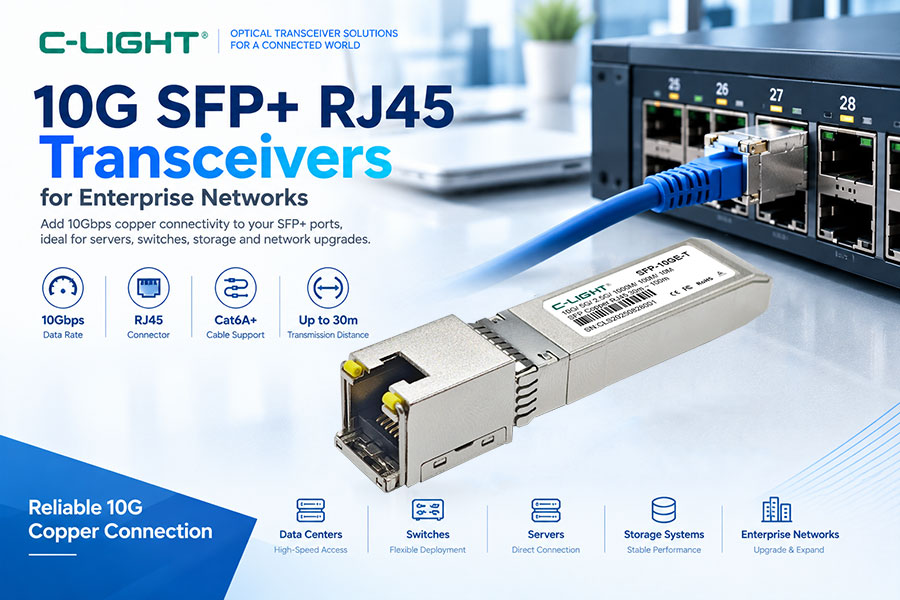
10G SFP+ RJ45 copper transceivers provide 10Gbps Ethernet connectivity between SFP+ switch ports and RJ45-based network devices. They are useful in data center networks that combine SFP+ switching platforms with existing Cat6A or higher copper cabling for server, storage, and short-distance network connections.
1. What Is a 10G SFP+ RJ45 Copper Transceiver?
A 10G SFP+ RJ45 copper transceiver is a pluggable Ethernet module that fits into an SFP+ port and provides an RJ45 copper interface. It allows a switch, router, or other SFP+ host device to connect to a standard twisted-pair Ethernet port.
The module performs the electrical conversion required for 10GBASE-T operation while maintaining the compact SFP+ form factor.
2. Why Use 10G SFP+ RJ45 in Data Center Networks?
Many data centers contain a mixture of fiber-based switch ports and copper-based server or storage interfaces. A 10G SFP+ RJ45 transceiver provides a practical way to connect these different interfaces without replacing the existing copper network equipment.
This is particularly useful during network upgrades where high-speed SFP+ switching is deployed while many endpoints continue to use RJ45 Ethernet.
3. How Does a 10G SFP+ RJ45 Transceiver Work?
A typical connection is:
SFP+ Switch Port → 10G SFP+ RJ45 Transceiver → RJ45 Copper Cable → 10GBASE-T Network Device
The module receives the electrical signal from the SFP+ host interface, processes it for 10GBASE-T operation, and transmits the resulting signal over twisted-pair copper.
4. 10GBASE-T and SFP+ RJ45
10GBASE-T is the copper Ethernet technology most commonly associated with 10G SFP+ RJ45 transceivers. It provides 10Gbps Ethernet over balanced twisted-pair copper cabling.
The transceiver must support the electrical requirements of 10GBASE-T and the host platform must support the corresponding SFP+ copper module.
5. SFP+ RJ45 Is Not the Same as a Native RJ45 Port
An SFP+ RJ45 transceiver does not turn an SFP+ switch into a native fixed RJ45 switch port. The module itself contains the copper PHY required to provide the RJ45 interface.
This means module power, firmware compatibility, supported speeds, and thermal conditions must be considered when deploying the solution.
6. Typical Applications in Data Centers
10G SFP+ RJ45 copper transceivers can be used for server-to-switch, storage-to-switch, switch-to-switch, management, and other short-distance Ethernet connections.
They are especially useful where the switching infrastructure uses SFP+ cages but the connected equipment already has 10GBASE-T RJ45 interfaces.
7. 10G Server-to-Switch Connectivity
A common application is connecting a server with a 10GBASE-T RJ45 NIC to an SFP+ switch.
This allows the server to continue using its existing copper network interface while the switch uses a high-density SFP+ architecture.
8. 10G Storage Connectivity
Storage appliances and storage servers may use RJ45-based 10GbE interfaces. A 10G SFP+ RJ45 transceiver allows them to connect to switches equipped with SFP+ ports.
9. 10G Switch-to-Switch Connectivity
In some networks, two compatible switches can be connected through 10GBASE-T copper by installing suitable SFP+ RJ45 transceivers at the required ports.
The exact distance and supported operating mode depend on the modules, switches, and copper channel.
10. 10G SFP+ RJ45 Transmission Distance
The transmission distance depends on the exact transceiver and cable installation. Many 10GBASE-T SFP+ modules support short copper distances, while some vendor implementations specify up to approximately 30m at 10Gbps with suitable Cat6A or Cat7 cabling.
Distance should always be checked against the exact product specification rather than assuming that every 10G SFP+ RJ45 module provides the same reach.
11. Why Cable Quality Matters
10Gbps copper transmission is sensitive to attenuation, crosstalk, return loss, and installation quality. Cable category, connector quality, patch panels, and total channel length all affect link performance.
12. Cat6A for 10G SFP+ RJ45
Cat6A is a common choice for 10GBASE-T data center and enterprise installations. Its design provides improved high-frequency performance and crosstalk control compared with lower-category cabling.
13. Cat6 vs Cat6A
| Cable | Typical Role | 10G Consideration |
|---|---|---|
| Cat6 | Existing enterprise cabling | Reach depends on channel and installation |
| Cat6A | New 10G structured cabling | Common choice for 10GBASE-T |
| Cat7 | Higher-category copper systems | Can support high-frequency copper applications |
14. Multirate 10G SFP+ RJ45 Transceivers
Some copper SFP+ transceivers support more than 10Gbps Ethernet. Depending on the implementation, they may also support 1Gbps or 100Mbps operation.
This can simplify network migration by allowing different Ethernet speeds to operate through the same copper interface family.
15. 10G Only vs Multirate Modules
A 10G-only module is designed around 10Gbps operation, while a multirate module can support additional Ethernet speeds when the host and remote device also support those modes.
The supported speed range should be confirmed from the specific module documentation.
16. SFP+ Port Compatibility
Not every SFP+ port supports a 10G RJ45 copper transceiver. The host switch or router must explicitly support the relevant 10GBASE-T SFP+ module.
Compatibility depends on the platform, software, transceiver power, supported speed modes, and manufacturer specifications.
17. Why an SFP+ Port May Reject a Copper Module
A switch may reject a copper transceiver because of unsupported module type, vendor coding, power restrictions, firmware limitations, or platform-specific restrictions.
Therefore, the presence of an SFP+ cage alone is not proof of 10G RJ45 compatibility.
18. Power Consumption
10GBASE-T SFP+ modules often consume more power than many short-reach optical SFP+ modules because the copper PHY performs substantial signal processing.
This can affect both switch power budgets and thermal management.
19. Thermal Considerations
High-power copper transceivers can increase local temperature around the switch front panel. A switch may therefore limit the number of 10GBASE-T modules that can operate simultaneously.
20. Why Power Is Important in Dense Data Centers
A modern data center switch can contain a large number of populated ports. If each copper transceiver consumes additional power, the aggregate impact can become significant at switch and rack level.
Power should therefore be checked before deploying large numbers of 10G SFP+ RJ45 modules.
21. 10G SFP+ RJ45 vs 10G SFP+ SR
| Feature | 10G SFP+ RJ45 | 10G SFP+ SR |
|---|---|---|
| Medium | Copper | Multimode fiber |
| Connector | RJ45 | LC |
| Existing cable compatibility | Twisted-pair Ethernet | Multimode fiber |
| Power | Often higher | Typically lower |
| Typical use | Copper endpoint connectivity | Short fiber links |
22. 10G SFP+ RJ45 vs SFP+ DAC
A 10G SFP+ RJ45 module uses standard twisted-pair Ethernet cabling, while an SFP+ DAC uses an integrated twinax copper cable with fixed SFP+ connectors.
RJ45 modules are useful where structured copper cabling already exists. DAC is often simpler for short direct switch-to-server connections.
23. SFP+ RJ45 vs SFP+ Optical for Data Center Upgrades
The choice depends heavily on the existing infrastructure. Copper modules can preserve existing RJ45 cabling, while optical modules may provide greater reach, lower module power, and better suitability for some high-density or longer-distance links.
24. Network Architecture with Mixed Copper and Fiber
Many data centers use mixed media. Fiber can be used for switch uplinks and longer connections, while copper remains at selected server or storage endpoints.
SFP+ RJ45 modules provide an interface bridge between these network layers.
25. Top-of-Rack Deployment
Top-of-rack switches are commonly installed close to the servers they serve. This physical arrangement is well suited to short copper connections.
10G SFP+ RJ45 transceivers can connect SFP+ ToR ports to servers with RJ45 10GBASE-T interfaces.
26. End-of-Row Deployment
In end-of-row architectures, cable paths can be longer than typical ToR connections. The actual copper channel should be checked carefully because longer distances can reduce the available signal margin.
27. 10G SFP+ RJ45 for Legacy Network Migration
One practical use is upgrading an existing network to higher-density SFP+ switching while retaining copper server interfaces.
This approach can reduce the need for immediate endpoint replacement and allow migration to occur in stages.
28. 10G SFP+ RJ45 for Server Refreshes
When new switches are installed before server NICs are upgraded, SFP+ RJ45 modules can provide a temporary or long-term connectivity path between the two generations of equipment.
29. 10G SFP+ RJ45 for Storage Systems
Storage appliances can generate significant network traffic and may already use 10GBASE-T ports. A copper SFP+ module can connect these systems to higher-density SFP+ switching infrastructure.
30. 10G SFP+ RJ45 for Enterprise Networks
Enterprise networks often contain existing structured copper cabling and a mixture of access, aggregation, and data center equipment. RJ45 SFP+ modules can help extend 10G connectivity without replacing the entire cable plant.
31. Auto-Negotiation
Auto-negotiation behavior depends on the transceiver and host platform. Some multirate 10GBASE-T SFP+ modules support negotiation across multiple Ethernet speeds.
When a link fails to establish, verify the negotiated mode and the configuration on both endpoints.
32. Speed Configuration
A mismatch between forced speed settings and supported negotiation behavior can prevent the link from coming up.
For troubleshooting, confirm both the advertised capabilities and the configured interface speed.
33. Full-Duplex Operation
10GBASE-T is intended for full-duplex Ethernet operation. Both endpoints must support the same Ethernet operating mode and maintain compatible physical-layer conditions.
34. EEPROM and Module Identification
The transceiver contains identification and management information that can be read by the host system. This information can include manufacturer, part number, serial number, supported capabilities, and diagnostic information.
35. Vendor Coding
Some network equipment checks module identification or vendor coding before allowing a transceiver to operate.
For multi-vendor environments, the module should be correctly coded for the target equipment and validated under actual operating conditions.
36. Compatibility with Switch Brands
10G SFP+ RJ45 modules are available for a wide range of network platforms, but compatibility remains model-specific.
The correct procedure is to verify the exact switch or router model, supported transceiver list, software requirements, and maximum permitted module power.
37. Compatibility with Network Adapters
The remote device must support 10GBASE-T through its RJ45 interface. Common endpoints include 10GbE server NICs, storage adapters, network appliances, and compatible switches.
38. Cable Channel Design
The complete copper path may contain patch cords, permanent links, connectors, patch panels, and intermediate termination points.
Each additional connection introduces potential insertion loss and reflection, so complete channel design is important for reliable 10Gbps operation.
39. Electromagnetic Interference
Copper Ethernet is more susceptible to electromagnetic interference than optical fiber. Proper cable routing, shielding where required, and installation practices can help maintain signal quality in electrically noisy environments.
40. Crosstalk
At 10Gbps, crosstalk between copper pairs can affect signal integrity. Cable construction and connector design therefore play an important role in maintaining reliable transmission.
41. Return Loss
Impedance discontinuities can cause signal reflections. Excessive return loss can reduce the signal margin available to the transceiver and may contribute to link instability.
42. Insertion Loss
Insertion loss increases as the copper channel becomes longer and more complex. At high frequencies, the electrical loss of the channel becomes an important constraint on transmission distance.
43. 10G SFP+ RJ45 Link Budget
Unlike a simple optical power budget, copper links are evaluated through electrical channel parameters. The transmitter and receiver must maintain sufficient signal margin after accounting for channel loss, reflections, crosstalk, and other impairments.
44. Data Center Cable Management
Copper cabling can become bulky when large numbers of connections are installed. Cable diameter, bend radius, weight, and airflow should be considered when deploying many 10G SFP+ RJ45 connections.
45. Airflow and Copper Cable Density
Large copper bundles can interfere with airflow around switch and server equipment. Good cable routing can reduce congestion and help maintain effective cooling.
46. Optical vs Copper Cable Density
For very high port counts, optical cabling can offer advantages in cable weight and physical density. Copper remains attractive for short connections where its simplicity and existing infrastructure provide clear benefits.
47. 10G SFP+ RJ45 Power and Thermal Trade-Off
The main trade-off is that copper modules can preserve existing RJ45 infrastructure but may require more module power and generate more heat than some optical alternatives.
48. When Should You Choose 10G SFP+ RJ45?
RJ45 SFP+ is a strong candidate when the switch provides compatible SFP+ ports, the endpoint already has a 10GBASE-T interface, and existing copper cabling can satisfy the distance requirement.
49. When Should You Choose Optical SFP+?
Optical SFP+ can be preferable when longer transmission distance, lower module power, electromagnetic isolation, or existing fiber infrastructure is more important than retaining copper connections.
50. When Should You Choose DAC?
DAC is often the simplest option for very short direct switch-to-server or switch-to-switch connections when both devices support compatible SFP+ interfaces.
51. 10G Connectivity Selection
| Requirement | Preferred Solution |
|---|---|
| Existing RJ45 10G cabling | 10G SFP+ RJ45 |
| Very short direct connection | SFP+ DAC |
| Short fiber connection | SFP+ SR or similar optical module |
| Longer fiber connection | SFP+ LR or other long-reach optical module |
52. Installation Best Practices
Use the correct cable category, verify the complete channel length, clean connectors on connected equipment, confirm switch compatibility, and check module power requirements before deployment.
53. Testing a 10G SFP+ RJ45 Link
After installation, verify transceiver recognition, negotiated speed, interface status, error counters, temperature, and link stability.
Where possible, perform sustained traffic testing to confirm that the connection remains stable under load.
54. Troubleshooting a Failed Link
A practical troubleshooting sequence is:
Check module recognition → Verify host compatibility → Check speed configuration → Check cable category and length → Replace the cable → Test another port → Check module diagnostics → Run traffic testing
55. Common 10G SFP+ RJ45 Problems
Common issues include unsupported modules, excessive power consumption, incompatible firmware, cable problems, excessive channel length, incorrect speed configuration, negotiation mismatches, and vendor coding restrictions.
56. Link Drops Under Load
A link that works at idle but becomes unstable under heavy traffic may indicate marginal signal integrity, thermal problems, or host-side issues.
Check temperature, error counters, cable quality, and the specific module's operating conditions.
57. Link Runs at 1G Instead of 10G
If the module supports multiple speeds, the connection may negotiate to 1Gbps because of endpoint capabilities or configuration.
Check the capabilities and configured speed on both devices before replacing the hardware.
58. Module Runs Too Hot
High temperature can result from high module power, insufficient airflow, excessive port density, or environmental temperature.
Review the host platform's permitted transceiver power and thermal specifications before deploying additional copper modules.
59. 10G SFP+ RJ45 for AI and HPC Data Centers
10G RJ45 connectivity is less common for the highest-bandwidth AI fabric links, where 400G and 800G optical technologies dominate high-performance network layers. However, 10G SFP+ RJ45 can still be useful for management, legacy systems, storage, infrastructure services, and lower-speed network segments within AI facilities.
60. 10G SFP+ RJ45 for Management Networks
Data centers often maintain separate management and infrastructure networks. 10G copper connectivity can be useful where existing RJ45 equipment and structured cabling are already deployed.
61. Role in Hybrid Data Center Networks
A modern data center may combine 10G copper endpoints with 25G, 100G, 400G, and 800G optical switching layers.
10G SFP+ RJ45 transceivers can therefore remain useful as part of a multi-speed, mixed-media infrastructure.
62. 10G SFP+ RJ45 and Network Migration
During a network migration, copper SFP+ modules can provide compatibility between new SFP+ switching platforms and existing 10GBASE-T endpoints.
63. Advantages of 10G SFP+ RJ45
The primary advantages include reuse of existing copper infrastructure, RJ45 interoperability, straightforward installation, and compatibility with SFP+ switch architectures that support copper modules.
64. Limitations of 10G SFP+ RJ45
The main limitations include relatively short 10G copper reach, higher power consumption than some optical modules, increased thermal requirements, and platform-specific compatibility restrictions.
65. C-LIGHT 10G SFP+ RJ45 Copper Transceiver
C-LIGHT 10G SFP+ RJ45 copper transceivers are designed to provide copper Ethernet connectivity through an SFP+ host interface. The product family is suitable for enterprise networks, data centers, servers, storage systems, and other compatible Ethernet applications.
Depending on the specific model, supported speeds and transmission distances can vary. The exact part number should be matched with the target switch or router and the required copper cabling.
66. 10G SFP+ RJ45 Selection Checklist
| Check | Requirement |
|---|---|
| Host port | SFP+ port with 10GBASE-T module support |
| Speed | 10G or required multirate operation |
| Cable | Compatible Cat6A or higher cabling where required |
| Distance | Within the module's specified copper reach |
| Power | Within the switch's permitted module power |
| Thermals | Adequate airflow and port density |
| Compatibility | Module coding, firmware, and platform support |
67. Conclusion
10G SFP+ RJ45 copper transceivers provide a practical way to connect SFP+ switching platforms with 10GBASE-T RJ45 equipment. They are particularly useful in data centers that already have structured copper cabling or need to connect servers and storage systems with RJ45 interfaces to high-density SFP+ switches.
The main factors to consider are host compatibility, transmission distance, cable category, power consumption, thermal conditions, speed negotiation, and vendor coding.
For short copper connections, 10G SFP+ RJ45 can simplify network deployment and extend the useful life of existing Ethernet infrastructure. For longer distances or higher-density optical architectures, optical SFP+ modules, DAC, AOC, or higher-speed optical solutions may provide a better fit.
 >
>

 >
>
 >
>
 >
>
 >
>
 >
>
 >
>
 >
>