TEL:+86 132 6656 7067




10G SFP+ RJ45 compatibility depends on the switch SFP+ port, 10GBASE-T transceiver, copper cable, network standard, speed settings, power budget, and vendor qualification. A compatible module can connect an SFP+ switch port to a standard RJ45 Ethernet device while preserving 10Gbps copper connectivity.
1. What Is a 10G SFP+ RJ45 Transceiver?
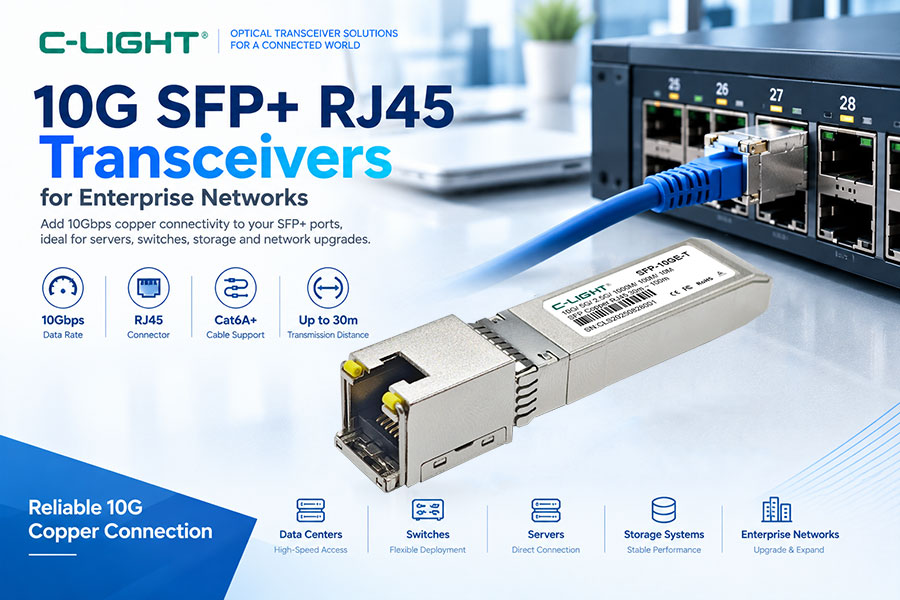
A 10G SFP+ RJ45 transceiver is a copper Ethernet module that uses the SFP+ form factor on the switch side and an RJ45 connector on the network side. It allows an SFP+ port to connect to twisted-pair copper infrastructure instead of requiring a fiber optic transceiver.
The module internally handles the electrical interface required for 10GBASE-T operation while presenting itself to the host as an SFP+ pluggable device.
2. Why 10G SFP+ RJ45 Compatibility Matters
SFP+ is a physical pluggable form factor, but not every SFP+ port supports every copper transceiver. Host-port firmware, platform qualification, power limits, supported speeds, and vendor restrictions can determine whether a particular 10GBASE-T module will operate correctly.
Therefore, compatibility should be evaluated at both ends of the connection rather than based only on the fact that the switch has an SFP+ cage.
3. Basic 10G SFP+ RJ45 Connection
A typical connection can be represented as:
SFP+ Switch Port → 10G SFP+ RJ45 Transceiver → Twisted-Pair Cable → RJ45 Network Port
The remote device can be a server, storage system, NIC, switch, router, or other Ethernet device with a compatible copper Ethernet interface.
4. Is an SFP+ Port Compatible with RJ45?
An SFP+ port can support RJ45 connectivity only when the switch platform supports an appropriate 10GBASE-T SFP+ module. The SFP+ cage itself does not automatically provide native RJ45 electrical connectivity.
For example, Cisco documents 10GBASE-T SFP+ modules that plug into compatible SFP+ Ethernet ports and provide RJ45 connectivity for 10GBASE-T endpoints. :contentReference[oaicite:0]{index=0}
5. 10G SFP+ RJ45 and 10GBASE-T
The primary Ethernet standard associated with a 10G SFP+ RJ45 copper module is 10GBASE-T, defined by IEEE 802.3an. The technology transmits 10Gbps Ethernet over balanced twisted-pair copper cabling.
The transceiver therefore needs to implement the electrical requirements of 10GBASE-T rather than simply converting an SFP+ signal to an RJ45 connector.
6. 10GBASE-T Compatibility with 1G and 100M
Multirate SFP+ RJ45 modules may also support lower Ethernet speeds. Cisco's documented SFP-10G-T-X, for example, supports 100Mbps, 1Gbps, and 10Gbps operation, although exact supported speeds depend on the module and host platform. :contentReference[oaicite:1]{index=1}
This makes a multirate copper module useful when migrating from 1G to 10G Ethernet without replacing all network equipment at the same time.
7. 10G SFP+ RJ45 Switch Compatibility
The first compatibility check should be the switch model and its SFP+ port specification.
A switch should explicitly list support for 10GBASE-T SFP+ or the specific compatible copper transceiver. Some platforms support only optical SFP+ modules, while others support both optical and copper variants.
8. Why Two SFP+ Ports May Behave Differently
Different ports on the same platform may have different supported speeds, breakout capabilities, power limits, or transceiver restrictions. Platform documentation and compatibility matrices are therefore more reliable than assuming every SFP+ cage behaves identically.
Cisco, for example, documents platform-specific support and deployment restrictions for its 10GBASE-T SFP+ modules. :contentReference[oaicite:2]{index=2}
9. Switch-to-SFP+ RJ45 Connection
One common deployment is connecting a switch SFP+ port to a server or storage device with a native RJ45 10GBASE-T port.
This arrangement can be useful when the aggregation switch uses SFP+ cages while the endpoint already has an integrated RJ45 10GBASE-T interface.
10. SFP+ RJ45 to RJ45 Transceiver-to-Transceiver Connection
Two compatible 10GBASE-T copper transceivers can also be connected through twisted-pair cabling when the host devices support them.
The important requirement is not simply that both modules have RJ45 connectors, but that both host ports and modules support the same Ethernet operating mode and required management behavior.
11. 10G SFP+ RJ45 and Network Cable Types
Cable selection directly affects the achievable 10Gbps distance and link stability.
| Cable Type | Typical Role | 10G Consideration |
|---|---|---|
| Cat5e | Existing copper infrastructure | 10G reach depends strongly on installation and channel conditions |
| Cat6 | Enterprise and short data center links | Reach depends on channel characteristics |
| Cat6A | Structured 10G cabling | Preferred for full-length 10GBASE-T structured cabling |
| Cat7 | Higher-category copper systems | Supports high-bandwidth copper applications when properly installed |
12. 10G SFP+ RJ45 and Cat6A
Cat6A is a common choice for 10GBASE-T installations because it is designed for high-frequency copper Ethernet and controlled crosstalk performance.
Vendor-specific SFP+ RJ45 modules can have shorter validated limits. For example, Cisco specifies up to 30m for its SFP-10G-T-X at 10Gbps over Cat6A/Cat7 or better. :contentReference[oaicite:3]{index=3}
13. 10G SFP+ RJ45 Transmission Distance
There is no single distance that applies to every 10G SFP+ RJ45 module. A module may support 10Gbps over a shorter distance than its lower-speed modes.
For example, the Cisco SFP-10G-T-X specification lists up to 30m at 10Gbps over Cat6A/Cat7 or better, while 100M/1Gbps operation can reach up to 100m with supported cable categories. :contentReference[oaicite:4]{index=4}
14. Why 10G Distance Depends on the Complete Channel
The usable distance is determined by the complete copper channel rather than the cable length printed on a package. Patch panels, connectors, patch cords, cable quality, electromagnetic interference, and installation practices can all affect performance.
A link should therefore be considered as a complete structured-cabling channel instead of evaluating the transceiver and cable separately.
15. 10G SFP+ RJ45 and Auto-Negotiation
Auto-negotiation behavior is an important compatibility issue. Some 10GBASE-T SFP+ implementations support multiple speeds and negotiation features, while support can vary by platform.
Cisco explicitly notes that auto-negotiation capability varies by platform for its SFP+ 10GBASE-T connectivity. :contentReference[oaicite:5]{index=5}
16. Fixed Speed vs Auto-Negotiation
When a multirate copper module is used, both ends should be configured according to the platform's supported operating modes. A mismatch between forced speed settings and negotiation behavior can prevent the link from establishing correctly.
For troubleshooting, verify the actual negotiated speed and the interface capabilities reported by the switch.
17. 10G SFP+ RJ45 and Full Duplex Ethernet
10GBASE-T Ethernet is designed for full-duplex Ethernet operation. Both endpoints must support the required Ethernet mode and maintain the expected physical-layer conditions.
Modern 10Gbps Ethernet deployments normally use switched full-duplex links rather than the half-duplex operating concepts associated with much older Ethernet environments.
18. 10G SFP+ RJ45 and Network Standards
| Standard | Speed | Medium |
|---|---|---|
| IEEE 802.3an / 10GBASE-T | 10Gbps | Twisted-pair copper |
| IEEE 802.3ab / 1000BASE-T | 1Gbps | Twisted-pair copper |
| IEEE 802.3u / 100BASE-TX | 100Mbps | Twisted-pair copper |
Multirate modules may support several of these standards, but the exact combination should always be verified against the module and switch specifications.
19. 10G SFP+ RJ45 and SFP+ MSA Compatibility
SFP+ defines a compact pluggable form factor and electrical/mechanical interface ecosystem, but it does not mean that every SFP+ host accepts every SFP+ transceiver.
The host must support the electrical characteristics, power requirements, management interface, and specific module type. A copper 10GBASE-T module has very different power and thermal behavior from a low-power optical SR or LR module.
20. Power Consumption Is a Major Compatibility Factor
10GBASE-T electronics inside an SFP+ module can consume significantly more power than some optical SFP+ modules because the copper PHY performs substantial signal processing.
Cisco lists 2.5W maximum power consumption for its SFP-10G-T-X at 10Gbps and documents platform deployment restrictions related to this power level. :contentReference[oaicite:6]{index=6}
21. Thermal Compatibility in SFP+ Ports
High power consumption can raise the temperature around a densely populated switch front panel. A switch may therefore limit the number of 10GBASE-T SFP+ modules that can be installed simultaneously.
This is an important difference between optical and copper SFP+ deployments and should be checked before large-scale installation.
22. Vendor Compatibility and Coded Modules
Some network equipment manufacturers use transceiver identification mechanisms to determine whether a module is approved for a specific platform. The module EEPROM and vendor coding can therefore affect recognition.
For multi-vendor environments, a module should be selected with the required host coding and tested on the target platform.
23. Cisco 10G SFP+ RJ45 Compatibility
Cisco provides documented examples of SFP+ 10GBASE-T modules that operate with selected Nexus, NCS, Catalyst, and other platforms. However, support is model- and software-dependent, so the relevant compatibility matrix should be checked before installation. :contentReference[oaicite:7]{index=7}
This illustrates an important general rule: compatibility should be checked by exact switch model rather than by vendor name alone.
24. Other Switch Brands and 10G SFP+ RJ45
The same principle applies to other switch manufacturers. A switch may have SFP+ ports but still restrict which 10GBASE-T modules can be used, which speeds are supported, or how the port must be configured.
Before deployment, verify four items: the switch model, supported transceiver list, supported speed modes, and module power limit.
25. 10G SFP+ RJ45 with Server NICs
A common application is connecting an SFP+ switch to a server equipped with a 10GBASE-T RJ45 NIC. This allows an existing copper server interface to connect to a fiber-oriented aggregation or data center switch with SFP+ cages.
The endpoint simply needs to support the appropriate 10GBASE-T Ethernet standard and cable category.
26. 10G SFP+ RJ45 with Storage Networks
Storage servers and appliances frequently use copper Ethernet interfaces. A 10G SFP+ RJ45 module can bridge these devices to switches equipped with SFP+ ports without replacing the copper interface on the storage equipment.
27. 10G SFP+ RJ45 in Data Centers
In data centers, SFP+ RJ45 transceivers are useful where existing copper connections need to integrate with high-density SFP+ switching platforms.
They can reduce the need for dedicated RJ45 switch hardware in selected topologies while keeping structured copper cabling at the endpoint.
28. 10G SFP+ RJ45 for Enterprise Networks
Enterprise environments often have a mixture of fiber uplinks, copper access ports, servers, storage devices, and existing structured cabling. A 10G SFP+ RJ45 module can provide a practical interface bridge between these infrastructure types.
29. 10G SFP+ RJ45 vs 10G SFP+ Optical Module
| Feature | 10G SFP+ RJ45 | 10G SFP+ Optical |
|---|---|---|
| Medium | Copper | Optical fiber |
| Connector | RJ45 | LC or other optical interface |
| Typical use | Existing copper infrastructure | Fiber data center and campus links |
| Power | Often higher | Typically lower for many optical modules |
| Reach | Short copper reach | Ranges from short to many kilometers |
30. 10G SFP+ RJ45 vs SFP+ DAC
A 10G SFP+ RJ45 transceiver connects to standard twisted-pair cabling through an RJ45 interface. A passive SFP+ DAC uses an integrated twinax copper cable with fixed SFP+ connectors.
RJ45 transceivers are useful when structured Ethernet cabling already exists, while DAC is often preferred for very short switch-to-server connections where a fixed copper cable is practical.
31. SFP+ RJ45 Cable Length vs DAC Length
The two technologies should not be compared by cable length alone. A 10GBASE-T RJ45 module is designed around twisted-pair Ethernet channels, while DAC uses a controlled twinax assembly with different electrical characteristics.
Each solution should therefore be evaluated according to its own specified maximum channel length and host compatibility.
32. 10G SFP+ RJ45 Compatibility with 1G Devices
A multirate 10GBASE-T SFP+ module may support 1Gbps connections, but this is not automatic for every module. The module, switch port, and remote device must all support the same lower-speed mode.
When 1G connectivity is required, confirm the supported speed table instead of assuming that every 10GBASE-T SFP+ transceiver is backward compatible.
33. 10G SFP+ RJ45 Link Establishment Problems
Common causes of a failed link include unsupported module type, incompatible switch firmware, excessive module power consumption, incorrect speed configuration, unsupported auto-negotiation behavior, poor cabling, excessive distance, or vendor coding restrictions.
The troubleshooting process should begin with module recognition and platform support before investigating the physical cable.
34. How to Troubleshoot a 10G SFP+ RJ45 Link
First check whether the switch recognizes the transceiver. Then verify the port's supported speeds and the configured interface mode.
Next, confirm that the copper cable meets the required category and length, and test the connection with a known-compatible endpoint. Finally, check switch logs and transceiver diagnostics for errors, temperature, or other abnormal conditions.
35. How to Select a 10G SFP+ RJ45 Module
A practical selection process should consider:
Host interface: Confirm that the switch or router supports 10GBASE-T SFP+ modules.
Speed: Confirm whether the module needs 10G only or 100M/1G/10G multirate operation.
Cable: Match the module's supported cable category and distance.
Power: Verify the host port's transceiver power budget.
Compatibility: Check vendor coding, firmware, and interoperability requirements.
Temperature: Select the appropriate commercial or industrial operating range.
36. C-LIGHT 10G SFP+ RJ45 Compatibility
C-LIGHT 10G SFP+ RJ45 transceivers are designed to provide copper Ethernet connectivity through an SFP+ form factor and RJ45 interface. The product family can be used for enterprise, data center, server, storage, and other Ethernet applications where compatible SFP+ host ports and copper infrastructure are available.
Product configurations can support multiple copper Ethernet speeds and different distance requirements. The exact supported speed, cable category, and distance should be verified against the specific part number and host platform.
37. 10G SFP+ RJ45 Compatibility Checklist
| Check Item | What to Verify |
|---|---|
| SFP+ port | 10GBASE-T transceiver support |
| Module | Exact part number and host compatibility |
| Speed | 10G or multirate support |
| Cable | Category and channel length |
| Power | Maximum module power supported by the host |
| Configuration | Speed and auto-negotiation behavior |
| Coding | Vendor identification and firmware requirements |
| Remote device | Compatible 10GBASE-T RJ45 interface |
38. Conclusion
10G SFP+ RJ45 compatibility is determined by the complete combination of host platform, 10GBASE-T transceiver, copper cabling, speed configuration, power budget, and network standards. An SFP+ cage alone does not guarantee support for an RJ45 copper module.
For reliable deployment, verify the exact switch model, transceiver compatibility, supported speeds, cable category, transmission distance, and power limitations before installation. This approach helps avoid common link failures and provides a practical way to connect SFP+ switching platforms with existing RJ45 Ethernet infrastructure.
 >
>

 >
>
 >
>
 >
>
 >
>
 >
>
 >
>
 >
>