TEL:+86 132 6656 7067




DWDM technology, as a typical method for conserving fiber resources, has been widely adopted in global operator network deployments. Traditional DWDM solutions require stocking a large inventory of fixed-wavelength optical transceivers as spares, placing dual pressures on operators in terms of inventory management and operational costs.
Tunable technology, which enables a single laser to adapt to different DWDM wavelengths, is transforming the construction and operational models of fronthaul networks worldwide.
01 Addressing Core Challenges in Fronthaul Networks
5G fronthaul networks face unprecedented challenges. The intensive deployment of base stations leads to strained fiber resources, significantly increased operational complexity, and cost pressures, which are common difficulties for operators globally.
Traditional direct fiber connection schemes consume vast amounts of fiber resources, while transport equipment-based solutions entail high investment and maintenance burdens. It is in this context that tunable optical transceivers have emerged.
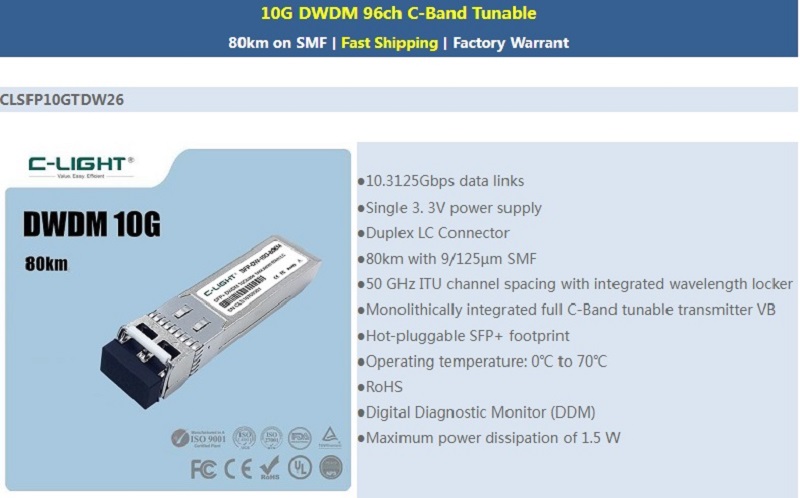
Their core advantage lies in wavelength adaptability. C-LIGHT's 10G Tunable optical transceivers utilize self-developed 10G/25G tunable optical chips. The transmitter employs an internally separated design with a self-developed tunable TOSA, and the receiver uses a self-developed APD/PIN chip solution.
This design allows a single transceiver to support multiple wavelength channels. The 10G transceiver can support up to 96 channels, and the 25G transceiver can support up to 48 channels.
Rapid tuning is another highlight. C-LIGHT's tunable transceivers can complete automatic wavelength adjustment within 3 seconds, with commercial temperature power consumption below 2W and industrial temperature power consumption below 2.5W.
Regarding transmission performance, C-LIGHT has achieved 10G over 80km and 25G over 15km link transmission. The transmit optical power range is 0~5dBm, and the transmitter eye diagram performance is normal.
02 Global Market: Regional Demand Variations and Applications
The global DWDM market shows distinct regional differences and diverse application scenarios. According to market analysis, DWDM technology is being widely deployed worldwide across multiple industries including IT & telecommunications, banking, financial services, insurance, retail & e-commerce, healthcare & life sciences, and manufacturing.
The Asia-Pacific region, being the most active in global 5G deployment, has particularly urgent demand for tunable optical transceivers. These products not only meet the high-density interconnection requirements of 5G base stations but are also suitable for ring network transmission scenarios.
The North American market places greater emphasis on network flexibility and reconfigurability, closely related to the region's longstanding demand for dynamic network configuration. In dynamic application scenarios for tunable lasers, wavelengths can change regularly during operation to adapt to varying capacity demands, which is especially valued in markets like the US. These applications typically require the ability to provide dynamic wavelengths for adding or removing wavelengths from a network segment to meet changing needs.
The European market focuses more on environmental protection and energy efficiency, demanding higher requirements for low-power optical transceivers. C-LIGHT's tunable transceivers, with commercial temperature power consumption below 2W and industrial temperature power consumption below 2.5W, comply with Europe's strict requirements for green communication equipment.
Bandwidth demands also vary by region. Analysis indicates the global DWDM market can be segmented by bandwidth into categories such as up to 10Gbps, 40Gbps, 100Gbps, and over 100Gbps. Although higher-rate 100G and above transceivers are emerging, 10G transceivers still hold significant economic and practical value in scenarios like fronthaul networks.
03 Future Evolution: From Static Configuration to Dynamic Intelligent Networks
Tunable optical transceiver technology is evolving from static applications towards dynamic intelligent networks. In static applications, the wavelength of a tunable laser is set during use and does not change over time, primarily serving to replace multiple fixed-wavelength lasers and simplify inventory management.
As technology develops, the performance of tunable transceivers continues to improve. Research shows that in terms of transmission distance, employing Optical Duobinary (ODB) encoding and Electronic Dispersion Compensation (EDC) technology can significantly increase the transmission distance of 10Gbps high-speed optical signals without adding dispersion compensation devices.
Intelligent management will become a core feature of next-generation tunable transceivers. C-LIGHT's 10G SFP+ tunable DWDM optical transceivers already provide an enhanced monitoring interface for real-time access to multiple device operating parameters. Future transceivers will further integrate AI algorithms to achieve predictive maintenance and autonomous optimization.
Single-Fiber Bi-Directional (BiDi) technology is another important direction for tunable transceiver development. C-LIGHT's 100G ZR QSFP28 transceiver achieves bidirectional transmission over a single fiber, theoretically doubling fiber resource utilization efficiency. This technology is expected to be downward compatible with future 10G tunable transceivers, further saving fiber resources in fronthaul networks.
The piles of various spare transceiver models in traditional fronthaul networks are gradually decreasing, being replaced by a smaller number of intelligent transceivers capable of adaptive wavelength tuning.
 >
>

 >
>
 >
>
 >
>
 >
>
 >
>
 >
>
 >
>