TEL:+86 132 6656 7067




Optical transceiver reliability depends on more than optical specifications and advertised data rates. Testing determines whether a module performs as expected, communicates correctly with network equipment, and maintains stable operation under defined conditions. When comparing 100% tested optical transceivers vs standard compatibility testing, it is important to understand what is tested, how many units are covered, and which results are verified.
The phrase "100% tested" generally means that every unit in a production batch undergoes the specified tests. Standard compatibility testing, however, describes a testing approach whose coverage depends on the manufacturer's procedures. It may involve a defined set of compatibility checks, sample-based verification, or broader validation. These terms are not universal test standards, so the actual test scope matters more than the label.
1. What Is 100% Testing for Optical Transceivers?
100% testing means each finished optical transceiver is tested against a defined set of acceptance criteria before shipment. Rather than relying only on results from a sample of units, the process checks every unit covered by the test plan.
1.1 Common Tests Included
Depending on the module type, speed, application, and manufacturer's quality procedures, the test plan may include:
Optical performance testing: Verification of applicable parameters such as transmit optical power, receiver sensitivity, wavelength, and other specified optical characteristics.
Electrical and signal checks: Verification of relevant electrical interfaces and signal performance against defined requirements.
Functional testing: Confirmation that the module powers up and performs its specified functions.
EEPROM and digital diagnostics: Checks of module identification, supported features, and diagnostic information where applicable.
Compatibility checks: Testing with selected switches, routers, NICs, or other host platforms when included in the test plan.
Burn-in or temperature testing: Additional procedures when required by the product qualification or quality plan. These are not automatically included in every 100% test process.
1.2 What 100% Tested Does Not Automatically Mean
The term does not mean that every possible host device, firmware version, environmental condition, or network configuration has been tested with every unit. It also does not guarantee that a module will be compatible with equipment outside the validated scope. The value of 100% testing depends on the tests performed, their acceptance criteria, and the reliability of the test equipment.
2. What Is Standard Compatibility Testing?
Standard compatibility testing evaluates whether an optical transceiver operates correctly with selected network equipment or within a defined technical environment. Its purpose is to identify interoperability issues that may not be revealed by checking optical parameters alone.
2.1 Typical Compatibility Checks
Host recognition: Confirming whether a switch, router, or network adapter detects the module.
Link establishment: Checking whether the optical link comes up at the intended data rate.
Traffic transmission: Verifying data transmission and reception under the tested configuration.
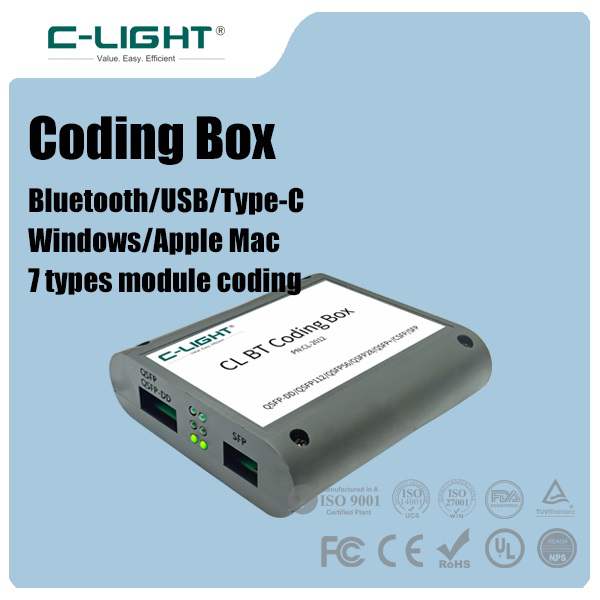
Error monitoring: Observing relevant error counters or bit error rate (BER), where the test setup supports these measurements.
Platform-specific behavior: Checking selected functions and diagnostics with the host equipment and software versions included in the test plan.
2.2 Testing Coverage Depends on the Test Plan
"Standard compatibility testing" does not identify one universally fixed procedure. One supplier may test a module on a representative host platform, while another may perform more extensive tests across several switch families and operating conditions. Testing may cover every unit or a sample, depending on the process. Buyers should confirm the actual coverage rather than assume a specific test scope from the term alone.
3. 100% Tested vs Standard Compatibility Testing: Main Differences
| Comparison Item | 100% Testing | Standard Compatibility Testing |
|---|---|---|
| Primary focus | Checks each covered unit against a defined test plan. | Evaluates interoperability with specified host equipment and configurations. |
| Unit coverage | Every unit undergoes the designated tests. | May use individual-unit testing, sample testing, or another defined procedure. |
| Optical performance | Included when specified in the production test plan. | May be included, but scope varies by procedure. |
| Host compatibility | Only verified if host-platform checks are part of the unit-level plan. | Directly evaluates compatibility within the selected test environment. |
| Firmware and coding | Can include EEPROM, identification, and coding checks. | Can verify host recognition and behavior for the tested platform. |
| Platform coverage | Depends on the hosts included in the test plan. | Depends on the number and types of host platforms selected. |
| Test records | Can provide per-unit results when records are maintained. | May provide platform-level reports, sample records, or individual-unit records. |
| Key limitation | Passing the defined tests does not guarantee every real-world scenario. | Results apply to the tested equipment, software, and conditions. |
The two approaches are not necessarily alternatives. A manufacturer can perform 100% production testing and also conduct compatibility testing across selected host platforms. This combination provides both unit-level verification and evidence of interoperability within the validated environment.
4. Why 100% Testing Matters for Optical Modules
4.1 Detecting Unit-Level Defects
Manufacturing variation can cause differences between individual units, even within the same product model. Testing every unit against defined acceptance criteria helps identify failures that sample-based checks may not detect in the specific units that were not sampled.
4.2 Improving Quality Consistency
A documented test process supports consistent production decisions. When measurements are recorded against clear limits, manufacturers can identify failed units before shipment and use production data to investigate recurring quality issues.
4.3 Supporting High-Speed Network Deployments
In 100G, 400G, and 800G networks, optical performance and host behavior must meet the requirements of the intended application. For AI clusters, data centers, and carrier networks, unit-level verification can be an important part of quality assurance, especially when links operate at high speeds or support critical services.
5. Why Compatibility Testing Is Equally Important
5.1 Optical Performance Alone Is Not Enough
A transceiver may meet its optical specifications but still fail to establish a link with a particular host. Compatibility can also depend on electrical interfaces, host configuration, module identification, supported data rates, firmware behavior, and equipment-specific requirements.
5.2 Compatibility Is Platform-Specific
A successful test on one switch does not automatically prove compatibility with every device from the same vendor. Hardware revisions, operating-system or network-OS versions, firmware releases, port configurations, and supported module policies may differ. A useful compatibility report identifies the equipment and versions tested.
5.3 Interoperability Requires End-to-End Verification
Where applicable, testing should go beyond module detection to include link establishment and traffic transmission. For higher-risk deployments, teams may also verify error performance, link stability, and behavior under the intended operating conditions.
6. What Can Cause a Module to Pass One Test and Fail Another?
Different tests detect different categories of problems. Passing one test should not be treated as proof that all other requirements have been met.
| Potential Issue | What May Pass | What May Fail |
|---|---|---|
| Host coding or module identification | Optical output and receiver measurements. | Recognition or acceptance by a particular host. |
| Optical specification mismatch | Module detection and basic electrical checks. | Link performance at the required distance or fiber type. |
| Unsupported data rate or interface | Basic power-up or identification. | Link establishment at the intended speed. |
| Firmware or host configuration | Operation on one tested software version. | Operation on another host or firmware version. |
| Fiber or connector issue | Module-level factory measurements. | End-to-end link operation after installation. |
| Environmental conditions | Tests performed at the specified laboratory conditions. | Operation outside the validated temperature or environmental range. |
These examples show why testing should be matched to the deployment requirements. A complete qualification plan combines appropriate production checks with compatibility and system-level validation where necessary.
7. How to Evaluate an Optical Transceiver Testing Process
When comparing suppliers, ask for the test scope and supporting evidence instead of relying on phrases such as "fully tested" or "compatible."
Confirm unit coverage: Ask whether every shipped unit receives the specified tests or whether some checks are performed on samples.
Request the test item list: Identify the optical, electrical, functional, and diagnostic parameters covered by the process.
Check acceptance criteria: Confirm that test limits align with the product specifications and intended application.
Verify compatibility scope: Ask which switch, router, NIC, or other host models were tested and which firmware or software versions were used.
Review test evidence: Determine whether the supplier can provide unit-level results, batch reports, or platform compatibility records.
Confirm traceability: Ask how serial numbers, test records, and production batches are linked when traceability is required.
Assess application requirements: For critical links, identify whether additional temperature, reliability, interoperability, or system-level tests are needed.
8. Choosing the Right Testing Approach for Different Applications
| Application | Recommended Testing Focus | Why It Matters |
|---|---|---|
| Enterprise Ethernet | Unit-level optical and functional checks, plus host compatibility verification. | Helps reduce installation issues across switches and network adapters. |
| AI and high-performance computing networks | Optical and electrical performance checks, link validation, and error monitoring. | High-speed links may be sensitive to signal integrity and interoperability issues. |
| Data center interconnect (DCI) | Wavelength, optical budget, fiber type, distance, and host compatibility checks. | Longer optical paths require the right transceiver specification and link budget. |
| Telecom and transport networks | Application-specific optical validation, equipment interoperability, and required environmental qualification. | Deployment requirements may include longer reach, strict operating conditions, and service continuity. |
| Large-volume deployments | Defined 100% production tests, documented quality controls, and representative platform validation. | Combines unit-level screening with evidence that the product works in the intended network environment. |
The right test plan depends on the transceiver type, deployment environment, network equipment, and consequences of a link failure. Not every application needs the same validation depth, but every application benefits from clearly defined acceptance criteria.
9. 100% Tested vs Standard Compatibility Testing: Which Is Better?
Neither label is sufficient on its own to determine overall product quality. 100% testing provides broader unit coverage for the specific checks performed, while compatibility testing verifies behavior with selected network equipment and configurations.
For most professional deployments, a strong approach combines both:
Test each unit against a defined set of production acceptance criteria.
Validate compatibility with the host platforms specified for the target deployment.
Record test results and retain traceability where required.
Expand validation when application risks, link speeds, reach, or operating conditions justify additional testing.
When sourcing optical transceivers, customers should compare the actual test coverage, acceptance limits, and compatibility evidence. This provides a more reliable basis for supplier evaluation than a testing claim alone.
10. Conclusion
100% tested vs standard compatibility testing is best understood as a comparison between unit-level test coverage and the scope of interoperability verification—not as a simple choice between two mutually exclusive methods. Testing every unit helps identify failures within the defined production test plan, while compatibility testing establishes whether the module operates correctly with specified network equipment.
For reliable optical connectivity, evaluate both the manufacturing test process and the compatibility evidence. Clear test procedures, relevant host-platform validation, and traceable results help buyers select optical transceivers that better match their network requirements.
 >
>

 >
>
 >
>
 >
>
 >
>
 >
>
 >
>
 >
>