TEL:+86 132 6656 7067




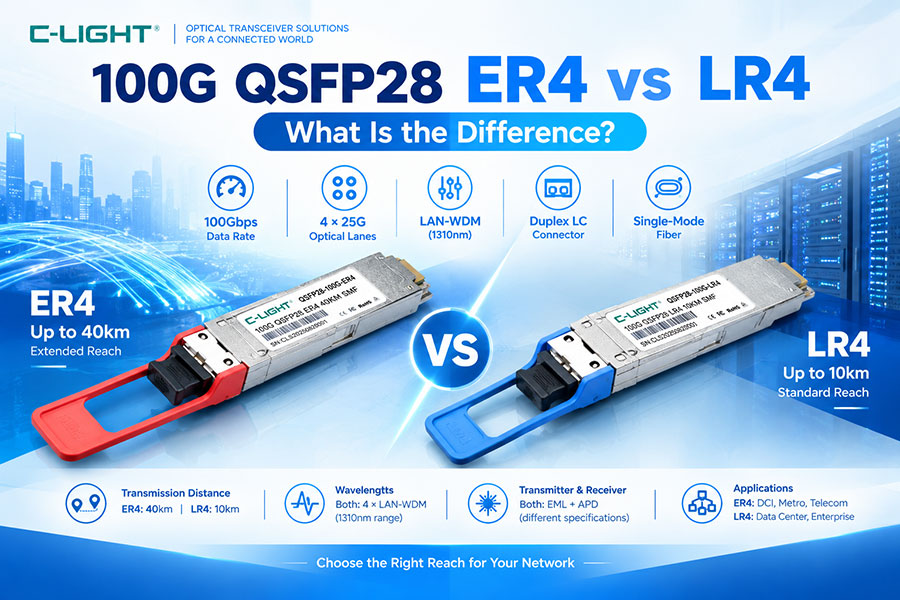
100G QSFP28 ER4 and LR4 are high-speed optical transceivers designed for 100Gbps Ethernet over single-mode fiber. Both use the QSFP28 form factor, four optical channels, LAN-WDM technology, and duplex LC connectivity, but they differ significantly in transmission distance, optical performance, and application requirements.
1. What Are 100G QSFP28 ER4 and LR4?
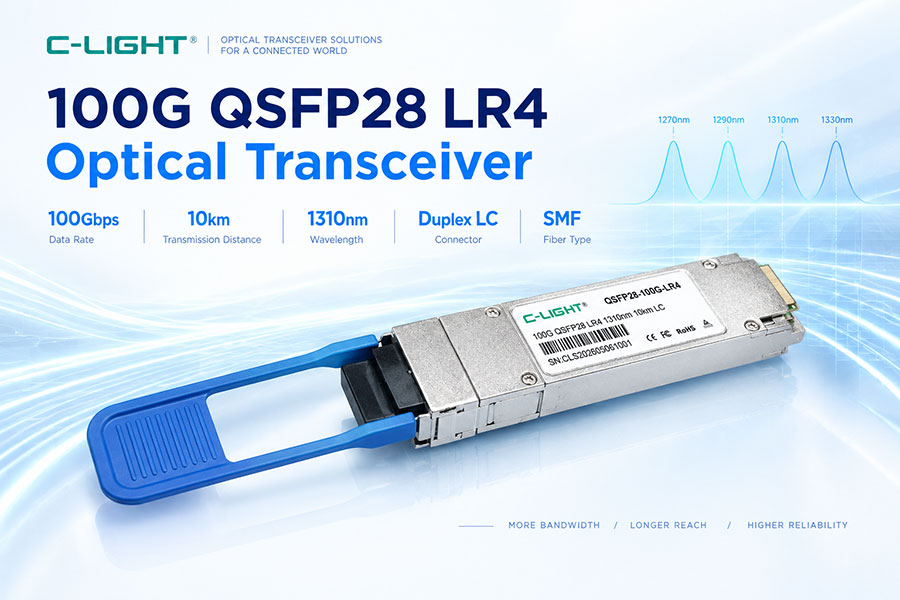
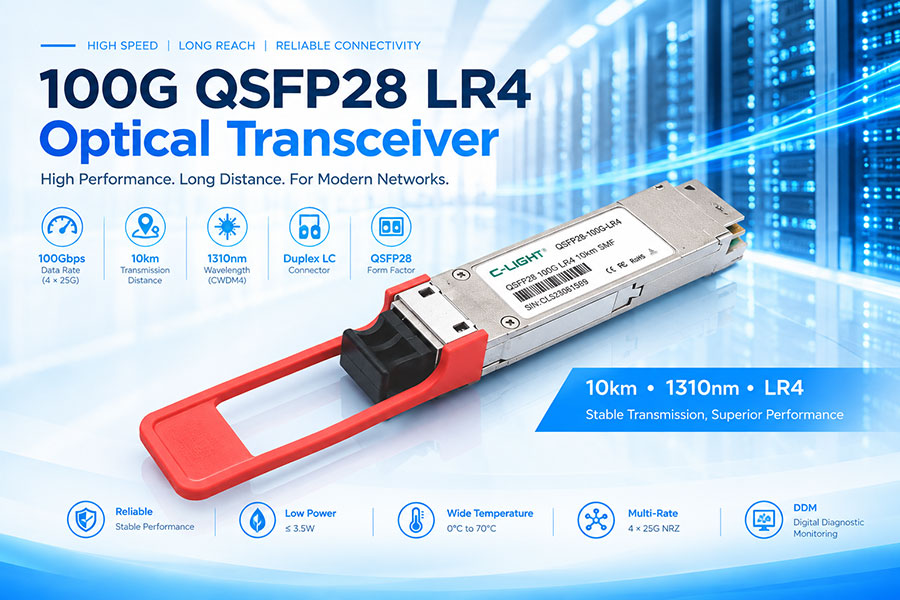
100G QSFP28 LR4 is a long-reach optical transceiver designed for transmission distances of up to 10km, while 100G QSFP28 ER4 is an extended-reach solution designed for links up to 40km.
Both modules use four optical channels operating around the 1310nm wavelength region. The four channels are multiplexed onto a duplex single-mode fiber connection, allowing 100Gbps transmission through a compact QSFP28 module.
2. 100G QSFP28 ER4 vs LR4: Key Differences
| Feature | 100G QSFP28 LR4 | 100G QSFP28 ER4 |
|---|---|---|
| Data Rate | 100Gbps | 100Gbps |
| Form Factor | QSFP28 | QSFP28 |
| Optical Channels | 4 × 25G NRZ | 4 × 25G NRZ |
| Wavelength Technology | LAN-WDM | LAN-WDM |
| Fiber Type | Single-Mode Fiber | Single-Mode Fiber |
| Connector | Duplex LC | Duplex LC |
| Maximum Reach | Up to 10km | Up to 40km |
| Typical Application | Data center and metro links | DCI, metro and long-distance links |
3. Transmission Distance
The most obvious difference between LR4 and ER4 is transmission distance. 100G QSFP28 LR4 is generally specified for links up to 10km, while 100G QSFP28 ER4 is designed to extend the reach to approximately 40km. :contentReference[oaicite:0]{index=0}
This makes LR4 suitable for many data center, campus, and metro connections, while ER4 is better suited to longer data center interconnect and metropolitan network links.
4. LAN-WDM Technology
Both LR4 and ER4 use four closely spaced LAN-WDM wavelengths in the 1310nm region. The four optical signals are multiplexed for transmission through one fiber and separated at the receiving end.
The C-LIGHT ER4 uses four LAN-WDM channels centered at approximately 1295.56nm, 1300.05nm, 1304.58nm, and 1309.14nm. This four-channel architecture provides the optical capacity required for 100Gbps transmission.
5. 4 × 25G NRZ Architecture
Both transceiver types use four optical lanes operating at approximately 25Gbps per channel. The combined optical bandwidth provides a 100Gbps-class connection.
The 4 × 25G NRZ architecture is different from newer 100G single-lane PAM4 solutions and remains widely used in established QSFP28 100G Ethernet deployments.
6. Optical Components
The longer reach of ER4 requires stronger optical performance than LR4. C-LIGHT's 100G QSFP28 ER4 uses LAN-WDM EML transmitters and APD receivers to support its extended transmission requirements.
LR4 implementations commonly use lower-power optical components optimized for links up to 10km. The specific transmitter and receiver design varies by manufacturer and product generation.
7. Link Budget and Receiver Sensitivity
ER4 provides a higher optical link budget than LR4 to support longer fiber links. The additional optical margin helps compensate for fiber attenuation, connector loss, splice loss, and other losses accumulated across a longer connection.
For a 40km deployment, the complete optical link should be evaluated rather than relying only on the nominal module reach. Fiber quality, connector loss, dispersion, and system-level requirements can affect actual performance.
8. Power Consumption
ER4 generally requires more optical performance and power than LR4 because of its extended transmission capability. C-LIGHT's 100G QSFP28 ER4 has a maximum power consumption of 5.5W under the specified operating conditions.
Power consumption should be considered when deploying large numbers of optical modules in high-density switches and routers, particularly in data centers where thermal capacity is limited.
9. Connector and Fiber Requirements
Both LR4 and ER4 use duplex LC optical connectivity and single-mode fiber. One fiber carries the transmitted signal while the other carries the received signal.
This makes both modules compatible with common duplex single-mode fiber infrastructure, although the actual link should meet the optical specifications required by the selected module.
10. 100G LR4 Applications
100G QSFP28 LR4 is suitable for applications where the required optical distance is within approximately 10km.
Data center interconnect
Enterprise network connections
Campus networks
Metro network access
Switch-to-router connections
High-speed Ethernet aggregation
11. 100G ER4 Applications
100G QSFP28 ER4 is designed for longer-reach 100G connectivity and is particularly useful when the link extends beyond the typical LR4 range.
Long-distance Data Center Interconnect
Metropolitan Area Networks
Telecom transport networks
Enterprise core networks
Building-to-building connectivity
Long-distance 100G Ethernet links
12. ER4 vs LR4 for Data Center Interconnect
For DCI applications within 10km, LR4 can provide an efficient and relatively simple 100G solution. When the distance approaches or exceeds the LR4 range, ER4 provides substantially greater reach without requiring a larger optical form factor.
ER4 is therefore particularly useful for connecting separate data center facilities or network sites across metro-scale distances.
13. ER4 vs LR4 Cost Considerations
ER4 typically costs more than LR4 because of its extended-reach optical components and higher performance requirements. The additional cost is justified when the network requires transmission beyond the LR4 range.
For links comfortably below 10km, using ER4 may provide little practical benefit unless additional optical margin or future expansion is required.
14. Which One Should You Choose?
Choose 100G QSFP28 LR4 when the required transmission distance is up to 10km and the network does not require the additional reach of ER4.
Choose 100G QSFP28 ER4 when the link requires transmission beyond 10km and up to approximately 40km over single-mode fiber.
The final selection should also consider optical budget, switch compatibility, power consumption, fiber infrastructure, operating temperature, and overall network cost.
15. 100G QSFP28 ER4 vs LR4 vs ZR4
| Module | Typical Reach | Fiber | Application |
|---|---|---|---|
| 100G LR4 | Up to 10km | SMF | Data center and metro links |
| 100G ER4 | Up to 40km | SMF | DCI and extended metro links |
| 100G ZR4 | Up to 80km | SMF | Longer-distance network connections |
LR4, ER4, and ZR4 form different reach options within the 100G QSFP28 optical transceiver family. The required distance is the primary factor when selecting between them.
16. C-LIGHT 100G QSFP28 ER4
C-LIGHT's CL100GQSFPER4 is a 100G QSFP28 ER4 optical transceiver designed for up to 40km transmission over single-mode fiber. It uses four LAN-WDM channels, EML transmitters, APD receivers, a duplex LC interface, and DDM support.
The module is designed for DCI, metro networks, telecom transport, enterprise networks, and other extended-reach 100G Ethernet applications.
17. Conclusion
The main difference between 100G QSFP28 ER4 and LR4 is transmission reach. LR4 supports links up to approximately 10km, while ER4 extends the reach to approximately 40km. Both use QSFP28 packaging, four 25G NRZ optical channels, LAN-WDM technology, duplex LC connectors, and single-mode fiber.
For links within 10km, LR4 is generally the more practical choice. For longer links up to 40km, ER4 provides the additional optical performance required for extended-reach 100G connectivity.
 >
>

 >
>
 >
>
 >
>
 >
>
 >
>
 >
>
 >
>