TEL:+86 132 6656 7067




100G QSFP28 ER4 optical transceivers provide a compact 100GbE interface for transport links that require longer reach than typical short-reach data center optics. With four LAN-WDM optical wavelengths around the 1310nm band and duplex LC connectivity, 100G ER4 is designed for single-mode fiber links up to approximately 40 km under suitable link conditions. This makes it relevant to 5G transport networks, aggregation sites, data center interconnection, and other high-capacity optical networks.
1. What Is 100G QSFP28 ER4?
100G QSFP28 ER4 is a 100Gbps optical transceiver based on the QSFP28 form factor. ER4 uses four optical channels in the LAN-WDM wavelength range and multiplexes them onto a duplex single-mode fiber interface.
The optical design typically uses four transmit wavelengths near 1310nm and four corresponding receive channels. At the network interface, the four optical channels are combined into a single fiber pair through wavelength multiplexing and demultiplexing.
2. Why 100G ER4 Matters for 5G Transport
5G radio access networks generate substantially more traffic than earlier mobile generations. As traffic moves from radio sites toward aggregation and core networks, transport infrastructure must support higher bandwidth while maintaining reach and operational stability.
100G ER4 can provide a practical optical interface for transport segments where 10G or 25G links are insufficient and short-reach 100G modules do not provide adequate distance.
3. 100G QSFP28 ER4 Basic Specifications
| Parameter | Typical 100G QSFP28 ER4 Configuration |
|---|---|
| Form Factor | QSFP28 |
| Data Rate | 100Gbps |
| Optical Interface | Duplex LC |
| Fiber Type | Single-Mode Fiber |
| Wavelength | LAN-WDM, approximately 1310nm band |
| Transmission Distance | Up to approximately 40km |
| Modulation | 4 × 25G-class NRZ optical channels |
| Application | 100GbE, transport, aggregation, DCI and enterprise networks |
4. QSFP28 Form Factor
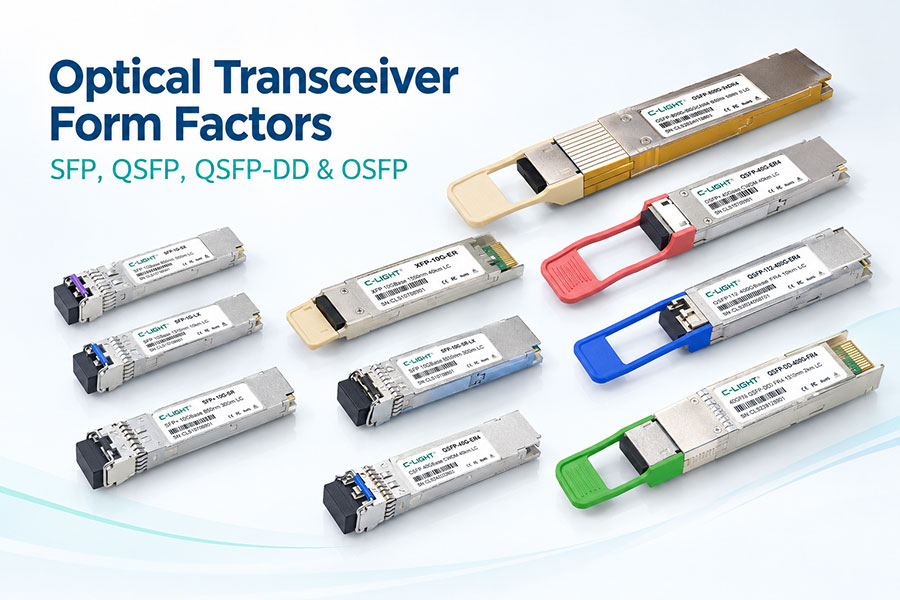
The QSFP28 form factor was developed for high-density 100Gbps networking. Compared with larger optical transceiver packages, QSFP28 allows network equipment manufacturers to increase port density while maintaining a relatively compact module footprint.
For 5G transport equipment, compact packaging can be important because aggregation switches, routers and transport platforms often need to accommodate a large number of high-speed interfaces within limited rack space.
5. How 100G ER4 Transmits Data
A typical 100G ER4 architecture divides the 100Gbps electrical data stream into four approximately 25Gbps channels. Each channel is converted from electrical data into an optical signal at a different LAN-WDM wavelength.
The four optical signals are combined through an optical multiplexer and transmitted through a single-mode fiber pair. At the receiving end, the optical channels are separated and converted back into electrical data.
6. Four-Channel LAN-WDM Architecture
The use of multiple wavelengths allows ER4 to achieve 100Gbps transmission without requiring four separate fiber pairs. The four optical channels occupy different wavelengths within the LAN-WDM range around 1310nm.
This architecture provides a balance between bandwidth, fiber utilization, optical reach and module complexity for medium- and longer-reach 100G applications.
7. 1310nm Wavelength for Transport Networks
The 1310nm wavelength region is widely used in single-mode fiber communication because fiber chromatic dispersion is relatively low in this region. This makes the wavelength range suitable for high-speed transmission over extended distances.
ER4 normally operates with multiple LAN-WDM wavelengths rather than using one optical wavelength for the entire 100Gbps signal.
8. 100G ER4 and Single-Mode Fiber
100G QSFP28 ER4 is designed for single-mode fiber. Compared with multimode fiber, single-mode fiber provides substantially greater reach and is therefore better suited to transport links connecting geographically separated network locations.
Fiber quality, connector loss, splice loss and overall optical link budget must still be evaluated before deploying an ER4 link at its maximum rated distance.
9. ER4 in 5G Fronthaul, Midhaul and Backhaul
5G transport networks can be divided into fronthaul, midhaul and backhaul segments depending on the network architecture. The optical requirements vary significantly between these segments.
100G ER4 is particularly relevant to aggregation and longer-reach transport scenarios where a 100Gbps interface must connect network nodes over single-mode fiber. The exact use case depends on the operator's transport architecture, equipment interfaces and required reach.
10. 100G ER4 for 5G Aggregation
Aggregation networks collect traffic from multiple access locations and forward it toward larger transport or core network nodes. As the number of 5G users and connected devices increases, aggregation links can become bandwidth-intensive.
100G ER4 provides a high-capacity optical interface that can connect aggregation equipment over longer single-mode fiber paths while maintaining the compact QSFP28 form factor.
11. ER4 for Mobile Backhaul
Mobile backhaul transports traffic from radio access and aggregation networks toward the mobile core. Depending on network topology, backhaul links may extend beyond the reach supported by short-reach 100G optics.
With a reach of up to approximately 40km under appropriate conditions, ER4 can address many metro and regional transport scenarios without requiring a larger optical module form factor.
12. 100G ER4 vs 100G SR4
| Feature | 100G SR4 | 100G ER4 |
|---|---|---|
| Fiber | Multimode Fiber | Single-Mode Fiber |
| Typical Reach | Short Reach | Up to approximately 40km |
| Connector | MPO/MTP | Duplex LC |
| Wavelength | 850nm-class | LAN-WDM 1310nm-class |
| Typical Application | Data Center | Transport, DCI and Longer-Reach Networks |
13. 100G ER4 vs 100G LR4
ER4 and LR4 share a four-channel LAN-WDM architecture and duplex LC interface, but they are designed for different reach classes. LR4 is commonly associated with links up to approximately 10km, while ER4 extends the reach toward approximately 40km.
The longer reach of ER4 generally requires a different optical link budget and transmitter/receiver design. Selection should therefore be based on actual distance and link requirements rather than data rate alone.
14. Optical Link Budget for 100G ER4
Link budget is one of the most important factors when deploying ER4 over long distances. The available optical power margin must account for fiber attenuation, connector loss, splice loss and other passive optical components.
A simplified calculation can be expressed as:
Optical Margin = Transmitter Output Power − Total Link Loss − Receiver Sensitivity Requirement
A positive and adequate margin helps provide operational tolerance for aging, temperature variation, connector contamination and other real-world conditions.
15. Fiber Attenuation and Transmission Distance
Fiber attenuation increases with transmission distance. A 40km ER4 link therefore requires significantly more optical power budget than a short 100G data center connection.
Actual deployment distance should be determined from the complete optical link budget rather than relying only on the nominal transceiver reach specification.
16. Dispersion Considerations
At 100Gbps, chromatic dispersion and other optical impairments can influence transmission performance over longer links. The effect depends on the optical design, fiber characteristics, wavelength and transmission conditions.
For transport applications, network engineers should evaluate the complete optical path and verify that the selected module provides sufficient performance for the intended distance.
17. Optical Power and Receiver Sensitivity
Transmitter optical power determines the signal level launched into the fiber, while receiver sensitivity indicates the minimum received optical power required to achieve the specified performance.
ER4 deployment should consider both parameters together with insertion loss, fiber attenuation and connector losses. A high transmitter output alone does not guarantee reliable operation if other link impairments consume the available margin.
18. Temperature and Environmental Conditions
5G transport equipment can operate in different environments, including telecom rooms, outdoor cabinets and equipment shelters. Temperature variation can affect laser characteristics, optical power, receiver performance and overall module behavior.
For deployment in demanding environments, the operating temperature range and thermal characteristics of the transceiver should be matched to the host equipment and installation environment.
19. Power Consumption of 100G ER4
Power consumption is an important consideration when large numbers of optical modules are installed in transport equipment. Optical transmitters, receivers, drivers, monitoring circuits and control components all contribute to total module power.
For high-density 5G aggregation platforms, selecting modules with appropriate power characteristics can help control equipment thermal load and overall system power consumption.
20. Digital Diagnostics and Monitoring
Modern optical transceivers commonly provide digital monitoring functions that allow network equipment to monitor parameters such as module temperature, supply voltage, transmitter optical power, receiver optical power and laser bias.
These diagnostic functions can assist operators in identifying optical degradation, abnormal temperatures, power issues and other conditions that may affect transport link performance.
21. 100G ER4 Compatibility
Compatibility is not determined solely by matching the optical data rate. The transceiver must also be compatible with the host switch, router or transport platform.
Important considerations include electrical interface requirements, firmware or module management behavior, optical specifications, coding, operating temperature, power limits and equipment vendor requirements.
22. Interoperability in 5G Transport Networks
Transport networks frequently contain equipment from multiple vendors. Interoperability testing can therefore be important before deploying third-party 100G ER4 modules at scale.
Testing should verify link establishment, optical power, receiver performance, error counters, temperature behavior and long-duration stability under the intended network configuration.
23. ER4 and Network Reliability
Optical reliability depends on the complete system rather than the transceiver alone. Fiber cleanliness, connector quality, optical power margin, module temperature, host equipment and installation practices can all affect network performance.
For 5G transport networks, where service availability is important, optical links should be designed with appropriate margin and monitored continuously where possible.
24. Deployment Scenarios for 100G QSFP28 ER4
5G mobile backhaul
5G aggregation networks
Metro transport networks
Data center interconnection
Enterprise campus backbone
Service provider optical networks
Router-to-router long-distance connections
High-capacity single-mode fiber links
25. 100G ER4 for Data Center Interconnection
Although ER4 is particularly relevant to transport networks, its approximately 40km reach also makes it suitable for selected data center interconnection scenarios.
When two facilities are separated by several kilometers or more, short-reach multimode optics may not provide sufficient distance. ER4 can provide a compact 100G interface for single-mode fiber-based connections.
26. ER4 and High-Density Network Equipment
The QSFP28 form factor allows multiple 100G ports to be integrated into switches and routers. This is useful for transport platforms where rack space and front-panel density are important design considerations.
High-density 100G interfaces can also simplify network upgrades by providing greater capacity without requiring a proportional increase in physical equipment footprint.
27. Selecting 100G QSFP28 ER4 for 5G Networks
Before selecting an ER4 transceiver, network engineers should evaluate several parameters:
Required transmission distance
Single-mode fiber type
Optical link budget
LAN-WDM wavelength requirements
Duplex LC connectivity
Host equipment compatibility
Operating temperature
Power consumption
Digital diagnostic support
BER and performance requirements
Network redundancy and protection
28. Installation Considerations
Proper installation is particularly important for longer optical links. LC connectors should be kept clean and properly seated, while fiber routing should respect the specified bend radius.
After installation, technicians can verify transmitter and receiver optical power, link status, error counters and other diagnostic parameters. For critical transport links, optical testing should be performed before the link enters service.
29. Troubleshooting a 100G ER4 Link
If an ER4 link fails to establish, troubleshooting should begin with the host configuration and physical connection. Verify that the QSFP28 module is correctly inserted and recognized by the host equipment.
The next steps can include checking LC connector cleanliness, fiber polarity, optical power levels, module temperature and diagnostic information. If the link remains unstable, the fiber path and total loss budget should be tested.
30. 100G ER4 and Future 5G Transport Evolution
As 5G networks continue to expand, transport capacity requirements are expected to increase. 100G remains an important interface for many existing aggregation and transport deployments, while higher-speed technologies such as 400G and 800G are increasingly relevant to network core, data center and high-capacity interconnection environments.
100G ER4 remains useful where a compact 100Gbps interface and extended single-mode fiber reach are required, particularly when network upgrades need to balance capacity, reach, port density and deployment cost.
31. Conclusion
100G QSFP28 ER4 combines a compact QSFP28 form factor, four-channel LAN-WDM architecture, duplex LC connectivity and single-mode fiber transmission for longer-reach 100G networks. Its approximately 40km reach class makes it relevant to 5G transport, aggregation, mobile backhaul, metro networking and selected data center interconnection applications.
For reliable deployment, the optical reach should be evaluated together with link loss, receiver sensitivity, fiber characteristics, environmental conditions and host equipment compatibility. A properly engineered ER4 link can provide a practical 100G transport interface while supporting the increasing bandwidth requirements of modern 5G networks.
32. Frequently Asked Questions
Q1. What is 100G QSFP28 ER4?
Q2. What is the typical reach of 100G ER4?
Q3. What fiber does 100G ER4 use?
Q4. What wavelengths does 100G ER4 use?
Q5. Can 100G ER4 be used in 5G networks?
Q6. What is the difference between 100G ER4 and 100G LR4?
Q7. What should be checked before deploying ER4 over 40km?
Q8. Is 100G ER4 suitable for data center interconnection?
Q9. Does ER4 require single-mode fiber?
Q10. Why is optical link budget important for ER4?
33. Summary
100G QSFP28 ER4 is a 100Gbps single-mode optical solution designed for extended-reach applications. Its four-channel LAN-WDM architecture, duplex LC interface and approximately 40km reach class make it applicable to 5G transport, aggregation, mobile backhaul, metro networks and selected DCI deployments.
 >
>

 >
>
 >
>
 >
>
 >
>
 >
>
 >
>
 >
>