TEL:+86 132 6656 7067




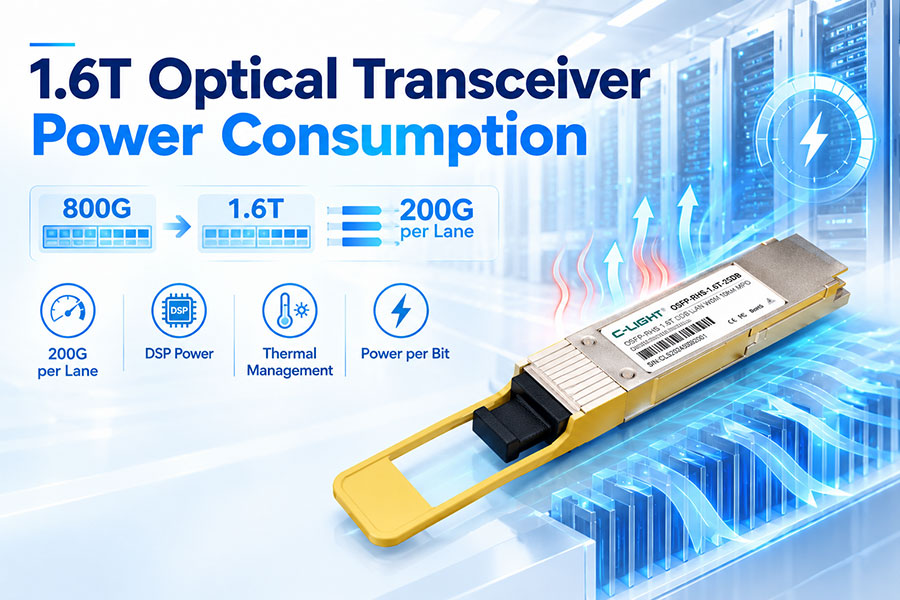
1.6T optical transceiver power consumption is a critical consideration for AI data centers, affecting switch power budgets, thermal density, cooling design, port density, and overall network efficiency. As optical links move to 200G-per-lane architectures, reducing power per bit is becoming as important as increasing bandwidth.
1. What Is 1.6T Optical Transceiver Power Consumption?
1.6T optical transceiver power consumption refers to the electrical power required by a 1.6Tbps optical module during operation. The total power includes the DSP, optical engine, laser or VCSEL/EML components, photodetectors, driver circuits, TIA, control circuitry, and thermal-management-related components inside the module.
2. Why 1.6T Power Consumption Matters
Power becomes a major issue when a data center deploys hundreds or thousands of high-speed optical ports. A few watts of additional consumption per module can translate into substantial rack-level and facility-level energy demand.
For this reason, 1.6T development is focused not only on higher bandwidth but also on lower power per transmitted bit.
3. Typical 1.6T Optical Transceiver Power Range
There is no single universal power value for every 1.6T optical transceiver. Power varies according to optical architecture, DSP generation, transmission distance, cooling method, form factor, and implementation.
Current 1.6T datacom module designs generally target the low-to-mid tens of watts, while higher-power coherent implementations can require substantially more.
4. Why 1.6T Uses More Power Than 800G
Moving from 800G to 1.6T doubles the aggregate bandwidth, but it also increases the requirements for electrical signaling, optical components, DSP processing, drivers, receivers, and thermal management.
The challenge is therefore not simply delivering twice the data rate. The complete module must maintain signal quality without allowing power consumption to scale at the same rate as bandwidth.
5. Power Consumption and 200G-per-Lane Technology
Many 1.6T architectures use eight 200G-class electrical and optical lanes. Compared with earlier generations, the higher lane rate requires more advanced SerDes, DSP, optical components, and electrical interfaces.
As a result, power optimization at the lane level becomes increasingly important.
6. Main Components That Consume Power
A 1.6T optical transceiver can include several major power-consuming blocks:
DSP: Performs high-speed signal processing, equalization, and other functions depending on architecture.
Laser or VCSEL/EML: Generates the optical signal.
Driver: Drives the optical transmitter at high speed.
Receiver and TIA: Detect and amplify the incoming optical signal.
FEC: Provides error-correction processing when integrated into the architecture.
Management circuitry: Handles monitoring and module control.
7. Optical DSP Is a Major Power Factor
DSP is one of the most important contributors to 1.6T module power consumption. High-speed signal processing requires substantial digital computation, especially when retiming, equalization, FEC, and other functions are implemented inside the module.
As a result, improvements in DSP architecture and semiconductor process technology can directly reduce transceiver power.
8. Process Node and 1.6T Power Efficiency
Smaller semiconductor process nodes can improve energy efficiency and increase transistor density. This is particularly important for 1.6T DSPs, where processing requirements are significantly higher than in previous generations.
The migration toward more advanced process technologies is therefore an important part of reducing power per bit.
9. DSP Power vs Total Module Power
The DSP is important, but it is not the only source of power consumption. Optical transmitters, photodetectors, drivers, TIAs, clocks, control circuitry, and thermal-related losses also contribute to total module power.
Optimizing only the DSP does not automatically produce the lowest-power 1.6T transceiver.
10. Optical Engine Power
The optical engine contains the components responsible for converting electrical signals into optical signals and recovering incoming optical signals.
Laser efficiency, modulator design, photodiode characteristics, driver efficiency, and optical coupling all influence the power consumed by the optical engine.
11. VCSEL-Based 1.6T Transceivers
VCSEL-based 1.6T solutions are primarily associated with short-reach multimode data center applications. Their architecture can provide attractive cost and power characteristics for short links.
However, achieving 200G-per-lane operation requires highly optimized VCSELs, photodiodes, electrical interfaces, and signal processing.
12. EML-Based 1.6T Transceivers
EML-based solutions can support longer-reach single-mode applications and are relevant to high-speed 1.6T optical architectures.
The laser and modulation structure, driver requirements, and transmission distance all affect total power consumption.
13. Silicon Photonics and 1.6T Power Consumption
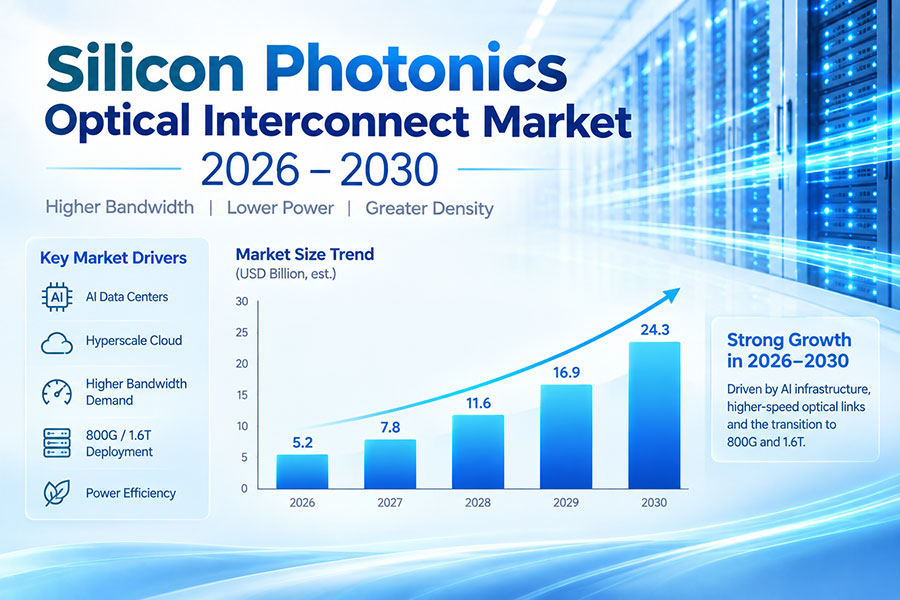
Silicon photonics can integrate multiple optical functions into a photonic integrated circuit and can help improve packaging density and optical integration.
Its role in 1.6T power optimization depends on the complete implementation, including the DSP, optical source, modulator, photodetector, packaging, and electrical interface.
14. 1.6T PAM4 Optical Transceivers
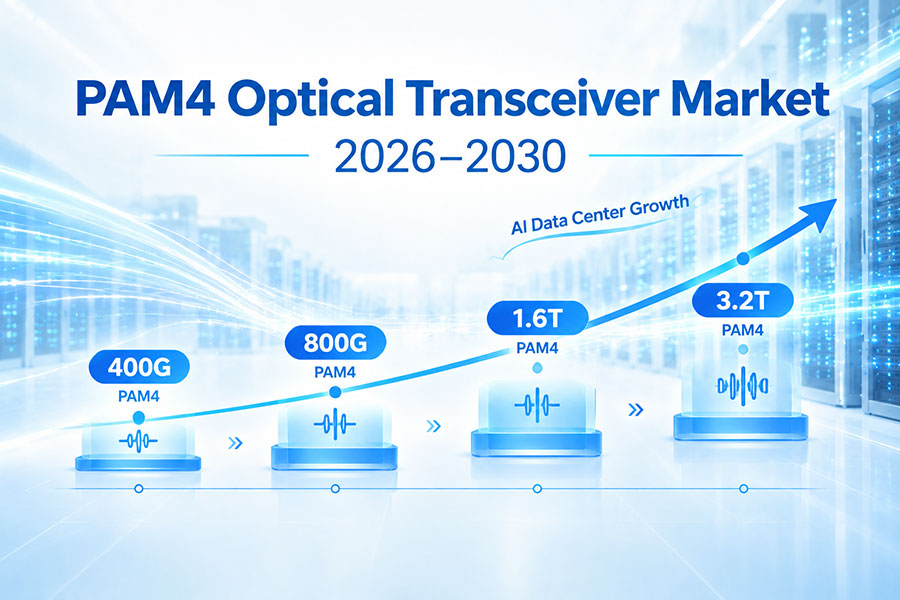
Many 1.6T datacom designs use PAM4 signaling with eight 200G-class lanes. PAM4 allows higher data rates without requiring an equivalent increase in symbol rate, but it also creates tighter requirements for signal quality.
These requirements can increase the complexity and power of the signal-processing chain.
15. Power Consumption and PAM4 Signal Integrity
At 200G-per-lane speeds, insertion loss, reflections, crosstalk, jitter, and other electrical impairments become more difficult to manage.
Equalization and signal conditioning can improve performance, but these functions consume additional power. Efficient signal processing is therefore a major engineering objective.
16. 1.6T Retimed Optical Transceivers
Traditional retimed optical transceivers use a DSP to process and condition the high-speed electrical signal before optical transmission or after optical reception.
This architecture provides strong signal processing capability, but the DSP can account for a significant portion of the module's power budget.
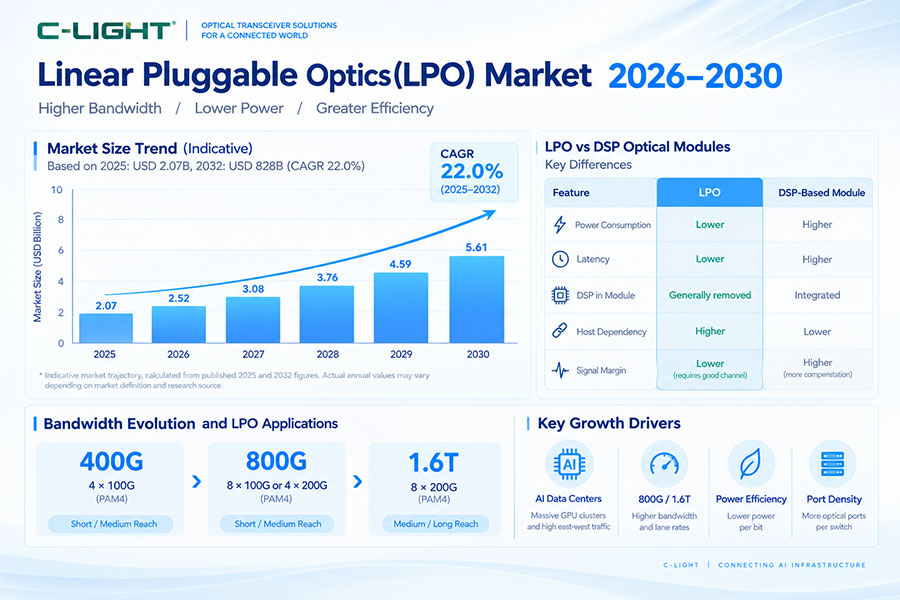
17. 1.6T LPO
Linear-drive pluggable optics, or LPO, aim to reduce or eliminate some of the retiming and DSP functions in suitable links.
The potential advantage is lower module power, but LPO places greater requirements on the host electrical channel, signal integrity, interoperability, and link design.
18. LPO vs Traditional 1.6T DSP Architecture
| Feature | Retimed 1.6T | 1.6T LPO |
|---|---|---|
| DSP | More extensive | Reduced or bypassed depending on design |
| Power | Higher | Potentially lower |
| Host signal quality | More tolerant | More demanding |
| Reach | Depends on full optical design | More limited in some applications |
| Interoperability | Generally easier | Requires careful system validation |
19. 1.6T LRO and Reduced-DSP Architectures
Low-power linear and retimed-linear optical architectures are also being developed for high-speed data center links. Their goal is to reduce power while maintaining sufficient transmission performance.
20. 1.6T Coherent Transceiver Power
1.6T coherent transceivers belong to a different power category from short-reach direct-detection datacom modules. Coherent systems require more complex DSP, optical modulation, detection, and signal recovery.
As a result, 1.6T coherent modules can have significantly higher power requirements than short-reach 1.6T datacom optics.
21. Datacom vs Coherent 1.6T Power
| Architecture | Typical Use | Power Trend |
|---|---|---|
| 1.6T short-reach datacom | AI data center | Targeting lower power per bit |
| 1.6T LPO/LRO | Short-reach AI interconnect | Lower-power architecture |
| 1.6T coherent | Longer-distance optical networking | Higher power due to advanced processing |
22. Why Form Factor Affects Power
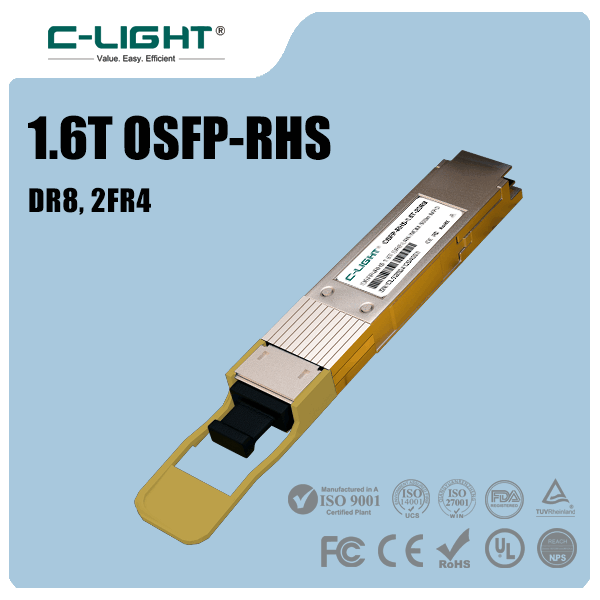
1.6T modules need to dissipate substantial heat within a compact mechanical envelope. Form factors such as OSFP provide different thermal and mechanical options for high-speed optical modules.
The module form factor must therefore be evaluated together with the cooling capability of the host system.
23. OSFP and 1.6T Thermal Management
OSFP is widely used for high-speed data center optical architectures and provides a relatively large thermal envelope compared with smaller pluggable form factors.
However, the actual cooling capability depends on the host switch, heatsink configuration, airflow, and module implementation.
24. Integrated Heatsink vs Reduced-Height Heatsink
1.6T modules can use different heatsink configurations depending on the host architecture. An integrated heatsink can provide greater cooling capability, while reduced-height designs may be needed where system airflow or mechanical constraints require a smaller profile.
25. Air Cooling for 1.6T Optics
Air cooling remains important for data center optical modules. At high module power levels, airflow must remove heat efficiently from the optical cage and heatsink.
Airflow direction, fan capacity, port density, heatsink geometry, and ambient temperature all influence the achievable cooling performance.
26. Liquid Cooling and 1.6T Optics
As module power increases, liquid cooling can become attractive for some high-density systems. Direct cooling approaches can remove heat closer to the source than conventional air cooling.
Whether liquid cooling is necessary depends on total module power, switch density, chassis design, and facility cooling architecture.
27. 1.6T Optical Power and Switch Port Density
Power must be considered at the switch level rather than only at the module level. A switch populated with many 1.6T ports can have a substantial optical power load before accounting for the switch ASIC, memory, fans, and other components.
This makes port density and optical power closely connected design parameters.
28. Example of Port-Level Power Scaling
For example, 32 optical ports operating at 25W per module would require approximately 800W for the optical modules alone:
32 × 25W = 800W
This simple calculation illustrates why even a few watts of improvement per module can have a significant system-level impact.
29. Power per Bit
Power per bit is a more useful metric than module power alone when comparing generations.
A higher-power 1.6T module can still be more energy-efficient than a lower-speed module if it delivers substantially more bandwidth for the additional power consumed.
30. 1.6T vs 800G Power Efficiency
| Metric | 800G | 1.6T |
|---|---|---|
| Aggregate bandwidth | 800Gbps class | 1.6Tbps class |
| Electrical lane rate | Typically 100G class | Typically 200G class |
| Module power | Lower | Higher |
| Power per bit | Depends on implementation | Key optimization target |
31. Power Consumption and Transmission Distance
Longer optical reach can require more sophisticated optical components, higher-performance DSP, stronger signal processing, or additional optical functions.
As a result, a 1.6T module designed for short-reach data center applications can have a different power profile from a longer-reach or coherent implementation.
32. 1.6T DR8 Power Considerations
Short-reach or medium-reach DR architectures can use parallel single-mode optical lanes. The exact power depends on the optical engine, DSP, laser technology, receiver architecture, and host requirements.
33. 1.6T 2xDR4 Power Considerations
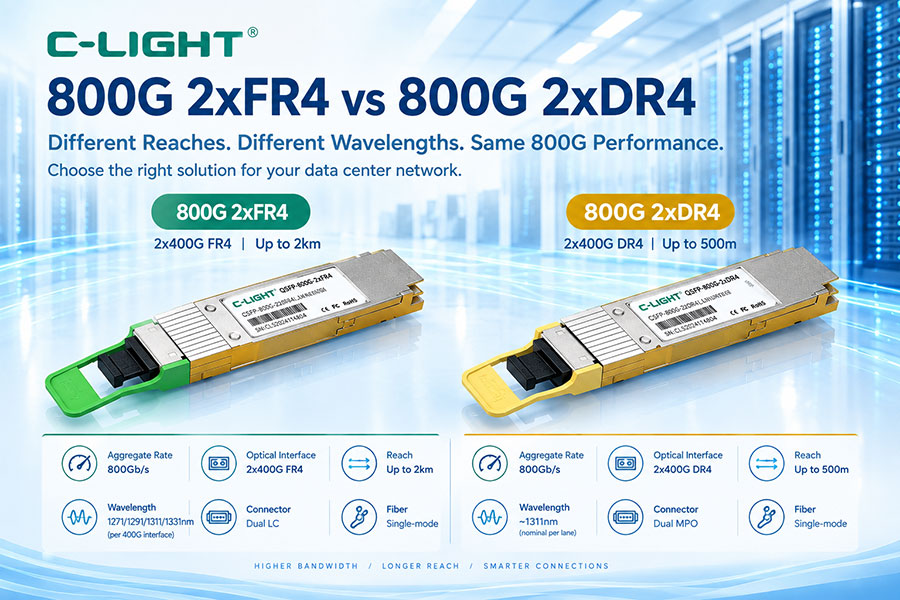
2xDR4 architectures divide the optical system into two 400G-class groups while maintaining 1.6T aggregate capacity. This architecture can influence optical component count, packaging, thermal distribution, and power consumption.
34. 1.6T 2xFR4 Power Considerations
2xFR4 uses multiple LAN-WDM wavelengths and single-mode fiber. The wavelength multiplexing architecture requires additional optical components compared with some parallel-optics implementations, which can influence power and packaging.
35. 1.6T LR4 Power Considerations
Longer-reach 1.6T architectures require stronger optical performance and often more advanced signal processing. Their power consumption can therefore be higher than short-reach modules.
36. Power Consumption and Optical Source Efficiency
Laser and optical-source efficiency directly affect the module power budget. Improving wall-plug efficiency at the transmitter can reduce heat generation and improve overall module efficiency.
37. Power Consumption and TIA Efficiency
The TIA converts small photodetector currents into usable electrical signals. At very high lane rates, maintaining low noise and sufficient bandwidth while minimizing power is a major design challenge.
38. Power Consumption and Driver Efficiency
Laser drivers and modulator drivers must operate at very high speeds. Driver efficiency therefore has a direct influence on the module's total power.
39. Power Consumption and FEC
FEC can improve transmission reliability by correcting certain errors, but the required processing adds complexity and power consumption.
The overall design must balance the benefit of stronger error correction against its computational and energy cost.
40. Power Consumption and Signal Equalization
Higher-speed electrical channels require increasingly advanced equalization. CTLE, DFE, FFE, and other equalization techniques can improve signal quality but require additional analog or digital processing.
41. 1.6T Power Consumption and Host SerDes
The optical module is only part of the complete high-speed channel. Host SerDes, PCB traces, connectors, and package structures also consume power or create signal losses that require compensation.
42. Module Power vs System Power
A module with lower nominal power is not automatically better for the complete network. System-level power also includes the switch ASIC, host SerDes, cooling, fan power, optical line components, and other supporting hardware.
43. Thermal Throttling
When thermal conditions become unfavorable, a system may reduce performance or restrict operating conditions. Maintaining sufficient cooling headroom is therefore important for fully populated 1.6T switches.
44. Ambient Temperature and Power
Optical modules are typically specified over a defined temperature range. Higher ambient temperatures can affect laser efficiency, electrical characteristics, and thermal dissipation.
Power measurements should therefore be evaluated across realistic operating temperatures.
45. 1.6T Power Testing
Module power should be measured under defined operating conditions rather than estimated from individual component ratings.
Useful measurements include idle power, normal traffic power, maximum traffic power, power at different temperatures, and power under different operating modes.
46. Idle vs Full-Load Power
Some modern optical modules support power-management functions that reduce consumption during periods of low activity. Full-load power remains the more important value for thermal and power-budget calculations in fully utilized AI networks.
47. Dynamic Power Management
Dynamic power management can adjust the operating state of parts of the optical module according to traffic activity or system requirements.
This can reduce unnecessary energy consumption without reducing peak bandwidth when the link is fully active.
48. 1.6T Power Budget in AI Switches
Network architects should calculate the worst-case optical power budget for a fully populated switch rather than using an average module value.
This ensures that the power supply, cooling system, airflow, and rack infrastructure are designed for the actual operating condition.
49. Example of Switch-Level Optical Power
If a switch contains 64 ports and each optical module consumes 20W, the optical subsystem could require:
64 × 20W = 1,280W
The calculation does not include the switch ASIC, host SerDes, fans, memory, power conversion, or other system components.
50. Why AI Data Centers Are Sensitive to Optical Power
AI clusters can contain large numbers of high-speed optical links. Even when each module operates within its specified power range, aggregate optical power can become a significant portion of the switch and rack power budget.
51. 1.6T Optical Power and Rack Density
Increasing the number of high-speed ports per rack increases both networking capacity and heat density. The optical architecture must therefore be selected together with rack-level power and cooling planning.
52. Power Consumption and Cable Type
1.6T optical transceivers, AOC, DAC, and AEC each have different power characteristics. A short copper link can consume less power than an optical module, while optical connectivity becomes more practical as distance increases.
53. 1.6T Transceiver vs 1.6T AOC
| Solution | Main Advantage | Power Consideration |
|---|---|---|
| 1.6T optical transceiver | Flexible fiber deployment | Module power can be significant |
| 1.6T AOC | Integrated cable assembly | Power distributed between two cable ends |
| 1.6T DAC | Very short reach | Potentially lower power |
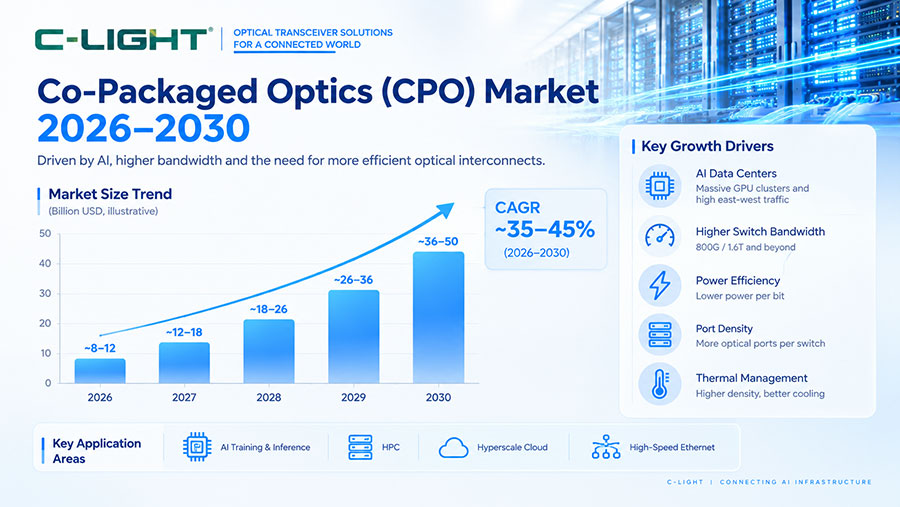
54. 1.6T Power Consumption and CPO
Co-Packaged Optics places optical engines much closer to the switching ASIC. Reducing the electrical distance can lower some electrical losses and may improve system-level energy efficiency.
CPO does not simply eliminate optical power consumption; instead, it changes where and how optical and electrical power are distributed in the system.
55. Pluggable vs CPO Power Architecture
| Feature | 1.6T Pluggable | CPO |
|---|---|---|
| Optical location | Front-panel module | Close to switch ASIC |
| Electrical path | Longer | Shorter |
| Serviceability | High | More complex |
| Power optimization | DSP and optical-engine optimization | Short electrical path and integrated optics |
56. How to Reduce 1.6T Optical Transceiver Power
Power optimization can be approached at several levels:
Use more power-efficient DSP process technology.
Optimize optical-source and driver efficiency.
Reduce unnecessary signal-processing stages.
Improve TIA and receiver efficiency.
Use LPO or other reduced-DSP architectures where appropriate.
Improve optical and electrical packaging.
Optimize thermal design to reduce cooling overhead.
57. Reducing Power per Bit
The long-term target is not simply lower watts per module. It is lower watts per gigabit or terabit of transported traffic.
A 1.6T module should therefore be evaluated based on both absolute power and bandwidth efficiency.
58. 1.6T Power and Future 3.2T Networking
The lessons learned from 1.6T will influence future 3.2T and higher-speed optical architectures. Higher lane rates will create additional pressure on DSP power, optical efficiency, signal integrity, packaging, and cooling.
59. Why Power Efficiency Will Become More Important
As the number of high-speed ports increases, the network can become a significant part of overall data center energy consumption. Lower power per bit allows higher network capacity without a proportional increase in energy demand.
60. 1.6T Optical Transceiver Selection
When selecting a 1.6T module, evaluate the complete operating environment rather than comparing only nominal bandwidth.
Important parameters include power consumption, reach, optical technology, DSP architecture, form factor, temperature, host compatibility, thermal solution, and interoperability.
61. 1.6T Power Selection Checklist
| Parameter | Why It Matters |
|---|---|
| Maximum power | Determines port and switch power budget |
| Typical power | Helps estimate normal operating consumption |
| DSP | Major contributor to signal-processing power |
| Optical engine | Affects transmitter and receiver power |
| Reach | Longer links can require more complex processing |
| Form factor | Determines mechanical and thermal constraints |
| Cooling | Determines whether the host can dissipate the heat |
| Power per bit | Useful for comparing network generations |
62. C-LIGHT and 1.6T Optical Connectivity
C-LIGHT's high-speed optical product development is focused on AI data center connectivity across 800G and 1.6T generations. For 1.6T deployment, power, optical reach, host compatibility, thermal design, and high-speed signal integrity are key considerations.
63. 1.6T Power Consumption Testing at System Level
Module power should be measured together with the host platform when evaluating a real deployment. This provides a more useful picture of actual switch-level energy consumption than testing the module in isolation.
64. 1.6T Power Consumption and AI Data Center Cooling
AI data centers increasingly operate at high rack power density. Optical modules form one part of this thermal load, but their contribution becomes important as the number of 800G and 1.6T ports increases.
Power planning should therefore be coordinated with airflow, heatsinks, liquid-cooling options, and rack-level thermal design.
65. Future 1.6T Power Optimization
Future 1.6T modules are expected to focus on more efficient DSPs, lower-power optical components, improved silicon photonics integration, advanced packaging, reduced-DSP architectures, and better thermal solutions.
66. Conclusion
1.6T optical transceiver power consumption is one of the most important challenges in next-generation AI data center networking. Higher bandwidth requires more advanced electrical and optical processing, but the resulting power increase must be controlled to keep switch and rack power within practical limits.
DSP efficiency, optical-engine design, 200G-per-lane technology, semiconductor process nodes, LPO, silicon photonics, packaging, and thermal management all contribute to the final power profile.
The most useful evaluation is not simply watts per module, but watts per transmitted bit under realistic operating conditions. As AI networks move toward 1.6T and beyond, power efficiency will become a fundamental factor in optical transceiver selection and data center architecture.
 >
>

 >
>
 >
>
 >
>
 >
>
 >
>
 >
>
 >
>